





The Role of IEC 61032 Test Probe 12 in Mitigating Access-Related Hazards
The global landscape of electrical and electronic equipment is governed by a fundamental imperative: safety. A primary vector of risk stems from the potential for human interaction with hazardous live parts, either through intentional probing or inadvertent contact. To standardize the evaluation of this risk, the International Electrotechnical Commission (IEC) publishes standard 61032, “Protection of persons and equipment by enclosures – Probes for verification.” This document specifies the dimensions, application forces, and usage of standardized test probes designed to simulate access by parts of the human body or objects. Among these, Test Probe 12, often colloquially termed the “test finger,” represents a critical tool for assessing protection against access to hazardous parts. This article provides a technical examination of IEC 61032 Test Probe 12, its application across diverse industries, and the implementation of this standard through precision calibration tools such as the LISUN Test Finger, Test Probe, and Test Pin series.
Anatomic Simulation and Dimensional Tolerances of the Standard Test Finger
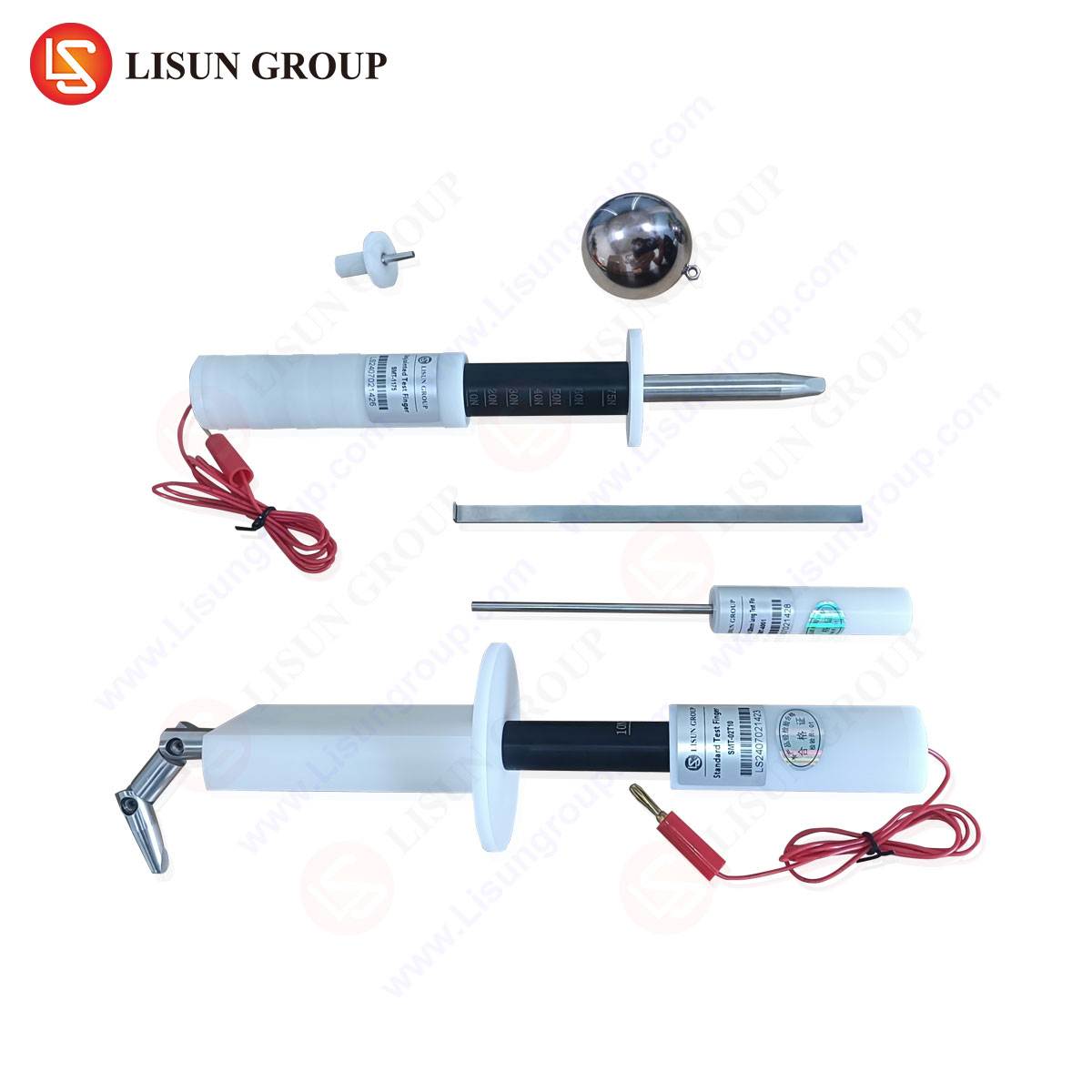
IEC 61032 Test Probe 12 is engineered to replicate the dimensions and probing capability of a human finger. Its design is not arbitrary but is based on anthropometric data to represent a credible threat model for accidental contact. The probe consists of a jointed, articulated metal assembly comprising three main sections: the finger, the palm, and the stop plate. The finger section itself is a cylindrical metal form with a hemispherical end, possessing specific diameters and radii that define its probing capability.
The critical dimensions, as per IEC 61032, are meticulously defined. The finger has a diameter of 12.0 mm ± 0.1 mm, with a hemispherical end radius of 6.0 mm ± 0.1 mm. The articulated joint allows the finger to pivot, simulating the natural flexing motion of a human finger attempting to explore an opening. The palm and stop plate ensure the probe is applied with the correct orientation and limits its penetration depth. The standard mandates an application force of 10 N ± 1 N for the probe itself, and a further 30 N ± 3 N may be applied to the stop plate to simulate a pushing action. These precise force parameters are essential; excessive force could invalidate a test by deforming a compliant opening, while insufficient force might not adequately simulate a realistic probing scenario. The LISUN Test Finger is manufactured to these exacting tolerances, utilizing materials such as anodized aluminum or stainless steel for durability and dimensional stability, ensuring repeatable and auditable test results across thousands of cycles.
Fundamental Testing Principles and Interpretation of Results
The principle behind testing with Probe 12 is one of simulated access. The test is applied to every opening, joint, vent, or aperture in an equipment enclosure that is deemed accessible during normal use, maintenance, or foreseeable misuse. The probe is inserted or articulated with the specified forces into these openings. The acceptance criterion is binary yet critical: the probe must not contact hazardous live parts or uninsulated moving parts (e.g., fan blades, gears).
A “hazardous live part” is typically defined by other standards (like IEC 61140 for protection against electric shock) and refers to parts carrying a voltage above a specified safety extra-low voltage (SELV) limit, usually 60 V DC or 30 V AC RMS. Contact is typically verified using a standardized “contact indicator” circuit specified in IEC 61032, which may be a signal lamp or a voltmeter with a specified internal resistance (e.g., 2 kΩ), providing a clear, objective pass/fail indication. The articulation of the joint is a key aspect; it is manipulated through an angle of up to 90° from the straight position in every possible direction to simulate a finger “hooking” or “feeling around” a barrier. This ensures that protection is evaluated not just against straight-on access, but against more insidious, angled probing.
Cross-Industry Applications for Enclosure Safety Validation
The universality of the finger-access hazard makes IEC 61032 Test Probe 12 relevant across a vast spectrum of industries. Its application ensures that safety is designed into products from the outset.
Electrical and Electronic Equipment & Industrial Control Systems: Panel builders and manufacturers of industrial programmable logic controller (PLC) cabinets, motor drives, and power supplies use Probe 12 to verify that IP20 (finger-protection) rated enclosures truly prevent access to busbars, terminal blocks, and live PCB assemblies. Even small gaps around mounting plates or cable glands must be scrutinized.
Household Appliances and Consumer Electronics: From food processors and blenders to gaming consoles and set-top boxes, any opening for ventilation, buttons, or seams is tested. A particular focus is on products that may be serviced or have user-replaceable parts, such as battery compartments, where a finger could slip past a battery terminal shield.
Automotive Electronics: Within the vehicle’s 12V/48V or high-voltage traction systems, electronic control units (ECUs), charging ports, and infotainment systems must be evaluated. Probe 12 testing ensures that after a cover is snapped into place, service technicians or users cannot accidentally bridge connectors carrying CAN bus signals or power lines.
Lighting Fixtures and Electrical Components: For light switches, socket outlets, and LED driver housings, the test verifies that fingers cannot reach live contacts through openings around toggle switches, plug apertures, or heat dissipation slots. This is a fundamental requirement for products certified under schemes like CE, UL, or CCC.
Telecommunications Equipment and Office Equipment: Network switches, routers, servers, and photocopiers contain both hazardous voltages and moving parts (like paper rollers). Probe 12 checks that maintenance panels and ventilation grilles provide adequate separation from internal power supplies and nip points.
Medical Devices and Aerospace Components: In these high-reliability sectors, the consequences of failure are severe. Testing with Probe 12 is part of a rigorous hazard analysis (per ISO 14971 for medical devices). It ensures that defibrillator storage bays, monitor interfaces, or in-flight entertainment system panels do not expose patients or personnel to shock hazards during routine interaction.
Cable and Wiring Systems & Toy Safety: For wiring accessories and connector housings, the probe checks that live pins are recessed sufficiently. In the toy industry, while voltages are typically low, the principle is applied to ensure that small, articulated fingers (simulated by other probes like Test Probe 18) cannot access battery contacts or motor parts, with Probe 12 often used for larger, structural openings.
The Imperative for Precision: LISUN Calibrated Test Probes
While the standard defines the “what,” the quality of the tool defines the “how well.” Using a non-compliant or worn probe can lead to false passes (increasing risk) or false fails (increasing cost). The LISUN series of calibrated test probes addresses this need for metrological integrity.
The LISUN Test Finger (Probe 12) is not merely a machined piece of metal; it is a calibrated instrument. Each unit is typically supplied with a calibration certificate traceable to national standards, verifying its critical dimensions (diameters, radii, joint pivot point) and the application force of its spring mechanism. This traceability is paramount for laboratories seeking ISO/IEC 17025 accreditation, as it provides objective evidence of measurement reliability.
The LISUN Test Probe and Test Pin series complement the Test Finger by covering the full suite of IEC 61032 probes. For instance, Test Probe 13 (the “test pin”) simulates a wire or tool, while Test Probe 19 (the “child finger probe”) is used for toy testing. Offering a complete, calibrated kit ensures that a safety testing laboratory or quality assurance department can perform the full battery of access tests with consistent, reliable tools. The competitive advantage of such a system lies in its reduction of measurement uncertainty, its durability under repetitive use, and its role in ensuring regulatory compliance audits proceed without non-conformities related to test equipment.
Integration into Product Design and Failure Mode Analysis
Integrating Probe 12 testing into the design process is a proactive safety engineering strategy. Using a physical probe or CAD model early in the design phase allows engineers to identify and mitigate access hazards before tooling is committed. Common failure modes identified include:
- Insufficient Creepage and Clearance: An opening may pass the probe, but the live part inside is just beyond the tip. However, if the distance from the opening edge to the live part does not meet required creepage/clearance distances (per IEC 60664-1), a conductive contaminant or condensed moisture could still create a path, indicating a design flaw.
- Flexible Material Deformation: An opening guarded by a flexible rubber flap or silicone seal may appear safe. However, under the 30 N push force, the material may deflect sufficiently to allow the probe to bypass it and contact a live part. The test mandates this force to simulate persistent probing.
- Misalignment in Assembly: Tolerances in molded parts can cause gaps to appear when housings are assembled. A design that is safe in CAD may fail in production if assembly variation is not accounted for. Testing production samples is therefore essential.
Table 1: Example of Probe 12 Test Integration in Design Phases
| Product Development Phase | Probe 12 Application | Typical Outcome/Decision |
| :— | :— | :— |
| Concept & CAD | Virtual simulation using 3D probe model. | Identify gross access issues; modify enclosure layout. |
| Prototype (Alpha) | Physical testing on first functional models. | Verify virtual model; test flexible parts and real-world assembly. |
| Pre-Production (Beta) | Testing on samples from production-intent tooling. | Validate manufacturing tolerances; finalize assembly instructions. |
| Production & QC | Periodic sampling from the production line. | Ongoing verification of manufacturing consistency; audit compliance. |
Navigating Related Standards and Global Compliance
IEC 61032 is a foundational test method standard, but it is invoked by dozens of product-specific safety standards. Understanding this hierarchy is crucial for compliance engineers.
- IEC 60529 (IP Code): Directly references IEC 61032 probes for verifying the first digit (solid object protection) of the Ingress Protection rating. Probe 12 is used for IP2X certification (protection against fingers).
- IEC 60335 (Household Appliances): Clause 8.1 on protection against access to live parts mandates the use of Test Probe 12, and in some cases Test Probe 13, to check accessibility.
- IEC 60601 (Medical Electrical Equipment): Clause 8.5 specifies the use of the IEC 61032 probes to ensure that applied parts, connectors, and enclosures prevent operator or patient contact with hazardous voltages.
- UL/CSA Standards: While North American standards (e.g., UL 60950-1, now UL 62368-1) have historically used slightly different probe dimensions, the principles align. Many standards now harmonize with or directly reference IEC 61032, especially for global market products. The calibrated geometry of the LISUN probes ensures they can be applied correctly across these varying, though converging, requirements.
Frequently Asked Questions (FAQ)
Q1: Can a product pass the Test Probe 12 check but still be unsafe?
Yes. Passing the probe test is necessary but not always sufficient. Other hazards exist, such as the emission of hazardous radiation, excessive temperatures on accessible surfaces, or energy hazards from capacitors. Probe 12 specifically addresses the risk of direct contact with live or moving parts. A comprehensive safety evaluation requires assessment against all applicable clauses of the relevant product safety standard.
Q2: How often should a physical test probe like the LISUN Test Finger be recalibrated?
Recalibration intervals depend on usage frequency, environmental conditions, and the quality management system requirements of the testing body. For a laboratory operating under ISO/IEC 17025, a typical interval is one year. However, if the probe is subjected to heavy use, mechanical shock, or damage, it should be inspected and potentially recalibrated immediately to ensure ongoing accuracy.
Q3: What is the difference between “accessible” and “live” part in the context of this test?
An “accessible part” is one that can be touched by a test probe or a standard test finger. A “live part” is a conductor intended to be energized in normal use. A “hazardous live part” is a live part that poses a risk of electric shock under certain conditions. The test determines if an accessible part is, or can become, a hazardous live part (e.g., if a metal decorative knob becomes live due to a fault and is touchable).
Q4: For an opening with an internal baffle or labyrinth, how is the test applied?
The probe is inserted as far as its geometry and the applied forces allow. The articulation of the joint is critical here. The tester must manipulate the probe through its full range of motion in all possible directions within the opening. If the labyrinth design successfully blocks the articulated finger from reaching a hazardous part under the specified forces, the design passes. The test simulates a persistent, probing action, not merely straight-line insertion.
Q5: Are 3D-printed replicas of Test Probe 12 acceptable for compliance testing?
No, for formal type testing or certification purposes, they are not acceptable. While useful for informal design checks, 3D-printed models cannot guarantee the precise dimensional tolerances, surface finish, joint articulation stiffness, or application force specified in the standard. Only properly manufactured and calibrated metal probes, like those in the LISUN series, provide the repeatability, durability, and traceability required for definitive compliance assessment and accredited laboratory work.