






An Examination of the IEC 61032 Test Probe 12: The Long Test Pin
The verification of safety in electrical and electronic equipment hinges upon a rigorous assessment of accessibility to hazardous live parts. International standards provide the framework for this assessment, specifying not only the test criteria but also the precise physical tools required to ensure consistent and reproducible results across global laboratories and manufacturing facilities. Among these essential tools, the IEC 61032 Test Probe 12, commonly termed the “long test pin,” occupies a critical role. This article provides a detailed technical analysis of the probe’s specifications, its underlying testing principles, and its diverse applications across multiple industrial sectors, with particular reference to its implementation in products such as the LISUN Test Finger, Test Probe, and Test Pin series.
Geometric and Material Specifications of the Long Test Pin
IEC 61032, “Protection of persons and equipment by enclosures – Probes for verification,” meticulously defines the dimensional and material characteristics of Test Probe 12. Its primary function is to simulate a long, rigid object, such as a straightened paperclip or a similar conductive rod, that could be inserted into an enclosure. The standard mandates a cylindrical pin with a hemispherical end. The critical dimensions are a diameter of 1.0 mm ± 0.02 mm and a length of 100 mm ± 1 mm from the tip to the shoulder of the handle. The probe is constructed from hardened steel, ensuring it maintains its rigidity and does not bend during application of the specified force. The hemispherical tip, with a radius of 0.5 mm, is designed to prevent snagging and to provide a consistent point of contact, crucial for determining whether a part is deemed “live” during electrical testing.
The handle of the probe is insulated and must be capable of withstanding the test voltage applied during the “live part” verification. In commercial implementations like the LISUN Test Pin, the handle is typically crafted from a durable, high-dielectric-strength polymer such as polyoxymethylene (POM) or a similar engineering plastic. This ensures operator safety and compliance with the standard’s requirement that the probe can be used in conjunction with an indicator circuit (e.g., a series lamp or voltmeter) to detect contact with hazardous voltage without risk of flashover or insulation breakdown at the handle. The complete assembly is precisely machined and finished to eliminate burrs or irregularities that could affect test outcomes.
Fundamental Testing Principles and Application Methodology
The application of Test Probe 12 is governed by a defined test procedure outlined in safety standards such as IEC 60529 (IP Code), IEC 62368-1 (Audio/Video, Information and Communication Technology Equipment), and the IEC 60335 series (Household and Similar Electrical Appliances). The core principle is one of simulated accidental access. The probe is applied, without appreciable force, to every opening, joint, or ventilation slot in an equipment enclosure. The objective is to determine whether the probe can make contact with parts that are hazardous live (i.e., carrying a voltage above a specified safety extra-low voltage (SELV) limit, typically > 60 V DC or > 30 V AC RMS).
The test is conducted in two distinct phases. First, the mechanical accessibility check: the probe is manipulated to explore the accessibility of parts through openings. If the probe can enter and potentially touch internal components, the test proceeds to the second, electrical phase. Here, the probe is connected to an appropriate detection circuit. For basic pass/fail verification, a simple series circuit with a neon lamp or LED indicator and a current-limiting resistor (often 40-60 kΩ) is common. For quantitative measurement, the probe is connected to a high-impedance voltmeter. The probe is then reintroduced to the opening. If the indicator illuminates or a hazardous voltage is measured, the design fails the test, indicating that a user could inadvertently bridge a dangerous potential with a common conductive object.
The standard prescribes a test force of 1 N ± 0.1 N. This low force is intentional; it simulates casual probing rather than deliberate, forceful insertion. The LISUN Test Probe is designed with this ergonomic consideration, allowing the technician to apply the minimal, consistent force required, thereby ensuring tests are neither overly stringent nor dangerously lenient.
Industry-Specific Applications and Compliance Contexts
The universality of the long test pin stems from its embodiment of a fundamental hazard across virtually all sectors producing enclosed electrical items. Its application is not uniform but is tailored to the specific risks and standards of each industry.
In Electrical and Electronic Equipment and Consumer Electronics (governed by IEC 62368-1), Probe 12 is used to verify that openings in cabinets, laptop housings, gaming consoles, and power adapters prevent access to primary-side circuits, busbars, or other hazardous parts. A common fail point is poorly designed ventilation grilles or gaps between removable panels.
For Household Appliances (IEC 60335 series), the probe checks openings in food processors, blenders, washing machine control panels, and oven doors. The concern is that a user, while cleaning or during curious exploration, could insert a metal object into a control panel crack and contact mains wiring or motor terminals.
Automotive Electronics components, which must often comply with ISO 20653 (derived from IEC 60529) for ingress protection, use the test pin to validate that connectors, control unit housings, and infotainment system enclosures in the vehicle interior protect against access to 12V/24V or higher voltage systems (e.g., in EVs).
Lighting Fixtures, especially recessed or track lighting, are tested to ensure that during lamp replacement or installation, a tool cannot slip through an opening and contact live lamp holders or driver outputs. Industrial Control Systems panels (following IEC 61439-2) are probed at door seams, cable entry points, and operator interface cut-outs to guarantee that only insulated or protected parts are accessible to maintenance personnel.
In Telecommunications Equipment and Office Equipment like servers, routers, and photocopiers, the probe ensures that service panels and fan openings do not expose telecom or mains voltages. Medical Devices (IEC 60601-1) apply the probe with extreme rigor, as patient safety is paramount; any accessible live part represents an unacceptable risk of electric shock or fire.
The Aerospace and Aviation Components industry references similar probe tests in standards like RTCA DO-160, ensuring avionics boxes withstand intrusion that could cause short circuits. For Electrical Components such as switches, sockets, and circuit breakers, the probe verifies that live terminals cannot be touched through openings intended for screwdrivers or when the device is partially assembled.
Cable and Wiring Systems conduit and junction box manufacturers use the probe to test access through knock-outs or cover seams. Even the Toy and Children’s Products Industry (under IEC 62115) employs a version of this test to ensure battery compartments or internal electronics are inaccessible to small metal objects a child might handle.
Comparative Analysis and Implementation in Calibrated Test Equipment
While the standard defines the probe, its practical implementation in a quality assurance or certification laboratory requires more than a simple metal pin. This is where integrated test equipment systems, such as those offered by LISUN, provide critical advantages. A standalone pin may suffice for a basic check, but for accredited testing, traceability, and repeatability, a calibrated system is essential.
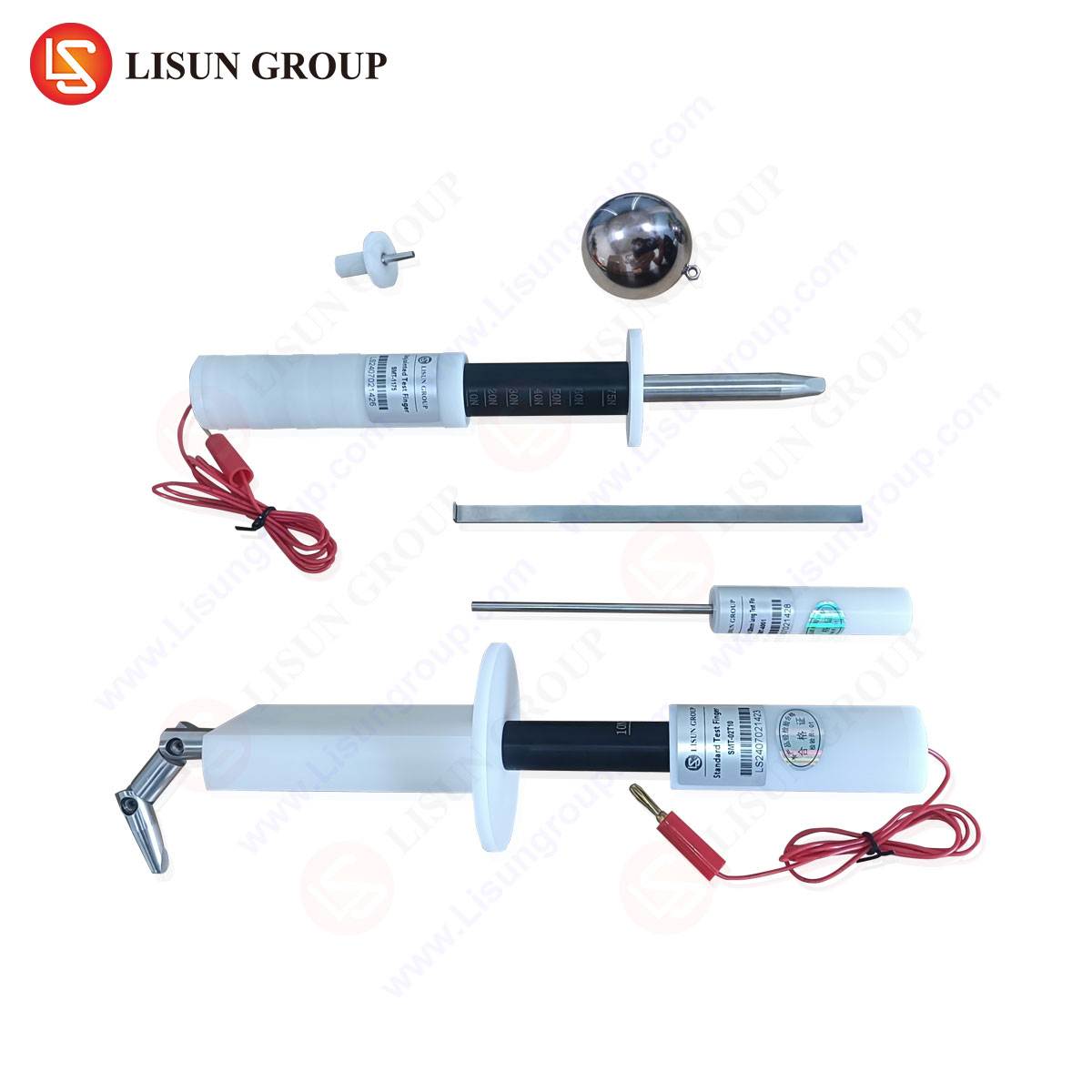
The LISUN Test Finger, Test Probe, and Test Pin kits typically include not only the IEC 61032 Test Probe 12 but also other mandated probes (like the jointed test finger, Test Probe 13, etc.), each mounted in a dedicated, ergonomic handle. The competitive advantage lies in the manufacturing precision and material certification. LISUN probes are manufactured from certified materials, with dimensional verification reports traceable to national standards. The insulation of the handle is rigorously tested for dielectric strength, often exceeding the minimum requirements of the standard.
Furthermore, these systems are often part of a larger test ecosystem. The probe handle may feature a standardized threaded insert for connection to a flexible cable, which is then connected to a dedicated Touch Current and Electric Strength Test System. This integration allows for automated sequencing: the probe is applied, and the system simultaneously monitors for contact with a hazardous voltage, logs the result, and can even apply a subsequent dielectric strength test if required. This reduces operator error and generates auditable test records, a necessity for manufacturers seeking global market access and compliance with quality management systems like ISO 9001.
Interpretation of Results and Design Mitigation Strategies
A failed test with the long test pin necessitates a redesign or corrective action. The interpretation is binary: if hazardous contact is possible, the enclosure’s degree of protection (IP code) related to access to hazardous parts (the second numeral in the IP code, specifically for IP2X) is not satisfied. Common mitigation strategies include redesigning vent patterns to use honeycomb or louvered structures with gaps less than 1mm, adding internal baffles or shrouds behind openings, improving the fit and overlap of mating enclosure parts, or relocating internal hazardous parts to a greater distance from the opening (using the standard’s specified “adequate distance” rules, which involve both clearance and creepage).
The test underscores a fundamental safety engineering principle: protection should not rely on user behavior. The assumption that a person “would not” insert an object is invalid; the standard assumes they might, and the design must account for it. The long test pin is the physical embodiment of this assumption.
FAQ Section
Q1: What is the primary difference between IEC 61032 Test Probe 12 (the long pin) and Test Probe B (the jointed test finger)?
A1: Test Probe 12 simulates a long, straight, rigid object like a wire. Test Probe B simulates a human finger or similar jointed object. They test for different hazards: Probe 12 for probing deep into openings, Probe B for contact with surfaces and larger openings. Both are often required in a complete safety evaluation.
Q2: Can a 3D-printed version of the test pin be used for official compliance testing?
A2: No. For official certification testing by a Nationally Recognized Testing Laboratory (NRTL) or in-house testing for compliance declarations, the probe must be manufactured to the exact material and dimensional tolerances of IEC 61032 and should have calibration traceability. 3D-printed plastics cannot replicate the required hardness, precise diameter, or hemispherical tip finish, leading to non-conforming and unreliable results.
Q3: How often should a test probe like the LISUN Test Pin be calibrated or verified?
A3: The calibration interval depends on usage frequency and quality system requirements. Annual verification is a common industry practice. This involves checking the critical dimensions (diameter, length, tip radius) with calibrated micrometers and optical comparators, and verifying the dielectric strength of the handle insulation. A certificate of conformity should be maintained.
Q4: In an IP rating test, if the long test pin cannot touch live parts but water from an IPX4 spray test could ingress through the same opening, how is this resolved?
A4: IP ratings are independent. The first numeral (solid particle protection) and the second numeral (liquid ingress) are tested separately. An opening might pass the probe test (e.g., IP2X) but fail a water spray test (IPX4). The final IP rating is the lowest passed level for each characteristic. A design may need to be modified to pass both the probe test and the required water ingress test.
Q5: For battery-operated toys with low voltage, is the long test pin still applicable?
A5: Yes, but the hazard criterion changes. Standards like IEC 62115 define accessible parts and hazardous live parts based on lower voltage and current limits suitable for children. The probe is still used to determine accessibility, but the subsequent electrical test checks for contact with voltages/currents exceeding the toy-specific safety limits, not just mains voltage.