





A Comprehensive Analysis of IP Code Enclosure Testing: Methodologies, Standards, and Instrumentation for Ingress Protection Validation
The integrity of an electrical or electronic enclosure against the ingress of solid foreign objects and water is a fundamental determinant of product safety, reliability, and operational lifespan. Governed by the International Electrotechnical Commission (IEC) standard 60529, the IP (Ingress Protection) Code provides a globally recognized classification system that quantifies an enclosure’s defensive capabilities. This technical article delineates the rigorous testing methodologies mandated for IP Code compliance, with a particular focus on the specialized test equipment essential for validating protection against contact with hazardous parts and the penetration of solid objects. The precision of this validation process is contingent upon the calibrated accuracy of test probes, fingers, and pins, which serve as the physical arbiters of compliance.
Deciphering the IP Code: A Two-Digit Classification Framework
The IP Code is expressed as “IP” followed by two characteristic numerals. The first numeral, ranging from 0 to 6, defines the level of protection against access to hazardous parts (e.g., live components, moving parts) and the ingress of solid foreign objects. The second numeral, from 0 to 9K, specifies the protection against harmful effects due to the ingress of water. It is critical to note that these tests are sequential and interdependent; achieving a specified second-digit rating often presupposes meeting the requirements of the first digit. For instance, an IP67 enclosure must first prove its IP6X-level dust-tightness before undergoing immersion testing for the IPX7 rating. Misinterpretation of this sequence is a common source of non-compliance.
Validating Protection Against Solid Objects and Hazardous Access
The first characteristic numeral necessitates a suite of mechanical tests designed to simulate real-world intrusion scenarios. These tests are not merely about physical blockage but are fundamentally safety-oriented, preventing user contact with dangerous internal components.
-
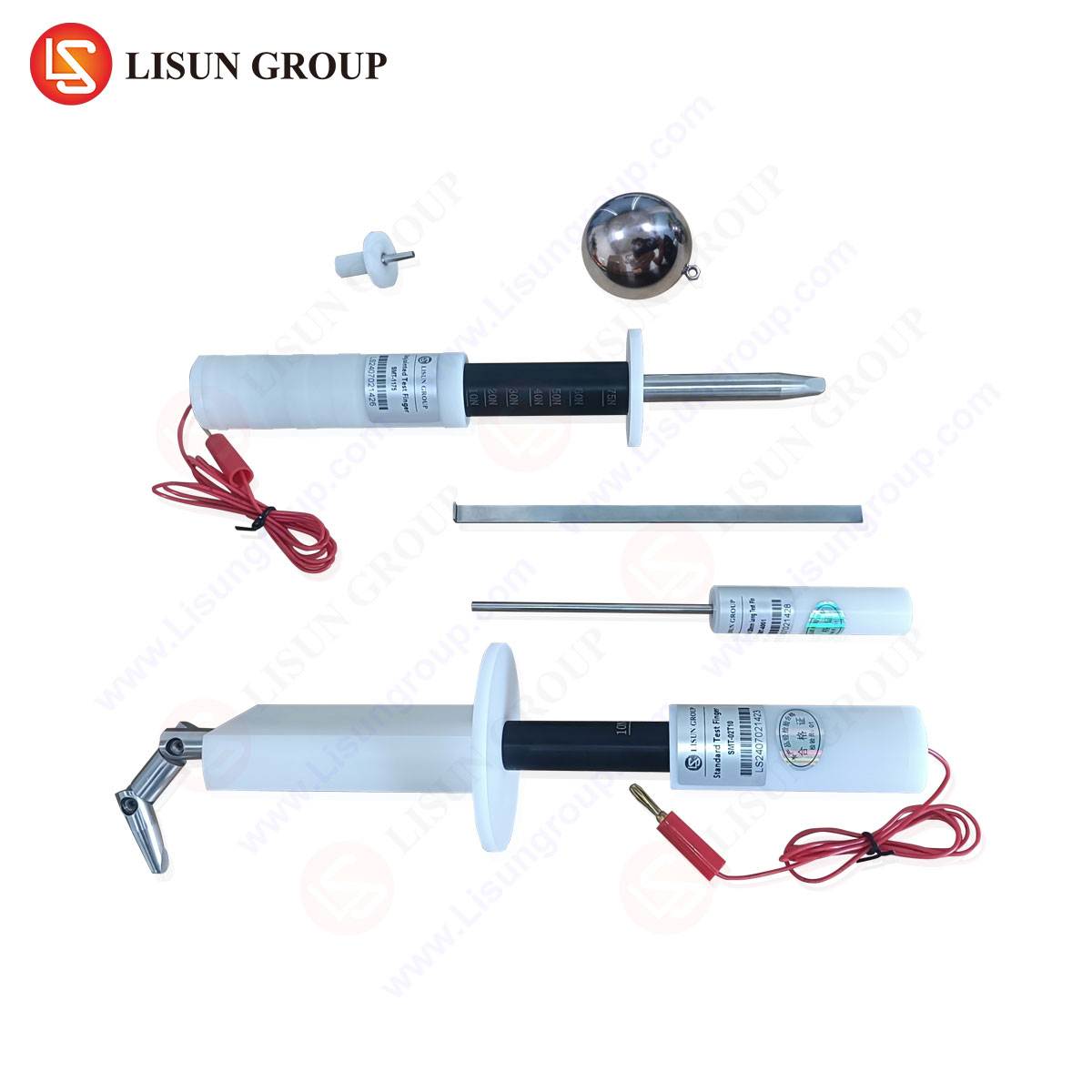
IP1X to IP4X: The Role of the Jointed Test Finger and Probes: For lower-level classifications (IP1X through IP4X), the primary concern is limiting access by parts of the human body or small tools. The central instrument for IP1X and IP2X validation is the LISUN Test Finger (IPXXB/IPXXD), a standardized, jointed simulation of a human finger. Constructed from rigid materials like metal with articulated joints, it applies a calibrated force (typically 10 N ± 1 N) to every possible opening in the enclosure. Its dimensions are precisely defined by IEC 60529 to replicate a worst-case scenario of finger probing. The test is deemed successful if the test finger cannot contact hazardous live parts or moving components. For IP3X and IP4X, the testing employs steel Test Probes of defined diameters—2.5 mm and 1.0 mm, respectively. These probes, such as the LISUN Test Probe (IPXXC), must not penetrate the enclosure fully. The 1.0 mm probe for IP4X is particularly challenging, designed to prevent ingress of most small tools and wires.
-
IP5X and IP6X: The Dust-Tightness Dichotomy: A significant conceptual shift occurs at IP5X. While IP1X-IP4X are about “protected access,” IP5X and IP6X are explicitly about “dust ingress.” IP5X (Dust Protected) permits a limited amount of dust to enter, provided it does not interfere with safe operation or impair performance. IP6X (Dust Tight) mandates that no dust enters the enclosure. The test for both levels involves placing the enclosure in a dust chamber (talcum powder is often used as the test dust) under a partial vacuum. For IP5X, the test runs for 8 hours; for IP6X, it runs for 8 hours or longer, with a more severe vacuum. The pass/fail criterion for IP6X is absolute: no visible dust inside. The LISUN Test Pin (IPXXA), a rigid steel wire of 1.0 mm diameter, is also applied with 1 N ± 0.1 N force for IP5X and IP6X to ensure that even a very fine object cannot breach basic safety.
Instrumentation Precision: The Critical Role of Calibrated Test Apparatus
The validity of any IP test is directly proportional to the geometrical and mechanical precision of the test equipment. Off-specification probes yield non-representative results, creating liability risks and potential safety hazards.
LISUN Test Apparatus: Specifications and Testing Principles
LISUN’s suite of IP test tools is engineered to exacting IEC 60529 tolerances, providing metrological traceability for compliance testing.
-
LISUN Test Finger (Model: LS-JF-01): This device simulates the dimensions and articulation of a human finger. Its construction from anodized aluminum alloy ensures durability and prevents deformation during repeated 10 N force applications. The articulated joints allow it to explore openings with a natural probing motion. The principle is one of simulated human interaction: if this standardized “finger” cannot make electrical or mechanical contact with internal hazards, the enclosure is deemed safe for user handling. This is paramount in Household Appliances (blenders, outlets), Consumer Electronics (power adapters), and the Toy and Children’s Products Industry, where curious probing is a foreseeable use case.
-
LISUN Test Probe (Model: LS-TP-02): This is a set of hardened steel rods with chamfered ends. The diameters are machined to the strict tolerances required for IP3X (2.5 mm ± 0.05 mm) and IP4X (1.0 mm ± 0.05 mm). The testing principle is one of mechanical defiance: the probe, applied with a defined force (3 N ± 0.3 N for IP3X, 1 N ± 0.1 N for IP4X), must not fully penetrate the enclosure. This test is critical for Electrical Components like industrial connectors, Telecommunications Equipment outdoor ports, and Automotive Electronics under-dash control units, where stray wires or small tools could cause shorts.
-
LISUN Test Pin (Model: LS-TPin-01): Often confused with the IP4X probe, the 1.0 mm Test Pin serves a distinct purpose for IP5X and IP6X enclosures. While dust is the primary concern, the standard mandates a basic safety check: that a rigid wire cannot easily access hazardous parts. The pin is applied with a minimal force (1 N ± 0.1 N). Its use underscores that even a dust-tight enclosure must have robust mechanical protection at its access points. This is especially relevant for Industrial Control Systems and Aerospace and Aviation Components, where environmental sealing cannot compromise basic touch safety.
Industry-Specific Applications and Compliance Imperatives
The application of IP testing spans industries where environmental resilience correlates directly with functional safety and product longevity.
-
Automotive Electronics & Aerospace: Components like engine control units (ECUs), sensors, and avionics boxes may require IP6X9K ratings, resisting high-pressure, high-temperature washdowns and dust storms. The test finger and probes validate that connectors and housings survive vibrational stresses without exposing internals.
-
Lighting Fixtures & Outdoor Telecommunications: IP65 (dust-tight and protected against water jets) or IP67 (temporary immersion) are common for streetlights, stadium lights, and 5G radio units. Here, the jointed test finger ensures that during bulb replacement or maintenance, service personnel cannot accidentally contact live terminals.
-
Medical Devices & Household Appliances: A dialysis machine (requiring IP22 for splash resistance) or a kitchen blender (IPX4 or higher) uses the test finger to guarantee that liquids from cleaning or spills cannot bridge conductive parts through user-accessible openings.
-
Industrial Control & Cable Systems: Panel-mounted switches, motor drives, and junction boxes in factories are subject to conductive dust and coolant sprays. IP54 (dust-protected, splash-resistant) is a minimum benchmark, validated by the 1.0 mm probe and water spray tests.
Competitive Advantages of Precision Test Instrumentation
The competitive landscape for test equipment is defined by accuracy, durability, and compliance assurance. LISUN apparatus offers distinct advantages:
- Metrological Traceability: Each tool is manufactured and verified against national or international standards, providing documented proof of accuracy for audit trails.
- Material Integrity: The use of hardened steel and robust alloys prevents wear and deformation, ensuring consistent results over thousands of test cycles—a critical factor for high-volume manufacturers in the Consumer Electronics and Electrical Components sectors.
- Ergonomic & Procedural Alignment: Tools are designed not only to meet dimensional specs but also to facilitate the application of the precise forces mandated by IEC 60529, reducing operator error and improving test repeatability.
Conclusion
IP Code enclosure testing is a non-negotiable pillar of modern product safety and environmental durability certification. Its scientific rigor transforms subjective claims of “ruggedness” into quantifiable, comparable data. The process hinges on the calibrated impersonality of test equipment—the jointed finger, the steel probe, the rigid pin. As products evolve to operate in ever more challenging environments, from smart home devices to autonomous vehicle systems, the precision of these fundamental validation tools becomes only more critical. Selecting instrumentation like the LISUN test suite, with its guaranteed adherence to IEC 60529, is therefore not merely a procurement decision but a foundational investment in product integrity, risk mitigation, and regulatory compliance.
FAQ Section
Q1: Can an enclosure rated IP67 automatically be considered compliant with IP66 requirements?
A1: Not necessarily. While IP67 involves immersion up to 1 meter, IP66 requires testing with powerful water jets (12.5 mm nozzle at 100 liters/min from 3 meters). The pressure and impact dynamics differ. An enclosure design may pass the static pressure of immersion but fail the directed kinetic energy of a jet. Standards require testing for each specific rating unless the standard covering the end-product specifies a superseding relationship.
Q2: Why is the force applied by the test finger (10 N) significantly higher than that of the test probes (1-3 N)?
A2: The forces simulate different real-world interactions. The 10 N force for the test finger replicates the reasonable pushing or probing force a person might exert with a finger. The lower forces for the steel probes (1-3 N) simulate the accidental intrusion by a small, rigid object like a dropped tool or a stray wire, which is less likely to be deliberately forced into an opening but must still be guarded against for safety.
Q3: For an IP6X (dust-tight) enclosure, is the Test Pin check redundant since dust cannot enter?
A3: No, it is a complementary safety requirement. IP6X specifically addresses the ingress of dust particles. The separate test with the 1.0 mm Test Pin (IPXXA) verifies that the enclosure still provides a basic degree of protection against access to hazardous parts with a rigid object. This ensures that the design’s dust sealing does not rely on flimsy barriers that a stiff wire could easily bypass, maintaining a fundamental level of mechanical protection.
Q4: In the context of medical devices, how is the required IP rating determined?
A4: The required IP rating is derived from a risk assessment as per standards like IEC 60601-1 (Medical Electrical Equipment). The assessment considers the intended use environment (e.g., hospital ward, operating room, home use), the nature of fluids present (splashes, spills, cleaning chemicals), and the risk of patient or operator contact. A device intended for use in a humid environment or subject to frequent disinfection would typically require a higher second-digit IP rating (e.g., IPX4 or IPX7).