







A Technical Examination of IP Code Finger Safety Testing: Methodologies, Standards, and Instrumentation
Introduction to Ingress Protection and the Imperative of Finger Safety
The Ingress Protection (IP) Code, as defined by international standards such as IEC 60529 and its regional equivalents (e.g., EN 60529, GB/T 4208), provides a systematic classification of the degrees of protection offered by enclosures against the intrusion of solid foreign objects and water. While all aspects of the IP code are critical for product reliability and user safety, the provisions for protection against access to hazardous parts—specifically the first characteristic numeral—form a foundational barrier against electric shock and mechanical injury. The “finger safety” test, corresponding to IP2X, is a mandatory safeguard designed to prevent access by a standardized test probe simulating the finger of a human hand. This test is not merely a compliance checkpoint but a fundamental engineering requirement that intersects with product liability, safety-by-design principles, and market access regulations across a diverse range of industries.
The objective of this article is to provide a detailed technical exposition of IP Code finger safety testing, with a particular focus on the standardized test equipment, its application, and the underlying principles that govern its use. We will explore the specifications and operational deployment of the requisite test probes, analyze their role within broader safety testing regimes, and examine industry-specific use cases and challenges.
Deciphering the First Characteristic Numeral: From IP2X to IP4X
The first digit of the IP code, ranging from 0 to 6, defines the level of protection against solid objects. For finger safety, the relevant classifications are IP2X and higher. IP1X offers protection against large surfaces of the body (like a hand) but does not guard against deliberate finger access. IP2X is the first level that explicitly addresses finger safety, requiring that a standardized 12.5mm diameter jointed test finger cannot penetrate the enclosure to contact hazardous live parts or moving components. IP3X and IP4X offer increased protection against tools and wires (2.5mm and 1.0mm diameter probes, respectively), but the IP2X test remains the primary benchmark for preventing accidental human contact.
The distinction is crucial: an enclosure rated IP22 (protected against fingers and dripping water) is deemed safe for general household installation of a socket outlet, whereas an IP20-rated enclosure for the same application would fail basic safety requirements. The test thus serves as a critical differentiator between products intended for different environments and user interactions.
Anatomic Simulation: The Design and Specifications of Standardized Test Probes
The efficacy of the IP2X test hinges on the geometric and mechanical fidelity of the test equipment to the human anatomy it simulates. Standards prescribe exact dimensions, tolerances, and articulation for the test finger (or test probe) to ensure consistent, repeatable, and globally recognized results.
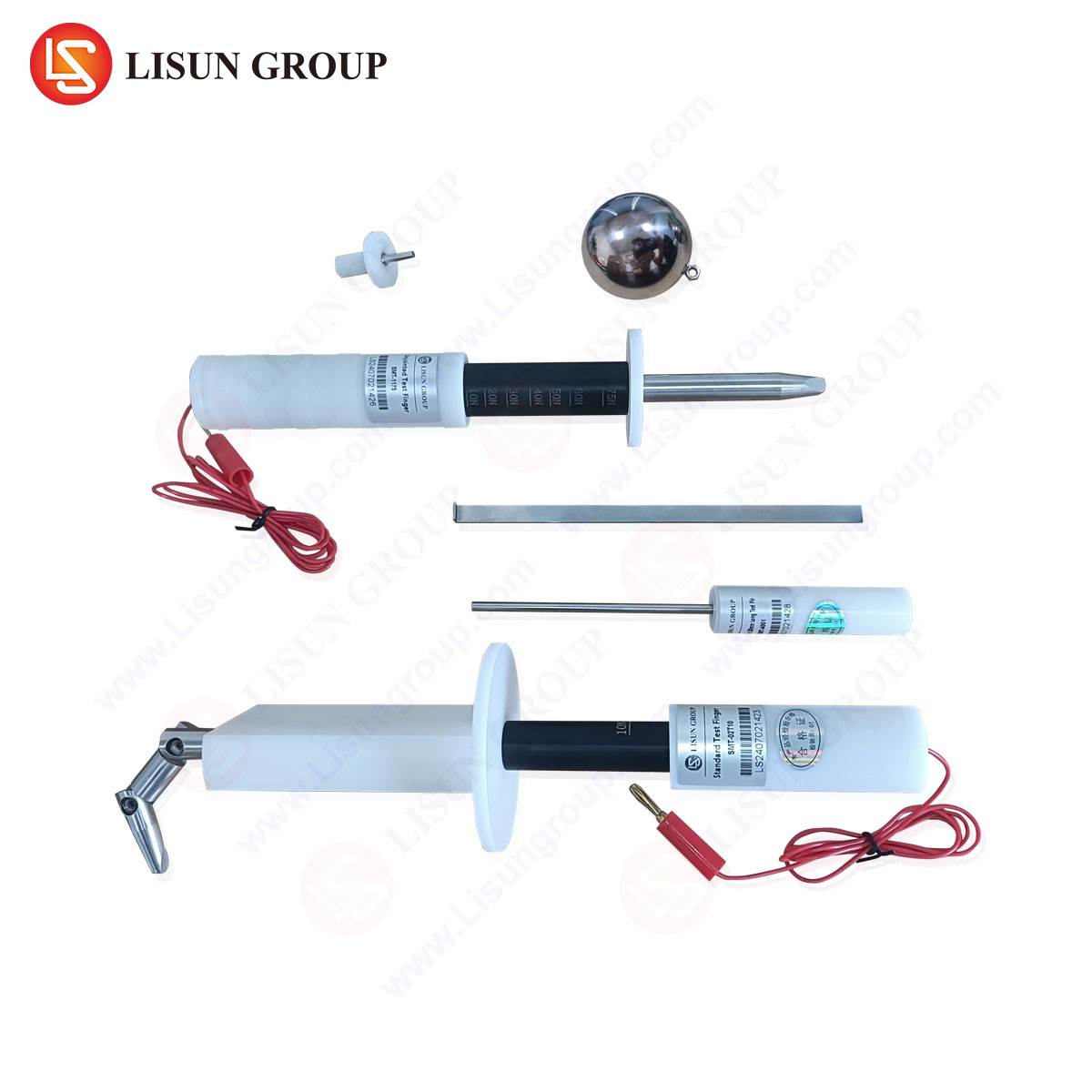
The LISUN Test Finger (IP2X Probe), a precision instrument constructed in accordance with IEC 60529 Figure 2, exemplifies this requirement. Its specifications are non-negotiable for accredited testing:
- Material: High-strength, insulating material, typically a rigid polymer, to prevent electrical conductivity during testing.
- Dimensions: The probe simulates a human finger with three jointed segments. The distal end is a hemisphere of 12.5mm ± 0.2mm radius. The overall length and joint spacing are precisely defined to replicate the reach and articulation of a typical adult finger.
- Articulation: The joints allow the probe to pivot, simulating the natural curling motion of a finger attempting to probe an opening. A stop mechanism limits the pivot angle to a standard range (e.g., 90° from the straight position in either direction), ensuring the test represents reasonable, not extreme, force application.
- Test Force: A calibrated force of 10N ± 1N is applied to the probe. This force is intended to simulate a deliberate probing action without representing excessive or abusive force.
For higher protection levels, different probes are mandated. The LISUN Test Probe (IP3X Probe) is a rigid steel wire of 2.5mm diameter, and the LISUN Test Pin (IP4X Probe) is a rigid steel wire of 1.0mm diameter. These are applied with a 1N ± 0.1N force. The selection of material (steel) and reduced force for these smaller probes reflects their simulation of tools or small objects rather than a body part.
Table 1: Summary of Standard Test Probes for Solid Object Protection
| IP Code (First Digit) | Object Protected Against | Standard Test Probe | Probe Diameter / Radius | Test Force | Typical Simulant |
| :— | :— | :— | :— | :— | :— |
| 2 | Fingers | Jointed Test Finger | 12.5mm radius | 10N ± 1N | Human finger |
| 3 | Tools, Thick Wires | Rigid Test Probe | 2.5mm ± 0.05mm | 1N ± 0.1N | Screwdriver, wire |
| 4 | Small Wires, Insects | Rigid Test Pin | 1.0mm ± 0.05mm | 1N ± 0.1N | Small tool, wire |
Operational Protocol: The Testing Procedure and Pass/Fail Criteria
The testing procedure is a formalized exercise in simulated human interaction. The enclosure under test is mounted in its normal position of use. The appropriate test probe—the jointed test finger for IP2X—is connected to an indicator circuit. For electrical safety, this circuit typically consists of a 40V to 50V supply in series with a visible indicator (e.g., an LED). The probe is articulated and applied with the specified 10N force to every conceivable opening, seam, gap, or mesh in the enclosure.
The pass/fail criterion is binary and absolute: The indicator must not light. Illumination signifies that the probe has made electrical contact with a hazardous live part or, in the case of mechanical hazard testing, has triggered a switch or contacted moving parts. The test is not solely about the size of the hole but about the access path. A small opening in a thick wall may prevent a straight probe but may be bypassed by the articulated joint of the test finger if placed near an internal corner or chassis feature. This necessitates a thorough and thoughtful application of the probe, exploring not just openings but potential paths created by internal geometry.
Cross-Industry Applications and Safety Implications
The universality of the finger safety test is evidenced by its mandated application across disparate sectors, each with unique risk profiles.
- Electrical Components & Household Appliances: For switches, socket outlets, circuit breakers, and appliance housings (e.g., for food processors, heaters), IP2X is often a baseline safety requirement. It prevents children or users from inserting fingers into apertures around buttons or power connectors.
- Lighting Fixtures: Recessed lighting, street luminaires, and industrial high-bay fixtures must prevent finger contact with live terminals or lamp bases during relamping or maintenance.
- Industrial Control Systems & Automotive Electronics: Control panels, PLC enclosures, and in-vehicle electronic control units (ECUs) located in passenger compartments or service areas must safeguard against accidental contact by operators or technicians.
- Medical Devices & Telecommunications Equipment: Patient-operated devices and network equipment in accessible locations must ensure no finger-access to hazardous voltages within ventilation grilles or service panels.
- Aerospace and Aviation Components: While subject to additional stringent standards (e.g., DO-160, AS9100), the fundamental principle of preventing inadvertent contact with wiring or connectors in cabin or ground-support equipment remains, often using IP2X as a design guide.
- Toy and Children’s Products Industry: This sector imposes some of the most rigorous interpretations. Standards like EN 71-1 and ASTM F963 incorporate finger probe tests to ensure battery compartments, joints, and openings cannot trap or contact small fingers, addressing both electrical and mechanical hazards.
The Role of Precision Instrumentation: Case Study of LISUN Test Equipment
Reliable compliance testing is contingent upon the accuracy and durability of the test instrumentation. Equipment such as the LISUN Test Finger, Probe, and Pin set is engineered not as a generic tool but as a calibrated measurement device. Its competitive advantage lies in its traceable adherence to the standard’s geometric and material specifications, which directly translates to test validity.
- Metrological Assurance: Each probe is manufactured with tight tolerances on all critical dimensions (radius, joint pivot points, length). This ensures that a “pass” result in one laboratory is equivalent to a “pass” in another, facilitating global product acceptance.
- Durability and Consistency: The joints are designed to withstand repeated articulation without developing excessive play or wear that could alter the probe’s effective profile or reach. The insulating material resists deformation under the 10N load.
- Ergonomic and Functional Design: A well-designed test finger includes features such as a comfortable handle, a clear mounting point for the force gauge, and integrated wiring channels for the indicator circuit, streamlining the testing process and reducing operator-induced variability.
In practice, a test engineer evaluating a new design for an outdoor-rated power supply (targeting IP67, which includes IP6X dust-tightness and IPX7 waterproofing) will still first verify the IP2X finger safety. They will methodically apply the LISUN Test Finger to the cable gland entry points, the seam between the housing and lid (even if gasketed), and any ventilation slots. Only after confirming the fundamental safety barrier can they proceed to the dust and water tests.
Integration within a Broader Product Safety Ecosystem
IP finger safety testing is rarely an isolated activity. It is a core component of a comprehensive safety engineering workflow that includes:
- Design Phase: Computational modeling and physical prototyping with test probes to identify and mitigate access points early.
- Pre-compliance Testing: In-house verification using standardized equipment before submission to a notified body or certification lab.
- Formal Certification: Testing by an accredited laboratory as part of a suite of evaluations for standards like IEC 62368-1 (Audio/Video, Information and Communication Technology Equipment), IEC 60335-1 (Household Appliances), or IEC 60601-1 (Medical Electrical Equipment).
- Production Line Sampling: Periodic audits using the same test equipment to ensure manufacturing consistency, particularly for critical components like molded enclosures where tooling wear could create non-compliant gaps.
Conclusion
The IP Code finger safety test, embodied by the precise application of the jointed test finger, represents a critical convergence of anthropometric simulation, electrical safety engineering, and preventive design. Its simplicity in concept belies its profound importance as a first line of defense against electric shock and injury. As products across industries—from consumer IoT devices to rugged industrial controllers—continue to evolve, the immutable requirement to prevent hazardous access by a human finger remains a cornerstone of responsible engineering. The consistent use of precision test equipment, validated against international standards, is therefore not a mere procedural formality but an essential practice for ensuring product integrity, safeguarding users, and achieving unimpeded access to global markets.
Frequently Asked Questions (FAQ)
Q1: Can a product with an IP rating for water (e.g., IPX7) be assumed to also be finger-safe (IP2X)?
No. The IP code is independent for solids and liquids. A product rated IPX7 is only defined for its protection against immersion in water. It may have no rating for solid object protection (denoted by an “X”). It must explicitly be rated IP2X or higher (e.g., IP27) to be certified as finger-safe. The tests are separate and must be evaluated independently.
Q2: Our product’s ventilation slots are narrower than 12.5mm. Is formal IP2X testing still necessary?
Yes. The width of the slot is only one factor. The test must be performed because the articulated joint of the test finger may allow it to reach through a slot and then contact a hazardous part located near the inside surface. Furthermore, the standard assesses the access to hazardous parts, not just the opening size. Internal baffles or distances (standardized as “adequate clearance”) may provide the required protection, but this must be verified by the physical test.
Q3: What is the difference between the “Test Probe” and the “Test Pin,” and when is each used?
The Test Probe (IP3X) is a 2.5mm diameter rigid steel wire, simulating tools like screwdrivers or thick wires. The Test Pin (IP4X) is a 1.0mm diameter rigid steel wire, simulating small wires or insects. They are used to verify the third and fourth levels of protection against solid objects, respectively. Both are applied with a 1N force, unlike the 10N force for the jointed Test Finger (IP2X).
Q4: How often should test equipment like the LISUN Test Finger be calibrated or verified?
While the standards (IEC 60529) do not specify a recalibration interval, best practice in quality management systems (e.g., ISO/IEC 17025 for labs) dictates periodic verification. This typically involves an annual check of critical dimensions (radius, joint play), the applied force (using a calibrated force gauge), and the continuity of the indicator circuit. The frequency may increase with heavy usage.
Q5: For a device powered by a Safety Extra-Low Voltage (SELV) circuit below 40V, is the IP2X finger test still required?
The electrical hazard portion of the test, using the 40-50V indicator circuit, may not be applicable if all accessible parts are reliably SELV. However, the mechanical hazard aspect remains. The test probe must also check for access to moving parts like fans, gears, or sharp edges that could cause injury. Many safety standards therefore mandate the physical probe test regardless of voltage, to assess both electrical and mechanical hazards.