




A Technical Examination of Ingress Protection (IP) Dust Testing: Methodologies, Standards, and Instrumentation
Introduction to Solid Particle Ingress and Its Implications
The reliable operation of modern technological systems across diverse sectors is fundamentally contingent upon their resilience to environmental contaminants. Among these, solid particulate matter—encompassing dust, sand, and other fine debris—poses a persistent and insidious threat. The intrusion of such particles can precipitate a cascade of failure modes, including mechanical binding, electrical short-circuiting, optical obstruction, thermal insulation leading to overheating, and accelerated wear of moving components. To quantify and standardize a product’s defensive capabilities against these incursions, the International Electrotechnical Commission (IEC) developed the Ingress Protection (IP) rating system, codified in standard IEC 60529. This classification provides a concise, internationally recognized code denoting levels of protection against both solid objects (first numeral) and liquids (second numeral). This article provides a rigorous, technical dissection of the dust testing protocols associated with the first numeral of the IP code, with particular emphasis on the stringent requirements for ratings of 5 and 6.
Deciphering the IP Code: Specifics of the First Characteristic Numeral
The first digit in an IP code (IP_X) specifically defines protection against access to hazardous parts and the ingress of solid foreign objects. Ratings from 0 (no protection) to 4 (protection against objects larger than 1.0 mm) are primarily concerned with safety and larger debris. The most critical ratings for fine particulate sealing are IP5X and IP6X.
- IP5X – Dust Protected: Equipment is not entirely dust-tight, but dust ingress is limited in such a quantity that it does not interfere with the satisfactory operation of the equipment or impair safety. A vacuum condition is maintained inside the enclosure during testing.
- IP6X – Dust Tight: No dust ingress is permitted under prescribed test conditions. This represents the highest achievable level of particulate protection.
The distinction is crucial: IP5X acknowledges that some particles may enter but not in harmful quantities, while IP6X mandates a complete seal. The testing methodologies to verify these claims are correspondingly more severe for IP6X.
Theoretical Foundations and Testing Methodologies for IP5X and IP6X
The core principle underlying IP5X and IP6X testing is the sustained exposure of the equipment under test (EUT) to a controlled, high-density cloud of fine talcum powder. The test powder, specified by the standard, must have a particle size distribution of ≤ 75 µm, with 50% by mass ≤ 50 µm and at least 90% by mass ≤ 75 µm. This simulates the most penetrating fraction of industrial and natural dusts.
The test chamber must generate a homogeneous, turbulent dust cloud surrounding the EUT. For IP5X testing, the chamber draws a partial vacuum inside the EUT (typically 2 kPa below atmospheric pressure) to simulate pressure differentials that could drive infiltration. The test runs for 8 hours. For IP6X, the test is more rigorous, often requiring a longer duration (typically 8 hours) and may involve multiple orientations or the use of a vacuum pump to create a more significant internal under-pressure (up to 20 kPa), actively attempting to draw dust into any potential breach.
Post-test evaluation is meticulous. For IP5X, the EUT is inspected for dust accumulation on internal components. The pass criterion is that dust has not accumulated in a location or quantity that would inhibit functional performance or violate safety standards. For IP6X, the examination is absolute: no visible dust is permitted inside the enclosure.
Instrumentation for Compliance: The Role of the Dust Test Chamber
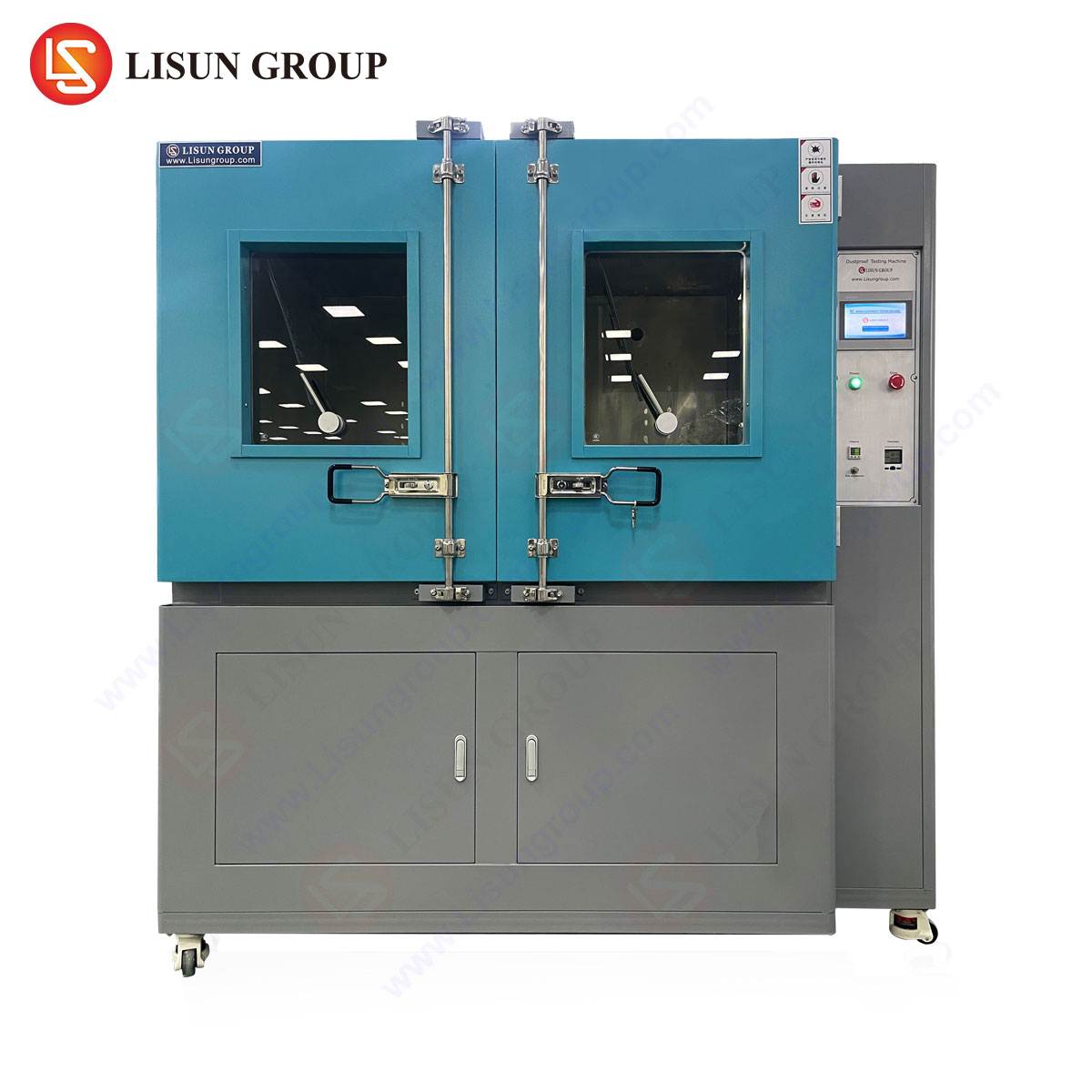
Achieving reproducible, standards-compliant results necessitates specialized instrumentation. A modern dust test chamber, such as the LISUN SC-015 Dust Sand Test Chamber, is engineered to precisely fulfill the exacting parameters of IEC 60529, as well as related standards like ISO 20653 (automotive) and GB/T 4208. This apparatus is not merely a sealed box with dust; it is a calibrated scientific instrument designed for reliability and repeatability.
Technical Specifications and Operational Principles of the LISUN SC-015 Chamber
The LISUN SC-015 exemplifies the integration of robust engineering with precise control systems to facilitate accredited testing. Its construction typically features an interior chamber of stainless steel, resistant to abrasion and facilitating easy cleaning. A closed-loop blowing system, powered by a centrifugal blower of specified capacity, circulates the talcum powder at a controlled velocity to maintain the required cloud density (e.g., 2 kg/m³ to 5 kg/m³, as stipulated by the test standard in use). The system includes a sieve mechanism to ensure consistent particle dispersion and prevent clumping.
Key specifications of such a system include:
- Chamber Volume: Sufficient to accommodate the EUT without compromising cloud uniformity (e.g., 0.5 m³ to 1 m³ are common sizes).
- Dust Circulation System: A blower with variable speed control to maintain the specified dust cloud density.
- Timing Control: Programmable digital timer for precise test duration management.
- Vacuum System: Integrated vacuum pump and pressure gauge (Magnehelic gauge or digital equivalent) to generate and monitor the required under-pressure for IP5X and IP6X tests.
- Observation Window: Large, sealed glass window with internal wipers to allow real-time monitoring without test interruption.
- Safety & Extraction: Integrated safety interlocks and a dust extraction port for safe post-test chamber evacuation.
The operational principle involves placing the EUT in the chamber, sealing all cable glands and ports according to manufacturer instructions, and initiating the test cycle. The blower agitates the pre-loaded talcum powder, creating the dense cloud. For IP5X tests, the vacuum system is activated to create the specified under-pressure inside the EUT. The test runs for the mandated duration, after which the EUT is carefully removed and inspected under controlled conditions to assess ingress.
Industry-Specific Applications and Compliance Imperatives
The demand for IP5X and IP6X validation spans virtually every sector where electronics or precision mechanics encounter non-benign environments.
- Automotive Electronics: Components like engine control units (ECUs), sensors, and lighting assemblies (per ISO 20653) require high dust protection for under-hood and underbody applications.
- Industrial Control Systems: Programmable logic controllers (PLCs), motor drives, and human-machine interfaces (HMIs) in manufacturing plants must resist conductive dust that could cause catastrophic failures.
- Telecommunications Equipment: Outdoor base station electronics, fiber optic terminal enclosures, and maritime communication devices necessitate dust-tight sealing for long-term reliability.
- Aerospace and Aviation Components: Avionics bay equipment and external sensors must withstand fine particulate ingress at altitude and in desert operations.
- Lighting Fixtures: LED luminaires for industrial, roadway, and hazardous location lighting (e.g., complying with ATEX/IECEx directives) require IP6X ratings to prevent lumen depreciation and overheating from dust coating.
- Medical Devices: Portable diagnostic equipment and devices intended for use in field hospitals or ambulances must be protected from contaminant ingress.
- Electrical Components & Wiring Systems: Switches, sockets, connectors, and junction boxes for outdoor or industrial use mandate validated IP ratings to ensure safety and longevity.
- Consumer Electronics & Household Appliances: High-end cameras, smartphones with claimed dust resistance, and garden power tools incorporate sealing validated by these tests.
Competitive Advantages of Integrated Testing Solutions
Utilizing a dedicated, fully featured chamber like the LISUN SC-015 offers distinct advantages over improvised or less capable testing setups. First, it guarantees compliance with the geometric, density, and duration requirements of the international standards, which is critical for generating test reports accepted by certification bodies (e.g., TÜV, UL, Intertek). Second, the integrated vacuum and circulation systems provide the consistent, repeatable conditions necessary for reliable comparative testing between product design iterations. Third, robust construction and safety features protect laboratory personnel and ensure the longevity of the equipment itself. Finally, such instrumentation enhances laboratory efficiency, allowing for sequential testing with minimal downtime for chamber cleaning and preparation.
Interpretation of Results and Limitations of the Test
It is imperative to understand the scope and limitations of the IP dust test. A passing grade for IP6X indicates no ingress under the specific, accelerated conditions of the test: a defined powder, an 8-hour exposure, and a specified under-pressure. It is not a lifetime warranty against all dust in all environments. Factors such as long-term gasket degradation, thermal cycling, mechanical vibration, and exposure to dust types outside the specification (e.g., conductive carbon dust, fibrous materials) can affect real-world performance. Therefore, the test is a vital type-approval and comparative design tool, but it must be considered alongside other environmental stress screenings (thermal, vibration, UV) for a comprehensive reliability assessment.
Conclusion
Ingress Protection dust testing, particularly for the IP5X and IP6X classifications, is a non-negotiable validation step for a vast array of products destined for challenging operational environments. The test protocols, defined by IEC 60529, are scientifically rigorous, designed to simulate severe particulate exposure in a controlled, reproducible manner. The reliability of the test data is directly dependent on the precision and compliance of the instrumentation used. Specialized dust test chambers, engineered to exacting specifications, provide the necessary controlled environment to generate defensible results, support robust R&D, and achieve crucial product certifications. As technological systems continue to permeate every facet of industrial and consumer life, the role of validated environmental protection—and the testing that proves it—will only grow in significance.
FAQ Section
Q1: What is the required test duration for IP5X and IP6X dust testing according to IEC 60529?
A1: IEC 60529 stipulates a continuous test duration of 8 hours for both IP5X and IP6X ratings. Some derivative standards or customer-specific test plans may specify longer durations, but the IEC baseline is 8 hours under continuous dust cloud exposure.
Q2: Can the LISUN SC-015 chamber be used for testing other materials besides talcum powder, such as sand?
A2: While primarily designed for the fine talcum powder specified in IEC 60529, the chamber’s robust construction and circulation system may accommodate other non-abrasive test dusts for research purposes. However, for official IP rating certification, the use of the specified talcum powder is mandatory. The chamber’s name often includes “Sand Test” to reflect compatibility with broader standards like ISO 20653 for automotive testing, which may involve different dust types.
Q3: How is the dust cloud density inside the chamber verified and maintained?
A3: The chamber design ensures density through calibrated mechanical means. The key factors are the precise mass of powder loaded, the volume of the test chamber, and the controlled velocity of the circulating blower. While direct real-time density measurement is complex, adherence to the manufacturer’s operational procedures—specifying powder quantity and blower settings—ensures the cloud meets the standard’s requirements (typically 2-5 kg/m³). Regular calibration and validation runs are recommended.
Q4: Is a vacuum test always required for IP5X?
A4: Yes. The IP5X test method explicitly requires creating a partial vacuum inside the enclosure under test (typically 2 kPa below ambient) to simulate conditions that could draw dust in through micro-leaks. The IP6X test is even more stringent, often utilizing a higher vacuum level (e.g., 20 kPa). The integrated vacuum system in a dedicated chamber like the SC-015 is essential for performing this correctly.
Q5: What industries most commonly require IP6X testing versus IP5X?
A5: IP6X (Dust Tight) is typically mandated for critical systems where any internal contamination is unacceptable. This includes aerospace avionics, sealed medical devices, underwater connectors, and electronics for extreme environments like deserts or mining. IP5X (Dust Protected) is often sufficient for applications where the equipment has internal filtering, occasional maintenance is possible, or the environment is less severe, such as some indoor industrial controls or protected outdoor consumer electronics. The choice is driven by the product’s safety, reliability, and lifetime maintenance specifications.