




A Comprehensive Framework for Validating Ingress Protection (IP) Ratings in Modern Electronic Systems
The proliferation of electronic systems across increasingly demanding environments has rendered ingress protection (IP) testing not merely a compliance exercise, but a critical pillar of product reliability and safety. The IP Code, as defined by international standards such as IEC 60529 and ISO 20653, provides a standardized classification for the degrees of protection offered by enclosures against the intrusion of solid foreign objects and water. However, the accurate and repeatable verification of these ratings demands sophisticated, precisely controlled test solutions. This article delineates the technical methodologies, equipment requirements, and application-specific considerations for conducting rigorous IP testing, with a focus on advanced test chamber systems.
Fundamental Principles of IP Code Interpretation and Test Classification
The IP Code is structured as IPXY, where ‘X’ denotes protection against solids (on a scale of 0-6) and ‘Y’ indicates protection against liquids (0-9K). It is imperative to understand that each digit represents a discrete test condition, not a cumulative performance gradient. For instance, an IP67 rating signifies that a device has separately passed the tests for complete dust ingress prevention (6) and temporary immersion in water (7). It does not inherently guarantee performance against high-pressure water jets (IPX5/6) or steam cleaning (IPX9K), which are distinct test protocols.
Testing for solid particle protection involves calibrated dust, typically talcum powder for IP5X (dust-protected) or a finer, circulating dust cloud for IP6X (dust-tight). The test assesses whether any dust penetrates the enclosure in quantities sufficient to interfere with safe operation. Liquid ingress testing encompasses a spectrum of simulated conditions: dripping water (IPX1-IPX4), water jets (IPX5-IPX6), temporary immersion (IPX7-IPX8), and high-pressure, high-temperature washing (IPX9K). Each test requires specific nozzle configurations, water pressure, flow rate, duration, and, for IPX9K, water temperature. The precision with which these parameters are controlled and maintained directly correlates to the validity and reproducibility of the test results.
Architectural Design of Integrated IPX1-X9K Test Chamber Systems
To address the full gamut of IP testing requirements efficiently, integrated test chambers have become the industry benchmark. These systems consolidate multiple test functionalities into a single, automated platform, eliminating the need for disparate setups and reducing transitional errors. A representative paradigm of this integrated approach is the LISUN JL-XC Series Multi-Function Waterproof Test Chamber.
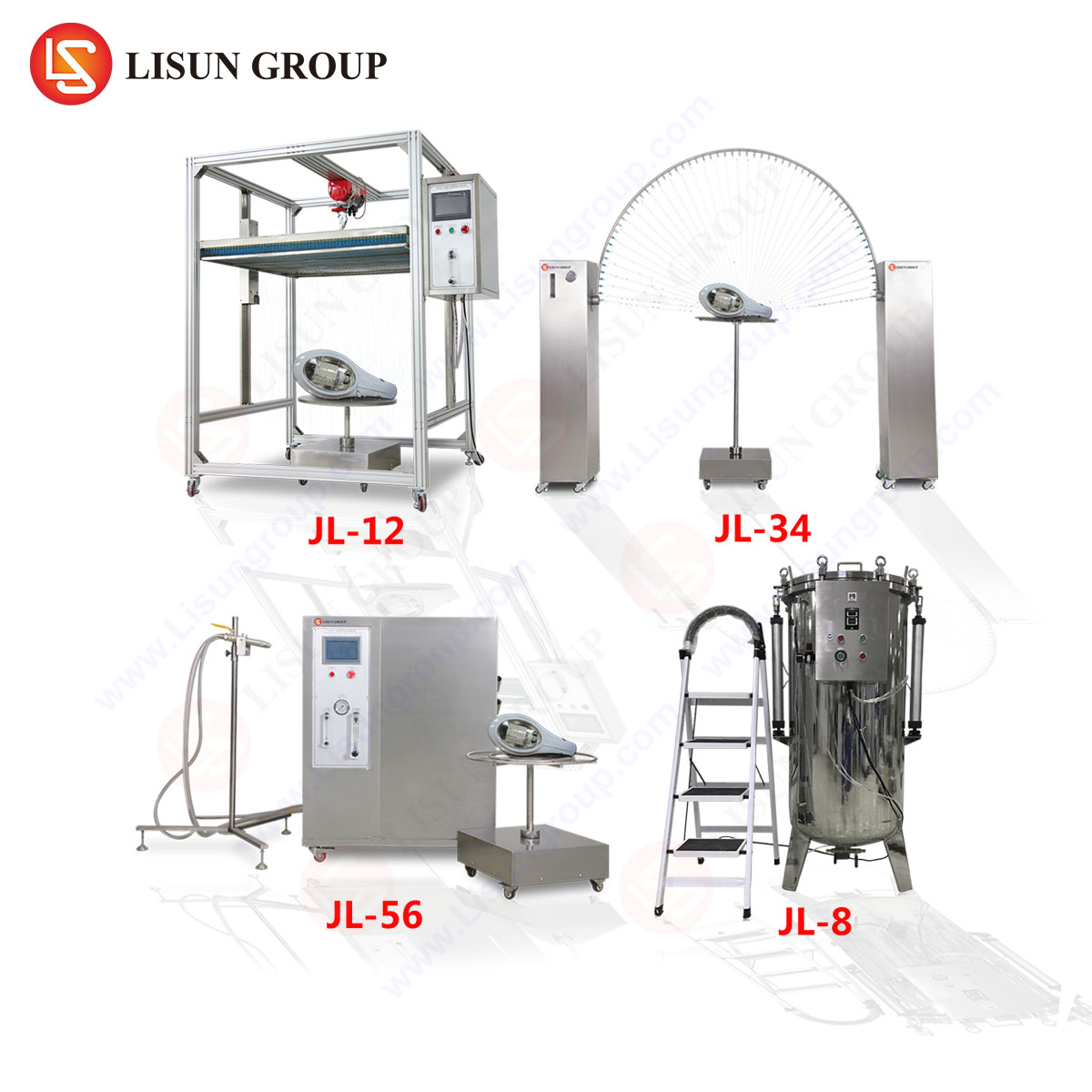
The JL-XC Series is engineered to perform IPX1 through IPX9K tests within a unified stainless-steel chamber. Its operational principle is based on modular, programmable control of all critical test variables. The system incorporates distinct subsystems: a drip rain apparatus with an oscillating tube or spray grid for IPX1-IPX4; a pressurized water jet system with interchangeable nozzles for IPX5 and IPX6; an immersion tank for IPX7 and IPX8; and a dedicated high-pressure, high-temperature rotary spray system for IPX9K. A centralized programmable logic controller (PLC) and human-machine interface (HMI) allow for the creation, storage, and execution of complex test profiles that automatically sequence through these conditions.
Key Technical Specifications of the JL-XC Series:
- Test Scope: Comprehensive coverage from IPX1 to IPX9K.
- Chamber Construction: 304 stainless steel, with reinforced structural integrity for pressurized tests.
- Water Jet System: Pressure range adjustable from 30-150 kPa for IPX5/6, with flow rate monitoring.
- IPX9K System: High-pressure pump capable of 8-10 MPa (80-100 bar), with water temperature controllable from 80°C ±5°C. The spray arm features a rotary oscillating mechanism to ensure coverage from 0°, 30°, 60°, and 90° angles as per standard.
- Immersion Tank: Integrated for IPX7 (1 meter depth for 30 minutes) and IPX8 (user-defined deeper depth/longer duration, per product specification).
- Control System: PLC with 7-inch color HMI, supporting preset IEC/ISO test programs and custom parameterization.
- Safety Features: Water circulation and filtration system, overflow protection, electrical leakage protection, and chamber door safety interlocks.
Industry-Specific Application Protocols and Use Cases
The application of IP testing varies significantly across sectors, dictated by operational environments and relevant regulatory frameworks.
Automotive Electronics & Aerospace Components: These sectors heavily utilize IPX6 (powerful water jets), IPX7 (immersion for waterproof connectors), and particularly IPX9K. The IPX9K test simulates high-pressure, high-temperature wash-downs encountered in vehicle underbody components, engine bay electronics, and aerospace landing gear systems. The JL-XC Series’ precise temperature and pressure control is critical here, as per ISO 20653 and automotive manufacturer-specific standards like LV 214.
Household Appliances & Lighting Fixtures: Products such as outdoor lighting (IP65/66/67), kitchen appliances (IPX4 for splashes), and garden equipment require robust testing. The oscillating drip and spray systems in a chamber like the JL-XC are used extensively to validate performance against rain and cleaning sprays.
Medical Devices & Industrial Control Systems: For devices requiring cleaning sterilization (e.g., surgical tool interfaces, food processing control panels), IPX5/6 and IPX9K tests are vital. The ability to program automated wash-cycle simulations, including specific dwell times and pressure sequences, ensures the enclosure can withstand repeated sanitation procedures.
Telecommunications & Cable Systems: Outdoor cabinets, fiber optic splice closures, and waterproof connectors are tested to IP55, IP65, or IP67. The integrated chamber allows for sequential testing—first with dust (IP5X/6X) followed by water jet or immersion tests—without manually moving the test sample, ensuring test integrity.
Electrical Components & Consumer Electronics: Switches, sockets, and outdoor electronic devices undergo drip and spray testing. The precision of the water flow rate and nozzle distance in the test chamber, as configured in the JL-XC’s PLC, is essential for replicating standard-compliant conditions.
Competitive Advantages of Unified, Programmable Test Platforms
The transition from manual, discrete test setups to integrated chambers like the JL-XC Series confers several substantive advantages that transcend mere convenience.
Enhanced Repeatability and Compliance: Automated control of pressure, flow, temperature, angle, and duration eliminates operator-induced variance. This ensures test results are fully traceable and auditable, a key requirement for ISO/IEC 17025 accredited laboratories and quality assurance documentation.
Operational Efficiency and Resource Optimization: Consolidation reduces laboratory footprint and capital expenditure on multiple single-function testers. The automated sequences minimize labor intervention, increase throughput, and significantly reduce water consumption through integrated recirculation and filtration systems.
Mitigation of Cross-Contamination and Test Integrity: Performing all water-based tests in a sealed, dedicated chamber prevents water damage to other laboratory equipment. More importantly, it allows for sequential testing (e.g., dust followed by water) on the same sample without environmental exposure, which is critical for validating combined IP6X7 ratings accurately.
Future-Proofing and Adaptability: As product designs and standards evolve, a programmable platform can be updated with new test profiles. This adaptability protects the investment against obsolescence, allowing the same chamber to validate next-generation products against emerging environmental resilience requirements.
Methodological Considerations for Accurate Test Execution
Deploying an advanced test chamber does not, in itself, guarantee valid results. Strict methodological rigor must be observed.
Sample Preparation and Mounting: The device under test (DUT) must be configured in its operational state. For rotating devices, they should be operating at rated speed during the test unless the standard specifies otherwise. Mounting must replicate the intended installation angle, as a 15-degree variation can drastically alter water ingress paths.
Pre- and Post-Test Evaluation: A thorough visual and functional inspection must precede the test. Following the test, the enclosure is opened and inspected for any traces of water or dust ingress. For electrical devices, dielectric strength tests or functional operational checks are mandatory to determine if ingress has compromised safety or performance.
Calibration and Maintenance: Regular calibration of pressure transducers, flow meters, temperature sensors, and timer functions is non-negotiable. Nozzles must be inspected for wear, and water filtration systems must be maintained to prevent clogging and ensure consistent water quality, which can affect spray patterns and pressure.
Data Logging and Reporting: Modern systems should automatically log all test parameters throughout the procedure. This data log forms the evidentiary basis for the test report, providing objective proof that the standard’s prescribed conditions were met for the entire specified duration.
Frequently Asked Questions (FAQ)
Q1: Can an IPX7 or IPX8 rated device be assumed to also meet the requirements for IPX5 or IPX6?
No. IPX7/8 ratings for temporary or continuous immersion are fundamentally different tests from IPX5/6 for pressurized water jets. The sealing mechanisms that prevent water ingress under static pressure during immersion may fail under the dynamic, localized force of a water jet. These ratings must be established independently, though a product may be dual-rated (e.g., IP65/IP67) if it passes both distinct tests.
Q2: What is the critical distinction between IP5X and IP6X dust testing?
IP5X (“dust-protected”) testing permits a limited amount of dust to enter the enclosure, provided it does not interfere with safe operation or accumulate in a hazardous manner. IP6X (“dust-tight”) is a more stringent test where no dust ingress is permitted. The test apparatus and dust density are similar, but the pass/fail criterion is different. Achieving IP6X typically requires more robust sealing solutions.
Q3: For the IPX9K test, why is water temperature control so critical?
The 80°C ±5°C requirement serves two primary purposes. First, it simulates the high-temperature wash-downs common in industrial and automotive cleaning. Second, and more critically, thermal stress can cause differential expansion and contraction of enclosure materials and seals. A seal that remains effective with cold water may fail when exposed to hot water and subsequent cooling cycles, making temperature a key stress variable in the test.
Q4: How does an integrated chamber like the JL-XC Series handle the transition between a dust test (IP5X/6X) and a subsequent water test?
Advanced integrated chambers are designed to conduct sequential tests without removing the sample. After the dust test concludes, the chamber can be sealed and the water test systems activated. This closed-loop process is vital for testing to combined ratings like IP66, as it prevents the accidental removal of settled dust from the sample’s exterior before water testing, which could yield a false positive result.
Q5: What are the primary calibration points for maintaining a water spray test system?
The essential parameters requiring periodic calibration are: water pressure (for IPX5/6 and IPX9K), water flow rate (for all spray tests), nozzle orifice diameter, water temperature (for IPX9K), and oscillation rate/angle (for drip and IPX9K tests). Calibration intervals should be defined based on usage frequency and adherence to the laboratory’s quality management system.