




IP Water Testing Explained: Standards, Methodologies, and Technological Implementation
The ingress protection (IP) rating system, codified by the International Electrotechnical Commission (IEC) under standard 60529, provides a globally recognized framework for classifying the degree of protection offered by enclosures against the intrusion of solid foreign objects and water. While both digits are critical, the second digit—specifying water resistance—is often the primary determinant of product suitability in environments where liquid exposure is a foreseeable risk. This article provides a technical examination of IP water testing standards, detailing the methodologies, validation processes, and practical implementation through advanced testing instrumentation, with a specific focus on the LISUN JL-XC Series of waterproof test equipment.
Deciphering the IP Code: A Focus on Liquid Ingress Protection
The IP code’s structure is defined as IPXY, where ‘X’ denotes protection against solids and ‘Y’ against liquids. For water testing, the second digit, ranging from 0 to 9K, defines specific test conditions. It is imperative to understand that these ratings are not cumulative in a linear fashion but represent distinct, standardized tests. For instance, IPX7 (immersion) does not automatically imply compliance with IPX5 (water jets). Each test is an independent verification under prescribed conditions.
Key water protection ratings include:
- IPX1 & IPX2: Dripping water at defined angles, simulating condensation or light rain.
- IPX3 & IPX4: Spraying water, with IPX3 at an oscillating angle up to 60° and IPX4 offering omnidirectional splash protection.
- IPX5 & IPX6: Powerful water jets from a nozzle at specified distance, pressure, and flow rate, simulating cleaning processes or storm-driven rain.
- IPX7 & IPX8: Temporary (IPX7) or continuous (IPX8) immersion under specified depth and time, as defined by the manufacturer. IPX8 parameters are typically more severe and subject to manufacturer-specified agreement.
- IPX9K: High-pressure, high-temperature water jets, primarily for cleaning validation in industrial settings like automotive or food processing.
Compliance is binary: the enclosure must prevent harmful ingress of water under the test conditions. Post-test examination involves internal inspection for water droplets and functional testing of the device to ensure no degradation of performance.
Methodological Rigor in Laboratory Water Ingress Testing
Achieving a certified IP rating requires adherence to strict laboratory procedures that replicate real-world environmental stresses with high repeatability. The test methodology is governed by a sequence of controlled parameters.
Test Apparatus Calibration: The foundation of any valid test is calibrated equipment. Nozzle dimensions for IPX3-IPX6, flow rate meters, pressure gauges, and immersion tank dimensions must conform to IEC 60529 tolerances. Regular calibration against national standards is mandatory for accredited laboratories.
Specimen Preparation and Conditioning: The unit under test (UUT) is typically prepared in its operational state. For powered devices, it may be energized and monitored during testing. Conditioning at a stable ambient temperature prior to testing is often required, particularly for IPX9K where thermal shock is a factor.
Test Execution and Monitoring: The test is conducted for the exact duration specified (e.g., 3 minutes for IPX5/IPX6, 30 minutes for IPX7). For jet tests, the nozzle is traversed across the enclosure at a defined speed and distance. During immersion, the UUT is placed at the specified depth. Continuous monitoring for electrical leakage or functional failure is critical.
Post-Test Evaluation: This is a two-stage process. First, a visual inspection for any trace of water inside the enclosure. Second, a full functional and safety test, which may include dielectric strength verification (hipot testing), insulation resistance measurement, and operational checks to confirm no latent damage has occurred.
The LISUN JL-XC Series: Engineering Precision for Compliance Verification
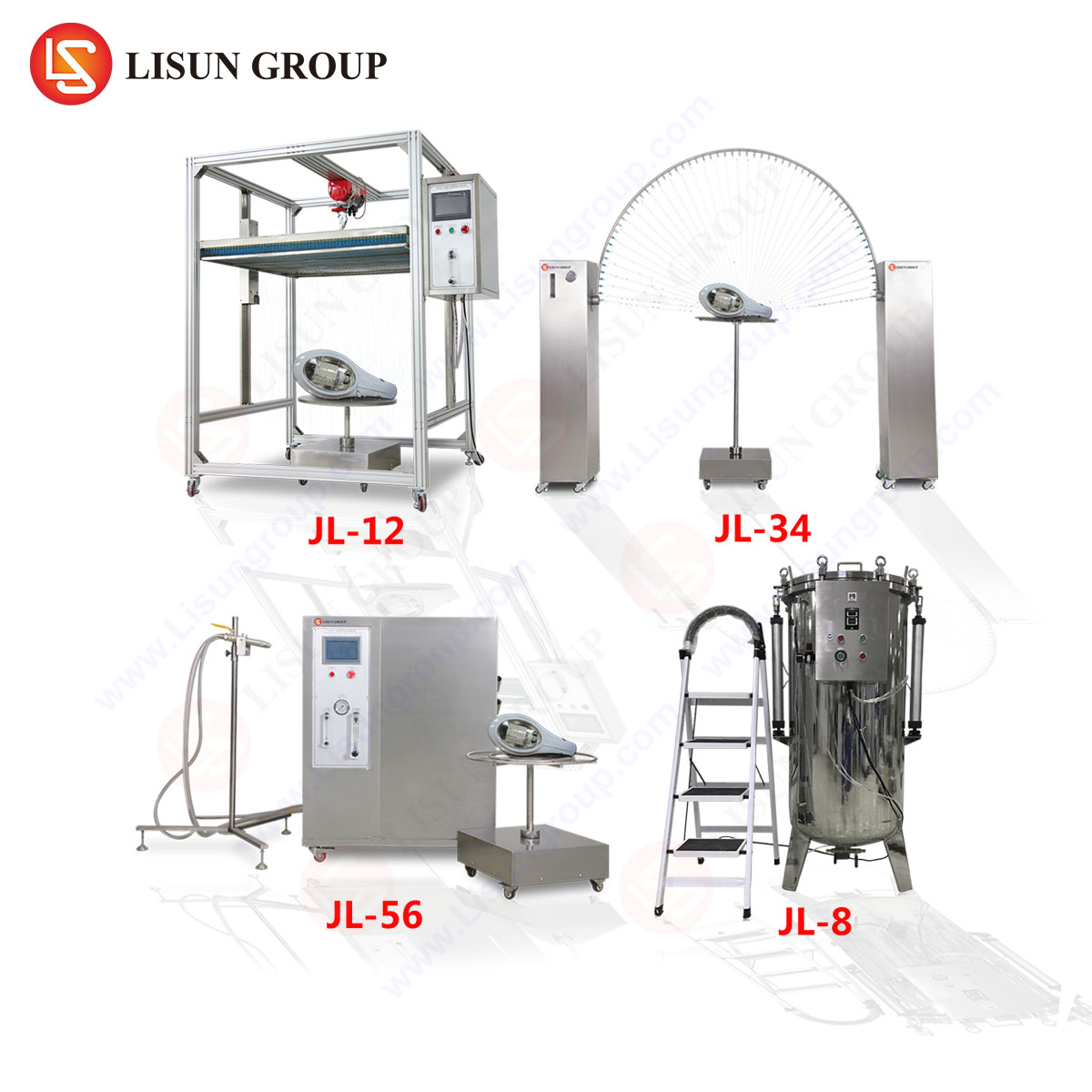
Implementing the rigorous methodologies of IEC 60529 demands instrumentation that offers precision, reliability, and operational flexibility. The LISUN JL-XC Series waterproof test chambers are engineered to meet this demand, providing integrated solutions for IPX1 through IPX9K testing in a modular or consolidated platform.
Core Specifications and Testing Principles: The JL-XC Series is designed around a modular philosophy, allowing configuration for specific test regimes. A standard high-performance system might include a stainless-steel test chamber, a precision rotary table with variable speed control (1-5 rpm typical), a multi-stage pressure pump system, and a dedicated IPX9K high-temperature/high-pressure unit.
The testing principle is one of controlled simulation. For jet testing (IPX5/IPX6), a centrifugal pump maintains a constant pressure (e.g., 100 kPa for IPX5, 1000 kPa for IPX6) to a standardized nozzle, with flow rate verified by a calibrated flowmeter. The rotary table ensures even exposure. For immersion testing (IPX7/IPX8), the chamber serves as a water tank, with depth controlled by an overflow port or programmable lift mechanism. The IPX9K module integrates a water heating system to deliver 80°C ±5°C water at 8-10 MPa pressure through four specific nozzles in a defined spray pattern.
Industry Application and Use Cases: The versatility of the JL-XC Series makes it applicable across a broad industrial spectrum.
- Automotive Electronics: Validating IPX6/6K for exterior-mounted control units, sensors, and lighting against road spray and high-pressure car washes (IPX9K).
- Lighting Fixtures: Testing outdoor luminaires (IP65, IP66) for landscape, architectural, and industrial lighting, and submerged lights (IP67, IP68) for pools or fountains.
- Telecommunications Equipment: Ensuring outdoor cabinets, antennas, and fiber optic enclosures (typically IP55, IP65) withstand driving rain.
- Medical Devices: Verifying splash resistance (IPX4) for bedside equipment and immersion cleaning capability (IPX7) for surgical hand tools or portable monitors.
- Aerospace and Aviation Components: Testing components for resistance to condensation (IPX2) and pressurized sprays (IPX6) encountered in flight and ground operations.
- Consumer Electronics & Wearables: Proving splash resistance (IPX4) for smartphones and full immersion (IP68) for smartwatches and sports cameras.
Competitive Technological Advantages: The JL-XC Series differentiates itself through several key engineering features. Its integrated PLC (Programmable Logic Controller) with a touch-screen HMI (Human-Machine Interface) allows for the programming of complex, multi-stage test sequences—such as cycling between IPX5 and IPX7 tests—without manual intervention. The use of corrosion-resistant 304 stainless steel for all wetted parts ensures long-term durability and prevents contamination. Furthermore, its advanced water filtration and temperature control system maintains test consistency, while comprehensive safety interlocks and leak detection circuits protect both the operator and the UUT. This combination of automation, durability, and safety reduces test cycle variability and operational cost.
Cross-Industry Standards and Regulatory Synergy
IP testing rarely exists in isolation. It is frequently a component within a larger suite of environmental reliability tests mandated by industry-specific standards. Understanding this synergy is crucial for comprehensive product validation.
- Electrical/Electronic & Household Appliances: IEC 60529 is often combined with IEC 60068-2 (environmental testing) and safety standards like IEC 60335, which references IP codes for appliances used in damp environments.
- Automotive: ISO 20653 (replacing DIN 40050-9) is the direct automotive equivalent of IEC 60529. Testing is integrated into larger qualification suites per ISO 16750, which defines environmental conditions for electrical equipment.
- Industrial Control Systems: Enclosures are governed by IEC 60529 but also by the IEC 61131 series for programmable controllers, specifying environmental requirements.
- Medical Devices: IEC 60529 testing supports compliance with IEC 60601-1 (medical electrical equipment), which specifies required IP ratings for equipment based on its intended use environment (e.g., splash-proof for general care).
- Aerospace: While RTCA DO-160 defines environmental test conditions for airborne equipment, IP testing provides a foundational verification often referenced in equipment specifications.
This interrelation necessitates a testing strategy where the IP rating is verified under conditions that simulate not just the standalone water exposure, but also the thermal, vibrational, or pressure cycling the product will experience in service.
Interpretation Challenges and the Imperative of Direct Testing
A common pitfall in product specification is the misinterpretation of IP ratings. As noted, ratings are not cumulative. A product designed for IP68 immersion may fail an IPX5 jet test due to differing failure mechanisms—pressure-driven penetration versus static pressure immersion. Furthermore, the “K” in IPX9K denotes it as a separate test from IPX9 (which is obsolete); it is not a higher grade of IPX8.
Manufacturer-defined parameters for IPX8 present another nuance. While the test requires more severe conditions than IPX7, the exact depth, duration, and pressure (if applicable) are agreed upon between manufacturer and user. This underscores that an IPX8 rating alone is meaningless without the accompanying test parameters.
These complexities make direct, physical testing on production samples non-negotiable. Relying solely on design seals or material properties is insufficient. Prototype and production qualification testing using calibrated equipment like the JL-XC Series is the only method to obtain defensible certification and mitigate field failure risk. The data derived from such testing also feeds back into the design process, informing gasket selection, seal geometry, and vent design.
FAQ: IP Water Testing and the JL-XC Series
Q1: Can the LISUN JL-XC Series test both IPX7 (immersion) and IPX8 (continuous immersion) ratings?
A1: Yes, the JL-XC Series chamber is designed for immersion testing. The key difference between IPX7 and IPX8 is the test conditions, which are defined by depth and time. The JL-XC system can be configured with programmable depth control and timing functions to meet the specific parameters for IPX7 (up to 1m for 30 minutes) and the more stringent, manufacturer-defined parameters required for IPX8 certification.
Q2: For testing a product to both IPX6 and IPX9K, is separate equipment needed?
A2: Traditionally, these tests required distinct setups due to the vastly different pressure and temperature requirements. However, the modular design of the JL-XC Series allows for the integration of a high-pressure, high-temperature IPX9K test module within the same system framework. This enables sequential testing in a single, coordinated test cycle, improving efficiency and ensuring consistent specimen handling.
Q3: How critical is the rotary table speed during IPX3-X6 spray testing?
A3: It is a critical parameter defined by the standard. IEC 60529 specifies the speed to ensure a uniform distribution of water over the enclosure’s surface. An incorrect speed can lead to over-testing on one area and under-testing on another, producing invalid results. The JL-XC Series features a programmable, servo-driven rotary table with precise speed control to comply with these requirements.
Q4: What water quality is required for valid IP testing, and how does the JL-XC system manage this?
A4: IEC 60529 specifies that water used should be of “drinking water quality” but may contain a dye (like fluorescein) for easier leak detection. Impurities or ions can affect electrical monitoring and cause corrosion. The JL-XC Series typically includes a filtration and deionization system to maintain consistent water purity, and for IPX9K testing, it incorporates a water heating and softening system to prevent scaling in the high-pressure circuit.
Q5: When qualifying a product for an automotive application, should we use IEC 60529 or ISO 20653?
A5: For automotive components, ISO 20653 is the industry-specific standard and is generally required by OEMs. While the test methodologies between IEC 60529 and ISO 20653 are very closely aligned (and often technically identical), the certification and reporting should be performed to the automotive standard. The JL-XC Series is designed to meet the test conditions stipulated in both standards, ensuring cross-compliance.