




Understanding the IPX4 Ingress Protection Rating: A Technical Analysis of Splash Resistance
Within the rigorous landscape of product design and validation, the assurance of environmental resilience is paramount. Among the suite of standards governing this domain, the Ingress Protection (IP) rating system, codified under IEC 60529, provides a globally recognized framework for classifying the degree of protection offered by enclosures against the intrusion of solid foreign objects and water. This article provides a detailed technical examination of the IPX4 rating, elucidating its testing parameters, industrial significance, and the methodologies employed to verify compliance, with a specific focus on advanced testing instrumentation.
Deciphering the IP Code: Structural Significance of the Numeric Designation
The IP code is an alphanumeric designation where each character conveys specific information. The letters ‘IP’ are followed by two numerals: the first indicates protection against solid particles (on a scale of 0-6), and the second denotes protection against liquids (on a scale of 0-9K). The ‘X’ placeholder is used when a characteristic is not specified or not relevant to the assessment. Consequently, an IPX4 rating explicitly defines a product’s protection against water ingress, with no formal rating declared for solid particle protection. The numeral ‘4’ is the critical differentiator, signifying a defined level of splash resistance.
Defining the IPX4 Test Regimen: Parameters and Tolerances
The IPX4 test is designed to simulate conditions of water splashing from any direction. The standard mandates a very specific and reproducible environmental challenge. The core apparatus is a oscillating tube or spray nozzle test rig. The device under test (DUT) is placed on a turntable at a defined distance from the spray apparatus. The test employs a spray nozzle with a 0.4mm diameter hole, delivering water at a flow rate of 0.07 liters per minute, plus or minus 5%, per hole. The water pressure is regulated to ensure consistent droplet size and impact energy.
The procedural chronology is critical. The oscillating spray head covers an arc of approximately 180° (or 360° in a variant) while the turntable rotates, ensuring the DUT is exposed from all practicable angles. The total test duration is a minimum of 10 minutes, though this is often extended proportionally based on the DUT’s size and the need to ensure full coverage. The water used must be clean, and its temperature is typically maintained within a range that avoids thermal shock, usually between 15°C and 35°C. Post-test evaluation involves a thorough visual inspection for water ingress and functional testing to confirm no degradation of performance. The acceptance criterion is stringent: no harmful water accumulation is permitted inside the enclosure that would interfere with safe operation or impair insulation.
Industrial Applications and Imperatives for IPX4 Compliance
The IPX4 rating finds critical application across a diverse spectrum of industries where exposure to incidental water splashing is a foreseeable operational condition, but full immersion or high-pressure jets are not anticipated.
In Consumer Electronics and Telecommunications Equipment, such as smartphones, Bluetooth speakers, and outdoor Wi-Fi access points, IPX4 ensures resilience against rain, sweat, or spills. For Household Appliances like food processors, blenders, and countertop coffee makers, it protects against splashes during cleaning or use. The Automotive Electronics sector relies on IPX4 for interior components like infotainment systems, control modules, and sensors that may encounter spilled liquids or condensation.
Within Lighting Fixtures, both indoor (e.g., bathroom vanity lights, kitchen downlights) and outdoor (path lights, wall sconces) fixtures utilize IPX4 to withstand humidity and direct splashing. Electrical Components, including switches, sockets, and connectors designed for damp locations, often specify IPX4 as a minimum requirement. Office Equipment such as printers and photocopiers located in open-plan offices may require this rating for protection against accidental drink spills.
For Medical Devices, particularly portable monitors, handheld diagnostic tools, and non-critical care equipment used in ward environments, IPX4 safeguards against cleaning agents and bodily fluid splashes. While more stringent ratings are needed for harsh environments, IPX4 serves as a foundational benchmark for Industrial Control Systems panels and Aerospace and Aviation Components in cabin areas where spill risks exist.
Instrumentation for Verification: The LISUN JL-XC Series Waterproof Test Chamber
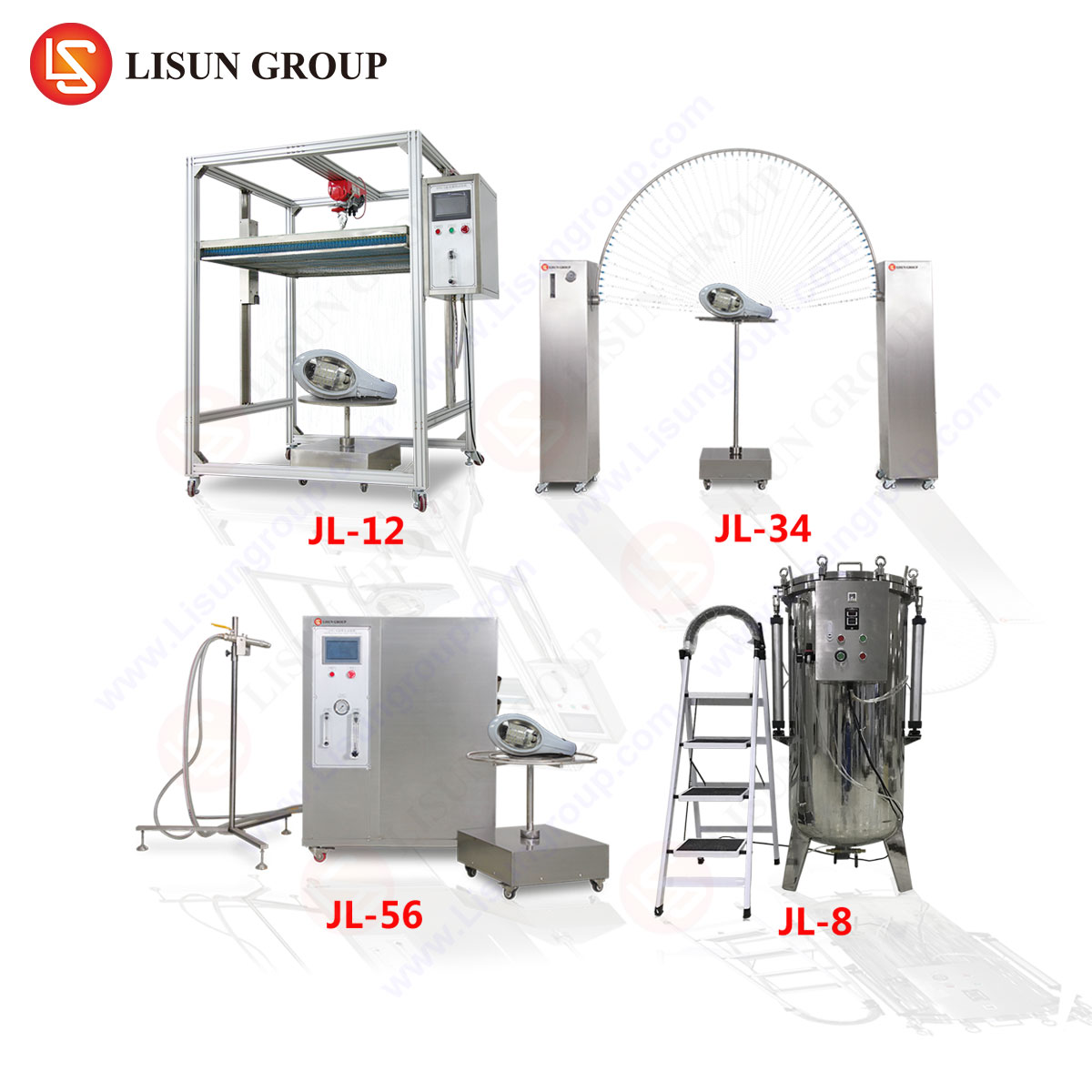
Accurate and reliable verification of IPX4 compliance necessitates precision-engineered test equipment that can faithfully replicate the standard’s stipulations. The LISUN JL-XC Series IP Waterproof Test Chamber represents a sophisticated solution engineered for this purpose. This apparatus is designed to conduct a range of IPX tests, with specific configurations and programming tailored for the IPX4 regimen.
The chamber’s core principle involves the precise control and delivery of water spray. It integrates a high-precision pump system, flow meters, and calibrated spray nozzles to achieve the exact flow rate of 0.07 L/min ±5% specified for IPX4. The oscillating mechanism is driven by a servo motor, ensuring a consistent and repeatable angular sweep. The sample turntable, also motor-driven, rotates at an adjustable speed to guarantee uniform exposure of the DUT’s entire surface.
Key Specifications of the JL-XC Series for IPX4 Testing:
- Test Standards: Compliant with IEC 60529, ISO 20653, and other derivative national standards.
- Spray System: Utilizes a dedicated IPX4 spray nozzle with precision-drilled orifices.
- Flow Control: Digital flow regulation with real-time monitoring and feedback to maintain the required 0.07 L/min.
- Oscillation Range: Programmable swing angle, typically 0-180° or full 360°.
- Turntable: Diameter and rotation speed (e.g., 3-5 RPM) are configurable to accommodate products of varying sizes.
- Construction: The test chamber is manufactured from corrosion-resistant stainless steel, with a transparent viewing window for observation. Water is filtered and recirculated via a dedicated tank system.
Competitive Advantages in Validation: The JL-XC Series distinguishes itself through its programmability and consistency. Users can store specific test profiles (duration, oscillation pattern, turntable speed) for different products, eliminating manual setup variances. Its closed-loop flow control system provides a higher degree of accuracy than simpler gravity-fed systems, which are prone to pressure drops and flow inconsistencies. This ensures that test results are not only compliant with the standard but are also reproducible and defensible in audit or certification scenarios. For manufacturers across the listed industries, this level of precision reduces false failures and ensures that products are neither under-tested (posing a field reliability risk) nor over-tested (adding unnecessary cost).
Beyond the Spray: Correlations with Product Reliability and Safety
Achieving an IPX4 rating is not merely a compliance exercise; it is intrinsically linked to product reliability, safety, and longevity. Water ingress, even in minute quantities, can initiate several failure modes. These include short-circuiting of low-voltage cable and wiring systems, corrosion of metallic contacts in electrical components, fogging of optical elements in lighting fixtures or sensors, and the degradation of printed circuit board laminates.
From a safety perspective, particularly for mains-powered household appliances or industrial control systems, ingress can lower insulation resistance, creating leakage current paths and potential electric shock hazards. The IPX4 test, therefore, serves as a proactive risk mitigation tool. It validates the integrity of seals, gaskets, and enclosure joints under dynamic splash conditions. Data derived from such testing informs design iterations, material selection (e.g., hydrophobic coatings, specific elastomers for gaskets), and assembly processes, ultimately contributing to a lower lifetime failure rate and enhanced brand reputation.
Integration into Broader Testing and Certification Frameworks
IPX4 testing is rarely an isolated event. It is typically one component within a broader product qualification strategy. A device may also undergo thermal cycling, vibration testing, and dust ingress (IP5X or IP6X) assessments. The sequence of testing is important; for instance, a durability test simulating years of use might precede the IPX4 test to evaluate whether wear on seals compromises water resistance.
Furthermore, while the IEC 60529 standard defines the test method, certification is often granted by independent notified bodies (for regions like the EU under the RED or LVD directives) or nationally accredited laboratories. The use of calibrated, auditable equipment like the JL-XC Series provides the necessary traceability and data integrity required for these certification processes. Test reports must meticulously document environmental conditions (water temperature, ambient temperature), equipment calibration dates, flow rates, test duration, and the precise orientation of the DUT.
Frequently Asked Questions (FAQ)
Q1: Can a product labeled IPX4 be used in heavy rain or washed under a tap?
No. IPX4 is defined for water splashing from any direction. A heavy rainstorm, particularly with wind-driven rain, or the direct, concentrated stream from a tap exerts significantly higher pressure and volume than the calibrated, low-pressure spray defined in the IPX4 test. Such use constitutes a misuse case and likely voids warranties. For hose-directed water, a minimum of IPX5 or IPX6 is required.
Q2: How does the JL-XC Series ensure the correct “splash” intensity for IPX4, as opposed to a higher-pressure spray?
The JL-XC Series employs a dedicated IPX4 nozzle orifice (0.4mm) coupled with a precisely controlled pump and flow meter system. The standard specifies a very low flow rate (0.07 L/min) and a resulting low impact pressure. The equipment is calibrated to maintain this parameter within a tight tolerance (±5%). This is fundamentally different from the higher-flow, higher-pressure nozzles and pump settings used for IPX5 (6.3mm nozzle, 12.5 L/min) and IPX6 (12.5mm nozzle, 100 L/min) tests.
Q3: Is testing duration always exactly 10 minutes?
IEC 60529 states a minimum of 10 minutes. However, for larger products where the oscillating spray cannot cover the entire surface simultaneously, the test duration must be increased. The standard dictates that the duration is calculated based on the time it takes to cover all surfaces, typically by rotating the sample. The JL-XC Series allows for this extended, programmable duration to ensure complete coverage without manual intervention.
Q4: After passing an IPX4 test, is periodic re-testing required during manufacturing?
While initial design validation requires comprehensive testing, ongoing production typically involves audit testing or batch acceptance testing. Quality management systems (e.g., ISO 9001) often mandate periodic verification to ensure that manufacturing processes, such as gasket installation or ultrasonic welding, remain in control and continue to produce compliant enclosures. The use of automated chambers facilitates this routine production-line validation.
Q5: Does the IPX4 rating imply any level of protection against dust?
No. The ‘X’ in IPX4 explicitly means the level of protection against solids is not specified. A product could have a very loose enclosure vulnerable to dust while still passing the IPX4 splash test. If dust protection is claimed, it must be tested and assigned a first digit (e.g., IP54 for dust-protected and splash-resistant).