




A Technical Analysis of IPX5 and IPX6 Water Spray Test Equipment for Ingress Protection Validation
Introduction to Ingress Protection (IP) Testing and Water Spray Standards
The proliferation of electrical and electronic equipment across diverse and often harsh environments necessitates rigorous validation of their resilience against environmental factors. Among these, protection against the ingress of water is paramount, as liquid penetration remains a leading cause of premature component failure, safety hazards, and operational downtime. The International Electrotechnical Commission (IEC) standard 60529, “Degrees of protection provided by enclosures (IP Code),” provides a globally recognized framework for quantifying this protection. Within this framework, the IPX5 and IPX6 ratings represent critical benchmarks for resistance to powerful water jets, simulating conditions such as heavy rain, deck washing, or high-pressure cleaning.
IPX5 testing subjects an enclosure to water jets from a 6.3mm nozzle at a flow rate of 12.5 L/min ±5% from a distance of 2.5 to 3 meters, for a minimum of 3 minutes per square meter of the test sample’s surface area, with a total test duration of at least 15 minutes. The IPX6 test is more severe, employing a 12.5mm nozzle at a flow rate of 100 L/min ±5% from the same distance, for the same duration criteria. The pressure at the nozzle for an IPX6 test is significantly higher, designed to simulate more aggressive conditions. The objective is to verify that no harmful quantity of water penetrates the enclosure in a manner that would impair safety or functionality. Specialized IPX5 IPX6 water spray test equipment is therefore an indispensable tool in the design, qualification, and production verification stages for manufacturers across a multitude of sectors.
Fundamental Design Principles of Water Jet Test Apparatus
The core function of IPX5/IPX6 test equipment is to generate, control, and direct a calibrated water jet with precise and repeatable parameters. The system’s architecture is engineered around several key subsystems. The water delivery system comprises a high-pressure pump, precision pressure regulators, flow meters, and accumulators or damping devices to ensure a stable, pulseless flow. The pump must be capable of generating the requisite pressure to achieve the specified flow rates through the standardized nozzles, even against backpressure from the test sample.
The nozzle assembly is a critical component, machined to the exact dimensions stipulated in IEC 60529. Any deviation in nozzle bore diameter or internal finish can significantly alter the jet’s characteristics, invalidating the test. The nozzle is typically mounted on a movable apparatus, allowing for manual or programmable articulation to ensure the jet can be directed at all possible angles of incidence on the test specimen, as the standard requires testing from “all practicable directions.” The test chamber or cabinet is constructed from corrosion-resistant materials such as stainless steel or coated steel, with integrated water collection and drainage to facilitate safe operation and recovery of test water for recirculation in closed-loop systems. Safety interlocks, viewing windows, and appropriate lighting are standard features to protect the operator and allow for observation of the test in progress.
Operational Methodology and Calibration Protocols
The operational validity of any IPX5/IPX6 test is contingent upon strict adherence to a calibrated methodology. Prior to testing, the equipment itself must undergo regular calibration. This involves verifying the flow rate using a calibrated flow meter and collection vessel over a timed interval, ensuring it falls within the ±5% tolerance for both the 12.5 L/min (IPX5) and 100 L/min (IPX6) settings. Nozzle condition is inspected for wear or damage. The distance from the nozzle exit to the test sample surface is precisely set using a gauge, typically between 2.5 and 3 meters, as the hydrodynamic characteristics of the jet change with distance.
The test specimen is mounted in its intended service position on a turntable or fixture within the test chamber. For IPX5 and IPX6, the test duration is not fixed per sample but is calculated based on surface area: at least 3 minutes per square meter, with a minimum of 15 minutes. The jet is then methodically directed at the enclosure. Following the test, the specimen undergoes a thorough examination. This includes visual inspection for water ingress, functional testing of all electrical and mechanical systems, and, where specified, a dielectric strength test or measurement of insulation resistance to detect any moisture that may have penetrated and settled on live parts or insulation. Data logging of environmental conditions (water temperature, ambient temperature) and test parameters (flow, pressure, duration) is essential for audit trails and compliance documentation.
The JL-9K1L Integrated Waterproof Test Chamber: A Technical Examination
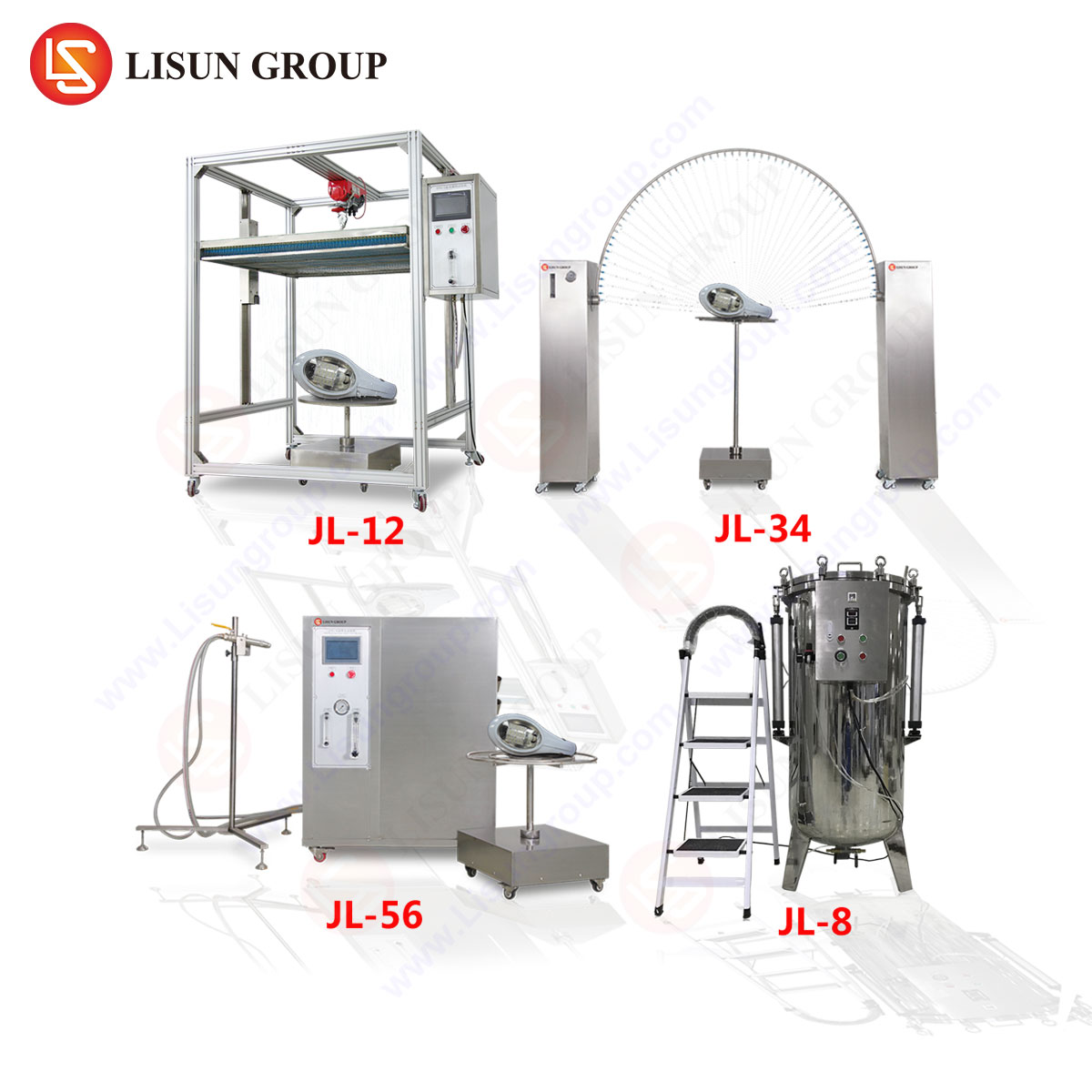
As a representative example of modern, integrated test solutions, the LISUN JL-9K1L waterproof test chamber embodies the engineering principles required for compliant and efficient IPX5 and IPX6 validation. This apparatus is designed as a comprehensive, self-contained system for performing tests from IPX1 to IPX6, offering versatility for laboratories servicing multiple product categories.
The JL-9K1L utilizes a closed-loop water circulation system, incorporating filtration and temperature control to maintain water quality and consistency across repeated test cycles—a critical factor for repeatability. Its core testing principle for the IPX5/IPX6 phases involves a precisely machined nozzle bank. A servo-driven mechanism automatically switches between the IPX5 (6.3mm) and IPX6 (12.5mm) nozzles, with the system’s pump and control valves adjusting the pressure and flow rate accordingly to meet the stringent requirements of each standard.
Key Specifications of the LISUN JL-9K1L Chamber:
- Test Standards: IEC 60529, ISO 20653, GB 4208 (IPX1-X6).
- IPX5 Flow Rate: 12.5 ±0.625 L/min.
- IPX6 Flow Rate: 100 ±5 L/min.
- Nozzle Diameter: 6.3mm (IPX5), 12.5mm (IPX6).
- Jet Distance: Adjustable between 2.5m and 3m.
- Test Table: Motorized turntable (1-3 rpm adjustable), with adjustable height and load capacity.
- Water Circulation: Closed-loop system with filtration.
- Control System: Programmable Logic Controller (PLC) with touch-screen HMI for setting test parameters, including test grade, duration, turntable rotation, and water temperature.
The integration of a motorized turntable is a significant operational advantage. It ensures uniform exposure of the test sample to the water jet from all directions, automating a process that would otherwise be manual and potentially inconsistent. The programmable controller allows for the storage of test profiles, reducing setup time and operator error. For industries with high-throughput needs, such as automotive component suppliers or consumer electronics manufacturers, this automation directly enhances testing efficiency and reproducibility.
Industry-Specific Applications and Compliance Imperatives
The application of IPX5 and IPX6 testing is dictated by the intended use environment of the product. Compliance is not merely a quality checkpoint but often a regulatory or safety mandate.
- Automotive Electronics & Aerospace Components: External sensors, lighting assemblies (headlamps, taillights), engine control unit (ECU) enclosures, and underbody components must withstand high-pressure spray from road wheels or runway debris and during vehicle/aircraft washing. IPX6 is frequently a minimum requirement for these externally mounted parts.
- Industrial Control Systems & Telecommunications Equipment: Enclosures for programmable logic controllers (PLCs), remote terminal units (RTUs), base station antennas, and outdoor networking gear are exposed to weather and may be cleaned with pressurized water in industrial settings. IPX5/IPX6 testing validates their field reliability.
- Lighting Fixtures: Outdoor luminaires for street lighting, architectural floodlighting, and industrial high-bay lighting are subjected to driving rain and jet wash. IPX6 testing is common for such fixtures to ensure long-term performance and electrical safety.
- Electrical Components & Household Appliances: External switches, sockets, junction boxes, and outdoor appliances (grills, power washers) require protection against hose-directed water. An IPX5 or IPX6 rating provides a clear marketable claim of durability.
- Medical Devices & Office Equipment: Equipment used in environments requiring frequent and rigorous decontamination cleaning, such as hospital settings or food processing areas, may need to be validated against IPX6-level jets from cleaning hoses.
Comparative Advantages of Integrated Test Systems
When evaluating IPX5/IPX6 test equipment, laboratories and manufacturers must consider total cost of ownership, operational efficiency, and data integrity. Integrated systems like the JL-9K1L offer distinct advantages over piecemeal or manually configured setups.
First, they ensure standard compliance by design. The nozzles, flow systems, and distances are engineered as a coherent unit, certified to meet the relevant standards, reducing the validation burden on the end-user. Second, automation and programmability minimize human intervention, leading to higher test consistency and freeing technical staff for analytical tasks. The stored test programs ensure that every unit of a specific product model is tested under identical conditions. Third, closed-loop water systems with filtration conserve water, reduce utility costs, and prevent nozzle clogging from particulates, which is a common issue in systems using tap water directly. Finally, the comprehensive data logging capabilities provide an immutable record for quality audits and failure analysis, which is crucial for industries with stringent traceability requirements, such as medical devices or automotive Tier-1 suppliers.
Interpretation of Test Results and Failure Analysis
A successful test concludes with no ingress of water deemed harmful. The standard allows for the entry of water in quantities that do not interfere with the operation of the equipment or impair safety. For instance, moisture accumulation on internal surfaces that does not bridge clearance and creepage distances or form droplets on live parts may be permissible. However, the presence of water on printed circuit boards (PCBs), inside connectors, or in contact with insulated windings typically constitutes a failure.
Upon failure, a systematic analysis is required. The focus should be on the path of ingress: gasket seals, cable gland entries, mating surfaces of enclosures, membrane vents, or weld/join lines. The test conditions should be reviewed to ensure they were applied correctly. Subsequent design iterations may involve improving seal geometry, specifying higher-grade elastomers, revising fastener patterns to ensure even clamping pressure, or adding hydrophobic membrane breathers to equalize pressure without allowing water entry. The IPX5/IPX6 test equipment thus serves not only as a pass/fail gauge but as a vital diagnostic tool in the product development cycle, providing empirical feedback to drive design-for-manufacturability and design-for-reliability improvements.
Frequently Asked Questions (FAQ)
Q1: Can a single test sample be sequentially tested to both IPX5 and IPX6, and if so, in which order?
Yes, the IEC 60529 standard permits sequential testing. It is generally recommended to perform the less severe test first (IPX5) followed by the more severe test (IPX6) on the same sample, provided the sample is thoroughly examined after the first test and any entered water is removed. This approach is efficient for products seeking dual certification. The reverse order is not advisable, as the IPX6 test may compromise seals, making subsequent IPX5 results invalid.
Q2: How critical is water temperature control during IPX5/IPX6 testing?
While IEC 60529 specifies a temperature differential between the test water and the specimen not to exceed 5K to prevent thermal shock-induced vacuum effects that could draw water in, precise control is crucial for repeatability. Systems with temperature stabilization, like the closed-loop system in the JL-9K1L, prevent variances in water viscosity that can subtly affect jet dynamics and ensure tests are comparable over time and across different laboratories.
Q3: For a product with a very large surface area, how is the minimum test duration of 15 minutes reconciled with the “3 minutes per square meter” rule?
The “3 minutes per square meter” is a minimum exposure time per unit area. For large enclosures, the total test time will be calculated accordingly and will exceed 15 minutes. The 15-minute rule is a global minimum for smaller products. The test must be conducted such that every area of the enclosure receives the specified jet exposure for its proportional share of the total calculated time.
Q4: What is the importance of the turntable rotation speed during testing?
The rotation (typically 1-3 RPM) ensures that no single area of the test specimen is exposed for a disproportionately long time while others are neglected. It automates the standard’s requirement to test from “all practicable directions,” creating a uniform and comprehensive test condition. An adjustable speed allows optimization for different product sizes and shapes.
Q5: After a successful IPX6 test, is it necessary to also perform an IPX5 test for certification?
No, the IP ratings are independent classifications. If a product is tested and passes the criteria for IPX6, it inherently satisfies the requirements for all lower ratings in the second digit (X5, X4, etc.) concerning water jets. A product can be certified as IPX6 without a separate IPX5 test. However, manufacturers may choose to test both to market the product for different use cases or customer specifications.