




Abstract
Accurately predicting the long-term lumen maintenance and reliability of LED-based products is a cornerstone of modern lighting design and manufacturing. This technical article provides an in-depth analysis of the methodologies and equipment required for compliance with critical industry standards. Focusing on the LED Life Test Oven | LISUN LED Optical Aging Test Chambers, we explore the technical architecture of systems like the LEDLM-80PL and LEDLM-84PL, designed explicitly for IES LM-80/TM-21 and LM-84/TM-28 testing. The discussion covers the integration of Arrhenius Model-based software, dual testing modes, and the practical application of standards including IES LM-79-19 and CIE 127. For engineers and lab technicians, this article delivers actionable insights into achieving reliable, data-driven lifetime projections, such as L70 and L50 metrics, through controlled 6000-hour accelerated aging tests.
1.1 Defining Reliability: Lumen Depreciation and Lifetime Metrics
LED lifetime is not defined by catastrophic failure but by gradual lumen depreciation. The industry-standard metrics L70 and L50 denote the point at which an LED’s luminous flux output has depreciated to 70% and 50% of its initial value, respectively. Predicting when this depreciation occurs under real-world operating conditions requires accelerated life testing. This process subjects LEDs to elevated temperatures and drive currents to accelerate the chemical and physical degradation mechanisms, allowing for the extrapolation of long-term performance from a manageable test duration, such as the standard 6000-hour test.
1.2 The Role of Industry Standards in Validation
Robust lifetime projections are meaningless without standardized methodologies. Key standards provide the framework: IES LM-80 governs the measurement of LED package, array, and module lumen maintenance, while IES TM-21 provides the mathematical procedures for extrapolating LM-80 data to predict long-term lumen maintenance. For complete luminaires, IES LM-84 and its companion projection standard IES TM-28 fulfill the same role. Compliance with these standards is not merely a regulatory hurdle; it is a critical risk-mitigation and quality assurance process for manufacturers, ensuring product claims are substantiated by empirical, repeatable data.
2.1 Dual-System Philosophy: LEDLM-80PL vs. LEDLM-84PL
LISUN’s approach addresses the distinct testing requirements for LED components versus complete luminaires through two dedicated systems. The LEDLM-80PL is engineered for IES LM-80 and TM-21 compliance, testing LED packages, arrays, and modules. Its design prioritizes precise thermal control of the component under test. Conversely, the LEDLM-84PL system is configured for IES LM-84 and TM-28 testing of fully assembled luminaires. This system accommodates larger form factors and integrates the necessary photometric measurement apparatus to assess the luminaire as an entire system, recognizing that internal thermal management affects overall light output.
2.2 Core Hardware Configuration and Scalability
The system’s hardware is built for flexibility and precision. A central control unit manages up to three independent temperature test chambers simultaneously, each capable of hosting multiple LED samples or luminaires. Each chamber features precise temperature control with uniformity better than ±2°C, a critical parameter for valid Arrhenius analysis. The system integrates high-accuracy programmable DC power supplies and multi-channel optical sensors connected to an integrating sphere (referencing CIE 127 and IES LM-79-19 for measurement protocol) or a goniophotometer for luminaire testing. This modular design allows labs to scale capacity based on throughput needs.
3.1 Arrhenius Model Integration and Lifetime Projection
The core intelligence of the system resides in its software, which automates the Arrhenius Model calculations. This model describes the relationship between the rate of a chemical reaction (like lumen depreciation) and temperature. The software continuously logs luminous flux data at multiple controlled temperature setpoints (e.g., 55°C, 85°C, 105°C as per LM-80). It then calculates the activation energy of the degradation process, enabling the extrapolation of long-term lumen maintenance at a specified use temperature, as mandated by TM-21 and TM-28. This transforms raw aging data into actionable lifetime projections and L70/L50 estimates.
3.2 Dual Operational Testing Modes
To accommodate different R&D and validation phases, the systems offer two fundamental testing modes. In Normal Life Test Mode, samples are driven at their rated current and held at a constant temperature for the duration, such as a 6000-hour test. This mode is used for gathering the foundational LM-80/LM-84 dataset. Accelerated Life Test Mode employs elevated drive currents and temperatures to induce faster degradation, useful for rapid comparative analysis of materials, designs, or failure mode investigation. Both modes feed data into the same projection algorithms for consistent analysis.
Table 1: Comparison of LISUN LED Life Test System Operational Modes
| Feature | Normal Life Test Mode | Accelerated Life Test Mode |
| :— | :— | :— |
| Primary Purpose | Compliance data collection for LM-80/LM-84 | Rapid design validation & failure analysis |
| Drive Conditions | Rated current, constant standard temperatures | Elevated current & temperature |
| Test Duration | Long-term (e.g., 6000+ hours) | Shortened, stress-induced |
| Standards Alignment | Directly aligned with IES LM-80 & LM-84 | Informs design, not for direct compliance reporting |
| Data Output | Raw dataset for TM-21/TM-28 projection | Comparative degradation rates |
4.1 Pre-Test Calibration and Photometric Baseline
Prior to aging, establishing an accurate photometric baseline is paramount. Following IES LM-79-19 and CIE 84 guidelines, the system’s integrating sphere and spectrometer are calibrated using standard lamps. Each LED sample or luminaire is then measured at its rated current and at a stabilized junction temperature (often estimated via a Tj measurement method) to record initial luminous flux (Φ0), chromaticity, and CCT. This baseline measurement, conducted under controlled thermal conditions (e.g., 25°C ambient), ensures all subsequent depreciation measurements are relative to a consistent and accurate starting point.
4.2 In-Situ Measurement and Data Acquisition Protocol
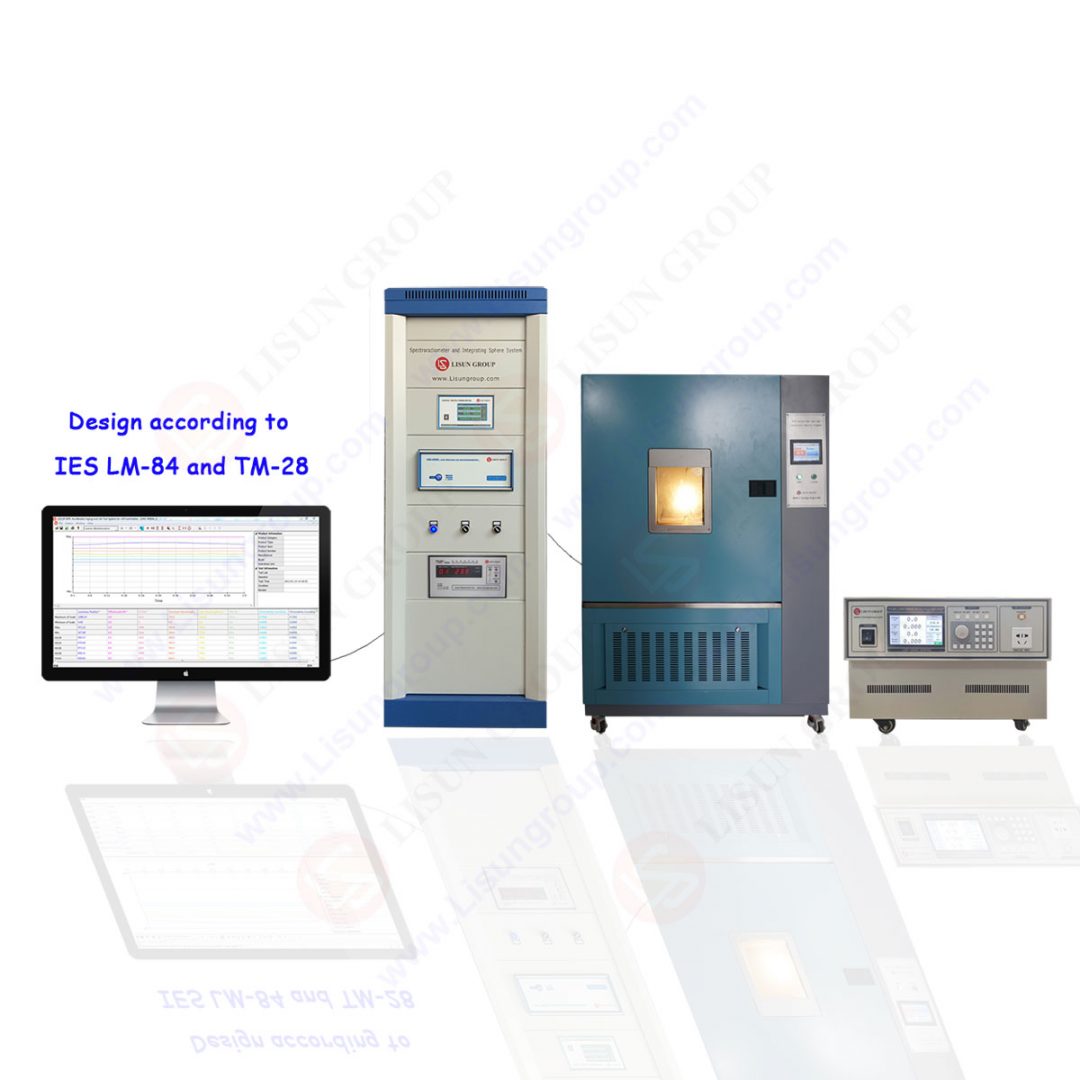
During the extended aging test, the system automatically performs in-situ optical measurements at defined intervals (e.g., every 1000 hours). Samples are briefly brought to a stable thermal measurement condition, and their luminous flux is captured by the integrated optical sensor without removal from the chamber. This closed-loop process, automated by the software, eliminates handling errors and ensures thermal consistency. The software logs all data—flux, current, voltage, chamber temperature—creating a time-stamped database that is essential for the integrity of the final TM-21 or TM-28 projection report.
5.1 Understanding TM-21/TM-28 Projection Reports
Upon test completion (typically at 6000 hours), the software processes the logged data to generate a standards-compliant projection report. TM-21 projections, for example, can only extrapolate data up to a maximum of six times the total test duration (e.g., 36,000 hours from a 6000-hour test). The report will provide the projected L70 lifetime at multiple confidence levels and use temperatures. It is crucial for engineers to understand that these are statistical projections based on the measured data and the Arrhenius model, not guarantees, and they are only valid within the constraints defined by the standard.
5.2 Analyzing L70, L50, and Degradation Curves
The primary deliverables are the L70 and L50 values, but deeper insight comes from analyzing the lumen maintenance curve itself. A smooth, predictable curve suggests stable degradation kinetics, increasing confidence in the projection. A curve with inflection points or sudden drops may indicate a secondary failure mechanism or measurement anomaly, requiring investigation. The system’s software allows for detailed graphical analysis of these curves for each individual sample and temperature bin, enabling engineers to identify outliers and understand batch-to-batch consistency.
6.1 Testing Beyond Luminous Flux: Chromaticity Maintenance
While lumen maintenance is primary, color shift can be equally critical for many applications. Referencing CIE 70 and CIE 84 for colorimetry, the system’s spectrometer can simultaneously track chromaticity coordinates (u’, v’ or x, y) and Correlated Color Temperature (CCT) throughout the aging process. This allows for the analysis of chromaticity maintenance, determining if an LED remains within a specified MacAdam ellipse or binning boundary over its lifetime, which is vital for applications requiring consistent color appearance.
6.2 Custom Configurations for Specialized Needs
The standard LED Life Test Oven | LISUN LED Optical Aging Test Chambers platform is highly configurable. For automotive LED testing, chambers can be modified to include humidity control or thermal cycling profiles. For high-power COB arrays, custom fixturing and heat sinking can be integrated. The system can also be linked with external spectroradiometers or imaging colorimeters for spatially resolved measurements of luminaires. This flexibility ensures the core testing methodology can be adapted to meet the specific validation challenges of diverse industries, from general lighting to automotive and display technologies.
7.1 Sample Selection, Fixturing, and Thermal Management
A reliable test begins with representative sample selection and proper fixturing. Samples must be mounted in a way that ensures consistent thermal contact with the chamber’s thermal plate or ambient air, as defined by the standard. For LM-80 testing, controlling the case temperature (Tc) is often required. Engineers must carefully design test boards and thermal interfaces to minimize thermal resistance variances between samples, as inconsistent junction temperatures (Tj) will invalidate the Arrhenius analysis and produce unreliable projections.
7.2 Quality Assurance and Data Integrity Measures
Maintaining data integrity over a 6000-hour test requires rigorous QA protocols. This includes regular calibration of optical sensors and temperature probes, verification of power supply accuracy, and system self-checks. The software should provide audit trails and be protected from unauthorized modification. Regular backups of the project database are essential. Furthermore, including control samples or samples with known performance in each test run can serve as a benchmark to confirm the system is operating within expected parameters throughout the extended duration.
The rigorous validation of LED lifetime through standardized accelerated aging testing is a non-negotiable requirement for product credibility and market success. The LED Life Test Oven | LISUN LED Optical Aging Test Chambers, exemplified by the LEDLM-80PL and LEDLM-84PL systems, provide a comprehensive, standards-aligned platform to execute this critical function. By seamlessly integrating precise thermal control, in-situ optical measurement, and sophisticated Arrhenius-based projection software, these systems transform the complex mandates of IES LM-80, LM-84, TM-21, and TM-28 into an automated, reliable workflow. The ability to generate defensible L70/L50 projections, analyze chromaticity shift, and customize hardware for specific applications empowers LED manufacturers and testing laboratories to de-risk product development, substantiate warranty claims, and deliver lighting solutions with predictable, long-term performance. Ultimately, investing in a robust testing infrastructure is an investment in product quality and brand reputation.
Q1: What is the fundamental difference between testing per IES LM-80 and IES LM-84, and how does LISUN’s equipment address both?
A: The core difference lies in the Device Under Test (DUT). IES LM-80 applies to LED packages, arrays, and modules (components), while IES LM-84 applies to complete, fully assembled luminaires. Testing a luminaire is more complex as it must account for the integrated driver, thermal management system, and optical design. LISUN addresses this with two dedicated systems: the LEDLM-80PL is configured for component-level testing with precise Tc control, and the LEDLM-84PL is designed for luminaires, featuring larger chamber capacity and integrated photometry to measure the total light output of the complete system as required by the standard.
Q2: How does the Arrhenius Model software actually project an L70 value from a 6000-hour test?
A: The software requires lumen maintenance data from at least two different temperature setpoints (e.g., 55°C and 85°C). It analyzes the rate of lumen depreciation at each temperature. The Arrhenius equation defines the exponential relationship between degradation rate and temperature. By fitting the measured data to this model, the software calculates the activation energy (Ea) of the degradation process. It then uses this Ea to mathematically extrapolate the depreciation curve to a lower, in-use temperature specified by the engineer. The point where this extrapolated curve crosses 70% of initial lumen output is the projected L70 lifetime, following the strict extrapolation limits set by TM-21 (max 6x test duration).
Q3: Can a single LISUN system test both LED components and full luminaires, or are two separate setups necessary?
A: While the core control software and measurement principles are similar, the hardware configurations are optimized for different DUTs, making dedicated setups highly recommended for compliance-grade testing. A system configured for LM-80 (LEDLM-80PL) typically uses smaller chambers and fixturing for individual components. An LM-84 system (LEDLM-84PL) requires larger chamber volume, different electrical interfaces for luminaire drivers, and often a different optical measurement setup (e.g., goniophotometer vs. integrating sphere). For a lab needing to perform both types of testing regularly, operating both system variants is the most efficient and technically sound approach.