




Abstract
In the competitive landscape of LED manufacturing, validating long-term lumen maintenance and reliability is paramount for product differentiation and regulatory compliance. This technical article provides an in-depth analysis of the LED Thermal Aging Chamber | LISUN LED Optical Aging Test Instrument, a sophisticated dual-system solution engineered for precision accelerated life testing. We explore its core architecture, including the dedicated LEDLM-80PL and LEDLM-84PL systems for IES LM-80/TM-21 and LM-84/TM-28 standards, respectively. The discussion covers the critical integration of Arrhenius Model-based software, dual testing modes, and hardware configurability supporting up to three temperature chambers. Aimed at testing professionals, this guide details how LISUN’s instrument delivers actionable data on L70/L50 metrics over 6000+ hour tests, ensuring robust lifetime projections and compliance with key industry standards.
1.1 The Critical Need for Accelerated LED Aging Testing
LED product longevity, defined by lumen maintenance, is a cornerstone of performance claims and warranty specifications. Traditional real-time testing over tens of thousands of hours is commercially impractical. Accelerated aging within a controlled LED Thermal Aging Chamber applies elevated thermal and electrical stress to induce and measure degradation mechanisms in a fraction of the time. This process is governed by well-established physical models, primarily the Arrhenius equation, which correlates increased temperature with accelerated chemical failure rates within the LED package. Validated accelerated testing is indispensable for R&D, quality assurance, and compliance with stringent industry standards for lighting products.
1.2 LISUN LED Optical Aging Test Instrument: System Overview
LISUN addresses this need with a modular, high-precision LED Optical Aging Test Instrument. The system is architected around two primary variants: the LEDLM-80PL for testing LED packages, arrays, and modules per IES LM-80, and the LEDLM-84PL for complete integrated LED lamps per IES LM-84. Each system integrates a precision optical measurement engine (spectroradiometer or photometer), a multi-channel constant current source, and dedicated software. A key feature is its ability to control and monitor up to three independent temperature and humidity chambers simultaneously, significantly enhancing testing throughput. The system automates the entire test cycle, from parameter setting and data acquisition to analysis and report generation against target standards.
2.1 Dual-Variant Design: LEDLM-80PL vs. LEDLM-84PL
The instrument’s design acknowledges the fundamental difference between testing light sources (LM-80) and complete luminaires (LM-84). The LEDLM-80PL system is optimized for source-level testing, typically employing a high-precision spectroradiometer coupled with an integrating sphere (aligned with CIE 127, CIE 70, and IES LM-79-19 for accurate photometric and colorimetric measurement). The LEDLM-84PL variant is configured for lamp-level testing, utilizing a photometer with a fixed-geometry test bench to measure total luminous flux. Both systems share the same robust software platform but are calibrated and equipped with hardware tailored to their specific standard’s measurement requirements.
2.2 Integrated Measurement and Environmental Control
At the heart of the LISUN LED Optical Aging Test Instrument is the synchronized control of electrical drive and environmental stress. The system provides a constant current output to each test sample, eliminating power supply variability as a degradation factor. Samples are housed in dedicated thermal aging chambers where temperature is precisely controlled, often at multiple case or board temperatures (e.g., 55°C, 85°C, 105°C) as mandated by LM-80. The system’s software continuously logs temperature data while periodically commanding the optical measurement system to capture luminous flux and chromaticity coordinates. This integration ensures data integrity and direct correlation between stress conditions and optical performance decay.
Table 1: Core System Configuration Comparison
| Feature | LEDLM-80PL (LM-80/TM-21) | LEDLM-84PL (LM-84/TM-28) |
| :— | :— | :— |
| Primary Application | LED Packages, Arrays, Modules | Integrated LED Lamps, Luminaires |
| Key Standard | IES LM-80, IES TM-21 | IES LM-84, IES TM-28 |
| Optical Measurement | Spectroradiometer & Integrating Sphere | Photometer & Goniophotometric/Fixed Bench |
| Typical Test Duration | Minimum 6000 hours | Minimum 6000 hours |
| Output Metrics | Lumen Depreciation, Lp(70/50) | Lumen Depreciation, Lp(70/50) |
| Reference Standards | CIE 127, CIE 70, IES LM-79-19 | IES LM-78, IES LM-79-19 |
3.1 Arrhenius Model-Based Lifetime Projection Software
The true power of LISUN’s system lies in its advanced software, which automates the complex data processing required for lifetime projection. Following the completion of a minimum 6000-hour test as per LM-80 or LM-84, the software employs the methodologies outlined in IES TM-21 (for sources) or TM-28 (for luminaires). It fits the collected lumen maintenance data to an exponential decay model. Crucially, it utilizes the Arrhenius Model to extrapolate the test data collected at elevated temperatures to predict performance at lower, in-use operating temperatures. This process calculates the Lp (projected lifetime) metrics, most commonly L70 and L50—the time until lumen output depreciates to 70% or 50% of initial lumens.
3.2 Dual Operational Testing Modes
To accommodate different R&D and quality control phases, the LED Thermal Aging Chamber software supports two distinct testing modes. The Standard Compliance Mode is a fully automated, hands-off operation that strictly follows the procedural and data collection intervals specified in LM-80 or LM-84. This mode is essential for generating audit-ready compliance reports. The Engineering Research Mode offers greater flexibility, allowing engineers to define custom stress profiles, adjust measurement frequencies, and monitor specific parameters of interest. This mode is invaluable for root-cause analysis, comparative material studies, and developing proprietary lifetime models beyond the scope of standard tests.
4.1 IES LM-80 & TM-21: The Foundation for LED Source Testing
IES LM-80-20, “Approved Method: Measuring Lumen Maintenance of LED Light Sources,” is the definitive standard for measuring the lumen depreciation of LED packages, arrays, and modules. LISUN’s LEDLM-80PL system is engineered for full LM-80 compliance, mandating testing at a minimum of three case temperatures, one of which must be 55°C, for at least 6000 hours. Data collected is then analyzed per IES TM-21-11, “Projecting Long-Term Lumen Maintenance of LED Light Sources,” which provides the mathematical framework for extrapolating data to estimate Lp(70) and other lifetime metrics, forming the basis for Energy Star and DLC certifications.
4.2 IES LM-84 & TM-28: Extending to Complete LED Lamps
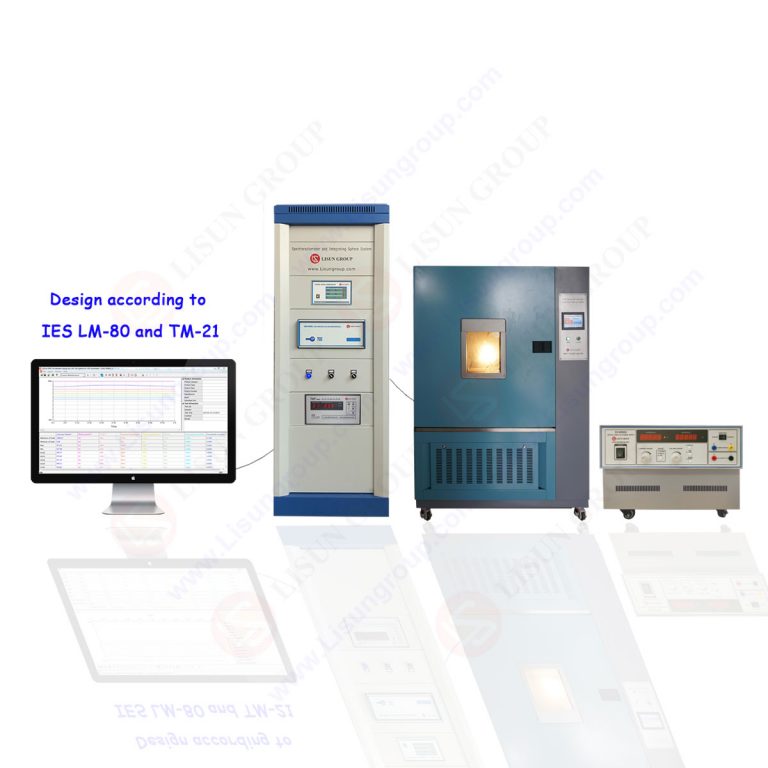
For finished products, IES LM-84-21, “Approved Method: Measuring Luminous Flux and Color Maintenance of LED Lamps, Light Engines, and Luminaires,” applies. The LEDLM-84PL system facilitates this testing, which involves monitoring the total light output of the complete system, including driver and thermal management effects. The subsequent analysis follows IES TM-28-21, “Projecting Long-Term Luminous Flux Maintenance of LED Lamps and Luminaires.” Compliance with this suite of standards is critical for lighting manufacturers to make verified lifetime claims on their product datasheets and for meeting broader market access requirements.
5.1 Test Setup and Execution Protocol
A typical workflow begins with sample selection and mounting within the LED Thermal Aging Chamber. The engineer configures the software with sample details, sets the target constant current, and defines the temperature setpoints for the connected chambers. The system initiates the test, cycling between prolonged aging periods and periodic optical measurement cycles. Throughout the 6000+ hour duration, the software generates real-time graphs of lumen maintenance (%) versus time for each sample and temperature group. All environmental and electrical parameters are logged to ensure any deviation can be correlated with optical performance changes.
5.2 Analysis and Reporting of Critical Lifetime Metrics
Upon test completion, the software’s analysis engine takes over. It processes the stabilized lumen maintenance data, applies the exponential curve fitting from TM-21/TM-28, and executes the Arrhenius-based temperature scaling. The primary outputs are the projected lifetime values, most notably the L70 and L50 in thousands of hours. The system generates comprehensive test reports that include all raw data, fitted curves, confidence intervals for projections, and a clear statement of compliance with the referenced standards. These reports provide the empirical evidence required for technical datasheets, regulatory submissions, and internal quality benchmarks.
6.1 Multi-Chamber Scalability for High-Throughput Labs
A significant advantage of the LISUN system is its support for controlling up to three independent temperature and humidity chambers from a single software instance. This allows laboratories to run concurrent tests on different product families or at different stress levels, dramatically improving capital equipment utilization and testing throughput. The software manages each chamber as a separate project, ensuring data isolation and integrity while providing a unified dashboard for monitoring all active tests.
6.2 Tailored Configurations for Specialized Research
Beyond standard compliance, the LISUN LED Optical Aging Test Instrument platform is highly customizable. Options include higher-precision spectroradiometers for detailed spectral power distribution (SPD) shift analysis (relevant to CIE 084 on color rendering), enhanced current sources for high-power automotive or specialty LEDs, and interfaces for additional sensors (e.g., thermal couples, voltage monitors). This flexibility makes it a powerful tool not just for compliance, but for advanced R&D into failure mechanisms, driver-LED interactions, and the long-term effects of coupled stress factors like temperature cycling.
7.1 For LED Manufacturers and Lighting OEMs
For LED package manufacturers and lighting OEMs, this instrument is a critical tool for design validation and competitive marketing. It provides the hard data needed to substantiate lifetime warranties, often exceeding 50,000 hours. By identifying lumen maintenance performance early in the design phase, engineers can make informed decisions about thermal management, driver selection, and material choices, ultimately reducing the risk of field failures and costly recalls.
7.2 For Third-Party Testing and Certification Labs
Independent testing laboratories require equipment that is accurate, reliable, and fully compliant with published standards to maintain their accreditation and authority. LISUN’s system, with its traceable calibration and standardized reporting, provides a turnkey solution for offering LM-80 and LM-84 testing services. The multi-chamber support enhances lab profitability by allowing multiple client projects to run in parallel, while the rigorous software ensures consistent, defensible results for certification bodies like UL, Intertek, and TÜV.
The rigorous validation of LED lifetime through accelerated aging testing has transitioned from an R&D novelty to a commercial necessity. The LED Thermal Aging Chamber | LISUN LED Optical Aging Test Instrument provides a comprehensive, standards-aligned platform to meet this demand. Its dual-system architecture, encompassing the LEDLM-80PL and LEDLM-84PL, directly addresses the distinct requirements of LED source and complete luminaire testing per IES LM-80/TM-21 and LM-84/TM-28. The integration of Arrhenius Model-based intelligence transforms raw, long-duration test data into actionable lifetime projections like L70 and L50. With configurable hardware supporting multi-chamber operation and flexible testing modes, LISUN delivers a solution that serves both routine compliance needs and advanced engineering research. For professionals committed to quality, reliability, and verified performance claims, this instrument represents a foundational investment in product integrity and market credibility.
Q1: What is the minimum required test duration for an LM-80 compliant report using your system, and why?
A: The IES LM-80-20 standard mandates a minimum test duration of 6000 hours. This period is required to collect sufficient lumen maintenance data points to establish a statistically meaningful degradation trend. Shorter tests may not capture long-term stabilization effects or accurately reflect the failure kinetics of the LED. The LISUN LEDLM-80PL system is configured to automate this entire 6000+ hour process. The collected data is then fed into the TM-21 projection methodology within the software, which extrapolates the trend to estimate lifetimes (e.g., L70) at typical use conditions, providing the essential data for product certifications.
Q2: How does the system differentiate between testing for LM-80 (LED packages) and LM-84 (integrated lamps)?
A: The differentiation is both hardware and software-based. For LM-80, the LEDLM-80PL system uses a spectroradiometer and an integrating sphere to measure the absolute photometric and colorimetric properties of the LED source itself, following guidelines from CIE 127 and IES LM-79-19. For LM-84, the LEDLM-84PL system measures the total luminous flux output of the complete lamp or luminaire using a photometer, often in a fixed geometry setup that captures all light output. The software applies the correct measurement protocol, data intervals, and subsequent analysis algorithm (TM-21 for LM-80 data, TM-28 for LM-84 data) specific to each standard’s requirements.
Q3: Can the system test samples at temperatures other than the standard 55°C, 85°C, and 105°C?
A: Yes, absolutely. While IES LM-80 recommends testing at least at 55°C and two other temperatures chosen by the manufacturer (with 85°C and 105°C being common), the LISUN LED Thermal Aging Chamber is highly flexible. The temperature chambers can be set to any stable temperature within their operational range (e.g., -40°C to +150°C, depending on model). This capability is crucial for several applications: testing automotive LEDs that must withstand extreme temperatures, conducting highly accelerated life tests (HALT) for research, or validating performance at a specific product’s maximum rated temperature as defined in its datasheet.