




Abstract
In the competitive landscape of LED manufacturing and integration, ensuring long-term lumen maintenance and accurately predicting operational lifetime are critical for product reliability, warranty validation, and market differentiation. This comprehensive technical article examines the methodologies and systems essential for conducting LED Optical Aging & Lumen Maintenance Test. It focuses on the core engineering principles behind accelerated life testing, the stringent compliance requirements of industry standards such as IES LM-80 and TM-21, and the practical implementation of automated test systems. The discussion centers on the value of precise, scalable, and data-driven testing solutions for R&D, quality control, and compliance verification, providing actionable insights for technical professionals tasked with validating LED performance and longevity.
1.1 Defining Lumen Maintenance and L70/L50 Metrics
Lumen maintenance describes the ability of an LED light source to retain its initial light output over time, expressed as a percentage. The industry-standard metrics L70 and L50 denote the elapsed operating time at which the luminous flux depreciates to 70% and 50% of its initial value, respectively. For general lighting, L70 is often cited as the useful life endpoint. In contrast, L50 may be more relevant for applications where absolute failure is critical, such as certain safety or indicator lighting. Accurately determining these points requires long-term, controlled testing under defined electrical and thermal conditions, as the degradation rate is non-linear and influenced by multiple interdependent factors including junction temperature, drive current, and environmental stressors.
1.2 Economic and Compliance Drivers for Rigorous Testing
Beyond technical performance, robust lumen maintenance testing is driven by significant economic and regulatory imperatives. Manufacturers rely on accurate life predictions to establish credible product warranties, mitigate costly field failures, and substantiate marketing claims. Compliance with industry standards like IES LM-80-20 (for LED packages, arrays, and modules) and IES LM-84-21 (for integrated luminaires) is increasingly a prerequisite for specification in commercial, industrial, and automotive projects. Furthermore, energy efficiency programs and certifications often require validated lumen maintenance data. A failure to conduct proper testing can therefore result in financial liability, reputational damage, and exclusion from key markets, making investment in capable test infrastructure a strategic necessity.
2.1 IES LM-80: Measuring Lumen Depreciation of LED Light Sources
IES LM-80-20, “Approved Method: Measuring Lumen Maintenance of LED Light Sources,” is the foundational standard for testing LED packages, arrays, and modules. It mandates testing a minimum sample size at a minimum of three case temperatures (e.g., 55°C, 85°C, and a third temperature selected by the manufacturer) for a duration of at least 6,000 hours. Measurements of luminous flux and chromaticity must be taken at prescribed intervals (e.g., every 1,000 hours) under stabilized conditions. The standard strictly defines the required test environment, electrical settings, and photometric measurement procedures to ensure consistency and comparability of data across the industry. Compliance with LM-80 is the essential first step in generating the dataset required for lifetime projection.
2.2 IES TM-21 and TM-28: Projecting Long-Term Lumen Maintenance
While LM-80 provides the raw depreciation data, IES TM-21-21, “Projecting Long-Term Lumen Maintenance of LED Light Sources,” provides the mathematical methodology for extrapolating this data to predict life beyond the 6,000- or 10,000-hour test period. TM-21 fits the collected data to an exponential decay model, calculating the rate constant (k) and deriving the projected Lp (e.g., L70, L50) values. Crucially, it imposes a projection limit of no more than 6 times the total test duration. IES TM-28-21 complements this for luminaires, offering a similar projection methodology for LM-84 data and providing guidance on reporting in-use conditions. Together, these standards transform empirical test data into actionable lifetime claims.
2.3 Integrating Safety and Performance Standards: UL, IEC, and LM-79
A complete testing regimen must also consider safety and initial performance. Standards like UL 60950-1 (ITE), IEC 62368-1 (AV/IT equipment), and IEC 60335-1 (household appliances) may apply to the safety of the test system and LED driver integrations. For initial photometric characterization, IES LM-79-19, “Electrical and Photometric Measurements of Solid-State Lighting Products,” is critical. It defines the methods for measuring total luminous flux, electrical power, efficacy, and chromaticity in an integrating sphere or goniophotometer. Data from LM-79 testing provides the baseline “initial lumen” value from which all subsequent LM-80/LM-84 depreciation percentages are calculated, making it an integral part of the lifetime validation workflow.
3.1 Integrated Optical, Electrical, and Environmental Monitoring
A sophisticated LED Optical Aging & Lumen Maintenance Test System is not merely an oven with a power supply. It is an integrated platform that simultaneously monitors and controls all critical stress factors. This includes precise constant-current or constant-voltage electrical driving, continuous measurement of forward voltage and current for real-time power calculation, and tight regulation of ambient temperature within the test chamber. Most critically, it incorporates in-situ photometric and colorimetric sensors—typically spectroradiometers or photodiode arrays with filters—to measure luminous flux and chromaticity coordinates (CCT, CRI, Duv) without removing the devices under test (DUTs), ensuring measurement stability and data continuity as mandated by LM-80.
3.2 The Arrhenius Model and Accelerated Life Testing (ALT) Methodology
The core principle enabling lifetime prediction within a practical timeframe is accelerated life testing, often based on the Arrhenius model. This empirical model describes how the rate of a chemical reaction—in this case, the degradation processes within an LED (e.g., phosphor thermal quenching, epoxy yellowing, solder joint intermetallic growth)—approximately doubles for every 10°C increase in junction temperature. By testing LEDs at elevated case temperatures (e.g., 85°C, 105°C) beyond their typical rated operating conditions, the degradation process is accelerated. Data collected at these high-stress conditions can then be used to model and extrapolate performance at lower, real-world operating temperatures, providing a projected L70/L50 life that may span tens of thousands of hours.
3.3 Automation, Data Logging, and System Control Software
The value of a test system is largely realized through its software. Advanced systems feature automation software that manages the entire test sequence: scheduling stabilization periods, triggering measurements, logging all optical, electrical, and environmental data into a structured database, and alerting operators to any DUT failures or parameter drifts. The software should directly implement TM-21 calculations, automatically generating depreciation curves and life projections from the collected data. This automation eliminates manual measurement errors, ensures strict adherence to standard protocols, and allows for the efficient management of multiple, long-duration tests running concurrently on hundreds of channels.
4.1 System Configuration and Scalability
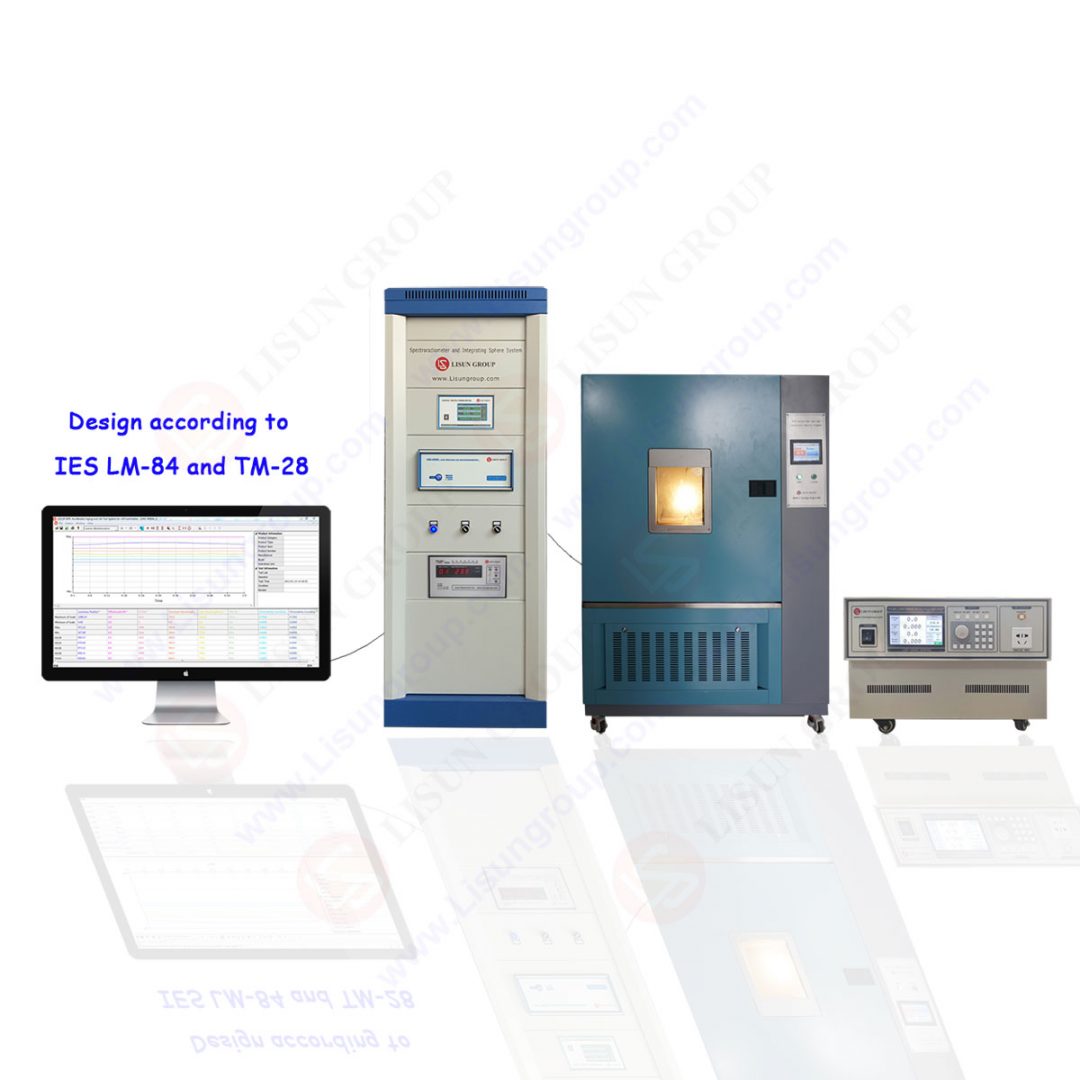
The LISUN LEDLM series is engineered to offer flexible, scalable solutions tailored to different stages of product development and compliance testing. The systems are built on a modular architecture, allowing for multi-chamber configurations to run parallel tests under different environmental conditions. A key feature is the availability of dual system types: the LEDLM-80PL, optimized for single LEDs, COBs, and modules, and the LEDLM-84PL, designed with higher-capacity chambers and fixtures to accommodate complete luminaires and light engines. Both systems support customizable test fixtures and DUT adapters, enabling secure electrical contact and optimal thermal coupling for a wide variety of form factors, from tiny SMD LEDs to large outdoor luminaires.
4.2 Dual Testing Methodology: Standard 6000-Hour and Accelerated Protocols
Reflecting the needs of modern LED validation labs, LISUN systems are designed to support two primary testing methodologies concurrently. The first is the standard IES LM-80/LM-84 compliance test, run at prescribed temperatures for the mandatory 6,000-hour duration. The second is an accelerated life testing (ALT) protocol, which leverages higher stress levels (increased temperature and/or drive current) to induce faster degradation. This dual capability allows laboratories to run official compliance tests for reporting while simultaneously conducting faster, more aggressive R&D tests to screen new materials, designs, or packaging technologies, thereby compressing development cycles and improving time-to-market for robust products.
| Parameter | LEDLM-80PL (LEDs/Modules) | LEDLM-84PL (Luminaires) | IES LM-80/LM-84 Minimum Requirement |
|---|---|---|---|
| Test Temperature Range | Ambient: 25°C ~ 105°C | Ambient: 25°C ~ 105°C | At least 3 temps, one at 55°C & one at 85°C |
| Typical Test Duration | 6,000 ~ 10,000+ hours | 6,000 ~ 10,000+ hours | Minimum 6,000 hours |
| Optical Measurement | In-situ spectroradiometer, 380-780nm | In-situ spectroradiometer or photometer | Periodic luminous flux & chromaticity |
| Data Projection Standard | IES TM-21-21 integrated | IES TM-28-21 integrated | Projection per TM-21/TM-28 |
| Key Application | LED packages, arrays, modules | Integrated luminaires, light engines | Source (LM-80) or Luminaire (LM-84) |
5.1 LED Manufacturing R&D and Quality Assurance
For LED chip and package manufacturers, the LEDLM-80PL system is an indispensable R&D and QA tool. In R&D, it facilitates rapid iteration by providing accelerated degradation data on new phosphor formulations, encapsulant materials, and chip structures. In quality assurance, it serves as a gatekeeper for production batches, running ongoing reliability monitoring to ensure consistent lumen maintenance performance and to detect any subtle process drifts that could affect long-term field performance. The ability to test large sample sizes statistically ensures that lifetime predictions are robust and representative of the entire production distribution.
5.2 Lighting Fixture Producers and Automotive Electronics Suppliers
Luminaire manufacturers and automotive lighting suppliers face the challenge of validating the performance of a complete system, where the LED source interacts with drivers, heat sinks, optics, and housings. The LEDLM-84PL system is designed for this task, capable of housing entire fixtures. Testing at the luminaire level per IES LM-84 is critical because the actual operating temperature of the LED is determined by the fixture’s thermal management. This integrated test validates not just the LED, but the entire design’s ability to maintain performance over time, which is paramount for automotive applications with extreme temperature cycles and stringent warranty requirements, as well as for commercial lighting projects with long-term performance guarantees.
5.3 Third-Party Testing and Certification Laboratories
Independent testing laboratories require equipment that delivers uncompromising accuracy, traceability, and auditability to serve diverse clients and uphold the integrity of certifications. LISUN systems, with their compliance to key standards, automated and tamper-evident data logging, and precise calibration to NIST-traceable standards, meet these rigorous demands. The scalability of multi-chamber systems allows a lab to optimize throughput, running LM-80 tests for one client, LM-84 tests for another, and custom ALT protocols for a third, all simultaneously. This flexibility and proven compliance make such systems a cornerstone of a reputable third-party test lab’s service offering.
6.1 Precision Measurement and Thermal Control Stability
The accuracy of lifetime projections is directly contingent on the stability and precision of the test conditions. Advanced systems employ high-stability programmable DC power supplies with low ripple to ensure consistent electrical stress. The environmental chambers utilize forced air circulation and sophisticated PID control algorithms to maintain temperature uniformity within ±1.0°C or better across the entire workspace, which is critical for ensuring all DUTs experience the same thermal stress as defined in LM-80. The integrated optical measurement system must itself be thermally stabilized and calibrated regularly to provide photometric data with uncertainties well within the tolerances allowed by the standards.
6.2 Customizable Fixturing and Multi-Channel Independent Control
A one-size-fits-all approach is ineffective in LED testing. High-quality systems offer extensive customization in test fixturing, including spring-loaded probes, DUT-specific sockets, and thermally conductive mounting plates that ensure proper electrical connection and thermal pathway to the controlled ambient. Furthermore, each test channel should be independently controllable and monitorable. This means each LED or luminaire can be driven by a unique current profile, and its individual optical and electrical data is logged separately. This independence is vital for identifying early failures or outliers in a batch and for testing products with different rated currents in the same chamber run.
6.3 Comprehensive Data Analysis and Compliance Reporting
The final deliverable of any test is a clear, standards-compliant report. Superior system software goes beyond data collection to include powerful analysis tools. It should automatically generate graphs of normalized lumen output vs. time, chromaticity shift plots, and apply the TM-21/TM-28 mathematical models to output projected Lp values with confidence intervals. The software should compile all necessary data—including test conditions, instrument calibrations, and raw measurement points—into a formatted report template that meets the documentation requirements of LM-80, LM-84, and other relevant standards, streamlining the submission process for certifications like ENERGY STAR or DesignLights Consortium (DLC).
The validation of LED lumen maintenance and the accurate projection of operational lifetime have evolved from a niche R&D activity to a fundamental requirement for market success and regulatory compliance. This process, governed by a suite of interlocking IES standards (LM-80, LM-84, TM-21, TM-28), demands a sophisticated integration of precise environmental control, stable electrical driving, in-situ optical measurement, and automated data management. As demonstrated by systems like the LISUN LEDLM series, the modern solution is a flexible, scalable platform capable of supporting both standard compliance testing and accelerated R&D protocols. For LED manufacturers, fixture integrators, automotive suppliers, and independent test labs, investing in such comprehensive LED Optical Aging & Lumen Maintenance Test capabilities is not merely an equipment purchase; it is an investment in product credibility, risk mitigation, and the data-driven confidence needed to compete in markets where longevity and performance are paramount. The ability to generate reliable, standards-based lifetime data ultimately translates into stronger warranties, reduced liability, and a demonstrable competitive advantage grounded in engineering rigor.
Q1: What is the fundamental difference between conducting an IES LM-80 test and an IES LM-84 test, and which system configuration is appropriate for each?
A: The core difference lies in the Device Under Test (DUT). IES LM-80-20 applies to LED packages, arrays, and modules (i.e., the light source component), while IES LM-84-21 applies to integrated luminaires (i.e., the complete, ready-to-install lighting product). Consequently, the appropriate system configuration differs. The LISUN LEDLM-80PL is optimized for LM-80 testing, with fixtures designed to hold individual LEDs or modules on temperature-controlled plates, focusing on the source’s performance in a standardized thermal environment. The LEDLM-84PL is designed for LM-84 testing, featuring a larger chamber capable of housing entire luminaires, testing the LED’s performance as influenced by the fixture’s own thermal, electrical, and optical design. Choosing the correct system is essential for generating valid, standard-compliant data.
Q2: How does the Arrhenius model enable the prediction of tens of thousands of hours of LED life from only 6,000 hours of test data, and what are the limitations of this extrapolation?
A: The Arrhenius model provides the theoretical foundation for accelerated life testing by quantifying the relationship between temperature and the rate of chemical degradation processes within the LED. By testing at elevated temperatures (e.g., 85°C, 105°C), these degradation mechanisms are accelerated. The rate constant (k) derived from the lumen depreciation curve at high temperature can be used, with an assumed activation energy, to estimate the much slower depreciation rate at a lower, typical operating temperature (e.g., 55°C or 25°C case). The key limitation is defined by IES TM-21, which restricts the projection to no more than 6 times the total test duration (e.g., 36,000 hours from a 6,000-hour test). This limit acknowledges that failure modes or degradation mechanisms at very long times may not be fully accelerated or revealed by the high-temperature test.
Q3: For a third-party laboratory serving multiple clients, what features in an LED aging test system are most critical for ensuring efficiency, credibility, and flexibility?
A: For a third-party lab, auditability, throughput, and versatility are paramount. The system must have software with secure, unalterable data logging that creates a complete audit trail for each test, meeting ISO 17025 requirements. Multi-chamber scalability is crucial for efficiency, allowing different tests (LM-80, LM-84, custom ALT) to run simultaneously for different clients. Independent per-channel control and monitoring are necessary to manage diverse DUTs with different drive currents in a single chamber. Finally, a wide range of customizable, reliable test fixtures is essential to accommodate the vast array of LED packages, modules, and luminaire form factors submitted by various clients, ensuring proper electrical contact and thermal coupling for accurate results.