





The Critical Role of Mechanical Compliance Accessories in Product Safety Verification
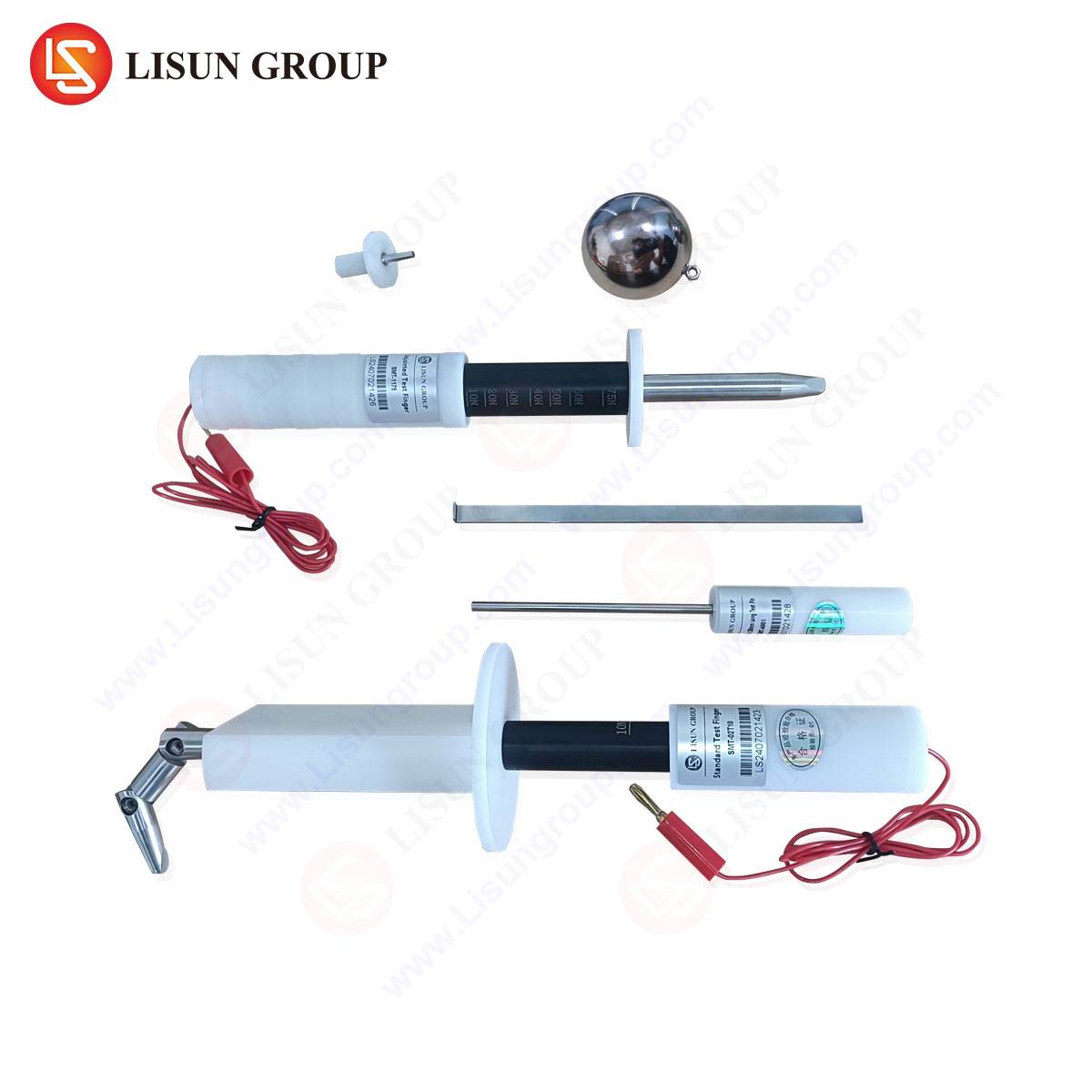
The validation of product safety is a non-negotiable prerequisite for market entry across the global electrical and electronics industry. While sophisticated instrumentation quantifies electrical parameters like insulation resistance and leakage current, the foundational assessment of mechanical safety—ensuring that hazardous live parts remain inaccessible under foreseeable conditions of use—relies on a class of deceptively simple yet precisely engineered tools: compliance test accessories. These devices physically simulate potential human interaction, providing a definitive, reproducible assessment of a product’s protective construction. Among these, the LISUN Test Finger, Test Probe, and Test Pin represent a calibrated triad essential for verifying compliance with international safety standards.
Anthropomorphic Simulation: The Philosophy Behind Mechanical Test Accessories
The core principle governing the design and application of mechanical test accessories is anthropomorphic simulation. Safety standards, such as IEC 61032, IEC 60529 (IP Code), and UL 60950-1 (now UL 62368-1), define specific probe geometries that model parts of the human body or common objects. These standards acknowledge that users, including children, may interact with equipment in unintended ways, using fingers, tools, or wires to explore openings. The objective of testing is not to assess deliberate vandalism but to evaluate protection against accidental contact during normal use, installation, or maintenance. By applying a defined force with a standardized accessory, test engineers can determine if a hazardous part becomes accessible, thereby quantifying the effectiveness of enclosures, barriers, and slot designs. This process translates subjective risk into an objective, repeatable measurement, forming a critical bridge between design intent and demonstrable safety.
Anatomic and Artifact Probes: The Triad of LISUN Compliance Tools
The LISUN suite addresses the spectrum of simulation needs through three distinct, standards-defined accessories. Each serves a unique verification purpose, targeting different failure modes and user interaction scenarios.
The LISUN Test Finger (Jointed Test Finger): Simulating Articulated Access
The Test Finger, often referred to as the “jointed test finger” or “articulated probe,” is designed to replicate the dimensions and articulation of a human finger. Typically constructed from robust, insulating materials like polyamide, it features two joints allowing for a range of motion that mimics natural probing. According to IEC 61032 Figure 2 (Test Probe 11), its critical dimensions include a diameter of 12 mm, a length of 80 mm, and a joint radius that dictates its reach and pivot.
- Testing Principle: The probe is inserted into any opening in an enclosure with a force of 10 N ± 1 N. It is manipulated through its joints to explore all possible angles of entry. The test is deemed failed if the probe contacts a hazardous live part (defined as a part exceeding specified safety extra-low voltage limits) or if it approaches such a part within a prescribed electrical clearance distance. A conductive foil wrapped around the probe’s tip, connected to a sensitive indicator (e.g., a contact detection circuit with a 40-50V nominal voltage), provides a definitive electrical signal upon contact.
- Primary Industry Applications:
- Household Appliances: Verifying that blade guards in food processors, openings in oven doors, or service panels on washing machines prevent finger access to moving parts or electrical connections.
- Consumer Electronics & Office Equipment: Checking ventilation slots in power adapters, gaming consoles, printers, and desktop computers.
- Electrical Components: Assessing socket outlets, switchgear, and distribution board enclosures.
- Toy and Children’s Products Industry: Critically evaluating battery compartments, charging ports, and any openings in electrically operated toys to ensure child safety beyond basic electrical insulation.
The LISUN Test Probe (Unjointed Test Probe): Assessing Straight-Line Access
In contrast to the articulated finger, the LISUN Test Probe is a rigid, straight accessory defined by standards like IEC 61032 Figure 1 (Test Probe 13). It simulates a stiff wire, a tool, or a child’s probing object. Its dimensions are more slender, typically featuring a 3 mm diameter spherical tip at the end of a 100 mm long rod.
- Testing Principle: Applied with a similar force of 1 N to 10 N (depending on the specific standard clause), this probe is pushed straight into openings without articulation. Its purpose is to evaluate protection against more rigid, linear intrusion. Failure occurs if the probe contacts a hazardous live part or, in IP code testing for “protection against access to hazardous parts,” it fully penetrates an opening.
- Primary Industry Applications:
- Lighting Fixtures: Testing gaps in luminaire housings, especially between diffusers and body, and in track lighting connectors.
- Industrial Control Systems: Verifying the integrity of push-button guards, keyhole openings, and cable gland entries on PLC enclosures and operator panels.
- Telecommunications Equipment: Assessing port protectors on routers, switches, and base station units.
- Automotive Electronics: Checking connector housings, fuse box covers, and infotainment system vents within the passenger compartment.
The LISUN Test Pin: Evaluating Specific Failure Points
The Test Pin is the most focused of the three, modeled after a slender, rigid object like a paperclip or a small tool. Defined in standards such as IEC 61032 Figure 9 (Test Probe 19), it is a straight metal pin with a specified diameter (e.g., 1.0 mm) and a hemispherical tip.
- Testing Principle: Applied with a low force (typically 1 N ± 0.1 N), its purpose is to test openings that are explicitly intended to prevent the entry of such small objects. A common application is in the testing of pin-hole vents or grilles. If the pin can enter and contact a live part, the construction fails. It is also used to verify that certain safety interlock switches cannot be easily defeated.
- Primary Industry Applications:
- Medical Devices: Critically testing battery compartment covers, small ventilation holes on portable monitors, and charging port designs where misuse could lead to critical failure.
- Aerospace and Aviation Components: Verifying the integrity of sealed connectors and protective covers on in-flight entertainment systems and cockpit instrumentation.
- Cable and Wiring Systems: Testing the accessibility of conductive parts through the strain relief or entry points of connectors.
- Household Appliances: Evaluating the safety of reset buttons and tiny openings in sealed electronic controls.
Material and Metrological Integrity in Accessory Fabrication
The validity of any test result is contingent upon the traceable accuracy of the tool used. LISUN accessories are manufactured to exacting tolerances, with material properties integral to their function. The Test Finger uses high-strength, dimensionally stable insulating polymers to prevent accidental conductivity and ensure joint movement remains within specified friction limits. The Test Probe and Test Pin are fabricated from hardened steel, with surface finishes that prevent corrosion and maintain precise tip geometry. Each accessory is subject to metrological verification, ensuring diameters, lengths, joint radii, and spherical tip dimensions conform to the micron-level tolerances mandated by international standards. This commitment to physical accuracy ensures that a test failure is unequivocally a result of product design flaw, not tooling inconsistency.
Integration into a Comprehensive Safety Testing Regimen
These mechanical probes are never used in isolation. They form a critical component within a holistic safety testing workflow. A typical sequence involves:
- Visual Inspection & Dimensional Check: Identifying all openings and applying standard gauges.
- Mechanical Probe Testing: Sequential application of the Test Finger, Probe, and Pin as required by the applicable standard (e.g., IEC 62368-1 for AV/IT equipment, IEC 60335-1 for household appliances, IEC 60601-1 for medical devices).
- Electrical Verification: Following a successful mechanical test, the product undergoes dielectric strength, leakage current, and protective earth continuity tests. A failed mechanical test often renders subsequent electrical tests moot, as a fundamental safety barrier has been compromised.
- Stress Testing: Some standards require probe tests to be performed after environmental stresses like humidity conditioning or enclosure rigidity tests (e.g., impact tests), verifying that safety is maintained throughout the product’s lifecycle.
Comparative Advantages in Precision and Application
The utility of the LISUN suite is underscored by its adherence to harmonized standards, a factor that streamlines global product certification. While generic or improvised probes may seem functionally similar, they introduce unacceptable risk. Non-compliant dimensions can lead to both false positives (unjustly failing a safe product) and, more dangerously, false negatives (passing an unsafe product). The LISUN tools offer distinct advantages:
- Metrological Traceability: Each accessory can be linked to national measurement standards, providing auditable proof of compliance for certification bodies like UL, TÜV, or Intertek.
- Material Durability: Engineered to withstand repeated use without deformation, ensuring consistent results over time and across multiple testing laboratories.
- Ergonomic Design: Handles and application aids are designed for consistent force application, reducing technician variability.
- Comprehensive Compatibility: The set is designed to meet the broadest array of international and regional standards, from IEC and EN to GB and ANSI/UL, making it a universal tool for manufacturers targeting global markets.
Concluding Implications for Product Design and Certification
The LISUN Test Finger, Test Probe, and Test Pin are more than simple tools; they are the physical embodiment of safety philosophy. Their application provides unambiguous feedback to design engineers, guiding decisions on slot geometry, barrier placement, and interlock design. In industries as diverse as medical devices, where patient safety is paramount, and consumer electronics, where volume production magnifies any design flaw, these accessories serve as the first and most direct line of defense verification. By investing in precisely engineered, standards-compliant mechanical test accessories, manufacturers and testing laboratories not only fulfill regulatory obligations but also embed a fundamental layer of user protection into the very fabric of their products, ultimately reducing liability and reinforcing brand integrity in an increasingly safety-conscious marketplace.
FAQ Section
Q1: Can a single LISUN Test Finger be used to certify a product for all global markets?
While the core geometry defined in IEC 61032 is widely harmonized, certain regional or product-specific standards may cite slight dimensional variants or require additional probes. The standard LISUN Test Finger (IEC 61032 Fig. 2) is acceptable for a vast majority of applications under IEC, EN, and many other standards. However, for specific certifications (e.g., certain UL clauses historically referencing a slightly different joint configuration), it is essential to verify the exact probe specification mandated by the target standard. Manufacturers should consult the specific safety standard applicable to their product in each target region.
Q2: How often should these mechanical test accessories be calibrated or verified?
Unlike electronic instruments with drifting components, the physical dimensions of these probes are stable. However, they are subject to wear, especially the tip of the Test Pin and the joints of the Test Finger. A regular visual and functional check before each critical test series is recommended. Formal dimensional calibration should be performed annually or biannually, depending on the laboratory’s accreditation requirements (e.g., ISO/IEC 17025) and frequency of use. Any drop, impact, or sign of deformation necessitates immediate verification.
Q3: In IP Code testing (IEC 60529), which probes are used for the “protection against access to hazardous parts” (first numeral)?
The first characteristic numeral of the IP code (e.g., IP2X) specifically references protection against solid object ingress, including access by probes. IP2X uses the Test Finger (12.5 mm sphere). IP3X uses a 2.5 mm diameter Test Probe (like the LISUN Test Probe). IP4X uses a 1.0 mm diameter Test Probe (similar to the Test Pin). IP5X and IP6X relate to dust protection and are tested with different methods. It is crucial to use the correctly dimensioned, standardized probe for each IP level claim.
Q4: What is the purpose of the conductive foil on the Test Finger, and how is it connected during testing?
The metal foil, typically a thin strip of aluminum or copper, simulates the conductivity of human skin. It is wrapped around the tip of the insulating Test Finger. During the test, this foil is connected via a wire to a “contact indicator circuit.” This circuit typically supplies a low, non-hazardous voltage (e.g., 40-50V) with a current limit. If the foil touches a hazardous live part, the circuit completes, and a visual or audible signal (like an LED lighting) alerts the technician. This provides a clear, unambiguous detection of electrical contact.
Q5: For a product with very small openings (like a medical sensor), is the Test Finger test still necessary if the Test Pin cannot enter?
Yes, the tests are often hierarchical and complementary. Standards generally require applying the probe that is most likely to gain access. If an opening is too small for the Test Finger to even partially enter, that probe test may be considered passed by inspection. However, the Test Pin test must still be performed on any opening its diameter allows it to approach, as it simulates a different type of threat. The requirements are cumulative; a product must defend against all simulated access attempts defined by its applicable safety standard.