




Technical Evaluation of Accelerated Corrosion Testing Methodologies and the LISUN YWX/Q-010X Cyclic Corrosion Test Chamber
Introduction to Accelerated Corrosion Simulation
The degradation of materials and components due to environmental corrosion represents a persistent and costly challenge across global manufacturing sectors. To preemptively assess product durability and validate protective coatings, industry relies on standardized, accelerated laboratory testing that simulates years of field exposure within a condensed timeframe. Salt spray (fog) testing, as defined by standards such as ASTM B117 and ISO 9227, has served as a fundamental, though limited, benchmark for decades. However, the increasing complexity of modern products, particularly those integrating sophisticated electronics and multi-material assemblies, demands more sophisticated simulation techniques. Cyclic corrosion testing (CCT), which incorporates phases of salt spray, humidity, drying, and sometimes static immersion, provides a far more accurate correlation to real-world performance by replicating the dynamic environmental transitions components endure in service. This technical analysis examines the principles, execution, and critical importance of advanced corrosion testing, with a specific evaluation of the LISUN YWX/Q-010X Cyclic Corrosion Test Chamber as a representative instrument for contemporary quality assurance protocols.
Fundamental Principles of Salt Spray and Cyclic Corrosion Testing
The foundational salt spray test operates on a principle of continuous, uniform atomization of a 5% sodium chloride solution within a sealed, temperature-controlled chamber. This creates a highly aggressive, static corrosive environment that primarily assesses the relative resistance of metallic substrates and inorganic coatings (e.g., electroplating, anodizing) to uniform corrosion and the propagation of scribe failures. While valuable for comparative quality control, its constant-state nature fails to replicate the cyclic wet-dry phases prevalent in natural atmospheres, where much of the corrosive damage occurs during the drying period as electrolyte concentration increases.
Cyclic corrosion testing addresses this limitation through programmable multi-phase cycles. A typical CCT profile may initiate with a salt spray phase to deposit electrolytes, transition to a high-humidity phase to promote galvanic and crevice corrosion, proceed to a controlled drying phase to concentrate corrosive agents, and potentially include a ambient conditioning phase. This phasic approach accelerates not only uniform corrosion but also galvanic corrosion, creepage from scribes, and the failure of organic coatings and sealants. The electrochemical processes are accelerated, but their mechanisms more closely mirror those observed in field exposures, leading to superior correlation coefficients between laboratory hours and actual service years.
Architectural and Operational Specifications of the LISUN YWX/Q-010X Chamber
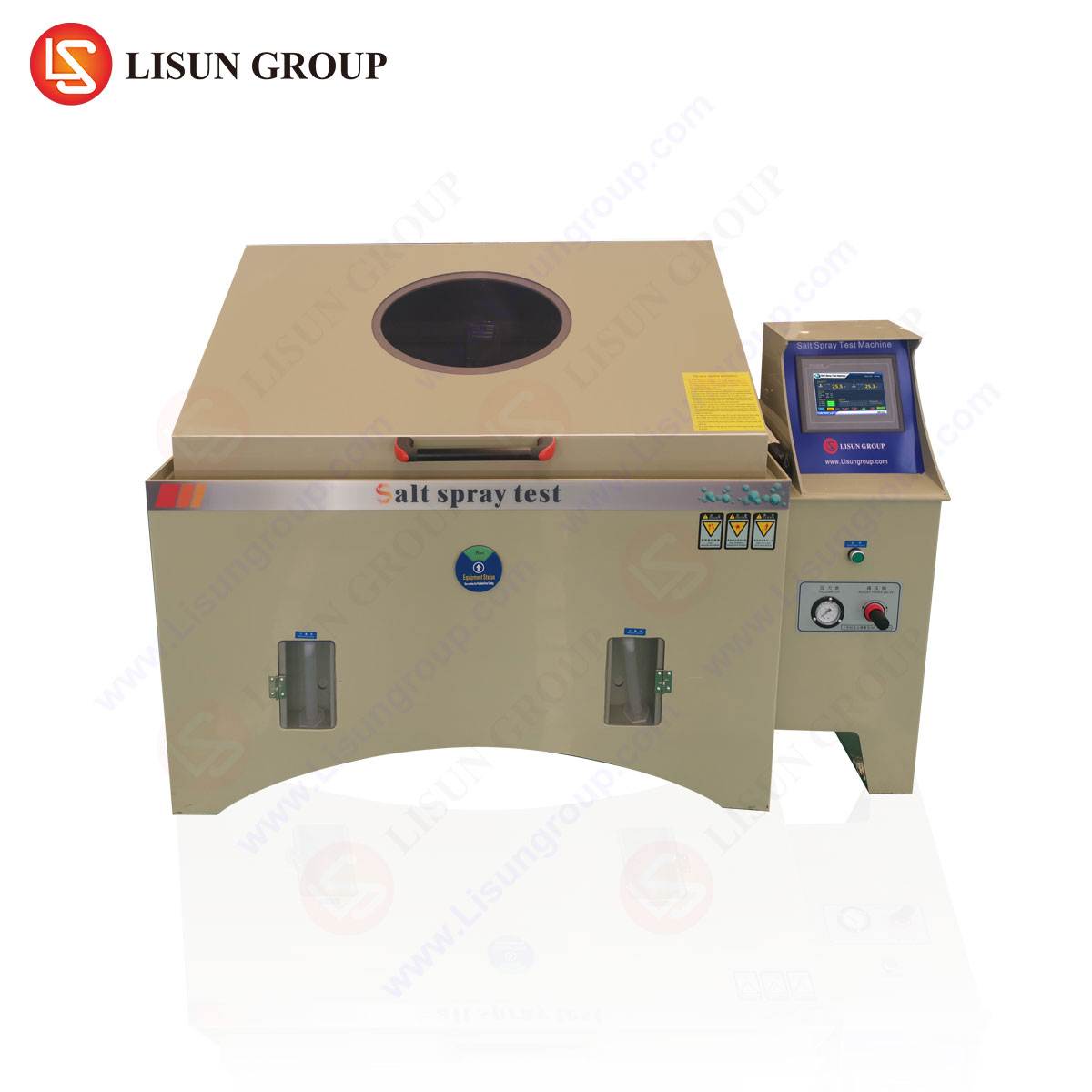
The LISUN YWX/Q-010X is engineered as a precision instrument for conducting both traditional neutral salt spray (NSS) tests and advanced cyclic corrosion tests. Its design integrates several subsystems to ensure parameter stability and repeatability, which are non-negotiable prerequisites for compliant testing.
The chamber’s internal workspace is constructed from reinforced, welded polypropylene plate, offering inherent resistance to the test solution and thermal stability across its operational range. A critical component is the saturated air barrel (also known as a tower), which pre-heats and humidifies compressed air before it is introduced to the atomizer. This process prevents the cooling and dilution of the salt fog, ensuring consistent droplet size, sedimentation rate, and chamber humidity as mandated by test standards. The chamber utilizes an air-driven nozzle-type atomizer, which generates a finer, more consistent fog compared to some bubbling-type designs, contributing to uniform spatial distribution of the corrosive medium.
Temperature control is managed via a PID (Proportional-Integral-Derivative) digital controller with separate settings for the chamber and the saturated barrel. The YWX/Q-010X typically maintains chamber temperature stability within ±1.0°C, a specification crucial for maintaining consistent corrosion kinetics. For cyclic testing, the system integrates a programmable logic controller (PLC) that automates the transition between test phases—salt spray, high humidity (achieved via built-in humidification systems), and dry-off (facilitated by internal heaters and fresh air introduction)—according to user-defined profiles.
Key Technical Specifications (Representative):
- Internal Volume: 108 liters (Model-specific)
- Temperature Range: Ambient +10°C to +55°C (Chamber); +40°C to +63°C (Saturated Barrel)
- Temperature Fluctuation: ≤ ±1.0°C
- Temperature Uniformity: ≤ ±2.0°C
- Salt Spray Settlement Rate: 1.0~2.0ml/80cm²·h (adjustable)
- Test Solution: Prepared per standard (e.g., 5% NaCl, pH 6.5-7.2 for NSS)
- Power Supply: 220V AC, 50/60Hz
Application Across Critical Industrial Sectors
The predictive data generated by chambers like the YWX/Q-010X are integral to the design validation and quality surveillance of components in industries where reliability is paramount.
In Automotive Electronics and Components, CCT is essential for evaluating engine control units (ECUs), sensor housings, connector systems, and lighting assemblies. These items face constant exposure to road salts, temperature swings, and humidity. Testing predicts failures in conformal coatings, connector pin corrosion, and the integrity of potting compounds.
For Aerospace and Aviation Components, the test environment can be tailored to simulate coastal marine atmospheres or specific flight cycle conditions for avionics enclosures, electrical harnesses, and non-critical structural fittings, assessing the efficacy of anodized layers and specialized paint systems.
The Electrical and Electronic Equipment, Industrial Control Systems, and Telecommunications Equipment sectors utilize these tests to validate the durability of printed circuit board (PCB) finishes, the corrosion resistance of shielded enclosures, and the performance of external ports and connectors. A failure here can lead to signal degradation, short circuits, or complete system downtime.
Medical Devices, particularly those designated for non-sterile environments or home healthcare use (e.g., external monitors, diagnostic equipment housings), must resist corrosion from cleaning agents and ambient humidity to ensure long-term functionality and patient safety.
Lighting Fixtures, especially outdoor and automotive lighting, are subjected to rigorous salt fog cycles to evaluate the integrity of lens seals, reflector coatings, and heat sink materials, preventing lumen depreciation and electrical hazards.
Consumer Electronics, Office Equipment, and Household Appliances with external metal trim, connectors, or internal components in vented areas (e.g., gaming consoles, laptops, washing machine control panels) are tested to ensure cosmetic durability and functional longevity throughout their warranty period and beyond.
Compliance with International Testing Standards
Operational protocols for the YWX/Q-010X are dictated by the test standard referenced. Compliance is not merely a function of the chamber but of the entire test method, including sample preparation, solution chemistry, and post-test evaluation.
- ASTM B117: Standard Practice for Operating Salt Spray (Fog) Apparatus. The foundational continuous salt spray test.
- ISO 9227: Corrosion tests in artificial atmospheres – Salt spray tests. Internationally aligned with ASTM B117.
- IEC 60068-2-11: Environmental testing – Part 2-11: Tests – Test Ka: Salt mist. Key for electrical and electronic products.
- IEC 60068-2-52: Environmental testing – Part 2-52: Tests – Test Kb: Salt mist, cyclic (sodium chloride solution). A primary standard for cyclic testing of electronics.
- JASO M609: Automotive standard for corrosion of materials by salt spray.
- SAE J2334: Laboratory Cyclic Corrosion Test for automotive coatings. A widely respected CCT profile.
- GM 9540P / Ford BI 103-01: Examples of original equipment manufacturer (OEM) specific cyclic test procedures that can be programmed into capable chambers.
Comparative Advantages of Cyclic Testing Capability
The primary advantage of a chamber like the YWX/Q-010X, which offers true cyclic functionality, lies in its improved correlation to real-world performance. Studies have demonstrated that CCT can produce failure modes—such as filiform corrosion under paint, fastener crevice corrosion, and electronic connector fretting—that are morphologically identical to service failures, whereas continuous salt spray often produces misleading, non-representative corrosion products.
Secondly, it provides enhanced test discrimination. For modern multi-layer coating systems or advanced alloys, continuous salt spray can yield pass/fail results for all samples, offering little granularity. CCT’s stressful dry phases exacerbate differences in performance, effectively ranking materials and processes with greater resolution.
Furthermore, it enables accelerated qualification. By applying a more realistic, yet intensified, environmental stress, development cycles can be shortened. Engineers can obtain predictive lifespan data earlier in the design process, allowing for timely material or design modifications without resorting to lengthy outdoor exposure trials.
Critical Considerations for Chamber Selection and Operation
Selecting and operating a corrosion test chamber requires careful attention to several technical and procedural factors. Chamber construction material must be entirely inert to salt solution; polypropylene is standard for its balance of cost, machinability, and chemical resistance. Spatial temperature uniformity is critical, as a gradient of even a few degrees can cause significant variance in corrosion rates across the test sample population. The precision and reliability of the atomization system directly govern the salt settlement rate, a core controlled variable in standards.
Calibration and maintenance are not ancillary activities but core requirements. Regular calibration of temperature sensors, verification of salt settlement rate using graduated collection vessels, and cleaning of nozzles and reservoirs are mandatory to maintain test validity. The quality of input compressed air is also paramount; it must be oil-free, filtered, and delivered at a consistent pressure to ensure proper atomization.
Perhaps most importantly, the programmability and control logic of the chamber must be robust and intuitive. The ability to create, store, and accurately execute complex multi-step profiles (e.g., 1-hour spray, 4-hour humidity at 95% RH, 2-hour dry, 1-hour ambient soak) with seamless transitions is what defines a capable CCT instrument. The system must manage heating, humidification, fog generation, and exhaust without operator intervention once the cycle is initiated.
Interpretation of Test Results and Failure Analysis
The output of a corrosion test is not merely a pass/fail determination but a rich dataset for failure analysis. Evaluation is conducted per the relevant product standard or internal specification, often involving:
- Visual Inspection: Documenting the appearance of corrosion products (red rust, white rust, etc.), blistering of paints, and creepage from scribed lines. Standards like ASTM D1654 provide guidelines for evaluating scribed coatings.
- Metrological Assessment: Measuring the extent of corrosion creepage from a scribe or cut-edge in millimeters, a common quantitative metric.
- Functional Testing: For electronic assemblies, post-test verification of electrical continuity, insulation resistance, and operational functionality is essential.
- Cross-sectional Analysis: In-depth failure analysis may involve microscopic examination of a cross-section to identify the specific failure interface—whether between substrate and primer, within the coating itself, or at a topcoat interface.
The findings must be contextualized within the specific test standard’s parameters. A result is only meaningful when the exact test conditions (standard, duration, temperature, solution pH, sample orientation) are fully documented. The data primarily serve a comparative purpose: comparing a new material to a known benchmark, or comparing different supplier components under identical, controlled aggressive conditions.
Frequently Asked Questions (FAQ)
Q1: What is the primary functional difference between a standard salt spray chamber and a cyclic corrosion test (CCT) chamber like the YWX/Q-010X?
A standard salt spray chamber operates in a single, continuous mode—producing a salt fog at a constant temperature. A CCT chamber, such as the YWX/Q-010X, incorporates programmable controls to execute multi-phase test profiles that sequentially introduce salt spray, high humidity, drying, and possibly ambient conditions. This cyclic process provides a more realistic simulation of natural environmental cycles and typically yields better correlation with real-world service life.
Q2: Can the YWX/Q-010X chamber be used to run tests compliant with both ASTM B117 and automotive cyclic standards like SAE J2334?
Yes, a properly equipped YWX/Q-010X is designed for this dual-purpose application. For ASTM B117, it operates in a continuous salt spray mode with precise temperature and settlement rate control. For SAE J2334 or similar cyclic standards, its programmable controller is used to automate the specific sequence of spray, humidity, and dry-off phases required by the standard, utilizing its integrated humidification and drying systems.
Q3: Why is control of the salt settlement rate so critical, and how is it verified?
The salt settlement rate (typically 1-2 ml per 80 cm² per hour) directly influences the concentration of corrosive electrolyte on the test specimens. An incorrect rate can accelerate or decelerate corrosion unrealistically, invalidating comparisons. It is verified by placing at least two clean graduated collection vessels (funnels) inside the chamber for a minimum of 16 hours, then calculating the average volume of solution collected per hour per unit area.
Q4: What are the key maintenance routines required to ensure the longevity of the chamber and the consistency of test results?
Essential maintenance includes: weekly cleaning of the chamber interior to remove salt deposits; regular inspection and cleaning of the atomizing nozzles to prevent clogging; periodic draining and cleaning of the solution reservoir to prevent contamination or biological growth; calibration of temperature sensors and verification of the settlement rate at intervals defined by quality procedures (e.g., quarterly); and ensuring the supply air filter is clean and the air saturator is filled with deionized water.
Q5: For testing printed circuit board assemblies (PCBAs), what specific failure modes does cyclic corrosion testing help identify?
CCT is particularly effective at identifying electrochemical migration (dendrite growth) between closely spaced conductors, corrosion of thin-circuit traces or component leads, degradation of solder mask adhesion, and failure of conformal coatings at edges or under components. The wet-dry cycles promote the formation of conductive electrolyte paths and subsequent corrosion during the drying phase, which continuous spray alone may not adequately reproduce.