




Mechanical Durability Testing for Plugs and Sockets: A Framework for Reliability Assessment
The long-term operational integrity of plugs and sockets is a non-negotiable prerequisite for electrical safety and product longevity. Mechanical durability, specifically, addresses the ability of these components to withstand repeated physical engagement and disengagement without degradation of their electrical or safety characteristics. This form of testing transcends simple functionality checks, probing the very limits of material resilience, contact design, and mechanical construction. Within the framework of international safety standards, IEC 60065 provides a critical and definitive methodology for evaluating this durability through the use of standardized test plugs. This article delineates the technical principles, procedural execution, and essential instrumentation required for rigorous mechanical durability testing in alignment with IEC 60065, with a focus on the specialized equipment necessary for compliant and repeatable results.
The Foundational Role of IEC 60065 in Safety Compliance
IEC 60065, “Audio, video and similar electronic apparatus – Safety requirements,” establishes comprehensive safety benchmarks for a wide range of electronic equipment. While its scope is broad, its specifications for the mechanical testing of mains inlets and connectors are particularly stringent and have been widely adopted as a de facto standard for plug and socket durability across multiple industries. The standard mandates that connectors must endure a specified number of mating cycles—simulating years of normal use—while maintaining electrical continuity, insulation resistance, and protective earthing integrity. The core challenge in executing these tests lies in achieving standardized, reproducible mechanical action that eliminates human variability. This is where the IEC 60065 test plug, a calibrated and geometrically precise artifact, becomes indispensable. It is not a simple dummy plug but a controlled instrument designed to apply consistent, measurable force and wear characteristics to the socket under test.
Anatomy and Function of the Standardized Test Plug
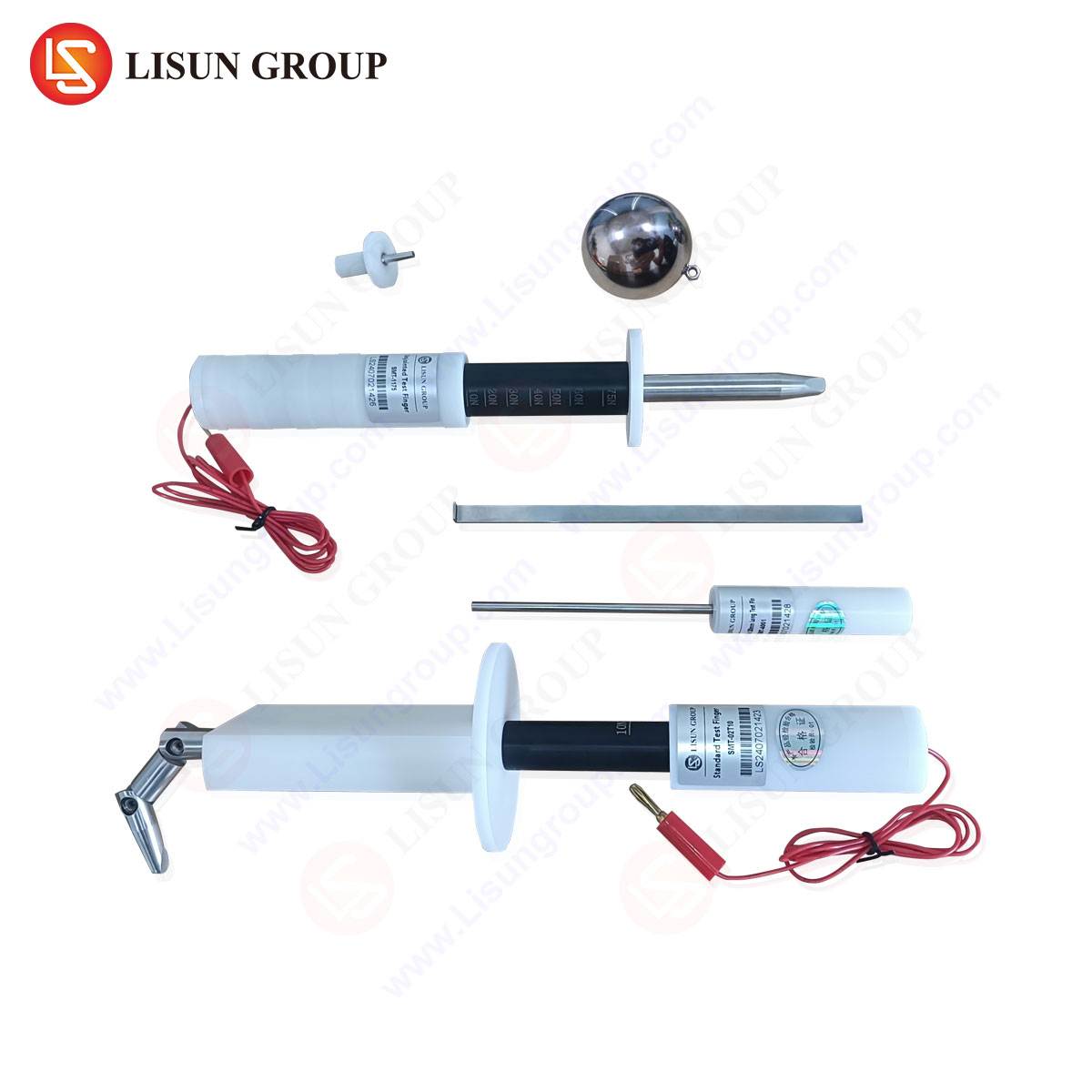
The IEC 60065 test plug is engineered to be a consumable reference that simulates the wear and mechanical interaction of a standard plug, but with enhanced precision and durability for laboratory use. Its construction is meticulously defined. The contact pins are typically manufactured from a hardened phosphor bronze or similar alloy, with specific surface finishes and dimensional tolerances often held to within ±0.05 mm. These pins are mounted in a body of specified material, such as polyamide or thermosetting plastic, with a defined Rockwell hardness. The geometry of the pins—including chamfer angles, pin length, and cross-sectional profile—is precisely controlled to ensure uniform insertion and extraction forces across all test samples and laboratories. Crucially, the test plug is designed to be used within a dedicated automated testing apparatus that controls the insertion rate, dwell time, extraction force, and angular alignment, thereby removing the unpredictable variables introduced by manual operation.
Quantifying Durability: Test Parameters and Failure Criteria
Mechanical durability testing is a quantifiable pass/fail evaluation. The primary parameter is the number of mating cycles, which for standard appliance inlets per IEC 60065 is typically 5,000 cycles, though this can vary based on product classification and regional standards derivatives (like EN 60065). A single cycle constitutes a full insertion followed by a full extraction at a standardized rate, often between 6 to 10 cycles per minute. The test is conducted under specific environmental conditions, usually at an ambient temperature of 23°C ± 5°C.
Failure is not merely mechanical breakage. Post-test evaluation is comprehensive and includes:
- Continuity Verification: The resistance of the live and neutral contacts must not exceed 50 mΩ, and the protective earth contact resistance must remain below 100 mΩ, as measured with a specified test current.
- Dielectric Strength: The socket must withstand a high-potential test (e.g., 2,000 V AC) between live parts and accessible metal parts without flashover or breakdown.
- Visual and Dimensional Inspection: There must be no cracking, deformation, or wear that compromises safety distances (creepage and clearance) or the secure retention of a standard plug. The engagement and disengagement force, measured at the beginning and end of the test, must not deviate beyond permissible limits.
Instrumentation for Automated and Compliant Testing: The LISUN Gauges for Plugs and Sockets
Executing 5,000 cycles manually is neither practical nor scientifically valid due to operator-induced variance. Therefore, specialized automated test equipment is mandated. The LISUN Gauges for Plugs and Sockets series represents a purpose-engineered solution for this application. This system integrates a programmable robotic actuator, a precision test fixture, and the calibrated IEC 60065 test plug into a single, controlled apparatus.
The testing principle is one of controlled repetition and monitoring. The socket under test is securely mounted in the fixture. The system’s actuator, guided by programmable logic, then repeatedly inserts and extracts the test plug with a defined stroke length, velocity profile, and axial alignment. Advanced systems, such as the LISUN LP-5123A, incorporate real-time monitoring of insertion/extraction force via a load cell, providing a continuous data stream that can reveal trends like increasing friction due to wear or plastic deformation. This force profile is a critical diagnostic tool, often more revealing than a simple pass/fail at the test’s conclusion.
Specifications and Competitive Advantages of the LISUN System:
- Programmable Cycle Control: Allows precise setting of cycles (1-99,999), speed (e.g., 5-30 cycles/minute), and dwell time, ensuring strict adherence to IEC 60065 clause 16.2.
- Integrated Force Measurement: A built-in dynamic force sensor provides real-time graphical output of insertion and extraction forces, enabling trend analysis and early detection of mechanical degradation.
- Universal Fixturing: Modular design accommodates a wide array of socket form factors (IEC 60320 C5, C7, C13, C19, C21, etc.) and national standards (NEMA, BS, AS/NZS) through interchangeable adapters.
- Data Logging and Compliance Reporting: Automated generation of test reports, including force vs. cycle graphs, is essential for audit trails and quality documentation. This eliminates manual transcription errors.
- Enhanced Repeatability: By eliminating human factors—variation in insertion angle, uneven force application, inconsistent cycle rate—the LISUN system ensures that results are attributable solely to the device under test, not the test method.
The competitive advantage lies in this integration of mechanical actuation with electronic measurement and data management. It transforms a qualitative durability check into a quantitative, data-rich analysis of product lifespan.
Industry Applications and Material Science Implications
The application of this testing extends across all sectors manufacturing or utilizing connectors. In the consumer appliance industry, it validates the inlet on televisions, audio equipment, and kitchen appliances. For IT and data center equipment, it ensures the reliability of power distribution unit (PDU) sockets and server power supplies subjected to frequent reconfiguration. Medical device manufacturers employ these tests to guarantee the reliability of mains connections on life-critical equipment.
The test results directly inform material science decisions. For instance, the wear pattern on the test plug pins after 5,000 cycles can indicate whether a socket’s contact material (e.g., beryllium copper vs. brass) has sufficient hardness and spring memory. Analysis of socket housing deformation can lead to the selection of alternative polymers or glass-filled composites. The force-trend data can validate finite element analysis (FEA) models predicting mechanical stress, closing the loop between design simulation and physical validation.
Correlation Between Mechanical Wear and Electrical Safety
A paramount consideration is the direct correlation between mechanical wear and electrical hazard. A socket that has become loose due to contact spring fatigue presents two risks: increased contact resistance leading to overheating (a fire hazard), and the potential for partial disconnection and arcing. The durability test, followed by the prescribed electrical tests, directly probes for these failure modes. The requirement to pass a dielectric strength test after mechanical stressing is especially significant, as micro-fractures or tracking paths induced by wear could compromise insulation. The IEC 60065 test plug, by applying consistent wear, creates the precondition to reveal these latent failures before they manifest in the field.
Integrating Durability Data into the Quality Management System
Data from automated mechanical durability testers should not exist in isolation. The force profiles, cycle counts, and post-test electrical measurements are key process indicators (KPIs) within a modern Quality Management System (QMS). Statistical process control (SPC) can be applied to insertion force data from production samples to monitor manufacturing consistency of contact springs and housing molds. A gradual upward drift in average extraction force, for example, could signal a tooling wear issue in the socket molding process, allowing for proactive maintenance. This integration of test data into the broader manufacturing intelligence framework elevates durability testing from a compliance checkpoint to a core pillar of predictive quality assurance.
Conclusion
Mechanical durability testing per IEC 60065, facilitated by standardized test plugs and automated equipment, is a rigorous engineering discipline essential for certifying the safety and reliability of electrical connections. It provides an accelerated-life model that exposes design and material weaknesses under controlled, reproducible conditions. The utilization of advanced, integrated systems like the LISUN Gauges for Plugs and Sockets is critical for achieving the precision, efficiency, and data integrity required by contemporary safety standards and quality-conscious manufacturers. By implementing this structured testing methodology, manufacturers can move beyond mere compliance, gaining actionable insights that drive material innovation, design refinement, and ultimately, the production of safer, more reliable products for the global market.
FAQ Section
Q1: Can a standard production plug be used instead of a calibrated IEC 60065 test plug for durability testing?
No. A production plug lacks the controlled material properties, precise geometry, and consistent wear characteristics of a calibrated test plug. Using one would introduce uncontrolled variables, making test results non-repeatable and non-compliant with the standard. The test plug is a calibrated measuring instrument.
Q2: How often should the IEC 60065 test plug itself be calibrated or replaced?
The test plug is a consumable item subject to wear. Its calibration interval should be defined by the quality laboratory based on usage frequency, but it must be inspected regularly for dimensional integrity and pin deformation. Most laboratories establish a replacement schedule after a set number of test cycles (e.g., every 50,000 cycles) or based on periodic verification against a master gauge.
Q3: Beyond IEC 60065, are there other relevant standards for plug and socket durability?
Yes. While IEC 60065 is widely referenced, product-specific standards often incorporate or expand upon it. Examples include IEC 60320 (appliance couplers), IEC 60950-1 (IT equipment, now superseded by IEC 62368-1), and IEC 60601-1 (medical equipment). Each may specify different cycle counts, force requirements, or test conditions tailored to the expected use environment of the product.
Q4: What does a rising trend in insertion force during a test typically indicate?
A progressive increase in insertion force often points to accumulating wear debris within the socket housing, deformation of the socket’s contact receptacles, or a loss of lubricity. It is a key indicator of potential mechanical failure and warrants investigation into socket material composition and contact design.
Q5: Can the LISUN automated system test sockets with mechanical shutters or other safety features?
Yes, provided the system can be programmed or fitted with an adapter to correctly actuate the shutter mechanism. The test sequence may require a modified insertion profile to simulate the angled engagement a user would employ to open the shutters. The system’s programmability is essential for adapting to such non-standard but critical safety features.