

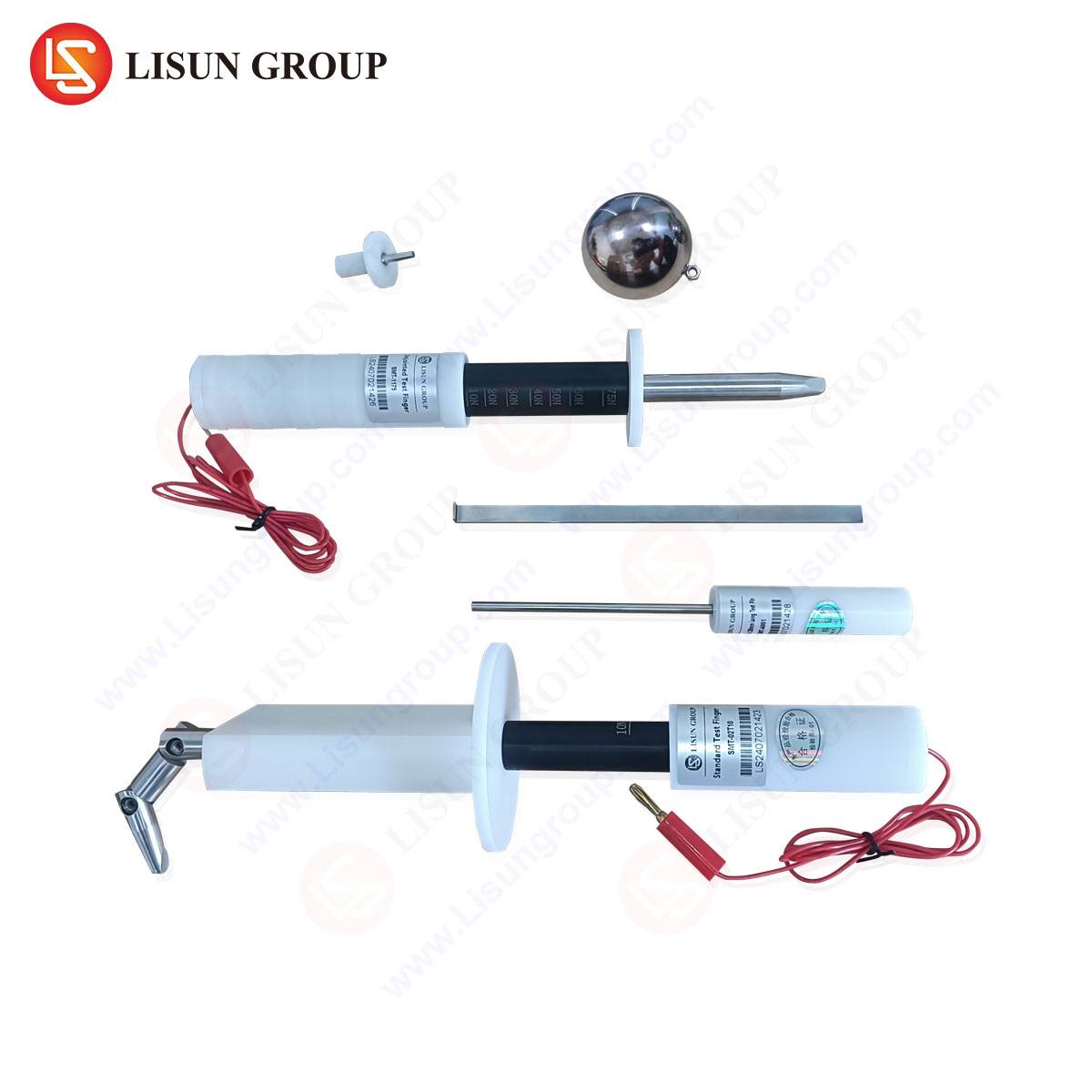





The Milling Grinding Probe: A Critical Instrument for Assessing Enclosure Integrity and Safety Compliance
Introduction to Enclosure Integrity Verification
In the engineering and manufacturing of electrical and electronic equipment, the integrity of an enclosure is a fundamental safety requirement. Enclosures serve as the primary barrier against accidental contact with hazardous live parts, the ingress of solid foreign objects, and the protection of internal components from environmental contaminants. The verification of this integrity is not a matter of subjective assessment but a rigorous, standardized process. Among the various test tools specified by international safety standards, the Milling Grinding Probe, often categorized within a family of test probes, test fingers, and test pins, plays a indispensable role. This article provides a technical examination of the Milling Grinding Probe, its operational principles, governing standards, and its critical applications across diverse industrial sectors. A specific focus will be placed on the implementation and specifications of the LISUN Test Finger, Test Probe, Test Pin system as a representative and compliant solution for modern testing requirements.
Defining the Milling Grinding Probe and Its Standardized Kinematics
The Milling Grinding Probe is a calibrated, articulated mechanical device designed to simulate the action of a human finger or a tool attempting to access hazardous areas within equipment. Unlike a simple rigid pin, its design incorporates joints that allow it to pivot and “feel” for openings, mimicking the probing action described in standards such as IEC 61032 and UL 60950-1 (now largely superseded by IEC 62368-1). The term “milling grinding” refers to a specific test wherein the probe is inserted into an opening and, through a combination of rotation and articulation, attempts to make contact with live parts or hazardous moving components. The probe must be applied with a defined force, typically 10 N ± 1 N, and is manipulated through every possible orientation to ensure no unsafe access is possible. Its dimensions—the diameter of the finger sections, the length of the finger, and the size of the shield—are precisely defined to represent a worst-case scenario for user access.
Governing Standards and the Framework of Compliance
The application of the Milling Grinding Probe is mandated by a suite of international safety standards. IEC 61032, “Protection of persons and equipment by enclosures – Probes for verification,” is the core document that specifies the dimensions, construction, and application of various test probes, including the articulated test finger (Probe 11). This standard is then referenced by numerous product-family and sector-specific standards:
- IEC 62368-1: Audio/video, information and communication technology equipment.
- IEC 60335-1: Household and similar electrical appliances.
- IEC 60601-1: Medical electrical equipment.
- IEC 60598-1: Luminaires.
- IEC 60950-1: Information technology equipment (historically significant).
- UL 943: Ground-fault circuit interrupters.
- GB 4706.1: Chinese standard for household appliances.
These standards collectively stipulate that enclosures must prevent the test probe from contacting hazardous live parts, defined as parts exceeding certain voltage thresholds (e.g., > 42.4 V peak or 60 V DC). The test also verifies that the probe cannot bridge insulation distances, compromise creepage and clearance, or contact moving parts like fans or gears that could cause injury.
The LISUN Test Finger, Test Probe, Test Pin System: Specifications and Implementation
The LISUN Test Finger, Test Probe, Test Pin system is engineered as a comprehensive kit to fulfill the requirements of IEC 61032 and its referenced standards. This system typically includes not only the articulated Milling Grinding Probe (Probe 11) but also other essential probes such as the rigid test pin (Probe 12) for smaller openings and the sphere probe (Probe 13). The specifications for the critical articulated test finger are meticulously controlled:
| Parameter | Specification | Tolerance | Purpose |
|---|---|---|---|
| Finger Diameter | 12 mm | ±0.1 mm | Simulates a user’s finger. |
| Finger Length | 80 mm | ±0.2 mm | Determines reach depth. |
| Shield Diameter | 50 mm | ±0.2 mm | Prevents over-insertion. |
| Shield Length | 100 mm | ±1.0 mm | Guides application angle. |
| Joint Articulation | 90° ±5° in both directions | — | Allows probing of complex openings. |
| Application Force | 10 N | ±1 N | Standardized probing pressure. |
The construction is typically of robust, insulating material such as polyamide or similar polymer, ensuring the probe itself does not conduct electricity and provides consistent mechanical properties. The joints are designed for smooth, repeatable articulation without excessive play. For the test to be valid, the probe is connected to an indicator circuit—often a signal lamp or a voltmeter with a 40-60V supply—that provides a clear, unambiguous indication of contact with a live part.
Sector-Specific Applications and Use Cases
The universality of the safety principles embodied by the Milling Grinding Probe makes it a ubiquitous tool across the manufacturing landscape.
- Household Appliances & Consumer Electronics: For products like food processors, blenders, and power supplies, the probe verifies that openings for ventilation, control shafts, or between housing seams cannot be exploited by a user’s finger to contact mains-voltage wiring or motor connections.
- Automotive Electronics & Industrial Control Systems: In control units for engine management or industrial PLCs, the test ensures that connector ports, service openings, and covers for fuses prevent access to high-voltage busbars or terminal blocks, even when a tool or wire is inadvertently pushed into an opening.
- Lighting Fixtures & Electrical Components: For LED drivers, switches, and sockets, the probe checks that live terminals are inaccessible after installation. A common test involves probing the gap between a switch plate and its mounting box.
- Medical Devices & Telecommunications Equipment: Patient monitors and network routers must protect service personnel during maintenance. The probe is used to verify that covers requiring a tool for removal adequately shield hazardous voltages before the tool is fully disengaged.
- Aerospace and Aviation Components: In this high-reliability sector, the probe test is part of DO-160 or similar compliance, ensuring that avionics enclosures in cramped cockpit or cargo bay installations prevent short circuits or shock hazards from incidental contact.
- Toy and Children’s Products Industry: Adhering to stringent standards like EN 62115, the probe assesses battery compartments and seams to ensure that small fingers cannot access battery contacts or internal circuitry, preventing shock or burn risks.
Competitive Advantages of a Calibrated Test System
Utilizing a standardized, calibrated system like the LISUN Test Finger, Test Probe, Test Pin offers distinct advantages over ad-hoc or non-compliant methods. First, it ensures regulatory acceptance. Compliance reports and certification submissions from bodies like UL, TÜV, or Intertek require tests performed with tools that meet the exact dimensional and functional criteria of the referenced standards. Second, it guarantees test repeatability and reliability. Variations in probe dimensions or joint stiffness can lead to false passes or failures, resulting in either unsafe products reaching the market or unnecessary design revisions. A precision-manufactured kit eliminates this variable. Third, it enhances laboratory efficiency. A comprehensive kit allows engineers to quickly select the correct probe for the specific test clause (e.g., finger access vs. tool access), streamlining the design validation and production line audit processes.
Integration into the Product Development and Quality Assurance Lifecycle
The Milling Grinding Probe test is not merely a final production checkpoint. It is integrated throughout the product lifecycle. During the design phase, engineers use the probe on prototypes to identify and rectify enclosure weaknesses early, avoiding costly tooling changes later. In the type-testing and certification phase, it is a mandatory part of the safety evaluation conducted by a Nationally Recognized Testing Laboratory (NRTL). For production line quality assurance, a sampling of finished goods is routinely tested to ensure manufacturing consistency—for instance, verifying that the molding of a plastic grill on a power supply has not created an unexpectedly large opening. This end-to-end application underscores its role as a fundamental metric of product safety.
Scientific Data and the Physics of Contact Prevention
The design of the probe and the pass/fail criteria are rooted in electrophysiology and risk analysis. The 12 mm diameter approximates the distal phalanx of a small adult finger. The 10 N force represents a reasonable probing pressure without being excessive. The electrical test circuit (typically a 50V indicator) is set below thresholds considered to be hazardous, ensuring that any detected contact represents a genuine risk. Research into impedance of human skin and let-go currents informs these voltage and current limits. The test, therefore, is a practical engineering proxy for a complex biological interaction, translating physiological data into a reproducible mechanical procedure.
FAQ Section
Q1: Can a simple metal hook or screwdriver be substituted for the standardized Milling Grinding Probe during internal design checks?
A: While such tools may be used for informal preliminary assessments, they are not substitutes for compliance testing. Their dimensions, articulation, and application force are not controlled, leading to non-repeatable results. For any test that will be part of a certification report or formal Quality Assurance record, the use of a calibrated probe meeting IEC 61032 is mandatory.
Q2: How often should a test probe kit like the LISUN system be calibrated or verified?
A: While the probes themselves are not typically subject to periodic calibration like an electrical meter, they should be inspected regularly for wear, damage, or deformation. The joints should articulate smoothly, and critical dimensions (diameter, length) should be checked annually or after any suspected impact using calibrated calipers or gauges. The force gauge used to apply the 10 N force, however, requires regular metrological calibration.
Q3: The standard mentions applying the probe “in every possible orientation.” What does this entail in practice?
A: This requires the test operator to not only insert the probe straight into an opening but also to articulate its joints fully, rotate it around its axis, and angle it relative to the enclosure surface. The goal is to simulate a user attempting to “fish around” or “hook” a component inside. The probe should be manipulated systematically to explore the entire accessible volume behind the opening.
Q4: If the test probe can contact a live part, but a user would need to disassemble the unit to create the opening, is the product still non-compliant?
A: Standards make a critical distinction between “operator-accessible” and “service-personnel-accessible” areas. Openings that require the use of a tool (e.g., a screwdriver) for access are evaluated differently, often with a different test probe (like the rigid test pin). However, if no tool is needed—if a cover can be opened with bare hands or fingernail pressure—then the articulated test finger assessment applies. The instructions for use and intended audience of the product define the applicable accessibility criteria.
Q5: Are there environmental conditions under which the test should not be performed?
A: The mechanical probe test is generally performed under ambient laboratory conditions. However, the integrity it assesses can be affected by environment. Some standards require a “conditioning” of the enclosure (e.g., heating in an oven) prior to the test to simulate material expansion or warping over the product’s lifetime. The probe test itself, however, is a mechanical verification performed on the conditioned sample.