




Corrosion Simulation and Accelerated Life Testing: Methodologies and Applications in Modern Manufacturing
The relentless pursuit of product durability and reliability remains a cornerstone of competitive manufacturing across a multitude of industries. Among the most pervasive and insidious threats to product longevity is corrosion, an electrochemical process that degrades materials, compromises structural integrity, and leads to catastrophic system failures. To preemptively identify vulnerabilities and validate protective measures, manufacturers rely on standardized, repeatable environmental simulation testing. Salt spray (fog) testing, as defined by international standards such as ASTM B117, ISO 9227, and JIS Z 2371, serves as a fundamental accelerated corrosion test, simulating years of environmental exposure within a controlled laboratory timeframe. This article examines the technical principles, industrial applications, and critical implementation parameters of salt spray testing, with a specific focus on the operational methodologies and technological advancements embodied in modern testing apparatus, exemplified by the LISUN YWX/Q-010X Salt Spray Test Chamber.
Electrochemical Foundations of Atmospheric Corrosion
Atmospheric corrosion is predominantly an electrochemical phenomenon driven by the formation of a thin, conductive electrolyte film on a metal surface, typically from condensed moisture containing ionic contaminants. Chloride ions, ubiquitous in coastal and de-icing salt environments, are particularly aggressive. They penetrate passive oxide layers, destabilize protective coatings, and catalyze anodic dissolution. The primary anodic reaction is metal oxidation (e.g., Fe → Fe²⁺ + 2e⁻), while the cathodic reaction is most commonly oxygen reduction (O₂ + 2H₂O + 4e⁻ → 4OH⁻) in neutral or alkaline environments.
Salt spray testing accelerates this natural process by creating a continuous, saturated saline fog within an enclosed chamber. This maintains a constant, highly conductive electrolyte layer on test specimens, eliminating the wet-dry cycles of natural exposure to perpetually drive the corrosion reactions. The test does not precisely replicate real-world corrosion morphologies or rates in a 1:1 correlation; rather, it provides a severely controlled, comparative environment. Its value lies in its reproducibility, allowing for rapid qualitative assessment of relative corrosion resistance between materials, platings, paints, and surface treatments when exposed to a chloride-laden atmosphere.
Architectural and Operational Principles of a Modern Salt Spray Chamber
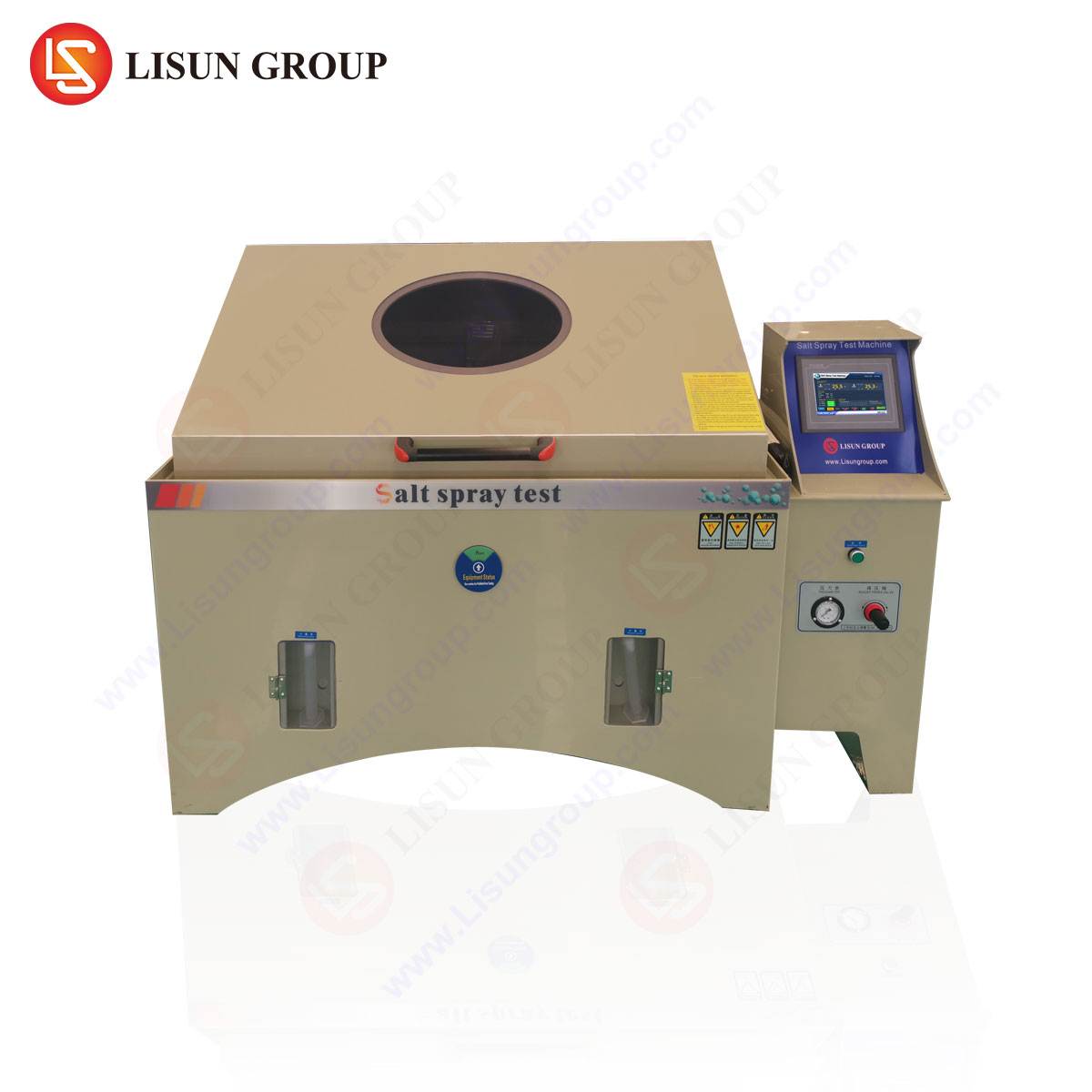
The efficacy and repeatability of salt spray testing are wholly dependent on the precision and consistency of the test chamber’s environmental controls. A contemporary chamber, such as the LISUN YWX/Q-010X, integrates several critical subsystems to maintain the stringent parameters mandated by international standards.
The chamber’s core is a temperature-controlled test workspace, constructed from chemically inert materials like polypropylene or glass-reinforced polyester to resist corrosion. Precise temperature maintenance, typically at 35°C ± 2°C (95°F ± 3.6°F) for neutral salt spray (NSS) tests, is achieved via a heating system with proportional-integral-derivative (PID) control logic, ensuring thermal homogeneity. The saline solution reservoir feeds a compressed-air atomization system. Here, purified air is humidified and heated in a saturation tower to prevent solution concentration changes during fog generation, before being forced through a precision nozzle to create a fine, uniform fog of 5% sodium chloride solution. The collection rate of this fog, measured in milliliters per hour per 80 cm², is a critical validation metric, with standards typically specifying 1.0 to 2.0 ml/hr.
The YWX/Q-010X model incorporates advanced features to enhance test fidelity and operational efficiency. These include a digital touch-screen controller for parameter programming and real-time monitoring, automatic water replenishment for the saturation tower, and built-in solution level alerts. Its specifications, crucial for technical validation, are detailed in Table 1.
Table 1: Key Technical Specifications of a Representative Salt Spray Test Chamber (YWX/Q-010X)
| Parameter | Specification | Standard Reference / Implication |
|---|---|---|
| Chamber Temperature Range | Ambient +10°C to +55°C | Enables NSS, AASS, CASS test variants. |
| Temperature Uniformity | ≤ ±2°C | Ensures consistent conditions across all specimens (ASTM B117). |
| Temperature Fluctuation | ≤ ±0.5°C | Prevents cyclical condensation/evaporation artifacts. |
| Test Chamber Volume | 1080 Liters (Model Specific) | Defines maximum specimen load capacity. |
| pH of Collected Solution | 6.5 to 7.2 (NSS) | Critical for test neutrality; monitored via pH meter. |
| Fog Collection Rate | 1.0 ~ 2.0 ml/hr/80cm² | Validates proper atomization and chamber saturation (ISO 9227). |
| Solution Tank Capacity | 60 Liters | Determifies uninterrupted test duration. |
| Spray Nozzle | Corrosion-resistant, precision-bore | Governs droplet size and distribution uniformity. |
| Controller | Digital PID, Touch-Screen Interface | Allows for programmable test cycles and data logging. |
Industry-Specific Applications and Test Protocols
The universality of corrosion risk makes salt spray testing a mandatory validation step in quality assurance protocols across diverse sectors. The test methodology, however, is often adapted through specific pre-conditioning, evaluation criteria, and duration as defined by industry-specific standards.
Automotive Electronics and Components: Modern vehicles contain hundreds of electronic control units (ECUs), sensors, and connectors. Tests like SAE J2334 or OEM-specific standards simulate the underbody and wheel-well environment. Connector housings, PCB assemblies with conformal coatings, and sensor metal casings are subjected to extended cycles (e.g., 500-1000 hours) to verify that corrosion does not cause intermittent electrical faults, short circuits, or signal drift. The YWX/Q-010X’s precise temperature control is vital here, as overheating can soften plastics and compromise seals.
Aerospace and Aviation Components: While often superseded by more complex “acidified salt spray” (AASS) or “copper-accelerated acetic acid-salt spray” (CASS) tests for high-performance alloys, neutral salt spray remains a baseline screening test for non-critical structural brackets, cabin electronics enclosures, and wiring harness components per standards like MIL-STD-810. The chamber’s ability to maintain a pristine, contaminant-free saline fog is paramount to avoid introducing variables that could invalidate results for these safety-critical parts.
Electrical & Electronic Equipment, Industrial Control Systems: For industrial PLCs, motor drives, telecommunications base station components, and outdoor lighting fixtures (e.g., LED drivers), resistance to salty, humid air is essential for field reliability. Standards such as IEC 60068-2-11 (Test Ka: Salt mist) define test durations and severity. Testing often involves powering the unit during exposure (“powered salt spray”) to evaluate electrochemical migration on printed circuit boards, a failure mechanism where dendritic metal growth forms conductive paths under bias.
Medical Devices and Consumer Electronics: Implantable device housings, surgical tool coatings, and the external casings of diagnostic equipment must resist sterilization chemicals and bodily fluids. For consumer electronics like smartphones and wearables, sweat resistance is a key concern. While not a direct simulation, salt spray testing provides a accelerated comparative assessment of the pitting and crevice corrosion resistance of stainless steels and the adhesion integrity of PVD coatings on aluminum frames after exposure to chloride ions.
Methodological Rigor and Post-Test Evaluation
The scientific value of a salt spray test is contingent upon rigorous methodology. Specimen preparation is critical: surfaces must be clean and free of contaminants, and cut edges must be appropriately protected or noted, as they often corrode preferentially. Specimen placement within the chamber must prevent dripping from one onto another and allow unimpeded fog circulation, typically at an angle of 15° to 30° from vertical.
Test duration is not arbitrary; it is selected based on the intended product lifecycle and exposure environment. A 96-hour test may be a quality check for a decorative household appliance trim, while a 2000-hour test might be required for a maritime electrical component. The test is concluded by carefully removing specimens, gently rinsing them with deionized water to remove salt deposits, and drying them prior to evaluation.
Evaluation is predominantly qualitative but follows structured rating systems. Common standards include:
- ASTM D610 / ISO 4628-3: Evaluating rust grade on painted steel.
- ASTM D1654: Evaluating corroded scribed areas on coated specimens.
- ASTM B537: Practice for rating of electroplated panels.
Assessment involves visual inspection for white rust (zinc corrosion), red rust (steel corrosion), blistering, cracking, and adhesion loss. Quantitative measures may include mass loss (after descaling) or measurement of creepage from a scribe line using calibrated calipers.
Comparative Advantages of Integrated Chamber Design
When selecting a salt spray test chamber, several technological differentiators directly impact data integrity and operational throughput. The LISUN YWX/Q-010X exemplifies these advantages through its integrated design philosophy.
First, precision atomization and air saturation are non-negotiable. The chamber’s use of a dedicated saturation tower, heated to the same temperature as the test zone, ensures the compressed air is fully saturated before atomizing the saline solution. This prevents evaporation at the nozzle, which would increase the salt concentration of the fog and produce non-standard, overly aggressive droplets. The precision-bore nozzle ensures a consistent, fine mist that settles evenly on specimens.
Second, advanced thermal management extends beyond simple heating. The PID-controlled system within the YWX/Q-010X minimizes thermal overshoot and stratification. Uniform chamber temperature (±2°C) is critical because a gradient of just a few degrees can cause localized condensation patterns, creating artificial corrosion “hot spots” and invalidating the comparative nature of the test.
Third, automated monitoring and failsafes reduce operator-induced error and protect long-duration tests. Features like low-solution and low-water level alarms, along with optional data logging of temperature and collection rate, ensure test continuity and provide an audit trail for compliance reporting. The digital interface allows for the programming of complex cyclic corrosion tests (CCT) when the chamber is configured for such modes, moving beyond simple continuous spray.
Finally, construction integrity using molded, seamless polymer interiors eliminates seams or joints where corrosion could start on the chamber itself, potentially contaminating tests. Robust seals on the chamber door maintain a consistent internal environment and prevent fugitive salt fog from damaging laboratory equipment.
Conclusion
Salt spray testing remains an indispensable, standardized tool in the reliability engineering arsenal. Its power lies not in literal environmental replication, but in its controlled severity and exceptional reproducibility. For industries ranging from automotive to aerospace, and from medical devices to consumer electronics, it provides a critical, accelerated feedback loop on material and design choices. The technological sophistication of modern test chambers, as seen in units like the LISUN YWX/Q-010X, directly translates to higher-quality data through precise control over temperature, fog density, and solution chemistry. By adhering to strict methodological protocols and leveraging these advanced instruments, engineers can confidently predict field performance, mitigate corrosion-related failures, and ultimately deliver products that meet the stringent durability expectations of the global market.
Frequently Asked Questions (FAQ)
Q1: What is the key difference between Neutral Salt Spray (NSS), Acetic Acid Salt Spray (AASS), and Copper-Accelerated Acetic Acid Salt Spray (CASS) tests?
The primary difference is the pH and chemistry of the solution, which alters the aggressiveness and mechanism of attack. NSS uses a 5% NaCl solution neutralized to pH 6.5-7.2, providing a general assessment. AASS adds glacial acetic acid to lower the pH to ~3.1-3.3, accelerating the corrosion of decorative coatings like nickel-chromium. CASS adds copper chloride to the acidified solution, further accelerating corrosion and used primarily for rapid quality control of copper-nickel-chromium or nickel-chromium electroplates.
Q2: How do I correlate a 500-hour salt spray test result to real-world years of service?
There is no universal conversion factor. Correlation is highly specific to the exact material, coating system, and real-world environment (e.g., industrial, marine, rural). The test is primarily a comparative tool. Correlation is typically established empirically by a company over time, comparing test results of legacy products with known field performance data to set pass/fail criteria for new designs.
Q3: Why must the compressed air be saturated in a separate tower before atomization?
Saturating the air to 100% relative humidity at the chamber temperature prevents evaporative cooling and concentration changes at the nozzle orifice. If dry air were used, evaporation would cause the droplet size to decrease and the salt concentration to increase mid-air, producing a non-standard, more aggressive fog and leading to inconsistent, non-reproducible results.
Q4: Can a salt spray chamber test complete assembled products, or only material coupons?
Both can be tested. While standardized material coupons are used for coating qualification, testing fully assembled products (e.g., a switch, a connector, a small PCB assembly) is common and valuable. This assesses real-world vulnerabilities like crevices at seams, galvanic couples between dissimilar metals, and the effectiveness of seals and gaskets. Care must be taken to support the product correctly and evaluate it according to relevant performance standards (e.g., electrical continuity post-test).
Q5: What are the most common causes of invalid salt spray test results?
Invalidation typically stems from: 1) Contamination: Oils from handling or previous tests in the chamber. 2) Improper pH: Drift in the reservoir or collected solution pH outside the standard range. 3) Incorrect Collection Rate: Fog density outside 1-2 ml/hr/80cm², often from a clogged or worn nozzle. 4) Temperature Deviation: Chamber temperature outside the ±2°C tolerance. 5) Specimen Interference: Dripping from one specimen onto another.