




Optimizing Product Quality with Advanced Cass Test Chambers: A Technical Analysis of Accelerated Corrosion Testing
The relentless pursuit of product quality and long-term reliability is a fundamental driver across modern manufacturing sectors. In industries where components are exposed to harsh environmental conditions, the ability to predict and mitigate failure modes related to corrosion is not merely advantageous—it is a critical imperative for safety, compliance, and brand integrity. Accelerated corrosion testing, specifically through standardized salt spray (fog) testing, serves as a cornerstone methodology for evaluating the corrosion resistance of materials and surface coatings. The evolution of test equipment, moving from basic chambers to sophisticated, digitally controlled systems, has significantly enhanced the precision, reproducibility, and relevance of these tests. This article provides a technical examination of how advanced Cass test chambers, exemplified by the LISUN YWX/Q-010X model, are instrumental in optimizing product quality assurance protocols.
The Foundational Principles of Accelerated Salt Spray Testing
Accelerated salt spray testing operates on the principle of simulating and condensing years of environmental exposure into a manageable laboratory timeframe. The core mechanism involves the atomization of a prepared sodium chloride solution into a fine fog within a sealed, temperature-controlled chamber. Test specimens are exposed to this consistent corrosive mist, which settles on surfaces, initiating electrochemical corrosion processes. The test does not precisely replicate any single natural environment but provides a controlled, severe, and comparative acceleration of atmospheric corrosion. The resulting data allows engineers to make informed comparisons between different materials, plating thicknesses, coating formulations, and manufacturing processes. The validity of the test hinges on strict adherence to international standards—such as ASTM B117, ISO 9227, JIS Z 2371, and IEC 60068-2-11—which define parameters including solution concentration, pH, chamber temperature, collection rate, and purity of compressed air. Deviation from these parameters introduces variability that can invalidate test outcomes, underscoring the necessity for equipment capable of unwavering stability and control.
Architectural and Control System Advancements in Modern Test Chambers
The transition from analog to digitally managed test chambers represents a paradigm shift in testing fidelity. Early chambers relied on simple thermostats and manual calibration, leading to significant temperature gradients and inconsistent fog dispersion. Contemporary advanced chambers, such as the LISUN YWX/Q-010X, integrate a systems-level architecture that addresses these historical limitations.
The chamber structure utilizes advanced polymer composites or reinforced fiberglass for the main body, offering superior thermal insulation and inherent resistance to the corrosive internal atmosphere. The internal workspace is typically constructed from polypropylene or glass-reinforced plastic (GRP) to prevent contamination of the test solution and ensure a chemically inert environment. A critical innovation is the implementation of a dual-wall, heated, and optically transparent lid. This design prevents condensate from dripping onto specimens—a common source of anomalous corrosion patterns—while allowing for visual inspection without disrupting the test climate.
The control system is the intellectual core of the apparatus. A microprocessor-based PID (Proportional-Integral-Derivative) controller manages chamber temperature with a precision often exceeding ±0.5°C. This level of control is non-negotiable, as temperature directly influences corrosion kinetics and the equilibrium of the salt fog. The system integrates high-precision sensors for temperature and humidity, with data logging capabilities that provide a continuous, verifiable record of test conditions—a feature indispensable for audit trails and failure analysis.
The fog generation and delivery system has also seen substantial refinement. Advanced chambers employ air saturator towers that pre-heat and humidify the compressed air to the chamber temperature before it enters the nozzle. This prevents cooling of the solution at the point of atomization, ensuring a consistent droplet size and settlement rate. The use of corrosion-resistant pneumatic components and sapphire or glass nozzles enhances longevity and prevents metallic contamination of the fog.
Technical Specifications and Operational Analysis of the YWX/Q-010X Model
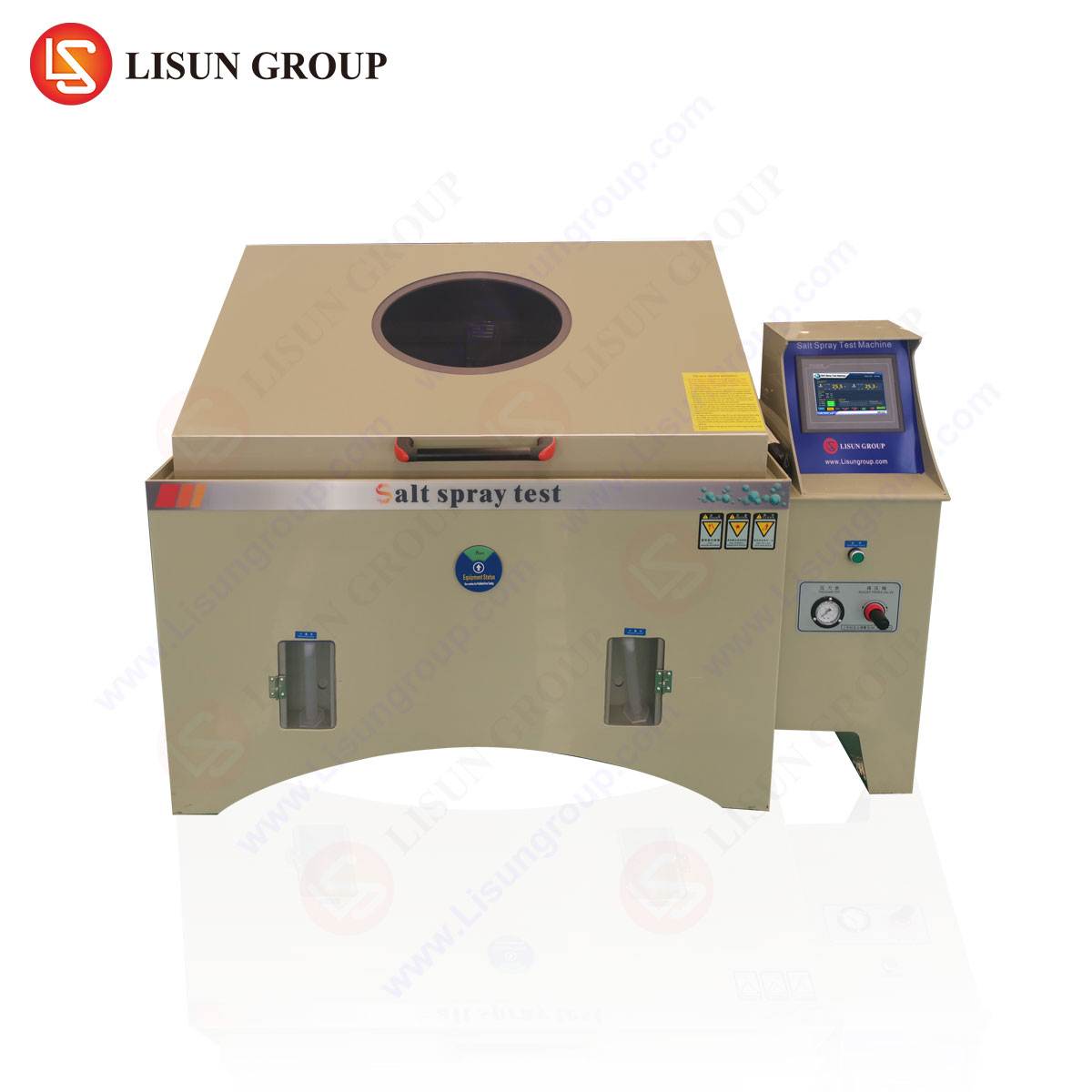
The LISUN YWX/Q-010X salt spray test chamber embodies the technological advancements described. Its design and specifications are tailored to meet the rigorous demands of modern quality laboratories.
Key Specifications:
- Internal Volume: 270 Liters (Standard model variant)
- Temperature Range: Ambient +5°C to +55°C
- Temperature Uniformity: ≤ ±2°C (per relevant standards)
- Temperature Fluctuation: ≤ ±0.5°C
- Salt Fog Settlement Rate: 1.0 ~ 2.0ml/80cm²·h (continuously adjustable)
- Test Solution: 5% NaCl solution, pH 6.5 ~ 7.2 (Neutral Spray, NSS), with capabilities for Acidified Salt Spray (ASS, pH ~3.1-3.3) and Copper-Accelerated Acetic Acid Salt Spray (CASS, pH ~3.1-3.3) tests.
- Control System: Microprocessor-based PID controller with digital display, programmable logic, and RS-485 or USB interface for PC connectivity.
- Construction: FRP (Fiber Reinforced Plastic) reinforced structure, polypropylene interior workspace, and transparent impact-resistant acrylic lid.
- Compliance: Conforms to ASTM B117, ISO 9227, JIS Z 2371, IEC 60068-2-11, and related standards.
The operational principle of the YWX/Q-010X involves a closed-loop control system. The controller maintains the saturated air barrel and chamber at setpoint temperatures (typically 47°C and 35°C, respectively, for NSS tests). Compressed air, filtered and pressurized to approximately 1 kg/cm², is bubbled through heated distilled water in the saturator, achieving near 100% relative humidity at the test temperature. This saturated air then forces the salt solution from a reservoir through a calibrated nozzle, creating a dense, uniform fog. The settlement rate is meticulously calibrated and monitored using specialized collection funnels, ensuring compliance with the 1-2 ml/80cm²/hour requirement.
Industry-Specific Applications and Use Cases
The application of advanced salt spray testing spans a diverse range of industries, each with unique failure mode concerns.
- Automotive Electronics & Components: Connectors, wiring harness terminals, engine control units (ECUs), sensor housings, and lighting assemblies are subjected to road salt, humidity, and thermal cycling. The YWX/Q-010X is used to validate the performance of zinc-nickel plating on brake component connectors or the conformal coating on a PCB within a transmission control module, ensuring functionality over a vehicle’s lifespan.
- Aerospace and Aviation Components: While subject to more specialized tests, baseline corrosion resistance for non-critical interior electronic housings, cable lugs, and ground support equipment connectors is often verified using neutral salt spray tests to meet standards like MIL-STD-810.
- Electrical & Electronic Equipment / Industrial Control Systems: Enclosures for programmable logic controllers (PLCs), switchgear cabinets, industrial networking hardware, and motor drives are tested to ensure their protective coatings (powder coating, e-coat) can withstand corrosive industrial atmospheres. A 500-hour test can simulate years of exposure in a chemical plant environment.
- Telecommunications Equipment: Outdoor base station components, antenna housings, and broadband enclosures use salt spray testing to qualify aluminum alloy anodizing processes and the sealing integrity of gasketed joints.
- Medical Devices: For devices used in coastal regions or requiring frequent chemical disinfection (e.g., housings for patient monitors, surgical tool casings), testing ensures that stainless steel passivation or medical-grade polymer coatings resist pitting and cosmetic degradation.
- Lighting Fixtures: Outdoor LED street lights, architectural floodlights, and marine navigation lights are exposed to severe saline environments. Testing evaluates the integrity of die-cast aluminum housings, the adhesion of thermal interface materials, and the resistance of optical lens coatings to fogging and hazing.
- Consumer Electronics & Household Appliances: The increasing use of electronics in kitchens (smart appliances) and bathrooms (personal care devices) subjects them to salty, humid air. Testing validates the corrosion resistance of internal metal brackets, shielding cans, and external decorative trims.
- Electrical Components & Cable Systems: Switches, sockets, circuit breakers, and cable termination lugs are tested to ensure safe, low-resistance electrical connections are maintained despite corrosive atmospheres that could lead to overheating and failure.
Competitive Advantages of Precision-Engineered Test Chambers
The value proposition of a chamber like the YWX/Q-010X lies in its contribution to test integrity and operational efficiency, which directly translates to higher product quality and lower lifecycle costs.
1. Enhanced Data Credibility and Reproducibility: The precision temperature control and consistent fog settlement eliminate key variables. This allows for direct, meaningful comparison between batches tested months apart and enables reliable correlation between accelerated test hours and real-world service years. The integrated data logging provides an immutable record for compliance reporting and defense of product claims.
2. Reduced Operational Variability and Waste: Automated systems with self-diagnostic alerts minimize operator-dependent errors. Stable conditions reduce the incidence of invalid tests, saving significant costs associated with scrapped test samples, technician time, and delayed product releases.
3. Flexibility for Comprehensive Test Regimes: The ability to easily configure the chamber for NSS, ASS, and CASS tests with precise pH control allows a single asset to support a wider range of material evaluation protocols, from testing decorative chrome plating (CASS) to evaluating anodized aluminum (ASS).
4. Long-Term Reliability and Lower Total Cost of Ownership: The use of corrosion-resistant materials in critical wear points (nozzles, air lines, reservoir) reduces maintenance frequency and downtime. Robust construction ensures chamber longevity, protecting the capital investment.
Integrating Advanced Testing into a Holistic Quality Framework
It is crucial to position accelerated salt spray testing within a broader product validation strategy. While it is a powerful tool, it is not a standalone predictor of field performance. Corrosion is a multi-factor phenomenon involving UV radiation, thermal cycling, mechanical stress, and pollutant gases. Therefore, the most effective quality programs use salt spray testing in conjunction with other environmental stress tests—such as cyclic corrosion tests (CCT), humidity cycling, and UV weathering—to build a more complete reliability model. The data from controlled Cass tests feed into Failure Mode and Effects Analysis (FMEA) and inform Design for Reliability (DfR) initiatives, creating a closed-loop system where test results directly improve material selection, design geometry, and manufacturing processes.
Conclusion
The optimization of product quality in corrosion-prone applications is fundamentally linked to the precision and reliability of the underlying test methodologies. Advanced Cass test chambers, through their sophisticated control systems, robust construction, and adherence to international standards, provide the necessary environmental fidelity to generate actionable, high-integrity data. As exemplified by the technical capabilities of the LISUN YWX/Q-010X, modern equipment transforms salt spray testing from a qualitative pass/fail checkpoint into a quantitative engineering tool. This enables manufacturers across the electrical, automotive, aerospace, and consumer goods sectors to make empirically grounded decisions, ultimately leading to products with enhanced durability, safety, and customer satisfaction in the global marketplace.
Frequently Asked Questions (FAQ)
Q1: What is the critical difference between Neutral Salt Spray (NSS), Acetic Acid Salt Spray (AASS), and Copper-Accelerated Salt Spray (CASS) tests, and when should each be used?
A1: The tests differ primarily in the pH and chemistry of the solution, which accelerates different corrosion mechanisms. NSS (pH ~6.5-7.2) is a general test for metallic coatings and organic finishes. AASS (pH ~3.1-3.3) is more aggressive, used for evaluating anodized aluminum or comparing the relative quality of similar coatings. CASS (pH ~3.1-3.3 with added copper chloride) is the most severe, specifically designed for rapid testing of decorative copper-nickel-chromium or nickel-chromium electroplates. The choice is dictated by the material system and the relevant industry standard.
Q2: How does chamber temperature stability directly impact test results?
A2: Temperature is a primary driver of chemical reaction rates. Instability or gradients within the chamber can cause uneven corrosion rates across the test specimen load, leading to non-representative and non-reproducible results. A fluctuation of just ±2°C can alter corrosion kinetics sufficiently to change time-to-failure metrics, making comparative analysis between different test runs invalid. Precise PID control, as seen in advanced chambers, is essential for maintaining the isothermal conditions mandated by testing standards.
Q3: Can salt spray test data be directly correlated to a product’s expected service life in years?
A3: Not directly in a universal 1:1 ratio. Accelerated salt spray testing is a comparative, ranking tool rather than an absolute predictor. A correlation factor between test hours and field years is highly specific to the material, coating system, and the actual environmental profile (e.g., marine, industrial, rural). Such correlations are typically developed empirically by a company over time by comparing test data with field performance history for similar products. The test’s primary value is in consistently identifying inferior materials or processes relative to a known baseline.
Q4: Why is the air saturator tower a critical component in a modern salt spray chamber?
A4: The saturator pre-heats and humidifies the compressed air to the chamber temperature before it atomizes the salt solution. If cold, dry air were used, it would cool the solution at the nozzle, causing evaporation and increasing the salt concentration of the droplets. It could also lower the chamber temperature. This would result in an inconsistent, non-standard fog settlement rate and droplet chemistry, violating the controlled parameters of the test standard and producing unreliable data.
Q5: What are the key maintenance routines required to ensure the ongoing accuracy of an advanced chamber like the YWX/Q-010X?
A5: Regular maintenance is vital. Key routines include: daily checking and adjustment of the salt solution level and pH; weekly cleaning of the chamber interior and nozzles to prevent salt buildup; monthly calibration of the temperature sensors and verification of the fog collection rate using calibrated funnels; and periodic inspection/replacement of the saturated air barrel’s water level and the air compressor’s filters and dryer to ensure clean, dry, oil-free input air. Adherence to the manufacturer’s scheduled maintenance plan is essential for sustained compliance.