






An Analytical Examination of the PA100A Web Stop Probe for Enclosure Safety Verification
Introduction to Enclosure Safety and the Role of Simulated Probes
The integrity of an electrical enclosure is the primary defense against accidental contact with hazardous live parts, a fundamental tenet of product safety enshrined in international standards such as IEC 61032 and its regional derivatives (e.g., UL 60950-1, IEC 60529-IP Code). These standards mandate that enclosures must prevent access by standardized test probes representing parts of the human body or common objects. Among these, the test finger, or “web stop probe,” simulates the back of a hand and the junction between fingers—a critical area where inadvertent contact can occur during exploration or routine interaction. The LISUN PA100A Web Stop Probe is a precision-engineered instrument designed to rigorously and reproducibly verify compliance with these stringent safety requirements. Its application spans industries where user safety is non-negotiable, from household appliances to aerospace components, ensuring that gaps, openings, and joints in enclosures do not constitute an electric shock hazard.
Anatomic Simulation and Mechanical Design Principles of the PA100A
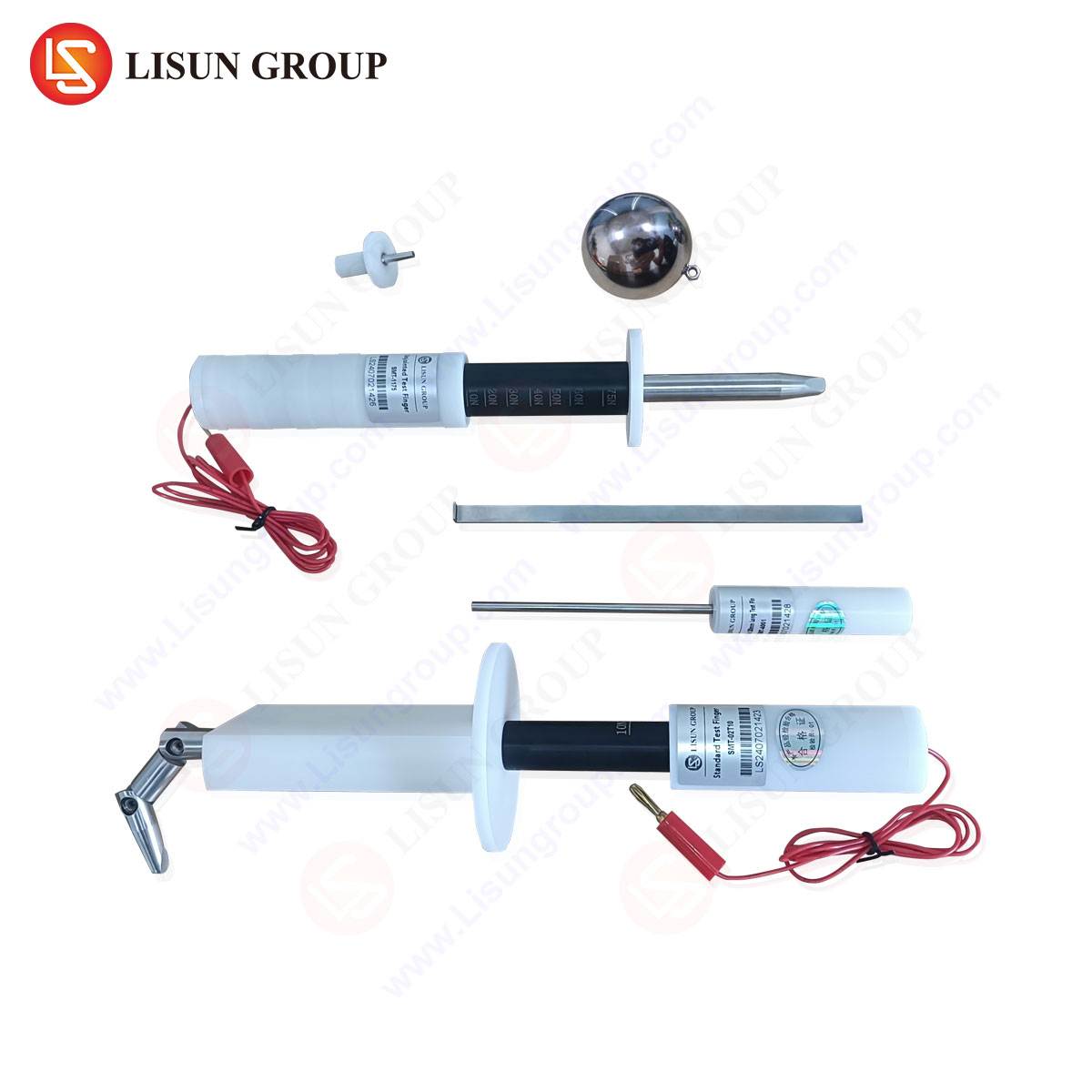
The design of the PA100A is not arbitrary; it is a direct physical translation of the dimensional and force specifications outlined in IEC 61032, Figure 2 (Test Probe B). Its primary function is to simulate the attempt by the back of a hand and the web between the thumb and forefinger to penetrate an enclosure. The probe consists of a rigid, jointed “finger” section with a specific radius and a pivotal “web” stop. The joint allows for articulation, mimicking the natural folding of knuckles, while the stop prevents over-insertion beyond the simulated hand’s geometry.
The probe is constructed from high-strength, insulating materials to prevent electrical conductivity during testing, which could yield false-negative results. The articulation point is calibrated to apply a standardized force, typically 10 N ± 1 N, as per the standard. This precise force application is critical; excessive force could deform a compliant enclosure unfairly, while insufficient force might not adequately test a rigid opening. The LISUN Test Finger incorporates a precision spring mechanism and force gauge (or is used in conjunction with a calibrated force application apparatus) to ensure this parameter is consistently met, a factor that distinguishes laboratory-grade equipment from generic replicas.
Operational Methodology and Compliance Testing Protocol
Deploying the PA100A probe follows a formalized test sequence to ensure comprehensive assessment. The probe is articulated and applied to every external surface of the equipment under test (EUT), including seams, vents, openings around controls, and interfaces between removable parts. The test is conducted with the probe both straight and at various angles, up to 90 degrees at the joint, to simulate different approaches.
The definitive pass/fail criterion is electrical. During the test, the probe is connected to a low-voltage (not exceeding 40V) continuity circuit, often in series with a signal lamp or a more sophisticated detection unit. The probe itself, or a metallic foil wrapped around it representing the skin surface, serves as one contact. The internal hazardous live parts of the EUT are electrically connected to the other side of the circuit. If contact is made, the circuit closes, and the indicator activates, signifying a failure. The LISUN Test Probe system is designed for seamless integration into such test setups, providing reliable electrical connection points.
Table 1: Typical PA100A Web Stop Probe Test Sequence
| Step | Action | Objective |
| :— | :— | :— |
| 1 | Visual Inspection & Identification | Map all potential access points on the EUT enclosure. |
| 2 | Probe Configuration | Set articulation joint to required angles (0°, 90°, etc.). |
| 3 | Force Calibration | Verify applied force is 10 N ± 1 N. |
| 4 | Application & Articulation | Apply probe to each access point, attempting to touch live parts. |
| 5 | Electrical Monitoring | Continuously monitor the detection circuit for continuity. |
| 6 | Documentation | Record results for each test point, including force and angle used. |
Cross-Industry Application Scenarios and Risk Mitigation
The universality of the enclosure safety principle makes the PA100A a vital tool across disparate sectors.
- Electrical and Electronic Equipment & Industrial Control Systems: Here, panels often house high-voltage terminals, busbars, and relay contacts. A vent slot for cooling must prevent the web of a hand from bridging a dangerous potential. The PA100A verifies that baffles or mesh within the vent are appropriately sized.
- Household Appliances and Consumer Electronics: From kitchen mixers to gaming consoles, user interaction is frequent. Openings for ventilation, cord wraps, or button interfaces are probed to ensure internal mains wiring or PCB-mounted components remain inaccessible during normal use and after foreseeable mishandling.
- Automotive Electronics and Aerospace Components: Under-hood control units or in-flight entertainment system housings are subject to vibration and environmental stress. The probe test validates that gaskets and seams remain protective under static conditions, a prerequisite for dynamic durability testing.
- Lighting Fixtures and Electrical Components: Recessed light fittings, socket outlets, and switch assemblies have defined apertures. The LISUN Test Pin (a separate but related accessory for testing openings) might assess front-face access, while the PA100A evaluates whether a hand could reach behind the facade through mounting or assembly gaps.
- Medical Devices and Telecommunications Equipment: Patient-connected monitors or base station cabinets must protect both users and service technicians. The probe ensures that service panels with simple tools cannot be opened to expose live parts without first de-energizing the unit.
- Toy and Children’s Products Industry: This represents a heightened safety tier. Enclosures must be robust against curious exploration. The PA100A simulates a child’s hand, testing battery compartments and joints to prevent access to small batteries or other hazardous parts.
Technical Specifications and Calibration Traceability
The efficacy of any test instrument hinges on its adherence to published specifications and its place within a traceable calibration chain. The PA100A is manufactured to the exacting dimensions stipulated by the standard.
Key Specifications:
- Simulated Anatomy: Back of hand and web between thumb and forefinger.
- Material: High-strength insulating material (e.g., polyamide).
- Joint Articulation: 90° minimum, with positive stops.
- Standard Test Force: 10 Newtons (± 1 N).
- Dimensional Compliance: Conforms to IEC 61032 Fig. 2 / ISO 8124-1 (for toys) relevant profiles.
- Accessory Integration: Designed for use with standardized foil strips and electrical detection circuits.
Calibration focuses on the applied force and the critical dimensional geometry. A certified calibration laboratory verifies the force application mechanism using traceable force gauges and measures the probe’s profile with coordinate measuring machines (CMM). This traceability to national standards is what differentiates a LISUN Test Finger intended for certified laboratory use from an uncertified inspection tool.
Comparative Analysis Within the Test Probe Ecosystem
The PA100A exists within a family of standardized probes, each serving a distinct purpose. Understanding its specific role clarifies its importance.
- vs. Test Finger (Probe A – Jointed Test Finger): Probe A simulates a single finger. It is thinner and can access smaller openings. The PA100A (Probe B) has a larger cross-section due to the “web stop,” making it the stricter test for any opening large enough to accommodate it. An enclosure that passes the PA100A test inherently provides a higher degree of protection.
- vs. Test Pin (Probe 13): The Test Pin is a rigid, straight rod of defined diameter (e.g., 1.0 mm). It tests for direct penetration through small openings, simulating a wire or tool. Its test is fundamentally different—assessing protection against pointed objects rather than the hand. The two probes are complementary, not interchangeable.
- vs. IEC 60529 IP Code Probes: The IP code (Ingress Protection) uses probes to test against solid objects (first digit) and water (second digit). The IP “finger” is similar but not identical to the safety probe. Compliance testing often requires both sets of equipment, as they answer different questions: one for safety from shock, the other for environmental protection.
Integration in Quality Assurance and Regulatory Workflows
Incorporating PA100A testing into the product development lifecycle is a proactive risk mitigation strategy. During the design phase, physical mock-ups or 3D-printed enclosures can be tested early to identify and rectify flaws. In production, sampling plans can include probe tests as part of routine quality audits to guard against manufacturing variances, such as misaligned panels or incorrectly installed gaskets.
For regulatory submission to bodies like TÜV, UL, or Intertek, documented evidence of compliance with IEC 61032 is routinely required. Test reports must detail the equipment used (including model and calibration status, e.g., LISUN PA100A, Cal. Cert. #XYZ), the exact procedure followed, and the results for each access point. Using a recognized, calibrated instrument like the PA100A lends immediate credibility to such documentation, streamlining the certification process.
FAQ: Common Inquiries on Web Stop Probe Testing
Q1: Can a product pass if the PA100A probe can physically enter an opening but does not touch a live part?
A1: Yes, physical entry is not itself a failure. The sole failure criterion is the establishment of electrical contact between the probe (or its foil) and a hazardous live part. However, if the probe can enter deeply, it may indicate a design at the margin of compliance, warranting review for robustness over product life.
Q2: How often should the PA100A probe be calibrated?
A2: Calibration intervals are typically annual, aligning with ISO/IEC 17025 accreditation practices for test equipment. However, the interval may be shortened based on usage frequency or if the probe is subjected to mechanical shock. It must always be calibrated before critical compliance testing.
Q3: Is the PA100A suitable for testing IP (Ingress Protection) ratings?
A3: Not directly. While conceptually similar, the dimensions and application standards for IP probes (IEC 60529) differ from those for safety probes (IEC 61032). A dedicated IP test finger (IP2X) should be used for environmental protection ratings. Some laboratories use adapters or specific models designed for dual-standard compliance, but the test purposes remain distinct.
Q4: What is the significance of the 10 N force?
A4: The 10 N force (approximately 1 kgf) is a consensus value representing a reasonable simulation of casual, non-deliberate pressure exerted by a person. It is a repeatable metric that ensures tests are neither overly punitive nor dangerously lenient, creating a consistent global benchmark for safety evaluation.
Q5: For very small products, is the web stop probe always applicable?
A5: The applicability is defined by the standard and product safety requirements. If an enclosure is so small that the simulated “web” of a hand cannot logically approach it, the test may be deemed not applicable. However, the related Test Pin or smaller Jointed Test Finger would still be used to evaluate accessible openings. The governing end-product standard (e.g., IEC 62368-1 for AV/IT equipment) provides the definitive application rules.