




Advancements in Portable Water Testing Equipment for On-Site Analysis in Electrical and Electronic Applications
Introduction to On-Site Water Ingress Evaluation
The integrity of electrical and electronic equipment against environmental ingress, particularly water, is a non-negotiable design and validation criterion across numerous industries. Traditional laboratory-based testing, while controlled, often fails to capture the dynamic, real-world conditions equipment faces during installation, operation, or maintenance. This disconnect has driven a significant shift towards robust, reliable on-site analysis. Portable water testing equipment now enables engineers and quality assurance professionals to perform immediate, location-specific ingress protection (IP) testing, dramatically reducing downtime, logistical costs, and the risk of field failures. This technical article examines the principles, specifications, and critical applications of such portable systems, with a detailed focus on the LISUN JL-XC Series waterproof test apparatus as a paradigm of modern field-deployable technology.
Core Principles of Portable Ingress Protection Testing
Portable water testing equipment operates on the same fundamental principles as fixed laboratory installations but is engineered for mobility, rapid deployment, and operational simplicity. The primary objective is to simulate exposure to water in various forms—dripping, spraying, splashing, jetting, or immersion—as defined by the IEC 60529 standard (International Protection Marking, or IP Code). Key testing modalities include IPX1 through IPX9K, each representing a specific severity and angle of water exposure. For instance, IPX4 (splashing water from all directions) and IPX5/IPX6 (water jetting) are common requirements for outdoor enclosures, while IPX7 (temporary immersion) and IPX8 (continuous immersion under specified pressure) are critical for submersible components.
The equipment must generate calibrated, repeatable water pressure and flow rates while maintaining precise nozzle distance and angle relative to the device under test (DUT). Advanced portable systems incorporate integrated pumps, precision pressure regulators, flow meters, and standardized test nozzles to ensure compliance with IEC 60529, ISO 20653 (road vehicles), and other derivative standards. The transition from laboratory to field necessitates rigorous attention to the equipment’s own environmental robustness, power autonomy, and calibration stability.
Specifications and Architecture of the LISUN JL-XC Series
The LISUN JL-XC Series embodies the evolution of portable waterproof testing, designed as a comprehensive, modular system for field engineers. Its architecture prioritizes versatility, accuracy, and user safety in diverse operational environments.
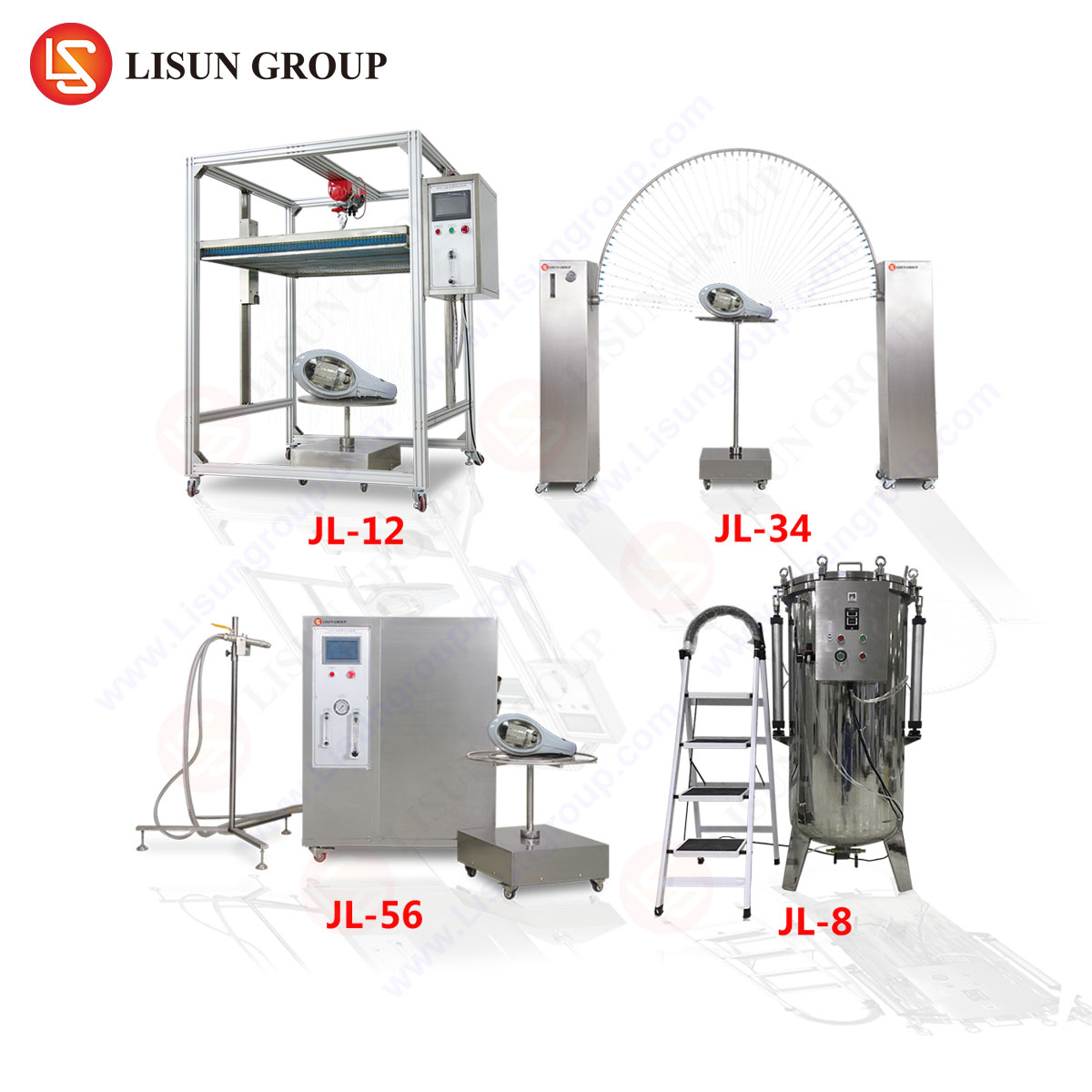
- Modular Test Nozzle System: The core of the JL-XC is its interchangeable nozzle kit, compliant with IEC 60529 specifications. This includes the oscillating tube for IPX1/IPX2 (dripping), the sprinkler nozzle for IPX3/IPX4 (spraying), the straight jet nozzles for IPX5 (6.3mm) and IPX6 (12.5mm), and the high-pressure, high-temperature nozzle for IPX9K. Each nozzle couples to a manifold with integrated pressure and flow sensors.
- Integrated Pump and Control Unit: A high-efficiency, low-noise diaphragm pump provides the necessary pressure range, from low-flow sprinkling at ~10 kPa up to high-pressure jetting exceeding 10,000 kPa for IPX9K tests. A digital microcontroller regulates pump output, continuously monitoring and displaying real-time pressure (kPa/psi) and flow rate (L/min). The unit features pre-programmed test profiles for each IPX level, automating test duration and parameters.
- Power and Portability: The system is equipped with a high-capacity lithium-ion battery pack, enabling over 4 hours of continuous operation, and supports DC input from vehicle power sources. Its construction utilizes a lightweight, impact-resistant polymer and stainless-steel frame, with all electronics housed in an IP65-rated enclosure for self-protection. The total kit weight is under 18 kg, facilitating transport.
- Data Logging and Compliance: An integrated digital display logs pressure, flow, and test duration. Optional Bluetooth connectivity allows for pairing with a tablet or smartphone to generate formal test reports, including timestamp, GPS location (for audit trails), and environmental conditions (ambient temperature logged via sensor).
Industry-Specific Use Cases for Field-Based Water Testing
The application of portable water testing equipment spans sectors where electrical safety and reliability are paramount. The JL-XC Series facilitates immediate validation and troubleshooting in these contexts.
- Automotive Electronics and Electric Vehicles: On-production lines or at component suppliers, testing battery management system (BMS) enclosures, electronic control units (ECUs), sensor housings (LiDAR, radar), and charging port assemblies for resistance to high-pressure washer jets (IPX5/6/9K) is critical. Field testing is also used to diagnose water ingress in vehicles post-assembly or after reported issues.
- Telecommunications Equipment: Outdoor cabinets for 5G infrastructure, fiber optic terminal enclosures, and submarine cable repeaters require validation against driving rain (IPX3/4) and powerful jet sprays (IPX5/6). Portable testers allow network engineers to verify the seal integrity of enclosures after installation or maintenance on cell towers and remote sites.
- Industrial Control Systems: Enclosures for programmable logic controllers (PLCs), motor drives, and human-machine interfaces (HMIs) installed in washdown environments (e.g., food processing, pharmaceuticals) must withstand frequent sanitization. On-site IPX4/IPX5/IPX6 testing ensures compliance with hygiene standards without removing panels from production facilities.
- Aerospace and Aviation Components: While ultimate certification requires lab testing, portable systems are used for rapid pre-screening of avionics bay enclosures, external lighting fixtures, and ground support equipment for resistance to rain and condensation.
- Lighting Fixtures: Outdoor, industrial, and underwater lighting (IP67/IP68) can be verified on-site after installation. For architectural lighting on buildings or bridges, performing an IPX4 test confirms resilience against wind-driven rain.
- Medical Devices: Portable diagnostic equipment, surgical tool handles designed for sterilization, and bedside monitors used in humid environments require splash-proof validation. On-site testing at manufacturing or healthcare facilities ensures ongoing compliance.
- Electrical Components and Wiring Systems: Connectors, switches, sockets, and junction boxes destined for outdoor or harsh environments are verified for ingress protection before system integration, preventing costly recalls.
Competitive Advantages of Integrated Portable Testing Solutions
The JL-XC Series and similar advanced systems offer distinct advantages over older field methods, such as improvised hosing or reliance on distant laboratory services.
- Quantitative Accuracy Over Subjective Assessment: By providing calibrated pressure and flow data, it removes subjectivity, ensuring tests are reproducible and legally defensible for compliance audits.
- Time and Cost Efficiency: Eliminates the need to dismantle and ship large enclosures or assemblies to a lab, minimizing equipment downtime from weeks to hours. This is particularly valuable for large-scale infrastructure.
- Preventive Maintenance and Failure Diagnosis: Enables routine proactive testing of seals and gaskets on deployed equipment, identifying degradation before catastrophic failure. It can also pinpoint the exact location of ingress during troubleshooting.
- Enhanced Safety: Controlled, standardized testing is safer than improvised high-pressure water applications, which can damage equipment or injure personnel. The system includes safety interlocks and grounded construction.
- Regulatory and Standards Alignment: Direct adherence to IEC/ISO parameters ensures that field data is consistent with laboratory certification data, supporting quality management systems like ISO 9001 and IATF 16949.
Scientific Data and Standards Integration
Effective portable testing is rooted in metrological traceability. The following table summarizes key parameters for common IP tests, which systems like the JL-XC are designed to replicate precisely:
| IP Code | Test Principle | Water Nozzle / Method | Water Pressure | Flow Rate | Duration | Applicable Standard |
|---|---|---|---|---|---|---|
| IPX3 | Oscillating Tube/Sprinkler | Spray nozzle, 60° arc | 50–150 kPa | 0.07 L/min per hole | 5 min minimum | IEC 60529 |
| IPX4 | Oscillating Tube/Sprinkler | Spray nozzle, 180° arc | 50–150 kPa | 0.07 L/min per hole | 5 min minimum | IEC 60529 |
| IPX5 | Water Jet | 6.3 mm diameter nozzle | 30 kPa at distance | 12.5 ±0.625 L/min | 3 min minimum | IEC 60529 |
| IPX6 | Powerful Water Jet | 12.5 mm diameter nozzle | 100 kPa at distance | 100 ±5 L/min | 3 min minimum | IEC 60529 |
| IPX7 | Temporary Immersion | Tank immersion | – | – | 30 min at 1m depth | IEC 60529 |
| IPX9K | High-Temp/High-Pressure Jet | Specified 0° nozzle | 8,000–10,000 kPa | 14–16 L/min | 30 sec per position | ISO 20653, DIN 40050-9 |
Portable systems for immersion (IPX7/8) typically utilize a separate, portable pressure vessel rather than a large tank. The scientific rigor comes from maintaining these parameters despite variable field conditions like water source quality or ambient temperature, which the JL-XC’s closed-loop pump and regulator system is designed to compensate for.
Conclusion: The Imperative for Field-Capable Validation
The trend towards decentralized, immediate quality assurance is irreversible. As electrical and electronic systems permeate more demanding environments, the ability to validate their environmental resilience on-site transitions from a convenience to a critical component of the product lifecycle. Portable water testing equipment, as exemplified by the technical capabilities of the LISUN JL-XC Series, provides the necessary bridge between controlled laboratory certification and the assurance of real-world performance. It empowers industries to enhance reliability, safety, and compliance while achieving significant operational efficiencies. The continued integration of digital data logging, wireless connectivity, and broader environmental simulation (e.g., dust combined testing) will further solidify the role of these systems as indispensable tools for engineers across the advanced manufacturing spectrum.
Frequently Asked Questions (FAQ)
Q1: Can a portable tester like the JL-XC Series truly replicate the accuracy of a fixed laboratory test chamber?
A: For water ingress testing per IEC 60529, the standard defines specific test methods, nozzles, pressures, and flow rates. A calibrated portable system like the JL-XC replicates these core parameters exactly. The primary variable in the field is the stability of the DUT mounting and environmental conditions (e.g., wind), which the operator must control. The water pressure and flow generation mechanism is functionally identical to a lab system, ensuring equivalent accuracy for the IPX1-X6 and X9K tests.
Q2: How is the water quality managed during field testing to prevent nozzle clogging or results skewing?
A: The JL-XC Series includes an integrated particulate filter in its water intake line. For optimal performance and to prevent mineral buildup, it is recommended to use deionized or distilled water, which can be carried in separate containers. The system’s design allows for easy flushing and cleaning of nozzles. Regular maintenance, as per the calibration schedule, ensures long-term accuracy.
Q3: What is the most complex IP test to perform in the field, and how does the equipment facilitate it?
A: IPX9K (high-pressure, high-temperature steam jet cleaning simulation) is particularly challenging due to its extreme parameters (80°C water at 8-10 MPa). Portable systems designed for this test, like the JL-XC with its IPX9K module, incorporate an electric water heater with precise thermostat control, a heavy-duty pump, and specialized safety shrouds. They are engineered to manage the high energy and safety requirements in a field-deployable format.
Q4: For IPX7 and IPX8 immersion tests, how is portability achieved?
A: Full immersion tests are not performed with a spray apparatus. Instead, portable testing for these codes utilizes a compact, pressurized immersion vessel or a collapsible test tank paired with a portable air pressure pump. The DUT is placed inside the vessel, which is then filled with water and pressurized to the required depth equivalent (e.g., 1 meter for IPX7, or a specified greater pressure for IPX8). This equipment is separate from but complementary to the spray/jet tester.
Q5: How frequently should a portable water testing instrument be calibrated, and can it be done on-site?
A: Calibration intervals depend on usage frequency and adherence to quality standards (e.g., annual calibration is common). While basic field checks of pressure and flow can be performed using calibrated gauges, full system calibration against a traceable standard typically requires returning the unit or its key sensors (pressure transducer, flow meter) to an accredited metrology lab. The JL-XC design facilitates modular removal of these sensors for calibration without shipping the entire unit.