




Advancements in Portable Water Testing Equipment for On-Site Analysis: Ensuring Reliability in Electrified Environments
Introduction: The Imperative for Field-Deployable Water Ingress Verification
The proliferation of electrical and electronic systems across diverse sectors—from automotive electronics to medical devices—has necessitated rigorous environmental testing protocols to ensure operational safety and long-term reliability. Among these, protection against the ingress of water and particulate matter is paramount. Traditional laboratory-based testing, while accurate, often introduces logistical delays, high costs, and the risk of damage during transit for large or integrated systems. Consequently, the industry demand for sophisticated, portable water testing equipment capable of delivering laboratory-grade accuracy in field settings has intensified. This technical article examines the critical role of such equipment, with a detailed focus on the implementation and advantages of the LISUN JL-XC Series waterproof test apparatus for on-site analysis. This equipment enables engineers and quality assurance professionals to perform standardized ingress protection (IP) testing, specifically IPX5, IPX6, and IPX6K ratings, directly at manufacturing sites, installation points, or maintenance facilities.
Fundamental Principles of Ingress Protection (IP) Code Testing
The International Electrotechnical Commission (IEC) standard 60529 classifies the degrees of protection provided by enclosures through an IP Code. The code’s format, IPXY, defines levels of protection against solid objects (first numeral, X) and liquids (second numeral, Y). For water ingress, key jet and spray tests include:
- IPX5: Low-pressure water jet test from a 6.3mm nozzle at 12.5 L/min ±5% from a distance of 2.5–3 meters for at least 3 minutes per square meter, minimum duration 15 minutes.
- IPX6: Powerful water jet test from a 12.5mm nozzle at 100 L/min ±5% from a distance of 2.5–3 meters for at least 3 minutes per square meter, minimum duration 3 minutes.
- IPX6K: High-pressure, high-temperature water jet test (used primarily in automotive and heavy industry) from a 6.3mm nozzle at 75 L/min ±5% at 8,000–10,000 kPa, water temperature of 80°C ±5°, from a distance of 0.10–0.15 meters for at least 3 minutes.
The core testing principle involves subjecting the equipment under test (EUT) to controlled, high-velocity water jets to simulate exposure to heavy seas, road spray, or high-pressure cleaning. The post-test inspection involves a thorough examination for any water penetration that could damage electrical components, impair functionality, or create safety hazards such as short circuits or ground faults.
Architectural Design of Portable Water Jet Testing Systems
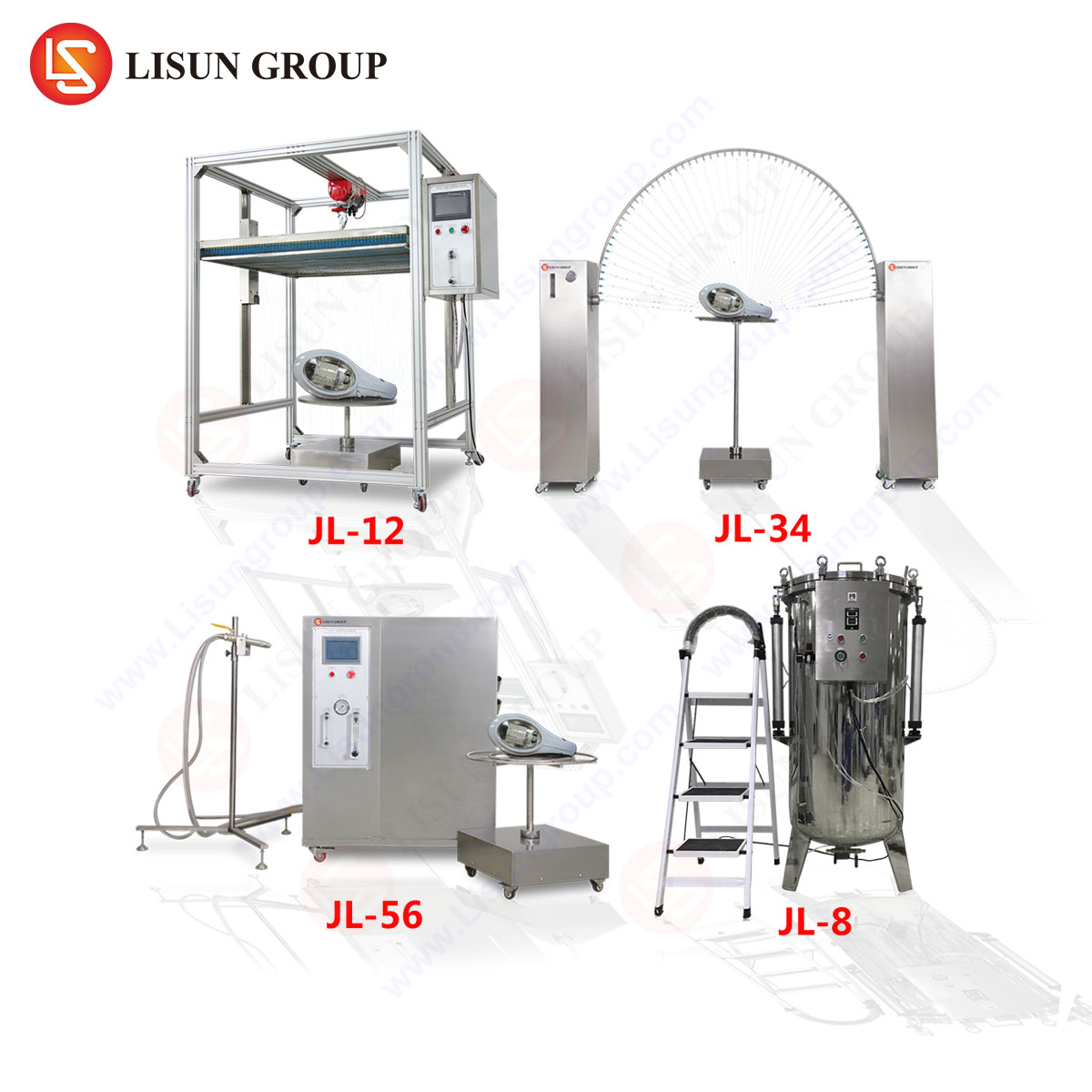
Portable systems like the LISUN JL-XC Series are engineered to replicate the hydraulic conditions specified in IEC 60529 while being contained within a mobile framework. The design typically integrates several key subsystems:
- High-Pressure Pump Unit: A compact, yet powerful, multi-stage centrifugal or positive displacement pump capable of generating the precise flow rates and pressures required for IPX5, IPX6, and IPX6K tests. The pump must maintain stable output despite fluctuations in mains water supply.
- Thermal Regulation Module (for IPX6K): An integrated heating and closed-loop temperature control system to elevate and maintain water temperature at 80°C, a critical requirement for testing automotive electronics like engine control units (ECUs), sensors, and lighting fixtures intended for under-hood applications.
- Nozzle Assembly and Positioning Apparatus: Interchangeable, calibrated nozzles (6.3mm and 12.5mm) mounted on a adjustable, often telescopic, boom or tripod. This allows for precise distance and angular positioning relative to the EUT, ensuring consistent test application across its entire surface.
- Flow and Pressure Metrology: In-line flowmeters (typically turbine or variable area type) and pressure transducers provide real-time feedback. Data is often displayed on a digital control panel, allowing operators to verify compliance with standard parameters throughout the test duration.
- Mobile Chassis and Containment: The entire system is mounted on a wheeled chassis with integrated water containment and recovery sumps. This design minimizes water spillage at the test site, a crucial feature for indoor facilities, and enhances operational safety.
Technical Specifications and Operational Parameters of the LISUN JL-XC Series
The LISUN JL-XC Series embodies a fully integrated, portable solution for high-pressure water ingress testing. Its specifications are engineered to meet and exceed the demands of field-based compliance verification.
Table 1: Key Specifications of the LISUN JL-XC Series Portable Water Test Equipment
| Parameter | Specification for IPX5/IPX6 Mode | Specification for IPX6K Mode | Notes |
| :— | :— | :— | :— |
| Applicable Standards | IEC 60529, ISO 20653, GB/T 4208 | IEC 60529, ISO 20653, DIN 40050-9 | |
| Test Grades | IPX5, IPX6 | IPX6K | Selectable via control interface |
| Nozzle Diameter | 6.3 mm (IPX5), 12.5 mm (IPX6) | 6.3 mm | Interchangeable, calibrated |
| Water Flow Rate | 12.5 L/min ±5% (IPX5), 100 L/min ±5% (IPX6) | 75 L/min ±5% | Monitored via digital flowmeter |
| Jet Pressure | As per standard for given flow & nozzle | 8,000 – 10,000 kPa (80–100 bar) | Regulated by pump and control system |
| Water Temperature | Ambient | 80°C ±5°C | Heated via integrated 18kW heater |
| Test Distance | 2.5 – 3.0 m (adjustable) | 0.10 – 0.15 m (adjustable) | Adjustable boom/tripod |
| Power Supply | 380V AC, 50/60Hz, 3-Phase | | Typical requirement; configurable |
| Dimensions (approx.) | 1500 (L) x 1000 (W) x 1500 (H) mm | | Mobile cart design |
| Water Supply | Connected mains or external tank (>200L) | | Requires pre-filtration |
Industry-Specific Use Cases and Application Scenarios
The portability of the JL-XC Series unlocks verification capabilities across the product lifecycle, from R&D prototyping to post-installation audits.
- Automotive Electronics and Components: Manufacturers of electronic control units (ECUs), battery management systems (BMS) for EVs, LED headlamps, and in-cabin infotainment systems utilize on-site testing to validate housings against ISO 20653 (the automotive equivalent of IEC 60529). Testing door seals, connector systems, and under-body components with IPX6K (high-temperature/high-pressure) simulations is critical before vehicle assembly or after component replacement.
- Telecommunications Equipment: Outdoor cabinets for 5G infrastructure, fiber optic terminal enclosures, and submarine cable junction boxes must withstand driving rain and pressurized cleaning. Portable testing allows network operators to verify the integrity of field-installed enclosures without removing them, ensuring network resilience.
- Industrial Control Systems: Enclosures for programmable logic controllers (PLCs), motor drives, and human-machine interfaces (HMIs) installed in factories, water treatment plants, or offshore platforms are exposed to high-pressure washdowns. On-site testing with equipment like the JL-XC Series confirms the IP rating is maintained after installation and field modifications.
- Aerospace and Aviation Components: While subject to more stringent environmental standards (e.g., DO-160), preliminary or acceptance testing of exterior lighting, avionics bay seals, and ground support equipment enclosures can be efficiently conducted using portable IPX6-grade equipment at maintenance hangars.
- Lighting Fixtures: Manufacturers of industrial, street, and architectural LED luminaires require IP65/IP66/IP67 ratings. Portable testing enables large fixture verification and spot-checks on production batches directly on the factory floor.
- Medical Devices: Equipment intended for hospital environments, such as portable diagnostic units or surgical tool consoles, may require protection against cleaning jets. On-site verification ensures compliance with medical device regulations without disrupting sterile laboratory environments.
Competitive Advantages of Integrated Portable Testing Solutions
Deploying a system such as the LISUN JL-XC Series offers distinct operational and technical benefits over reliance on fixed laboratory testing or less capable portable units.
- Accuracy and Compliance Assurance: The integrated metrology (flow, pressure, temperature for IPX6K) and use of calibrated nozzles ensure the test parameters strictly adhere to IEC/ISO standards. This eliminates the uncertainty associated with improvised field tests, providing legally defensible data for certification and quality audits.
- Operational Efficiency and Cost Reduction: Eliminating the need to ship large, delicate, or integrated systems to an external lab saves significant time and cost. It also prevents potential transit damage. Testing can be scheduled immediately during production runs or after field installation, accelerating time-to-market and maintenance cycles.
- Enhanced Diagnostic Capability: Performing the test on-site allows engineers to observe the test in real-time, identify specific points of failure (e.g., a particular seam or gasket), and make immediate adjustments. This iterative process is invaluable during product development and troubleshooting.
- Versatility Across Standards: The ability to switch between IPX5, IPX6, and the demanding IPX6K test with a single, reconfigurable unit makes it a future-proof investment for companies supplying components to multiple industries, particularly the automotive sector.
- Improved Safety Management: The built-in containment and recovery system controls water runoff, protecting the test site’s electrical infrastructure and preventing slip hazards. This is a critical feature for use in manufacturing or warehouse environments.
Integration with Broader Quality Assurance and Reliability Engineering Frameworks
Portable water ingress testing should not be an isolated activity. Data generated by the JL-XC Series feeds into broader reliability engineering and failure analysis processes. Quantitative data (precise pressure, flow, temperature) and qualitative results (location and severity of ingress) can be logged in product lifecycle management (PLM) or quality management system (QMS) software. This creates a traceable history for each product serial number or component batch. Furthermore, correlation studies can be performed between on-site test results and long-term field failure rates, allowing for the refinement of design standards and sealing specifications. For industries governed by functional safety standards (e.g., ISO 26262 for automotive), such documented verification of physical protection layers is a crucial component of the safety case.
Conclusion
The evolution of portable water testing equipment represents a significant advancement in practical quality assurance for electrically powered products. By bringing standardized, high-fidelity IP Code testing to the point of manufacture, installation, or service, organizations can achieve higher levels of product reliability, safety, and compliance with greater efficiency. Systems like the LISUN JL-XC Series, with their rigorous adherence to international standards, multi-test capability, and integrated design, provide the technical foundation for this decentralized testing paradigm. As electronic systems continue to permeate more demanding environments, the role of robust, verifiable ingress protection—and the field-deployable equipment to confirm it—will only grow in critical importance.
Frequently Asked Questions (FAQ)
Q1: Can the JL-XC Series be used to test for IPX7 (immersion) or IPX8 (continuous immersion) ratings?
A1: No. The JL-XC Series is specifically designed for jet and spray tests (IPX5, IPX6, IPX6K). IPX7 and IPX8 immersion testing requires a separate apparatus, typically a pressurized tank or diving bell system, to subject the enclosure to controlled immersion at specified depths and durations. These are fundamentally different test methodologies.
Q2: What are the primary site requirements for operating this portable equipment?
A2: Key requirements include: a stable, level floor area of approximately 3m x 3m; access to a three-phase electrical power supply (e.g., 380V/50Hz) with sufficient current capacity for the pump and heater; a source of clean water (mains connection or a large external tank); and adequate drainage or a plan for managing the recovered test water. Pre-filtration of inlet water is recommended to prevent nozzle clogging.
Q3: How is the test distance and nozzle angle maintained accurately during a manual test?
A3: The JL-XC Series incorporates a positioning apparatus, such as a calibrated telescopic boom or a tripod with distance markers. The operator sets the nozzle at the prescribed distance (e.g., 2.5-3m for IPX6). While the test is running, the operator systematically moves the nozzle to cover all possible angles of incidence on the EUT’s surface, as required by the standard. For highly repeatable testing, some users mount the nozzle in a fixed position and rotate the EUT on a turntable.
Q4: Is calibration required, and if so, for which components?
A4: Yes, periodic calibration is essential to maintain traceability and accuracy. The critical components requiring calibration are the flowmeter(s) and the pressure transducer(s). The nozzles themselves are precision-machined parts and should be inspected for wear or damage regularly. The temperature sensor and control system for the IPX6K mode also require calibration. Calibration intervals should follow the manufacturer’s recommendations or the company’s internal quality procedures, typically annually.
Q5: Can this equipment simulate exposure to corrosive fluids like salt spray?
A5: The standard JL-XC Series is designed for use with fresh water only, as per IEC 60529. Introducing salt or other corrosive chemicals into the system would damage the pump, seals, and metrology components. Corrosion resistance testing, such as salt spray (fog) testing per IEC 60068-2-52 or ASTM B117, is performed in a dedicated environmental chamber designed to handle corrosive atmospheres.