







Comprehensive Methodologies for Evaluating Accessibility of Hazardous Live Parts
The prevention of electric shock remains a paramount objective in the design and certification of electrical and electronic equipment. A fundamental tenet of product safety engineering is ensuring that hazardous live parts are not accessible under normal or single-fault conditions. This principle is universally embedded within international safety standards, which prescribe rigorous mechanical assessment procedures. These tests simulate the interaction of human body parts, tools, and foreign objects with equipment enclosures and openings. The fidelity and precision of the test apparatus used are critical, as they directly influence the validity of the safety certification and, consequently, user protection. This article delineates the technical frameworks, standardized methodologies, and essential instrumentation for evaluating the accessibility of live parts across diverse industrial sectors.
Defining Accessibility and the Role of Standardized Test Probes
Accessibility, in the context of electrical safety, is defined as the possibility of contact with a hazardous live part by a part of the human body, a conductive object held by a person, or a foreign object introduced without the use of a tool. Standards such as IEC 61032, “Outline of probes for verification of protection of persons and equipment,” and its regional derivatives (e.g., UL 61032, EN 61032) provide the definitive specification for a family of test probes. These geometrically defined artifacts are not arbitrary but are engineered to model specific threat vectors: the fingers of a child or adult, probing by long slender objects like wires, or contact from small conductive items.
The application of these probes is mandated across a vast spectrum of product safety standards, including IEC 60335 (household appliances), IEC 60601 (medical devices), IEC 60598 (lighting), IEC 60950/62368 (IT/AV equipment), and ISO 26262-relevant automotive electrical standards. A successful test outcome demonstrates that even under prescribed forces and angles, the probe cannot contact parts carrying hazardous voltage. The calibration, material composition, and dimensional accuracy of these probes are therefore non-negotiable prerequisites for any credible testing regimen.
Anthropomorphic Simulation: The Test Finger (Probe B) and Its Critical Application
The Test Finger, standardized as Probe B in IEC 61032, is an anthropomorphic simulation designed to represent a child’s finger. Its articulated joint and specific dimensions (Ø12mm diameter, 80mm length for the distal phalanx, with a 20mm radius semi-circle at the tip) allow it to explore openings in enclosures with a motion mimicking natural probing. The test is typically conducted with a force of 10 N ± 10%, and often in conjunction with an electrical contact indicator circuit set to a sensitive threshold (e.g., 40-50V AC with a current limit not exceeding 0.1-0.5 mA).
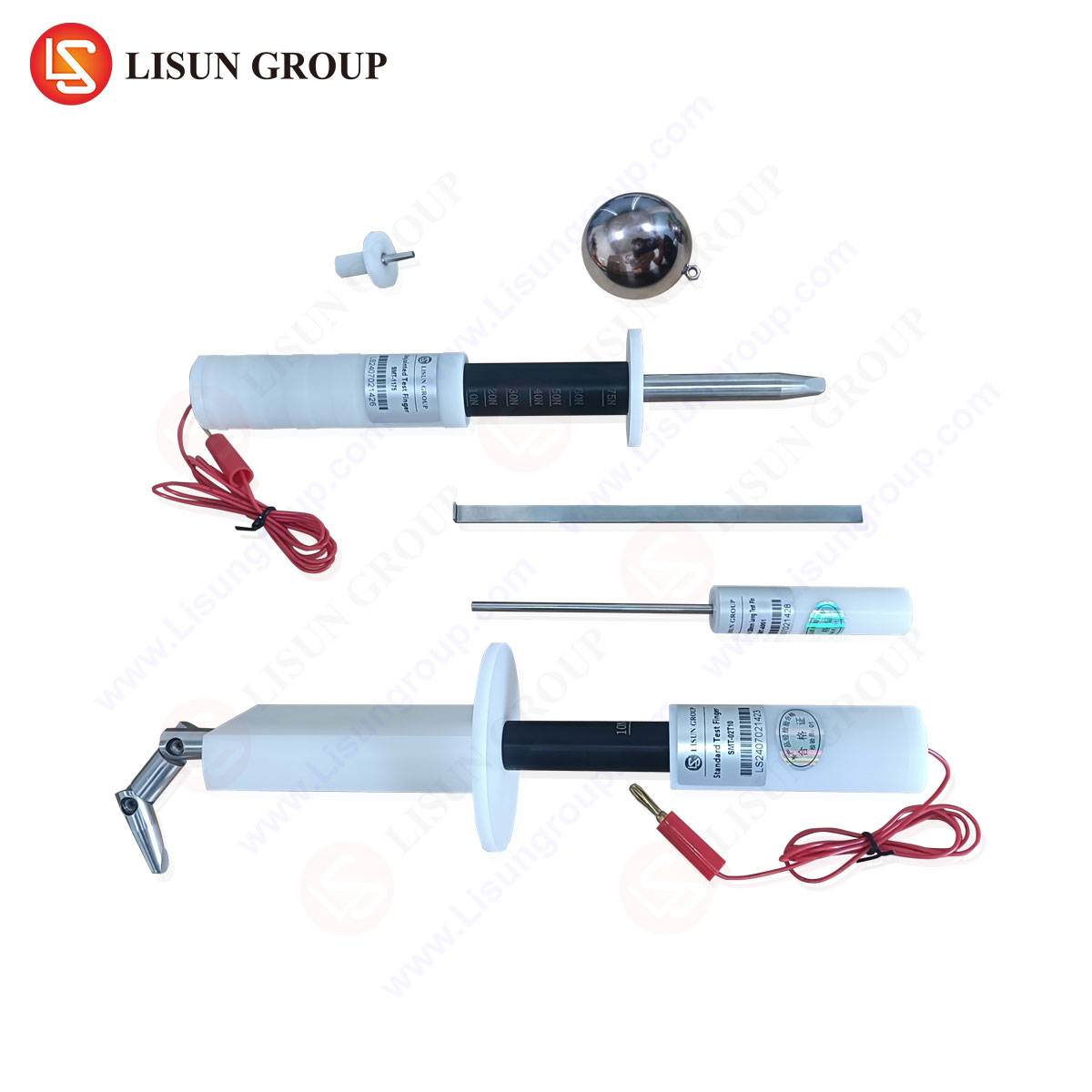
The LISUN Test Finger (IEC 61032 Probe B) is constructed from rigid, insulating material with metallic foil applied to its surface to facilitate electrical detection. Its articulated joint is precision-machined to ensure smooth, repeatable articulation within the specified angular limits (±90° from the straight position). This probe is indispensable for evaluating:
- Household Appliances: Testing openings in blender bases, hair dryer housings, and power tool casings.
- Consumer Electronics & Office Equipment: Assessing ventilation slots in power adapters, desktop computers, and printer enclosures.
- Toy and Children’s Products: Verifying that battery compartments or any openings in electrically operated toys cannot be penetrated by a small finger.
- Lighting Fixtures: Checking for finger access to live parts within lampholders or through diffuser seams in luminaires.
A failure occurs if the test finger contacts a live part or bypasses a protective interlock, potentially energizing an accessible conductive part. The test’s objective nature, reliant on a physically defined probe, eliminates subjective judgment from this key safety assessment.
Assessment of Openings for Tools and Foreign Objects: The Test Probe (Probe 13) and Test Pin (Probe 19)
While the test finger simulates bodily access, other threats involve objects like screwdrivers, keys, or jewelry. Probe 13, commonly called the Test Probe or “unbent test finger,” is a rigid, straight, jointless finger analogue. With dimensions similar to Probe B but without articulation (80mm long, Ø12mm diameter, hemispherical tip of 20mm radius), it is applied with a 30 N force. Its purpose is to assess the strength and integrity of barriers. If an opening can be penetrated by this rigid probe with greater force, it is deemed to offer inadequate protection against access by stiff objects.
Probe 19, the Test Pin, represents a more severe threat from slender, conductive objects. It is a hardened steel pin, 100mm in length, with a Ø3mm shaft terminating in a conical point (angle: 60°; point radius: 0.5mm max). Applied with a force of 3 N ± 10%, it is designed to test whether live parts are accessible through small openings, such as those found in socket outlets, connector ports, or mesh screens.
The LISUN Test Probe (IEC 61032 Probe 13) and Test Pin (IEC 61032 Probe 19) are manufactured from materials specified in the standard, ensuring correct rigidity and conductivity. The test pin’s tip geometry is meticulously ground and verified to maintain the critical radius, as a sharper point would constitute an over-test, while a blunter one would be non-compliant. Key applications include:
- Electrical Components: Testing the shutters of socket outlets and the openings in switchgear to ensure the pin cannot contact live terminals.
- Industrial Control Systems: Verifying that maintenance openings or cable gland entries in control panel enclosures (IP2X rating) are adequately protected.
- Telecommunications Equipment: Assessing RJ45 ports or DC power jacks on network hardware.
- Automotive Electronics: Evaluating connector housings and diagnostic port access in vehicle electronic control units (ECUs) under LV 214 or similar automotive standards.
- Aerospace and Aviation Components: Checking for live part accessibility in in-flight entertainment system panels and cockpit instrumentation.
Instrumentation and Procedure: Ensuring Reproducible and Compliant Results
The testing process extends beyond merely possessing the physical probes. Reproducibility, a cornerstone of laboratory science, demands controlled application. A standardized test apparatus, such as the LISUN Test Finger/Probe/Pin Kit, typically includes not only the certified probes but also a calibrated force application system and a sensitive electrical circuit indicator. The indicator circuit, often featuring a signal lamp and audible buzzer, is crucial for detecting contact without relying on visual observation alone, especially in deep or obscured compartments.
The procedure is methodical: the equipment under test (EUT) is de-energized, and its live parts are connected to the indicator circuit. The appropriate probe is selected based on the standard clause being evaluated. It is then applied to every opening, seam, or joint in the enclosure with the specified force and angle, attempting to contact live parts. The probe is also used to check the functionality of interlocks on doors or covers. Any activation of the indicator circuit signifies a failure of the accessibility test. Data recording, including photographs of probe application and detailed notes on failure points, is essential for audit trails and design feedback.
Cross-Industry Implications and Standard-Specific Nuances
The universal principle of live part inaccessibility manifests with nuanced requirements across industries. In Medical Devices (IEC 60601-1), patient accessibility adds layers of complexity, often requiring testing with additional probes under both normal and single-fault conditions, considering the reduced physiological resistance of a patient. For Household Appliances, the focus is often on user-accessible openings during everyday use and cleaning. Lighting Fixtures must be evaluated both when fully assembled and during user-replaceable component operations, such as lamp changes.
Automotive and Aerospace sectors incorporate environmental stress into their assessments. A probe test may be required after vibration, thermal cycling, or humidity exposure to ensure enclosures do not warp or crack to create a hazardous opening. Cable and Wiring Systems, such as connectors or junction boxes, are tested to ensure that mating or unmating sequences do not expose live pins in an accessible manner.
The LISUN portfolio addresses these nuances by ensuring their test apparatus kits are not only dimensionally compliant with IEC 61032 but are also recognized by major certification bodies. Their construction from durable, stable materials ensures longevity and consistent performance, which is critical for laboratories conducting high-volume compliance testing. The competitive advantage lies in the traceable calibration, comprehensive documentation, and design that faithfully replicates the standard’s intent, reducing measurement uncertainty and potential disputes during product certification.
Quantifying Protection: Integration with IP Code and Other Standards
The test finger, probe, and pin are directly linked to the IP (Ingress Protection) Code, defined in IEC 60529. The first characteristic numeral, indicating protection against solid foreign objects, is partially verified using these probes:
- IP2X: Protected against access with a finger (Test Finger, Probe B). The probe must not fully penetrate an opening or contact hazardous parts.
- IP3X: Protected against tools and thick wires (Test Probe, 2.5mm diameter sphere specified in IEC 60529, distinct from Probe 13).
- IP4X: Protected against most wires, screws, etc. (Test Probe, 1.0mm diameter sphere).
- IP5X/6X: Dust-protected and dust-tight, which involves different test methods but presupposes the lower-level probe protections.
Thus, these mechanical probes form the foundational verification step for the IP rating of an enclosure, bridging the gap between electrical safety and environmental protection requirements.
Conclusion
The evaluation of live part accessibility via standardized test probes is a deceptively simple yet profoundly critical exercise in product safety engineering. It translates the abstract principle of “no touchable live parts” into a quantifiable, repeatable laboratory test. The integrity of this test is wholly dependent on the precision, durability, and compliance of the test equipment used. As technological convergence brings more powered devices into human proximity, from smart home gadgets to advanced medical implants, the role of these definitive probes—the test finger, probe, and pin—will only grow in importance. Their consistent and correct application ensures that safety remains an engineered invariant, protecting users across all domains of electrical and electronic product use.
FAQ Section
Q1: What is the difference between the IEC 61032 Test Finger (Probe B) and the Test Probe (Probe 13)?
The Test Finger (Probe B) is articulated to simulate the joint of a child’s finger, allowing it to bend and explore openings with a 10 N force. It tests for accidental finger contact. The Test Probe (Probe 13) is a rigid, jointless version applied with a higher 30 N force. It tests the structural integrity of barriers against more forceful probing by stiff objects like tools or sticks.
Q2: How often should test probes like the LISUN Test Finger be calibrated or replaced?
Calibration intervals should be determined by the laboratory’s quality system, typically annually, or per accreditation body requirements (e.g., ISO/IEC 17025). Calibration verifies critical dimensions, articulation limits, and application force. Probes should be inspected before each use for damage, wear (especially the tip of the Test Pin), or deformation. Replacement is necessary if any parameter falls outside the tolerances specified in IEC 61032.
Q3: Can the same set of test probes be used for testing products certified to different regional standards (e.g., IEC, UL, EN)?
The core geometrical specifications in IEC, EN, and UL standards for Probes B, 13, and 19 are harmonized. Therefore, a single set of compliant probes, such as those from LISUN, is generally acceptable for testing against IEC, EN, and UL versions of product safety standards that reference IEC 61032. However, the tester must always verify the specific clause references and any unique national deviations in the standard applicable to the target market.
Q4: In the test circuit, why is a sensitive indicator (e.g., 40V, <0.5mA) used instead of simply applying operating voltage?
Using the equipment’s full operating voltage for detection would be hazardous to the tester and could cause damage. The low-voltage, low-current indicator circuit provides a safe means of detecting electrical contact. The chosen threshold (often 40-50V AC) is based on safety extra-low voltage (SELV) limits, below which contact is generally considered non-hazardous under normal conditions.
Q5: Are these probe tests sufficient to ensure complete protection against electric shock?
No, they are a necessary but not sufficient component of a comprehensive safety evaluation. Probe tests verify direct contact protection. Complete shock protection also requires evaluation of indirect contact (through accessible conductive parts becoming live due to insulation failure), which involves tests for grounding continuity, insulation resistance, dielectric strength, and leakage current. Both direct and indirect contact protections are required by safety standards.