




Protection Against Contact with Active Parts in Increased Safety Bases: Principles, Standards, and Verification Methodologies
The fundamental tenet of electrical safety engineering is the prevention of hazardous contact with live conductive parts. This principle is codified in various international standards through the concept of degrees of protection provided by enclosures, commonly referenced by IP (Ingress Protection) codes. While the first numeral of the IP code addresses protection against solid foreign objects, it is the second numeral—specifically the tests for protection against access to hazardous parts—that is critical for personnel safety. The “Increased Safety” concept, often associated with explosion-protected equipment (Ex e), extends this philosophy by mandating enhanced measures to prevent the possibility of arcs, sparks, or excessive temperatures, which inherently requires stringent control over contact with active parts. This article delineates the technical requirements, standardized testing methodologies, and the instrumental role of specified test apparatus, such as the LISUN Test Finger, Test Probe, and Test Pin, in validating compliance across diverse industries.
Theoretical Foundations of Contact Protection and the “Increased Safety” Philosophy
Protection against contact is not merely a mechanical barrier requirement; it is a systemic design imperative rooted in human factors and fault probability. The underlying risk assessment considers the likelihood of a person, using a part of their body or a handheld object, bridging a dangerous potential difference. The “Increased Safety” (Ex e) method, defined originally in IEC 60079-7, amplifies this by requiring equipment to be designed with additional safety margins so that it is unlikely to become a source of ignition under normal or specified abnormal conditions. This inherently demands that enclosures prevent access to live parts under all operational scenarios, including those with anticipated wear or minor misuse.
The design must account for diverse anthropometric data and behavioral scenarios. For instance, a child’s smaller finger dimensions or a technician’s use of a tool for probing necessitate different test simulations. Consequently, standardized test fixtures are engineered to represent these “worst-case” access scenarios in a repeatable, laboratory environment. The objective verification of these protective measures moves the safety paradigm from subjective design judgment to objective, quantifiable compliance, forming the bedrock of type testing and certification for electrical apparatus.
Standardized Access Probes: Simulating Real-World Hazard Scenarios
International standards, primarily the IEC 60529 series (Degrees of protection provided by enclosures) and its derivative standards like IEC 61032 (Protection of persons and equipment by enclosures – Probes for verification), define a suite of test probes. These geometrically precise tools simulate attempts at contact by human body parts or common objects. Their application is mandated across a vast spectrum of product safety standards, including but not limited to IEC 60335 (household appliances), IEC 60601 (medical devices), IEC 60950/62368 (IT/AV equipment), and the various ISO standards for automotive components.
Three primary probes form the core of most compliance testing regimes:
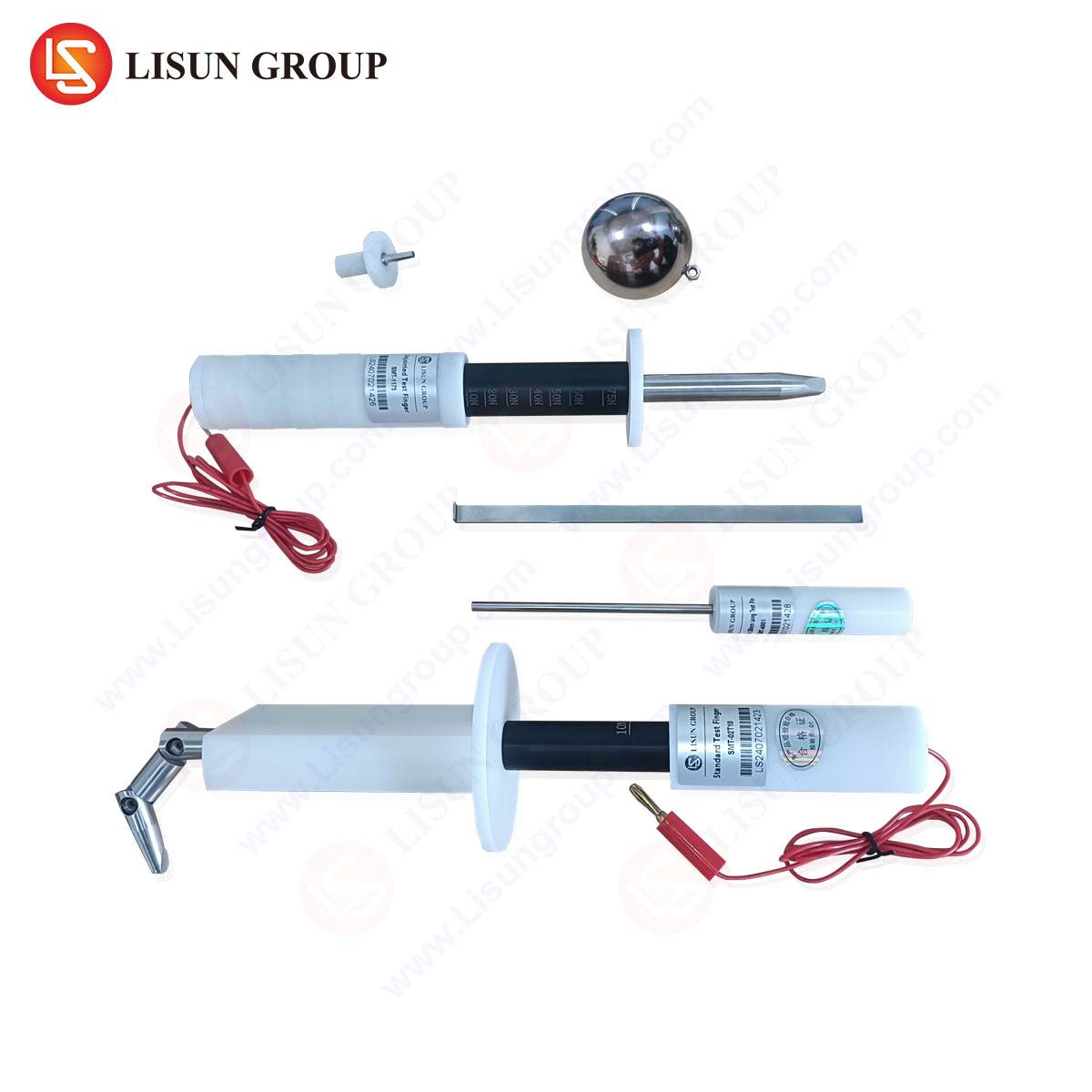
- The Jointed Test Finger (Test Probe B): Simulates a small child’s finger or an adult’s finger attempting to access an opening. It is the primary tool for verifying protection against contact with hazardous parts (IPXXB).
- The Test Probe (Test Probe 13): A rigid, straight probe representing tools like wires or rods that might be inserted into an enclosure.
- The Test Pin (Test Probe 18): A small-diameter pin simulating access attempts by slender objects such as needles or paper clips.
The precision in the construction, dimensions, articulation force, and application procedure of these probes is non-negotiable. Inconsistent or non-compliant test equipment can yield false-positive safety assessments, with potentially catastrophic consequences. Therefore, the calibration, material integrity, and geometric fidelity of these test probes are as critical to the safety ecosystem as the electrical design of the product itself.
Instrumentation for Compliance Verification: The LISUN Test Apparatus Suite
To ensure reproducible and standards-compliant verification, specialized instrumentation is required. The LISUN series of test probes, including the LISUN Test Finger (LS-JF-01), Test Probe (LS-TP-13), and Test Pin (LS-TP-18), are engineered to meet the exacting specifications of IEC 61032, IEC 60529, and related GB standards.
Specifications and Design Principles:
- LISUN Test Finger (LS-JF-01): This apparatus replicates the articulated jointed test finger defined in standards. It is constructed from durable, insulating materials with specific articulation limits and a built-in electrical contact indicator. The design ensures a consistent 10 N ± 1 N force is applied during testing. Its dimensions—two joints with specific pivot points, an overall length of 100mm, and a fingertip diameter—are machined to tolerances often within ±0.1mm to guarantee accurate simulation.
- LISUN Test Probe (LS-TP-13): A rigid, straight steel probe of 100mm length with a hemispherical tip of Ø2.5mm. It is used to apply a 3 N ± 0.3 N force to assess protection against access by solid objects. Its simplicity belies its importance; any deviation in tip radius or straightness can invalidate a test.
- LISUN Test Pin (LS-TP-18): This probe features a hardened steel pin of Ø1.0mm, typically with a rounded end (radius 0.5mm), mounted in an insulating handle. It is applied with a 1 N ± 0.1 N force to test for openings that could be accessed by very slender objects.
Testing Principle and Methodology: The fundamental testing principle involves applying the probe with the specified force and in every possible orientation to openings, joints, and gaps in the equipment enclosure. The test is conducted with the probe connected to a low-voltage (not less than 40 V and not more than 50 V) indicator circuit. If the probe contacts a live part or internal conductive part connected to a live test network, the indicator (typically a lamp or buzzer) activates, signifying a failure. For “Increased Safety” applications, the test is often performed under more stringent conditions or with additional checks for clearance and creepage distances after probe access attempts.
Cross-Industry Application of Contact Protection Testing
The universality of the human interaction hazard makes these test probes indispensable across virtually all sectors manufacturing electrical or electronic equipment.
- Household Appliances & Consumer Electronics: From toasters and blenders to gaming consoles and power adapters, the test finger ensures children cannot poke fingers into charging ports or ventilation slots to contact mains-voltage components. The test pin verifies that even the small apertures in a USB-C port housing are safely insulated.
- Automotive Electronics: In the high-vibration, variable-temperature environment of a vehicle, connectors and control units must maintain integrity. Test probes verify that HVIL (High Voltage Interlock Loop) connectors in electric vehicles are finger-safe and that infotainment system enclosures prevent tool access to 12V/48V busbars.
- Lighting Fixtures: LED drivers, both indoor and outdoor, must prevent access to Class I or Class II circuits. The jointed test finger is critical for testing luminaires with adjustable heads or removable diffusers to ensure no live parts are accessible after servicing or during operation.
- Industrial Control Systems & Electrical Components: Motor starters, PLC enclosures, circuit breakers, and socket outlets rely on these tests. For an Ex e increased safety terminal box, proving that the test finger cannot contact energized terminals—even when the gland plates are partially removed—is a certification prerequisite.
- Medical Devices: Patient safety is paramount. Equipment per IEC 60601 must prevent both patient and operator from contacting parts exceeding allowable touch current limits. Probes test openings for switches, battery compartments, and cable entry points.
- Telecommunications & Office Equipment: Network switches, power-over-Ethernet injectors, and server power supplies use these tests to ensure safety for installation and maintenance personnel.
- Aerospace & Aviation: While governed by specific DO-160 or MIL-STDs, the core physical safety principles remain. Test probes validate the safety of in-seat power outlets, cockpit switch panels, and avionics bay enclosures.
- Toys and Children’s Products: For electrically operated toys (EN 62115/IEC 62115), the test finger and test pin are primary tools to ensure that batteries, wiring, and any functional voltages are completely inaccessible, even after reasonable abuse testing.
Competitive Advantages of Calibrated, Standards-Compliant Test Equipment
Utilizing precision-engineered test apparatus like the LISUN suite offers distinct technical and commercial advantages over generic or improvised tools.
- Certification and Traceability: Genuine compliance test equipment is supplied with calibration certificates traceable to national metrology institutes, a requirement for accredited testing laboratories (ISO/IEC 17025). This traceability is non-negotiable for audit purposes and for defending product certifications.
- Repeatability and Reduced Uncertainty: The machined tolerances and specified material properties ensure that test results are reproducible across different technicians, laboratories, and time. This reduces measurement uncertainty in safety testing, a critical factor in risk assessment.
- Regulatory Acceptance: Notified Bodies, certification agencies (UL, CSA, TÜV, etc.), and market surveillance authorities recognize and require tests performed with standardized, compliant probes. Data generated using non-conforming tools may be rejected, causing costly re-testing delays.
- Risk Mitigation: From a product liability perspective, demonstrating that safety validation was performed with industry-accepted, calibrated equipment provides a stronger legal and technical defense in the event of an incident.
Integration with “Increased Safety” and Other Protection Concepts
In explosion protection, the “Increased Safety” type is particularly reliant on robust contact protection. The standard IEC 60079-7 explicitly references the use of the test finger (IPXXB) to verify that live parts are not accessible. Furthermore, it imposes additional requirements on terminal connections, creepage distances, and insulation that are validated after ensuring the basic mechanical protection is sound. The test probe thus serves as the first, critical gate in a series of verifications.
Similarly, for Protection by Enclosure (IP Code), the probes are the definitive tool for assigning the second characteristic numeral (e.g., IP2X: protected against fingers; IP4X: protected against wires). For Equipment for use in the presence of combustible dust (Ex tD), the ability of an enclosure to prevent ingress of dust (IP6X) is often tested in conjunction with contact protection, as dust ingress can bridge live parts.
Table 1: Summary of Key Test Probes and Applications
| Probe Type | Standard Designation | Simulates | Test Force | Primary Application (IP Code) | Typical Industry Use Case |
| :— | :— | :— | :— | :— | :— |
| Jointed Test Finger | IEC 61032 Probe B | A child’s finger | 10 N ± 1 N | IPXXB (Protection against finger contact) | Household appliance vents, toy battery doors, socket-outlet shutters. |
| Test Probe | IEC 61032 Probe 13 | Tools, wires, rods | 3 N ± 0.3 N | IPXXD (Protection against solid objects >1.0mm) | Industrial control cabinet vents, lighting fixture seams, telecom equipment slots. |
| Test Pin | IEC 61032 Probe 18 | Slender objects (e.g., clip) | 1 N ± 0.1 N | – (Often for specific product standard clauses) | Openings in connectors, gaps in double insulation, medical device battery compartments. |
Conclusion
The imperative to protect against contact with active parts is a cornerstone of electrical safety, transcending industry boundaries. Its validation through standardized mechanical probes transforms a qualitative safety goal into a quantitative, repeatable test. Apparatus such as the LISUN Test Finger, Test Probe, and Test Pin are not mere accessories but essential metrology instruments in the safety engineer’s toolkit. Their precise application, as dictated by international standards, provides the objective evidence required to certify that equipment—from a simple household switch to a complex increased safety motor controller—meets its fundamental duty of protecting human life. As technologies evolve and products miniaturize, the role of these definitive tests will only grow in importance, ensuring that safety keeps pace with innovation.
FAQ Section
Q1: What is the significance of the applied force (e.g., 10N for the test finger) in the testing procedure?
The specified force is a critical parameter that simulates a reasonable but not excessive probing action. It represents a compromise between simulating real-world poking or prodding and ensuring the test does not damage well-designed equipment. Applying too little force might miss a hazard, while excessive force could deform a compliant enclosure, creating a false failure. The standardized force ensures consistency and repeatability across all laboratories and product evaluations.
Q2: Can a product pass the test finger test but fail the test pin test, and what does this indicate?
Absolutely. This is a common and important outcome. Passing the test finger (IPXXB) but failing the test pin indicates that the enclosure provides basic finger-safe protection but has openings larger than 1mm that could allow a slender object to contact a hazardous part. This is often acceptable for general consumer equipment where tool access is not anticipated, but it would be a failure for certain types of equipment (like some medical devices or toys) or for a higher IP code rating (like IP4X). The finding directs the designer to address specific gap dimensions.
Q3: How often should test probes like the LISUN Test Finger be calibrated or replaced?
Calibration intervals are typically annual for equipment used in accredited laboratory settings, per ISO/IEC 17025 requirements. However, the frequency should be based on a risk assessment considering usage rate. Furthermore, probes should be inspected before each use for physical damage—such as nicks on the test pin tip, wear on the test finger joints, or deformation. Any damage can immediately invalidate the probe’s accuracy, necessitating repair or replacement. A calibration certificate provides a baseline, but routine visual and functional checks are essential.
Q4: In the context of “Increased Safety” (Ex e), are there tests beyond the basic IPXXB test finger check?
Yes, significantly so. The test finger check is a foundational access test. For Ex e, subsequent and more rigorous evaluations are performed. These include detailed measurements of creepage distances and clearances between live parts and earthed metal, both under normal conditions and often after a simulated impact test. The integrity of insulation is also rigorously tested. The philosophy is that the enclosure must first prevent access, and then the internal construction must provide enhanced security against sparking or excessive temperatures even under fault conditions like overload.
Q5: For a company setting up an in-house compliance lab, is investing in a full set of standardized test probes necessary?
For any organization performing design verification or pre-compliance testing for safety, investing in a complete, compliant set of test probes is highly advisable and often cost-effective in the long term. Using non-standard tools (e.g., actual fingers, paper clips, or machined pins without certification) introduces unacceptable risk. It can lead to “passing” an unsafe design or, conversely, failing a safe design, both of which have serious costs. For final certification, accredited third-party labs are required, but in-house testing with proper tools streamlines development and catches issues early.