




A Comprehensive Analysis of Salt Fog Test Equipment Cost and Technical Considerations
Introduction to Accelerated Corrosion Testing
The evaluation of material and component resistance to corrosive environments constitutes a critical phase in the product development and quality assurance lifecycle across numerous industries. Salt fog (salt spray) testing, as a standardized method for accelerated corrosion testing, simulates and amplifies the effects of saline atmospheres on products and surface coatings. The primary objective is to predict long-term performance and durability within a condensed timeframe, thereby identifying potential failure modes, verifying protective finishes, and ensuring compliance with international standards. The procurement of salt fog test equipment represents a significant capital investment for laboratories, manufacturing facilities, and research institutions. A thorough understanding of the cost structure, driven by technical specifications, compliance requirements, and operational parameters, is essential for making an informed acquisition decision that balances budgetary constraints with testing fidelity and long-term reliability.
Deconstructing the Cost Drivers of Salt Fog Chambers
The total cost of ownership for salt fog test equipment extends beyond the initial purchase price. A nuanced financial analysis must account for several interconnected factors that define the system’s capabilities, operational efficiency, and longevity. The chamber’s internal workspace volume is a primary cost determinant. Larger chambers, such as those exceeding 1000 liters, command a higher price due to increased material usage for the corrosion-resistant construction, more substantial heating elements, and enhanced fog dispersion systems required to maintain uniform test conditions. Conversely, benchtop units like the 90-liter models offer a lower entry point for testing smaller components.
Construction material quality is non-negotiable. Chambers must be fabricated from materials inherently resistant to neutral (NSS), acetic acid (AASS), and copper-accelerated acetic acid (CASS) salt solutions. While PVC is common for smaller, standard-temperature units, advanced units designed for cyclic corrosion testing or higher temperatures often utilize reinforced polypropylene or solid engineered plastics. The heating system, typically employing immersion heaters or air-heat exchangers, must provide rapid heat-up times and precise temperature control (±0.5°C or better) as mandated by standards like ASTM B117 and ISO 9227. Precision in temperature regulation directly influences test reproducibility and is a key differentiator between economic and high-performance models.
The sophistication of the control system represents another major cost variable. Basic units may feature analog controllers and manual solution level adjustments. Modern equipment, however, integrates programmable logic controllers (PLCs) with touchscreen human-machine interfaces (HMIs). These systems allow for complex multi-profile programming, real-time monitoring of temperature, fog settlement rate, and pH levels, data logging, and remote connectivity. The integration of such digital management systems enhances test accuracy, reduces operator intervention, and minimizes human error, but contributes to a higher initial investment.
Operational and Ancillary Cost Considerations
Recurring operational expenses form a critical part of the cost equation. Salt fog testing consumes purified water, high-purity sodium chloride, and, for specific tests, acetic acid or copper chloride. The volume of these consumables is proportional to chamber size and test duration. Energy consumption is primarily driven by the heating element and the compressor for the fog generation system. Chambers with superior thermal insulation and efficient heating designs yield lower long-term energy costs. Maintenance costs encompass the regular cleaning of nozzles and reservoirs to prevent clogging, calibration of sensors (temperature, pH), and periodic replacement of saturated air bubblers and seals. Equipment designed for ease of maintenance, with accessible components and clear service protocols, can significantly reduce downtime and associated labor costs.
Compliance with international testing standards is not optional; it is a fundamental requirement that influences design and cost. Reputable equipment must demonstrably meet the stringent spatial and temporal uniformity criteria outlined in ASTM B117, ISO 9227, JIS Z 2371, and other industry-specific standards. This compliance is verified through rigorous factory acceptance testing and often supported by third-party certification. The engineering required to achieve this compliance—including precise nozzle design, optimized baffling for fog distribution, and advanced air saturation systems—incurs substantial R&D and manufacturing costs that are reflected in the price of high-quality chambers.
The YWX/Q-010X Salt Spray Test Chamber: A Technical Benchmark
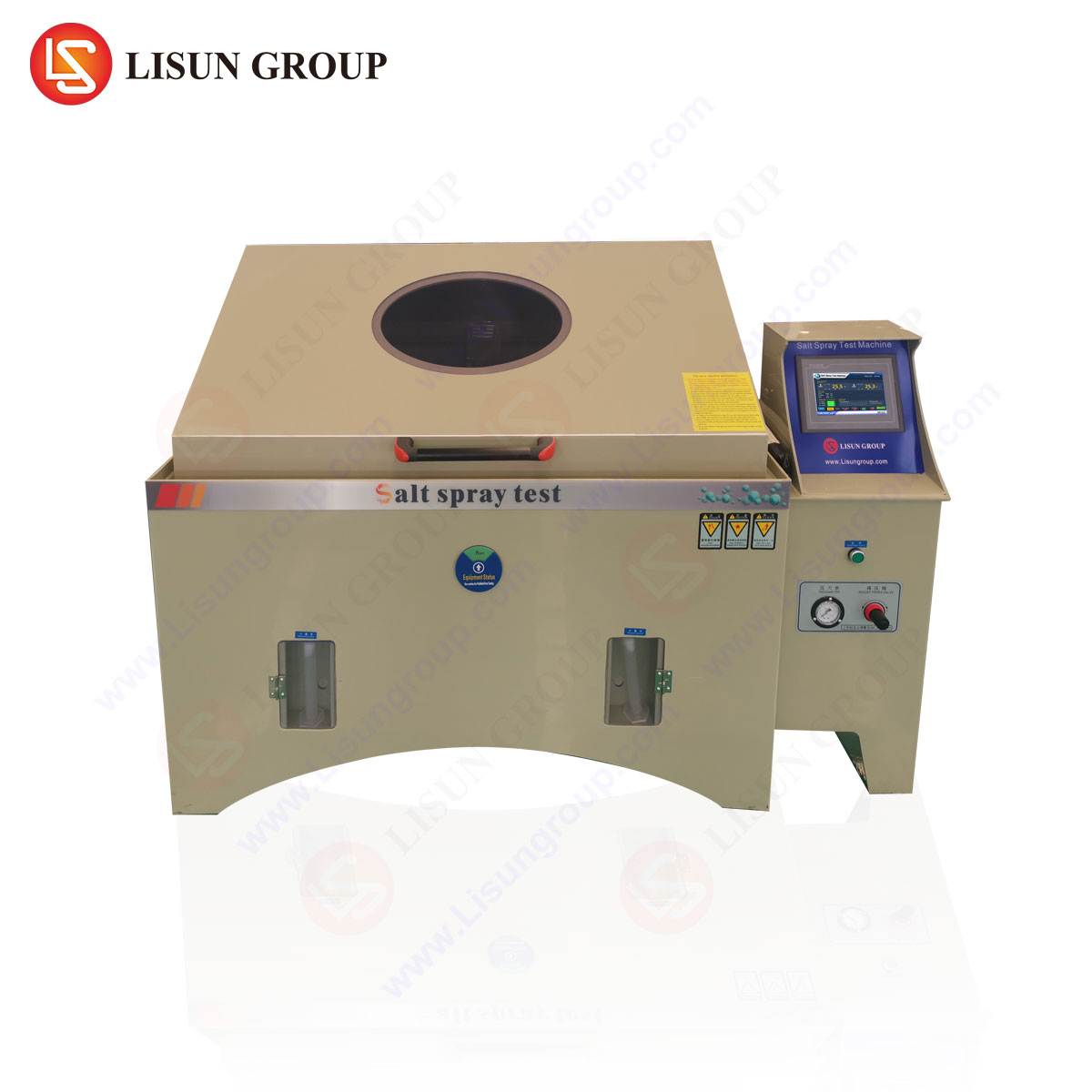
The LISUN YWX/Q-010X Salt Spray Test Chamber exemplifies the integration of robust performance with operational precision in a standardized testing platform. Designed for rigorous compliance with major international standards, this chamber is engineered to deliver consistent and repeatable corrosive environmental simulation.
Core Specifications and Testing Principle: The YWX/Q-010X features a standard internal volume of 90 liters, constructed from durable, corrosion-resistant polypropylene. Its operation is centered on the pressurized atomization principle. A compressed, purified, and saturated air supply is forced through a specialized nozzle, drawing the prepared salt solution from a reservoir to create a dense, finely dispersed fog. This fog is uniformly distributed throughout the test chamber at a controlled temperature, typically maintained at 35°C ± 2°C for neutral salt spray tests. The chamber incorporates a PID (Proportional-Integral-Derivative) microcomputer controller, allowing for precise temperature regulation and digital timer functionality. A built-in fog collector cylinder enables the operator to verify that the fog settlement rate remains within the standard-specified range of 1.0 to 2.0 ml per 80cm² per hour.
Industry Application Use Cases: The versatility of the YWX/Q-010X makes it applicable across a broad spectrum of industries. In Automotive Electronics and Electrical Components, it is used to test the corrosion resistance of connector housings, printed circuit board assemblies (PCBAs) with conformal coatings, and sensor housings. Lighting Fixtures manufacturers employ it to evaluate the integrity of exterior lamp housings and optical lens coatings against road salt exposure. For Telecommunications Equipment and Cable and Wiring Systems, the test validates the performance of external junction boxes, cable sheathing materials, and antenna coatings. Aerospace and Aviation Components suppliers use it for qualifying non-critical metallic parts and protective finishes. In the realm of Consumer Electronics and Household Appliances, it assesses the durability of external casings, control panels, and metallic trim on devices that may be exposed to coastal or high-humidity environments.
Competitive Advantages: The YWX/Q-010X presents several distinct advantages. Its construction from thick, welded polypropylene ensures exceptional longevity and resistance to the corrosive test media, reducing the risk of chamber degradation and test contamination. The integrated air saturator tower heats and humidifies the compressed air prior to fog generation, a critical feature for maintaining consistent solution concentration and complying with ASTM B117. The transparent chamber lid, made of impact-resistant acrylic, allows for continuous visual inspection of specimens without interrupting the test climate. Furthermore, its relatively compact footprint and straightforward user interface make it accessible for quality control laboratories without requiring highly specialized operator training, offering a favorable balance between advanced capability and operational practicality.
Financial Analysis: Capital Expenditure vs. Total Cost of Ownership
A prudent procurement strategy requires shifting focus from mere purchase price to a comprehensive Total Cost of Ownership (TCO) model. A lower-cost chamber may appear economically attractive initially but can lead to substantially higher costs over a five-to-ten-year period. These hidden costs manifest in several ways. Inconsistent test conditions due to poor temperature uniformity or fluctuating fog density can yield non-reproducible results, leading to product quality disputes, retesting, and potential delays in time-to-market. Frequent mechanical failures, such as heater burnout or nozzle clogging, result in unplanned downtime, halting production quality verification and incurring repair costs and labor.
Chambers lacking robust construction may suffer from internal corrosion or plasticizer leaching, which can contaminate test solutions and produce invalid, non-standard-compliant results. The financial and reputational risk of releasing a product based on flawed corrosion resistance data is immense, particularly in safety-critical industries like Medical Devices or Automotive Electronics. Therefore, investing in equipment with proven reliability, standard compliance, and durable construction, such as the YWX/Q-010X, typically results in a lower TCO. The higher initial investment is amortized over years of reliable service, consistent data generation, minimal downtime, and reduced risk of costly quality failures.
Selection Criteria Aligned with Industry-Specific Testing Regimens
The optimal salt fog chamber must be selected based on the specific testing protocols of the target industry. For basic pass/fail tests on Electrical Components like switches and sockets per ASTM B117, a standard neutral salt spray chamber suffices. However, industries requiring more sophisticated analysis need enhanced capabilities.
The Automotive sector frequently employs cyclic corrosion tests (e.g., GM 9540P, Ford CETP 00.00-L-467) that alternate between salt spray, humidity, and dry-off cycles. This requires a chamber with programmable logic for multi-stage testing and potentially a drying air system. Aerospace and Aviation specifications often demand testing with acidified salt solutions (AASS, CASS) for cadmium and zinc plating, necessitating chambers with materials resistant to these more aggressive chemistries. Telecommunications Equipment tested for outdoor use may require larger chamber volumes to accommodate full-sized enclosures or antenna assemblies.
For Industrial Control Systems and Office Equipment destined for global markets, the ability of a chamber to easily conform to multiple standards (ASTM, ISO, JIS) within a single platform is a key efficiency and cost-saving feature. The YWX/Q-010X, with its standard-compliant design, is particularly well-suited for industries requiring rigorous, repeatable NSS testing as a baseline qualification, providing a reliable and defensible data source for material and coating selection.
Conclusion: Strategic Investment in Corrosion Reliability
The procurement of salt fog test equipment is a strategic decision with direct implications for product quality, regulatory compliance, and brand integrity. A simplistic focus on initial capital expenditure is inadequate. A detailed technical and financial evaluation must prioritize the factors that ensure testing accuracy, operational reliability, and long-term economic efficiency. Equipment that embodies precise environmental control, durable corrosion-resistant construction, and adherence to international standards, such as the LISUN YWX/Q-010X, represents a sound investment. It provides the foundational capability to generate credible, reproducible corrosion data, enabling manufacturers across the spectrum from Medical Devices to Consumer Electronics to confidently validate product durability, mitigate field failure risks, and ultimately deliver reliable performance in corrosive end-use environments.
Frequently Asked Questions (FAQ)
Q1: What is the critical difference between a standard salt spray test and a cyclic corrosion test, and can the YWX/Q-010X perform both?
A: A standard neutral salt spray (NSS) test, per ASTM B117, exposes specimens to a continuous saline fog at a constant temperature. A cyclic corrosion test is more complex, involving programmed transitions between salt spray, high humidity, condensation, and dry-off periods to better simulate real-world environmental cycles. The YWX/Q-010X is designed specifically for continuous salt spray tests (NSS, AASS, CASS). It is not configured for the automated environmental cycling required by cyclic tests, which demand a separate, more sophisticated environmental chamber.
Q2: Why is air saturation a necessary feature in a salt spray chamber, and does the YWX/Q-010X include it?
A: Air saturation is mandated by testing standards to prevent a phenomenon known as “evaporative concentration.” Unsaturated air, when bubbled through or used to atomize the salt solution, causes water to evaporate from the droplets, increasing the salt concentration of the settling fog and invalidating the test. The saturator tower heats and humidifies the compressed air to 100% relative humidity before it reaches the nozzle. Yes, the YWX/Q-010X incorporates a built-in air saturator tower, which is essential for maintaining correct solution concentration and ensuring standard compliance.
Q3: How often should the salt solution and chamber components be maintained during continuous operation?
A: For a continuous test, the salt solution level in the reservoir should be checked and replenished with distilled or deionized water daily to maintain proper concentration. The pH of the collected solution should be measured and adjusted as specified by the standard (e.g., pH 6.5 to 7.2 for NSS). The nozzle should be inspected weekly for clogging and cleaned if necessary. A comprehensive chamber cleaning to remove salt deposits from walls and racks should be performed after each test to prevent cross-contamination and corrosion of the chamber itself.
Q4: What type of specimens or materials are not suitable for testing in a standard salt spray chamber like the YWX/Q-010X?
A: Materials that release volatile corrosive vapors or gases should not be tested, as they can contaminate the chamber and affect other tests. This includes certain magnesium alloys and materials containing sulfides. Extremely large specimens that obstruct fog circulation or prevent uniform fog settlement on all test samples are also unsuitable. The test is primarily designed for evaluating surface coatings and finishes on metallic substrates, and its relevance for certain plastics or composite materials may be limited unless testing a coated surface.
Q5: Can the chamber accommodate tests requiring different corrosive solutions, such as acidified salt spray?
A: Yes, the YWX/Q-010X is constructed from materials resistant to the three common test solutions: Neutral Salt Spray (NSS, 5% NaCl), Acetic Acid Salt Spray (AASS, 5% NaCl + acetic acid to pH ~3.1), and Copper-Accelerated Acetic Acid Salt Spray (CASS, 5% NaCl + acetic acid + copper chloride). The operator must thoroughly clean the chamber, reservoir, and all internal components when switching between solution types to prevent chemical contamination that would compromise test results.