




A Comprehensive Analysis of Salt Spray Chamber Pricing and Technical Specifications for Corrosion Testing
Introduction to Accelerated Corrosion Testing
The evaluation of a material’s resistance to corrosive environments is a critical component of product development and quality assurance across numerous industrial sectors. Salt spray (fog) testing, standardized under methods such as ASTM B117, ISO 9227, and JIS Z 2371, serves as a fundamental accelerated corrosion test. It simulates, in a controlled and highly aggressive manner, the degrading effects of saline atmospheres on surface coatings, substrates, and finished components. The apparatus enabling this testing—the salt spray chamber—represents a significant capital investment for laboratories. Its pricing is not arbitrary but is intrinsically linked to a complex matrix of technical specifications, construction quality, control systems, and compliance rigor. This analysis delves into the factors governing salt spray chamber pricing, with particular reference to the technical implementation exemplified by the LISUN YWX/Q-010X model, to provide a framework for informed procurement decisions.
Deconstructing the Core Components: A Cost Driver Analysis
The price of a salt spray chamber is a direct reflection of its constituent parts and their performance capabilities. A fundamental understanding of these components is essential to correlate cost with value.
The chamber body itself is typically constructed from reinforced polypropylene (PP) or glass-reinforced plastic (GRP). While PP offers excellent chemical resistance and is a cost-effective solution for standard testing, advanced GRP constructions provide superior structural integrity, thermal stability, and longevity, especially for larger chamber volumes or continuous operation, commanding a higher price point. The heating system, invariably a critical subsystem, utilizes either submerged heaters or external air heaters. Submerged heaters, placed directly in the saturator tower, offer rapid heat-up times but are susceptible to scaling. External air heaters, which heat the compressed air before it enters the tower, provide more stable and controllable saturation temperatures, enhancing test reproducibility—a feature that adds to the chamber’s cost and technical merit.
The atomization system is the heart of the chamber. The price escalates with systems that produce a finer, more consistent salt fog. This is achieved through precision-engineered nozzles, often crafted from materials like sapphire or specialized ceramics for wear resistance, coupled with precise air pressure regulation. A poorly atomized spray leads to droplet settlement rather than a homogeneous fog, invalidating test results. The control system represents perhaps the most significant variable in modern chamber pricing. Basic analog controllers manage only temperature, while mid-range digital PID controllers offer improved stability. The premium tier incorporates fully programmable touch-screen controllers capable of managing complex multi-stage test profiles (e.g., cyclic corrosion tests combining salt spray, humidity, and drying), logging vast amounts of data, and offering remote monitoring interfaces. The sophistication of this software and hardware is a major cost differentiator.
The LISUN YWX/Q-010X: A Technical Benchmark for Standardized Testing
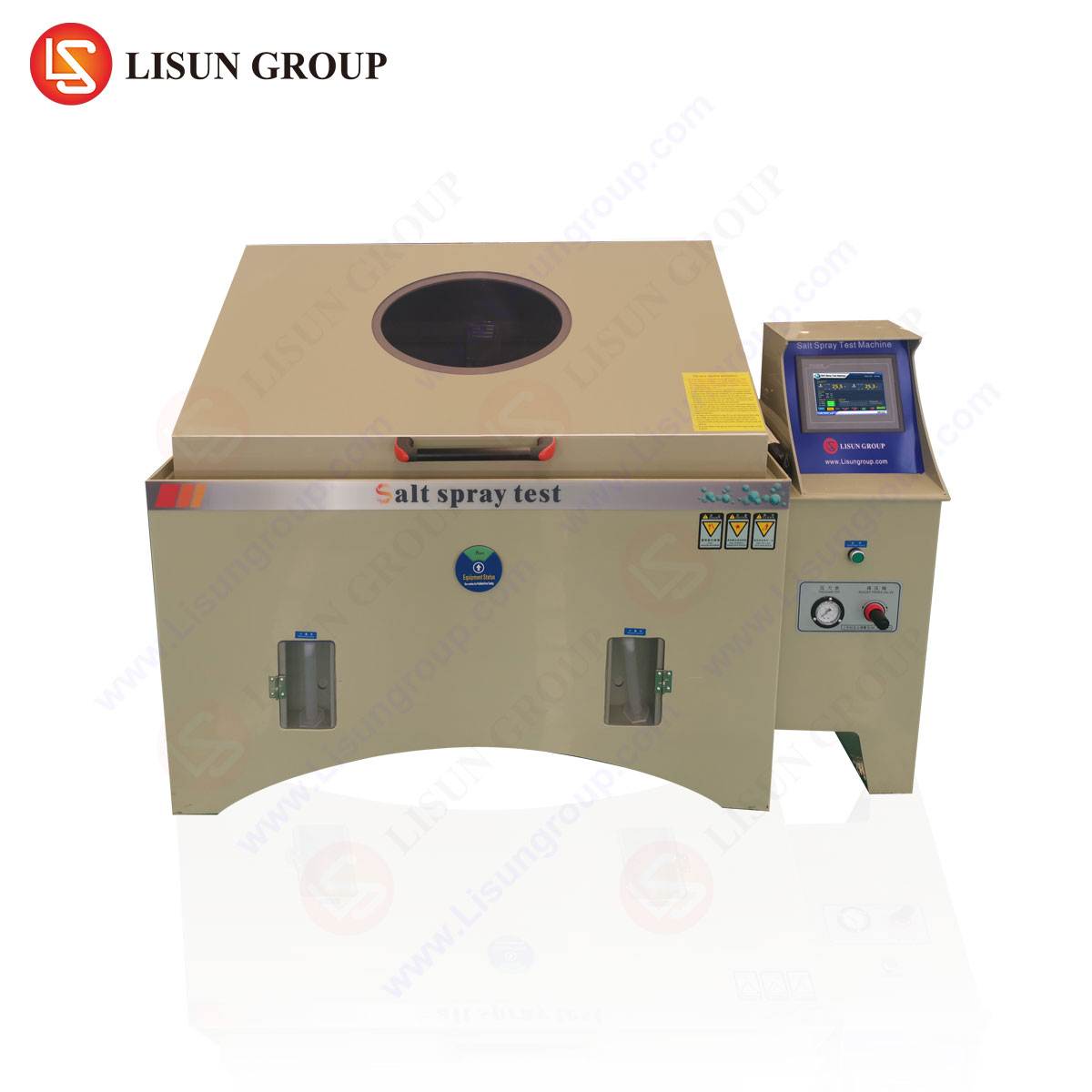
To contextualize the relationship between specification and investment, we examine the LISUN YWX/Q-010X Salt Spray Test Chamber. This model is engineered for rigorous compliance with international standards, positioning it within the mid-to-high range of the market, justified by its construction and features.
Specifications and Testing Principle: The YWX/Q-010X operates on the principle of creating a controlled corrosive environment. A 5% sodium chloride solution is pumped to a saturator tower, where it is heated and mixed with filtered, compressed air. This saturated, pressurized mixture is expelled through a precision nozzle, creating a dense, settling salt fog within the test chamber, maintained at a constant temperature of 35°C ± 2°C (for the NSS test). The chamber interior is constructed from anti-crystallization, reinforced polypropylene, resisting deformation and chemical attack. Its standard volume caters to a balanced throughput for component testing.
Key technical specifications include:
- Test Chamber Temperature Range: Ambient +5°C to 55°C.
- Saturation Barrel Temperature Range: Ambient +5°C to 65°C.
- Temperature Uniformity: ≤ ±2°C.
- Salt Spray Settlement Rate: 1.0~2.0ml/80cm²·h (continuously adjustable).
- pH of Collected Solution: 6.5~7.2 (for NSS).
- Controller: Digital PID touch-screen controller with programmable logic and data logging.
Industry Use Cases and Applications: The YWX/Q-010X finds application in quality control and R&D labs across the specified industries. In Automotive Electronics and Aerospace and Aviation Components, it tests the conformal coatings on engine control units (ECUs) or avionics circuit boards. Lighting Fixtures manufacturers use it to assess the corrosion resistance of aluminum housings and their protective anodized or painted finishes. For Electrical Components such as switches, sockets, and connectors, the test validates the integrity of metallic plating (e.g., nickel, chrome, zinc). Cable and Wiring Systems are evaluated for the durability of their insulation and shielding when exposed to saline condensation. In Medical Devices, it helps ensure the longevity of stainless-steel instrument casings and external components.
Competitive Advantages: The pricing of the YWX/Q-010X is justified by several engineered advantages. Its anti-crystallization PP construction minimizes maintenance downtime from salt clogging. The precision air pressure and temperature control system ensures a consistent settlement rate, a non-negotiable requirement for test validity per ASTM B117. The programmable controller not only automates tests but also provides an audit trail of environmental conditions, which is crucial for certification processes in regulated industries like automotive (IATF 16949) or aerospace. This integration of robust materials, precise control, and data integrity features positions it as a total-cost-of-ownership solution rather than a mere commodity purchase.
Standards Compliance and Its Impact on Procurement Cost
Chamber pricing is profoundly influenced by the scope and rigor of standards compliance. A chamber marketed as “ASTM B117 compliant” must demonstrably meet every stipulation of the standard regarding chamber construction, fog collection, settlement rate, temperature tolerance, and solution chemistry. Third-party certification or detailed validation reports from the manufacturer add to development and quality assurance costs, which are reflected in the price. Chambers capable of performing not only Neutral Salt Spray (NSS) but also Acetic Acid Salt Spray (AASS) and Copper-Accelerated Acetic Acid Salt Spray (CASS) tests require additional material compatibility for handling acidic solutions, such as specialized nozzle materials and solution reservoirs, increasing complexity and cost. Furthermore, the ability to perform cyclic corrosion tests, which are becoming the benchmark in Automotive Electronics and Telecommunications Equipment, requires advanced programming and hardware to cycle between salt spray, humidity, and dry-off conditions, placing such chambers at the premium end of the market.
Operational and Lifecycle Cost Considerations
The initial purchase price is a single component of the total investment. A lower-priced chamber may incur higher operational and lifecycle costs. Energy efficiency is a primary operational cost driver. Chambers with poor insulation, inefficient heaters, or outdated refrigeration systems (for certain test profiles) consume significantly more electricity. Maintenance costs are tied to component accessibility and durability. Chambers designed for easy nozzle cleaning, with accessible saturator towers and corrosion-resistant sensors, reduce labor time and frequency of part replacement. The mean time between failures (MTBF) for key components like pumps, heaters, and controllers directly impacts long-term reliability and cost. A chamber with a 20% higher initial price but a 50% longer service life and 30% lower energy consumption presents a superior financial proposition over a five-year horizon.
Procurement Strategy: Aligning Technical Requirements with Budgetary Constraints
Developing a strategic procurement framework is essential. The first step is a rigorous needs analysis: defining the specific tests (NSS, AASS, CASS, cyclic), the required chamber volume based on maximum sample size, and the necessary data logging and compliance reporting features. A technical specification sheet should be created, against which all potential chambers are evaluated. It is critical to request detailed validation data from manufacturers, including chamber temperature uniformity maps and settlement rate consistency reports. For industries like Medical Devices or Aerospace and Aviation Components, where supplier qualification is stringent, onsite factory acceptance tests (FAT) may be warranted, a cost often factored into higher-end models. The decision must balance the capital expenditure against the risk of test invalidation, product failure in the field, and the reputational damage that can arise from specifying an under-performing chamber based solely on initial price.
Conclusion
The pricing of a salt spray chamber is a multidimensional function of its technical capabilities, construction integrity, control sophistication, and compliance depth. It is an investment in product reliability and brand integrity. As exemplified by technical implementations such as the LISUN YWX/Q-010X, a chamber priced for value integrates precise environmental control, durable materials, and intelligent data management to deliver reproducible, standard-compliant results. By prioritizing a total-cost-of-ownership model and aligning specifications with long-term testing requirements, organizations can make a procurement decision that ensures the integrity of their corrosion testing program and, by extension, the durability of their products in a corrosive world.
Frequently Asked Questions (FAQ)
Q1: What is the significance of the “salt spray settlement rate” (1.0~2.0ml/80cm²·h), and why must it be adjustable?
The settlement rate quantifies the volume of salt fog condensing on a unit area per hour. Standards like ASTM B117 strictly mandate this range to ensure test severity is both consistent and reproducible across different laboratories and chambers. Adjustability allows technicians to calibrate the chamber precisely to the midpoint of the range (typically ~1.5ml/80cm²·h), compensating for environmental variables and ensuring compliance before each critical test series.
Q2: For testing printed circuit board assemblies (PCBAs) from Automotive Electronics, is a standard NSS test sufficient?
While NSS provides a baseline, the automotive industry increasingly requires Cyclic Corrosion Tests (CCT). These profiles, such as those in SAE J2334, expose components to cycles of salt spray, high humidity, and dry-off periods. This better simulates real-world conditions like driving, parking, and overnight condensation, which can cause more complex failure modes (e.g., creep corrosion, electrochemical migration) than a continuous salt spray alone. A chamber must have programmable multi-stage control to perform these tests.
Q3: How does the pH of the collected solution impact test results, and how is it maintained?
The pH is critical for test consistency. For NSS, a neutral pH (6.5-7.2) is mandated. An acidic or alkaline shift can drastically accelerate or alter the corrosion mechanism, invalidating comparisons. The YWX/Q-010X maintains pH through the use of high-purity salt and deionized water, coupled with a saturated air conditioning system (the saturator tower) heated to approximately 47°C. This process ensures the compressed air is heated and humidified before atomization, preventing CO2 absorption which would lower the pH.
Q4: What regular maintenance is crucial to ensure the longevity and accuracy of a salt spray chamber?
Essential maintenance includes: daily checking and cleaning of the nozzle to prevent clogging; weekly verification of the salt solution level and concentration; monthly cleaning of the chamber interior to remove salt deposits and inspection of all seals; and quarterly calibration of temperature sensors and verification of the settlement rate using a calibrated collection apparatus. Neglecting these leads to drift in test parameters and non-compliance.
Q5: Can a salt spray chamber be used to provide a direct correlation to real-world product lifetime?
Not directly. Salt spray testing is an accelerated, comparative test. Its primary value is in comparing the relative performance of different materials, coatings, or processes under the same severe conditions. Predicting an exact service life (e.g., “this coating will last 10 years”) requires correlation studies that compare accelerated test results with long-term field exposure data from a specific environment. It is a quality control and screening tool, not an absolute predictor.