




A Methodological Framework for Selecting Salt Spray Chambers in Corrosion Testing
Corrosion remains a preeminent failure mechanism across a vast spectrum of manufactured goods, with salt-induced degradation posing a particularly acute threat to product longevity and reliability. The salt spray (fog) test, standardized globally, serves as a fundamental accelerated corrosion assessment method. Its primary function is not to precisely replicate field conditions but to provide a controlled, severe, and reproducible environment for comparative evaluation of materials and protective coatings. The selection of an appropriate salt spray chamber, therefore, is a critical technical decision that directly influences test validity, operational efficiency, and compliance with international standards. This article delineates a comprehensive set of selection criteria, moving beyond basic specifications to consider the integrated system requirements necessary for rigorous, standards-compliant testing.
Defining Test Scope and Regulatory Compliance Imperatives
The foundational step in chamber selection is an unequivocal definition of the test scope. This encompasses the physical dimensions of test specimens, anticipated throughput volume, and, most critically, the specific testing standards mandated by industry or regulatory bodies. Chambers are designed to conform to the precise environmental parameters—temperature stability, salt solution concentration, pH, collection rate, and saturation tower conditions—stipulated in these documents. Predominant standards include ASTM B117, ISO 9227, JIS Z 2371, and various MIL-STD and IEC specifications, each with nuanced requirements. For instance, testing automotive electronics to IEC 60068-2-11 (Test Ka: Salt mist) for resistance to conductive corrosion may have different collection rate tolerances than testing aerospace fasteners to ASTM B117 for coating qualification. A chamber must not only claim compliance but provide transparent documentation and system design (e.g., precision atomizing nozzles, dual-wall air saturation tower) that demonstrably enables it.
Chamber Construction and Material Durability Analysis
The chamber itself is the primary test artifact and must exhibit superior corrosion resistance to ensure long-term integrity and prevent contamination. Interior construction materials are paramount. High-grade polymers like fiber-reinforced polypropylene offer excellent chemical resistance but may have temperature limitations. For higher-temperature tests or enhanced durability, glass-reinforced polyester (GRP) or solid polyvinyl chloride (PVC) structures are prevalent. The most robust, industry-preferred solution for critical testing is a one-piece molded chamber constructed from advanced engineered plastics, which eliminates seams and joints that are potential failure points. Exteriors typically employ powder-coated mild steel or stainless steel for structural support and aesthetic durability. The choice of material directly impacts maintenance cycles, risk of catastrophic failure from stress corrosion cracking, and the purity of the test environment.
Environmental Control System Precision and Stability
The core scientific value of a salt spray test lies in the precise and stable maintenance of the corrosive environment. The environmental control system is thus the chamber’s technological heart. Key subsystems include:
- Temperature Control: A high-accuracy, low-drift PID controller managing heaters and sensors is essential. Uniformity across the entire workspace, typically required to be within ±2°C of the setpoint (e.g., 35°C ± 1°C for neutral salt spray), must be validated. Multi-zone heating or sophisticated air circulation designs are often necessary for larger chambers.
- Atomization and Air Supply: The salt fog is generated by forcing a conditioned air supply through a specialized nozzle, drawing the salt solution from a reservoir. The air must be cleaned, humidified, and heated in a saturation tower to prevent solution concentration changes due to evaporation. Nozzle design (e.g., VeeJet type) and air pressure regulation are critical for achieving the specified fog collection rate of 1.0 to 2.0 ml/80cm²/hour.
- Solution Management: An integrated, corrosion-resistant reservoir with level monitoring and automatic replenishment from an external tank ensures uninterrupted testing. The system should facilitate easy preparation and maintenance of the solution per standard formulas (e.g., 5% NaCl solution with pH adjusted to 6.5 to 7.2 for neutral spray).
Instrumentation, Data Acquisition, and Validation Protocols
Modern testing demands not just execution but documentation and validation. Instrumentation should provide real-time monitoring of all critical parameters: chamber temperature, saturation tower temperature, air pressure, and test duration. Data logging capabilities, either through an integrated digital interface or connectivity to external data acquisition systems, are increasingly mandatory for audit trails and quality management systems (ISO 17025). Features like automatic pH monitoring of the collected solution and fog collection rate calibration aids are significant advantages. The chamber design should inherently support routine validation checks, such as easy placement of collection funnels and neutral pH test papers, as mandated by periodic standard compliance audits.
Operational Ergonomics and Maintenance Accessibility
A chamber is a long-term capital investment whose total cost of ownership is heavily influenced by operational efficiency and serviceability. Ergonomic design considerations include:
- Access: A large, transparent, and robust canopy or door with an effective sealing mechanism allows for easy loading and visual inspection without disturbing the environment.
- Specimen Mounting: Adjustable, non-conductive specimen racks that maximize workspace utilization while ensuring consistent exposure angles are vital.
- Maintenance Accessibility: Components subject to wear or scaling—nozzles, saturation tower, reservoir, and heaters—should be accessible for cleaning, calibration, or replacement with minimal downtime. A well-designed chamber anticipates maintenance with removable panels and service-friendly layouts.
Safety Interlocks and Exhaust Management
Safety is a non-negotiable criterion. Chambers must incorporate fail-safe mechanisms, including over-temperature protection, low solution level alarms, and power failure safeguards. A critical, often overlooked aspect is the management of the corrosive exhaust. The chamber must be connected to an appropriate external exhaust system, often requiring a dedicated fume hood or ducting to an acid-resistant scrubber. The chamber’s own exhaust port design and pressure regulation should prevent backflow and ensure safe dispersal of the salt-laden air, protecting laboratory personnel and equipment.
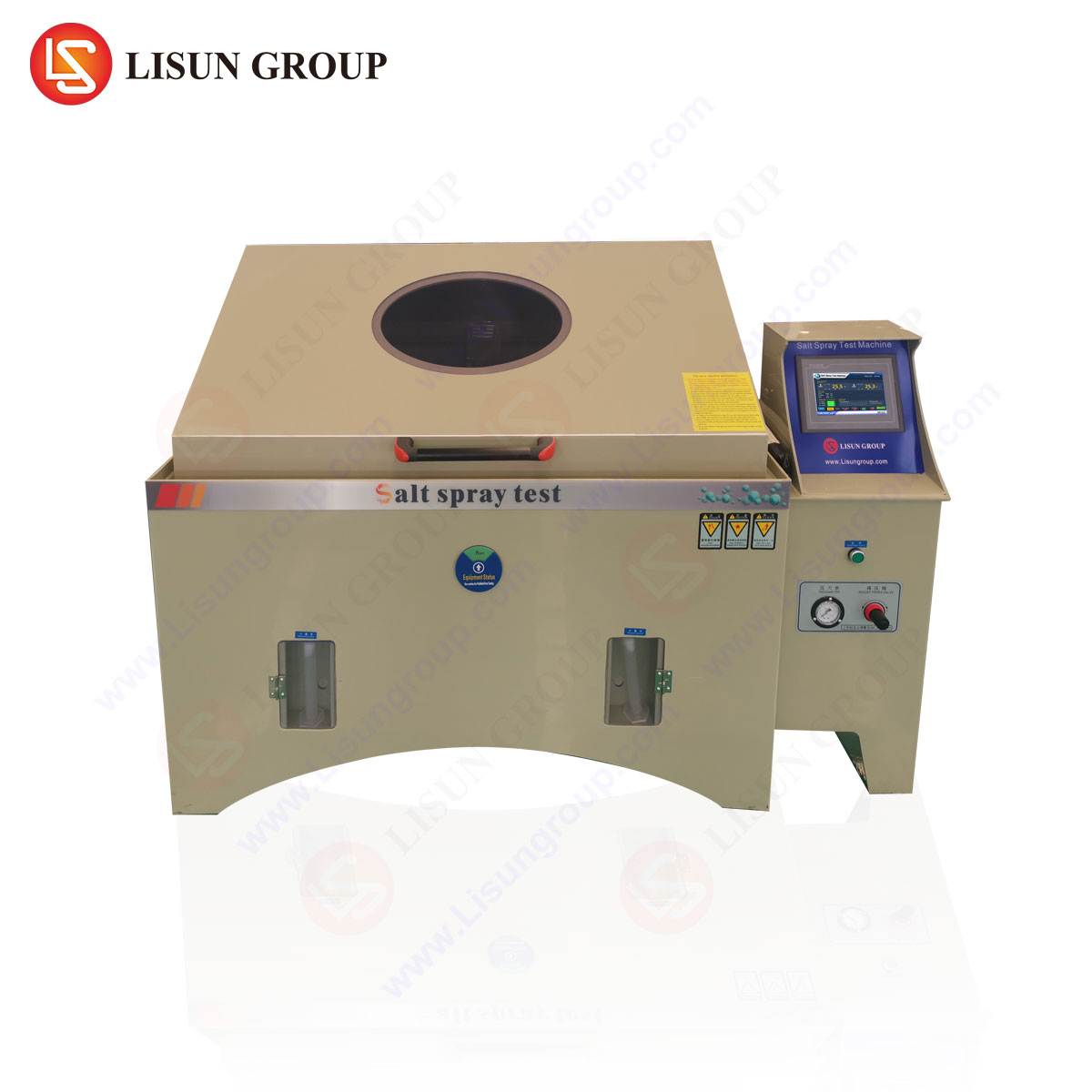
Case Study: The LISUN YWX/Q-010 Salt Spray Test Chamber
To contextualize these criteria, we examine the LISUN YWX/Q-010 Salt Spray Test Chamber, a model engineered to meet the rigorous demands of standardized corrosion testing.
Testing Principle & Core Specifications: The YWX/Q-010 operates on the principle of creating a controlled, accelerated corrosive environment. A conditioned air supply is pressurized and passed through a precision atomizing nozzle, drawing a prepared sodium chloride solution to create a dense, uniform salt fog. The chamber maintains a tightly regulated temperature of 35°C (±1°C) for the NSS (Neutral Salt Spray) test, with variants like the YWX/Q-010X capable of cycling between salt spray, dry-off, and humidity phases for more complex CASS (Copper-Accelerated Acetic Acid Salt Spray) or cyclic corrosion tests.
Its key specifications include an interior workspace volume tailored for standard batch testing, constructed from a one-piece molded polypropylene tank for maximum corrosion resistance. It features a transparent polycarbonate canopy for observation, an automatic solution leveling system, and a PID digital controller for precise parameter management. The integrated saturation tower ensures the incoming air is heated and humidified to the standard-specified temperature, maintaining consistent solution concentration.
Industry Use Cases: The YWX/Q-010 is applicable across the industries specified. For Electrical and Electronic Equipment and Automotive Electronics, it tests the efficacy of conformal coatings on PCBs and the corrosion resistance of connectors and housings. Lighting Fixtures and Telecommunications Equipment manufacturers use it to validate the durability of exterior aluminum castings and galvanized steel mounts. In Aerospace and Aviation Components, it qualifies coatings on fasteners and ancillary parts. Cable and Wiring Systems are tested for insulation integrity and metallic sheath protection. For Medical Devices and Consumer Electronics, it assesses the surface finish and material resilience of stainless steel components and decorative trims.
Competitive Advantages: The YWX/Q-010’s design addresses several selection criteria directly. Its one-piece molded polypropylene interior offers superior, maintenance-free durability compared to welded or assembled alternatives, directly impacting Chamber Construction longevity. The precision of its PID controller and air saturation system speaks to Environmental Control System Precision. Its compliance with ASTM B117, ISO 9227, and JIS Z 2371 is verifiable through its design, addressing the Regulatory Compliance imperative. The transparent canopy and accessible nozzle and tower design enhance Operational Ergonomics and Maintenance Accessibility.
Integrating Chamber Selection into a Quality Assurance Ecosystem
Ultimately, the selection of a salt spray chamber cannot be an isolated procurement decision. It must be integrated into the broader quality assurance and reliability testing ecosystem of the organization. Considerations for future needs, such as testing to evolving automotive standards requiring cyclic corrosion profiles, may justify selecting a more capable model like a cyclic chamber from the outset. Compatibility with laboratory information management systems (LIMS) and the availability of local technical support for calibration and repair are critical long-term factors. The selected chamber becomes a source of definitive data on product durability, informing design decisions, material selection, and warranty assessments. A methodical approach to selection, grounded in the technical criteria outlined herein, ensures this data is reliable, reproducible, and defensible.
Frequently Asked Questions (FAQ)
Q1: What is the primary difference between a standard neutral salt spray (NSS) test and a cyclic corrosion test, and which chamber is required?
A1: The standard NSS test (e.g., ASTM B117) exposes specimens to a continuous salt fog at a constant temperature (typically 35°C). It is a relatively simple, constant-state test. Cyclic corrosion tests involve programmed sequences of salt spray, humidity, drying, and sometimes freezing phases. These are designed to better simulate real-world environmental cycles and are often more damaging. A basic chamber like the LISUN YWX/Q-010 is suitable for NSS. Cyclic tests require a more advanced chamber, such as the YWX/Q-010X variant, with programmable controls for temperature and humidity cycling.
Q2: How often does the salt spray chamber require calibration, and what does it entail?
A2: Calibration frequency is typically annual, but it can be more frequent based on internal quality procedures or accreditation requirements (e.g., ISO/IEC 17025). Calibration involves verifying and adjusting the chamber’s critical parameters: temperature uniformity and stability across the workspace, the pH and concentration of the collected salt fog, and the fog collection rate (must fall within 1.0-2.0 ml/80cm²/hour). This is performed using traceable instruments like calibrated thermometers, pH meters, and graduated collection cylinders.
Q3: Can a salt spray test predict the exact service life of a coating in years?
A3: No. Salt spray testing is an accelerated comparative test, not a predictive one. It provides a controlled, severe environment to rank the relative performance of different materials, coatings, or processes in a much shorter time than natural exposure. While correlation studies between test hours and real-world years exist for specific materials in specific environments, a direct, universal conversion is not scientifically valid. The test’s value lies in quality control, benchmarking, and identifying potential failure modes quickly.
Q4: What are the critical factors in preparing the sodium chloride solution for testing?
A4: The purity of the water and salt is paramount. Standards require the use of distilled or deionized water with low conductivity and total dissolved solids. The sodium chloride must be high-purity (≥99.8%) with strict limits on impurities like copper and nickel. The solution is typically prepared at a 5% by mass concentration (5g NaCl per 95g water). After preparation, the pH must be adjusted to the range specified by the standard (e.g., 6.5 to 7.2 for NSS at 35°C) and measured using a pH meter calibrated at the test temperature.