




A Technical Guide to Salt Spray Test Chambers: Principles, Applications, and the YWX/Q-010 Series
Introduction to Accelerated Corrosion Testing
The degradation of materials due to environmental corrosion represents a significant economic and safety challenge across global manufacturing sectors. Predicting the long-term performance and durability of components and finished products in corrosive atmospheres, particularly those containing chlorides, is a fundamental requirement of quality assurance and product development. Natural environmental exposure testing, while valuable, is prohibitively time-consuming for modern product cycles. Consequently, accelerated corrosion test chambers, commonly referred to as salt spray (fog) test chambers, have become an indispensable laboratory instrument for simulating and accelerating corrosive attack in a controlled, reproducible environment. These chambers provide a standardized methodology to evaluate the relative corrosion resistance of materials, coatings, and surface treatments within days or weeks, offering critical data that correlates to years of service life. This guide details the operational principles, standardized methodologies, diverse industrial applications, and technical specifications of modern salt spray test equipment, with a specific examination of the LISUN YWX/Q-010 series as a representative example of contemporary engineered solutions.
Fundamental Operational Principles of Salt Spray Testing
At its core, a salt spray test chamber creates a controlled corrosive environment by atomizing a prepared electrolyte solution—typically a 5% sodium chloride (NaCl) solution per ASTM B117 and ISO 9227—into a fine, settled fog or mist. This mist uniformly blankets test specimens placed within the chamber’s exposure zone. The test is not designed to replicate a specific real-world environment exactly but to provide a severely corrosive, standardized condition that allows for comparative ranking of materials and coatings.
The chamber operates on several integrated subsystems. A reservoir holds the test solution, which is pumped to a nozzle system. Compressed air, meticulously cleaned and humidified to prevent contamination and ensure consistency, is used to atomize the solution. The resulting salt-laden fog is dispersed within a temperature-controlled exposure area, maintained typically at 35°C ± 2°C for neutral salt spray (NSS) tests. The chamber construction utilizes corrosion-resistant materials such as polypropylene, glass-reinforced polyester, or PVC to ensure longevity and prevent contamination of the test environment. A critical component is the saturated tower, or bubble tower, which heats and humidifies the compressed air to 100% relative humidity before it reaches the atomizer. This process ensures the expelled fog is warm and saturated, preventing evaporation of the droplets before they settle on the specimens, thereby guaranteeing a consistent and wet corrosive layer.
Testing standards strictly define parameters including solution pH, concentration, collection rate (typically 1.0 to 2.0 ml per hour per 80 cm²), chamber temperature, and specimen orientation. Adherence to these parameters is paramount for generating valid, reproducible results that can be compared across different laboratories and testing intervals.
The YWX/Q-010 Series: Architecture and Technical Specifications
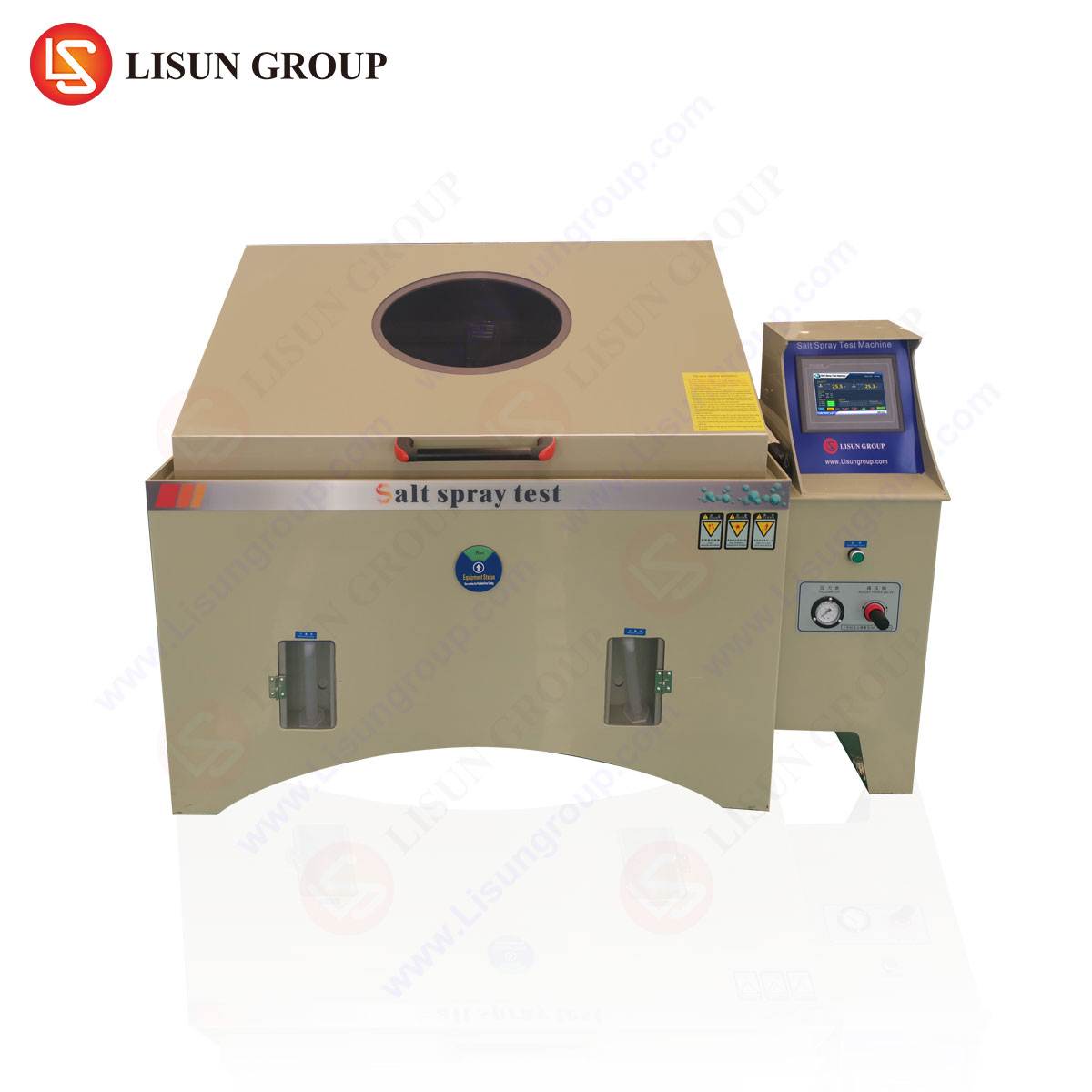
The LISUN YWX/Q-010 and YWX/Q-010X salt spray test chambers exemplify the integration of robust construction with precise environmental control. These chambers are engineered to comply fully with international standards including ASTM B117, ISO 9227, JIS Z 2371, and equivalent national standards.
The primary chamber body is constructed from reinforced fiberglass-reinforced plastic (FRP), offering superior resistance to the corrosive internal atmosphere and long-term structural integrity. The YWX/Q-010X variant often incorporates enhanced features such as a modular design for easier maintenance or advanced controller interfaces. The chamber cover is typically transparent acrylic, allowing for continuous visual inspection of specimens without disrupting the test environment.
A digital microprocessor-based controller manages all critical parameters. It regulates chamber temperature, saturated tower temperature, and test duration with high accuracy. The atomization system employs a pneumatic nozzle fed by pre-conditioned air from the saturated tower, ensuring consistent fog generation. Key specifications for the YWX/Q-010 series include:
- Chamber Volume: Standard models offer a 108-liter or 270-liter workspace, accommodating a range of specimen sizes and quantities.
- Temperature Range: The exposure zone is controllable from ambient to +55°C, with a standard NSS test setting of 35°C. The saturated air tower operates at a higher set point, typically around 47°C, to achieve 100% relative humidity.
- Control System: PID (Proportional-Integral-Derivative) digital controllers provide stable temperature regulation, minimizing fluctuation. Timers allow for automated test cycles.
- Solution Reservoir: A large-capacity, integrated tank constructed from corrosion-resistant material minimizes refill frequency during long-duration tests.
- Safety & Monitoring: Features often include low-solution level alerts, over-temperature protection, and chamber overheat safeguards to ensure unattended operation safety and test integrity.
The competitive advantage of such a system lies in its reproducibility and compliance. Precise PID control and proper saturated tower design ensure the collected fog rate consistently falls within the narrow band required by standards. The use of high-purity, inert construction materials prevents the introduction of contaminants that could alter solution chemistry or cause galvanic effects, which are critical factors for generating trustworthy data.
Standardized Test Methodologies and Their Applications
Beyond the standard Neutral Salt Spray (NSS) test, modern chambers can be configured to perform several distinct corrosive evaluations, each tailored to simulate different environmental conditions or to assess specific failure modes.
- Neutral Salt Spray (NSS): The most common test, using a 5% NaCl solution with a pH neutralized to 6.5 to 7.2. It provides a general assessment of corrosion resistance for metals and organic coatings (paints, platings). Evaluation criteria often include time to first red rust, extent of creepage from a scribe, or blister density.
- Acetic Acid Salt Spray (AASS): This test involves acidifying the salt solution with glacial acetic acid to a pH of 3.1–3.3. The acidic environment is more aggressive and is frequently used for testing decorative coatings like nickel-chromium or copper-nickel-chromium electrodeposits, as it accelerates corrosion and better differentiates between coating systems.
- Copper-Accelerated Acetic Acid Salt Spray (CASS): An even more severe test, where copper chloride is added to the acidified salt solution. Primarily used for rapid testing of decorative copper-nickel-chromium or nickel-chromium platings on zinc die castings, aluminum, or steel, it can produce results in 6-24 hours that correlate to weeks of NSS testing.
The selection of methodology is dictated by the material system, its intended application, and the relevant industry-specific qualification standard. Data from these tests are used not for predicting an exact service life, but for quality control, comparative ranking of materials/processes, and identifying processing flaws.
Industry-Specific Applications and Use Cases
The application of salt spray testing is ubiquitous in industries where product longevity and reliability in humid or coastal environments are critical.
- Automotive Electronics and Components: Connectors, wiring harnesses, sensor housings, and electronic control units (ECUs) must resist corrosion from road salts and underbody exposure. Testing validates the performance of conformal coatings, connector platings, and seal integrity.
- Aerospace and Aviation Components: While often subject to more exotic tests, many structural and interior components, including fasteners, brackets, and electrical assemblies, are tested via salt spray to ensure baseline corrosion resistance, which is crucial for safety and maintenance intervals.
- Electrical and Electronic Equipment / Industrial Control Systems: Enclosures for PLCs, switchgear, motor controls, and terminal blocks are tested to ensure their protective coatings prevent corrosion that could lead to short circuits, ground faults, or mechanical seizure. This is vital for industrial safety and operational continuity.
- Telecommunications Equipment: Outdoor cabinets, antenna mounts, and broadband hardware are exposed to global atmospheric conditions. Salt spray testing qualifies coatings and materials for coastal or de-icing salt environments.
- Lighting Fixtures: Outdoor, automotive, and marine lighting fixtures are subjected to salt fog to evaluate housing integrity, lens clarity retention, and the corrosion resistance of reflective surfaces and electrical contacts.
- Medical Devices: Devices used in sterile processing (which involves saline solutions) or portable equipment used in various environments may require validation of material compatibility and surface finish durability against chloride-induced corrosion.
- Consumer Electronics, Household Appliances, and Office Equipment: Products from smartphones to washing machines and printers may contain metal components susceptible to corrosion from handling (perspiration) or environmental humidity. Testing is used for quality audits and design validation of internal frames, connectors, and external trim.
- Electrical Components and Cable Systems: Switches, sockets, circuit breakers, and cable sheathing/jacketing materials are tested to ensure reliable electrical contact and insulation properties are not compromised by corrosive attack over time.
In each case, failure modes identified during testing—such as substrate corrosion, coating blistering, or galvanic corrosion at dissimilar metal junctions—inform design improvements, material selection, and manufacturing process controls.
Interpreting Test Results and Correlation to Real-World Performance
A critical understanding in salt spray testing is that it is primarily a comparative, qualitative tool rather than a precise predictive one. A result stating “500 hours to red rust” does not equate to 500 hours of real-world service. The acceleration factor is highly variable, depending on the specific real-world environment (industrial, marine, rural) and the material system itself.
Results are interpreted through standardized rating systems. For coated samples, common evaluations include:
- Scribe Creepage: Measuring the undercutting corrosion from a deliberate scratch through the coating, per ISO 4628 or ASTM D1654.
- Blister Density and Size: Assessing the formation of blisters in organic coatings per pictorial standards.
- Corrosion Percentage: Visually estimating the percentage of surface area affected by base metal corrosion.
The true value lies in benchmarking. By testing a new coating formulation against a known, field-validated standard under identical chamber conditions, a relative performance ratio can be established. This data, combined with other accelerated tests (e.g., humidity, UV) and field data, builds a correlation model that informs material qualification and warranty periods.
Critical Considerations for Chamber Operation and Maintenance
To ensure test validity, rigorous operational discipline is required. This includes using ASTM Type IV or deionized water for solution preparation, reagent-grade sodium chloride, and regular calibration of chamber temperature sensors. The pH of the collected fog must be monitored and adjusted daily for NSS tests. Nozzles must be kept clean to prevent clogging and ensure a consistent fog dispersion pattern.
Regular maintenance of the chamber itself is equally important. This involves cleaning the chamber interior to remove salt deposits, inspecting and cleaning the saturated tower, and verifying the integrity of seals on the chamber cover to prevent fog leakage and maintain a stable environment. A well-maintained chamber like the YWX/Q-010 series, with its corrosion-resistant construction and accessible components, supports consistent operation and reduces downtime, directly contributing to laboratory throughput and data reliability.
Conclusion
Salt spray test chambers remain a cornerstone of corrosion evaluation strategy. Their ability to provide rapid, comparative data on material and coating performance under a standardized, severe chloride-laden environment is irreplaceable for industries ranging from automotive to aerospace and consumer electronics. The effectiveness of the test hinges on strict adherence to published standards, meticulous chamber maintenance, and a clear understanding of the test’s purpose as an accelerator for comparative analysis. Instruments such as the LISUN YWX/Q-010 series, with their precise environmental controls and durable construction, provide the necessary platform to execute these standardized methodologies with the repeatability and accuracy required for meaningful material qualification and quality assurance in a global market.
Frequently Asked Questions (FAQ)
Q1: What is the key difference between the NSS, AASS, and CASS tests?
The key difference is the aggressiveness and specific application of the test solution. NSS uses a neutral pH salt solution for general testing. AASS uses an acidified salt solution (pH ~3.2) for faster, more aggressive testing of decorative coatings. CASS adds copper salts to an acidified solution for the most rapid testing of certain electroplated systems, particularly on substrates like zinc die castings.
Q2: How often should the salt spray test solution be replenished or changed?
The solution level should be monitored daily and replenished with fresh, pH-adjusted solution as needed to maintain the reservoir level. The entire solution in the reservoir should be completely drained, the reservoir cleaned, and refilled with a fresh batch at regular intervals—typically weekly or at the start of a new test series—to prevent the buildup of contaminants or biological growth that could affect test chemistry.
Q3: Can a salt spray test chamber be used to test non-metallic materials?
Yes, though the purpose differs. While metals are tested for corrosion, non-metallics like plastics, composites, and painted surfaces are tested for effects such as coating adhesion loss, blistering, surface degradation, color change, or the corrosion of any embedded metal inserts or fasteners. The test assesses the material system’s overall resistance to the corrosive environment.
Q4: Why is control of the compressed air quality so important for the test?
The compressed air is used to atomize the salt solution. If it contains oil, dirt, or moisture, these contaminants will be introduced directly into the test chamber, altering the chemistry of the salt fog and potentially creating non-standard corrosive conditions (e.g., introducing acids or particulates). This can lead to invalid, non-reproducible results. Proper filtration and humidification via the saturated tower are essential.
Q5: What factors most commonly lead to invalid or non-reproducible salt spray test results?
Common pitfalls include: incorrect solution concentration or pH; contaminated water or salt; improper chamber temperature or saturated tower temperature; clogged or misaligned atomizing nozzles; over-crowding of test specimens, which blocks fog circulation; and leakage from the chamber, which reduces fog density. Consistent calibration, maintenance, and adherence to standard operating procedures are critical to avoid these issues.