




Environmental Rigor: The Imperative of Sand and Dust Testing
The operational integrity and longevity of manufactured goods are inextricably linked to their resilience against environmental stressors. Among these, the pervasive and abrasive nature of airborne particulate matter—specifically sand and dust—presents a formidable challenge across a multitude of industries. Sand and dust testing, therefore, is not merely a quality assurance step but a critical engineering discipline that simulates the ingress and effects of fine particulates on equipment and components. This formalized testing is essential for validating product designs, ensuring compliance with international standards, and ultimately, safeguarding functionality in real-world conditions where particulate contamination is a constant threat.
Deconstructing Particulate Ingress: Mechanisms of Failure
The intrusion of sand and dust can precipitate a cascade of failure modes, each with significant consequences. The primary mechanisms are categorized as abrasive, obstructive, and conductive. Abrasive wear occurs when hard silicate particles, carried by wind or moving parts, erode surfaces, degrade seals, and damage optical components or bearing assemblies. Obstructive failure arises when particulate accumulation impedes mechanical motion, clogs ventilation pathways, or insulates heat sinks, leading to thermal runaway. Perhaps most critically, conductive dust—often hygroscopic—can create unintended electrical bridges across insulated conductors, leading to short circuits, leakage currents, and catastrophic electrical failures. For sensitive electronics in automotive control units or medical ventilators, even minute, non-conductive dust can interfere with sensor accuracy and signal integrity.
Governance by Standard: Key Testing Protocols and Methodologies
The methodology for sand and dust testing is rigorously codified in several international standards, which define the particulate composition, concentration, airflow, temperature, and duration of exposure. The most widely referenced standards include IEC 60529 (Ingress Protection or IP Code), MIL-STD-810G Method 510.5, and ISO 20653. These documents provide reproducible frameworks. For example, IEC 60529 defines IP5X and IP6X dust-protected and dust-tight tests, utilizing talcum powder in a controlled vacuum or pressurized differential. MIL-STD-810G Method 510.5 is more severe, employing Arizona Road Dust or similar blends to simulate blowing and drifting dust conditions, often with temperature cycling. The selection of standard is dictated by the product’s intended deployment environment, from a sealed industrial control panel in a factory (IP6X) to a military-grade communication device deployed in arid regions (MIL-STD-810).
Anatomy of a Test Chamber: The LISUN SC-015 Dust Sand Test System
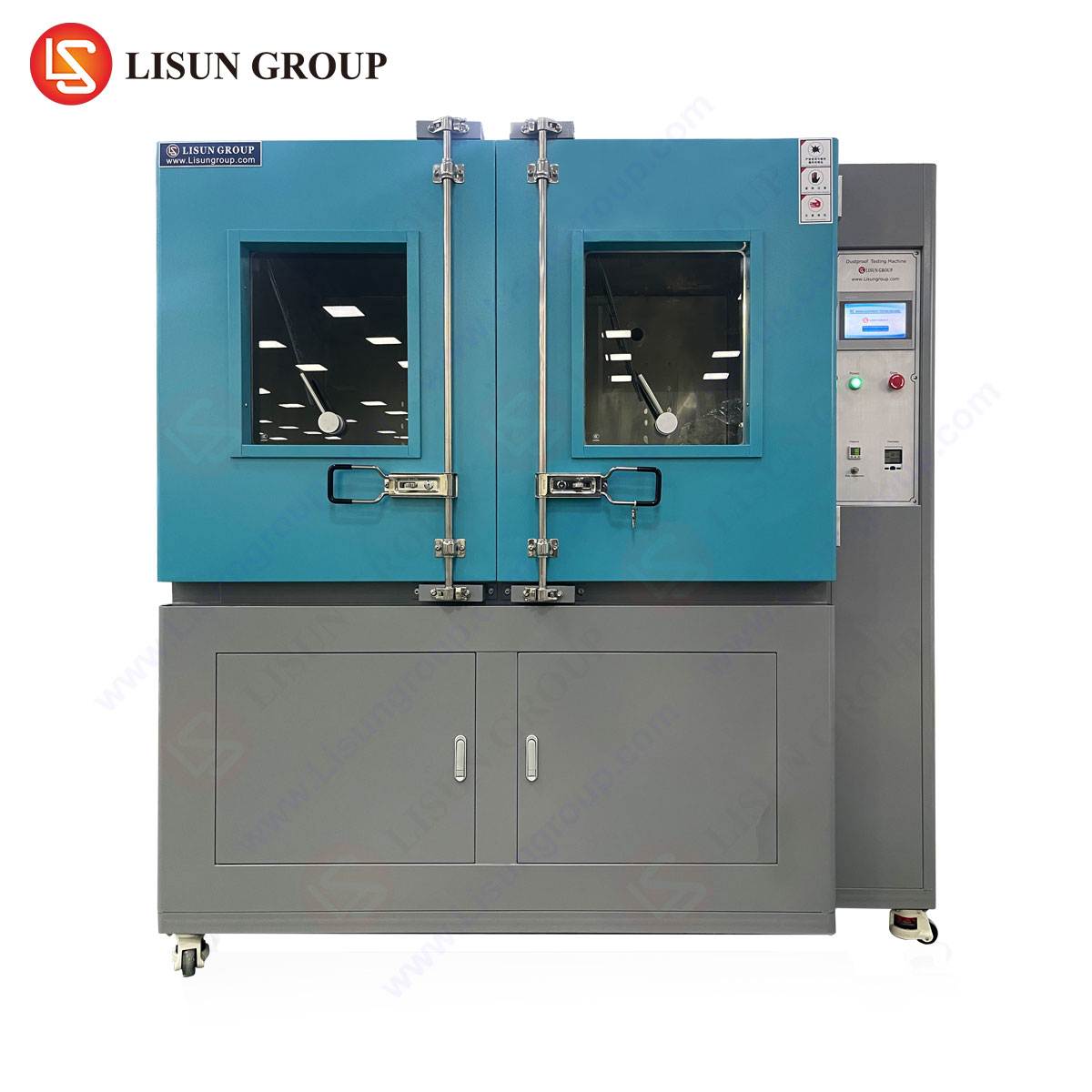
To execute these standardized tests with precision and repeatability, specialized environmental chambers are required. The LISUN SC-015 Dust Sand Test Chamber represents a sophisticated apparatus engineered for this exact purpose. Its core function is to generate, suspend, and circulate a calibrated concentration of test dust within a sealed workspace, subjecting the device under test (DUT) to controlled particulate assault. The chamber’s construction typically involves a stainless-steel test chamber with a reinforced glass observation window, an integrated dust reservoir and injection system, a circulation fan to maintain particulate suspension, and a filtering system to prevent environmental contamination post-test. Precise control over test duration, dust concentration (e.g., g/m³), and airflow velocity is paramount, and modern units like the SC-015 incorporate programmable logic controllers (PLCs) and touch-screen human-machine interfaces (HMIs) to manage these parameters.
Operational Principles: From Reservoir to Assessment
The testing principle follows a defined sequence. A predetermined mass of standardized test dust, such as fine Arizona Road Dust conforming to ISO 12103-1, A4, is loaded into the chamber’s reservoir. The DUT—for instance, an automotive LED headlamp assembly or a telecommunications outdoor unit—is mounted inside the workspace. The chamber is sealed, and the test cycle initiates. A high-velocity airflow is introduced, fluidizing the dust from the reservoir and ejecting it into the main chamber. A large-diameter circulation fan ensures a uniform dust cloud envelops the DUT. For IP5X tests, a vacuum pump may draw air through the DUT to simulate a pressure differential encouraging ingress. Following the exposure period, which can last from hours to days depending on the specification, the DUT is carefully removed. The post-test assessment is critical: visual inspection for dust penetration, functional testing of all electrical and mechanical operations, and measurement of any degradation in performance, such as luminous flux reduction in lighting fixtures or increased contact resistance in switches and sockets.
Specifications and Capabilities: A Technical Examination
The efficacy of a dust test chamber is quantified by its specifications. The LISUN SC-015, as a representative benchmark, is designed to meet the stringent requirements of IEC 60529 and MIL-STD-810. Key technical parameters include a standardized internal workspace volume (e.g., 1 m³ variants are common), constructed from 304 stainless steel. Its dust circulation system must maintain a consistent concentration, often up to 10 g/m³, with turbulence sufficient to keep particulates airborne. The chamber incorporates a sieve mechanism for dust dispersion, with mesh sizes typically at 75-150 μm to replicate fine blowing dust. Temperature control may be integrated to conduct combined environment tests. Safety and containment features, such as negative pressure within the workspace and high-efficiency exhaust filters, are essential to protect laboratory personnel from respirable silica hazards.
Cross-Industry Application Scenarios
The universality of the particulate threat makes sand and dust testing relevant to a vast industrial landscape.
- Electrical & Electronic Equipment / Industrial Control Systems: Enclosures for programmable logic controllers (PLCs), variable frequency drives (VFDs), and switchgear are tested to IP5X/6X to prevent internal contamination that could cause arc flashes or logic errors.
- Automotive Electronics: Components like engine control modules (ECMs), battery management systems for EVs, and ADAS sensors mounted in wheel wells or underbody must withstand road dust to ensure vehicle safety and reliability.
- Lighting Fixtures: Outdoor luminaires for street, architectural, or industrial use are subjected to dust testing to verify that optical chambers remain clear and that driver electronics are protected from long-term accumulation.
- Telecommunications Equipment: 5G mmWave antennas and base station hardware deployed in coastal or desert environments require validation against salt-laden or silica dust to maintain signal integrity and prevent corrosion.
- Medical Devices: Portable ventilators, patient monitors, and diagnostic equipment used in field hospitals or ambulances must be dust-resistant to guarantee operation in non-sterile, particulate-laden environments.
- Aerospace & Aviation: Avionics bay components, external sensors, and in-flight entertainment systems are tested per aerospace derivatives of MIL-STD-810 to ensure functionality after exposure to sand during takeoff/landing and high-altitude dust clouds.
- Consumer Electronics & Office Equipment: Drones, outdoor cameras, and printers used in workshops or warehouses are evaluated for dust ingress that could jam mechanical assemblies or foul sensitive print heads.
Comparative Advantages in Precision Testing
Selecting an appropriate test system involves evaluating key differentiators. Advanced chambers offer superior uniformity of dust distribution, verified through particle concentration mapping, which eliminates “dead zones” and ensures every DUT surface is challenged equally. Precision in dust feed rate control, achieved via screw feeders or controlled vibration systems, guarantees adherence to the exact concentration mandated by the test standard. Modern systems also emphasize operator safety and clean-down efficiency; features like automatic dust recovery systems, HEPA filtration on exhaust, and smooth, crevice-free interior welds significantly reduce exposure risk and chamber maintenance time between tests. The integration of data logging and recipe storage, as seen in systems like the LISUN SC-015, enhances traceability and audit readiness for certified testing laboratories.
Interpretation of Results and Failure Analysis
A test is not concluded with the simple presence or absence of visible dust inside an enclosure. Quantitative and qualitative analysis is required. For dust-protected (IP5X) devices, a post-test examination under magnification assesses the amount and location of ingress. For dust-tight (IP6X) claims, a more sensitive assessment, often involving the deposition of talcum powder on the DUT during a vacuum test, is performed. Functional failure analysis is crucial: a connector may pass visual inspection but show increased insertion loss due to dust on the ferrule of a fiber optic link. Similarly, a cooling fan in a server power supply may still spin but at a reduced RPM due to bearing contamination, leading to insufficient airflow. Correlating physical ingress with measurable performance degradation is the ultimate goal of the test, informing design iterations such as improved gasket geometry, alternative venting materials, or conformal coating on circuit boards.
Future Trajectories: Evolving Standards and Test Demands
The domain of particulate testing continues to evolve. As technology miniaturizes and penetrates harsher environments—from deep-sea mining robots to Mars rovers—test standards are being pushed to new extremes. There is a growing trend toward combined environmental testing, where dust exposure is synchronized with temperature cycling, humidity, and vibration profiles to create a more synergistic and destructive test regimen. Furthermore, the rise of micromobility (e-scooters, e-bikes) and renewable energy infrastructure (solar inverters, wind turbine converters) has created new categories of equipment requiring robust environmental validation. Test chamber technology, in response, is advancing with more sophisticated climate conditioning integration, real-time particle concentration monitoring via laser scattering sensors, and automated robotic handling for high-throughput testing of consumer electronics components.
Frequently Asked Questions (FAQ)
Q1: What is the difference between IP5X and IP6X dust testing, and how does the LISUN SC-015 chamber accommodate both?
IP5X (Dust Protected) permits a limited amount of dust ingress, provided it does not interfere with operation or safety. IP6X (Dust Tight) allows no dust ingress. The test methods differ: IP5X often uses a vacuum to draw air/dust into the enclosure, while IP6X typically uses a pressurized chamber filled with dust. The LISUN SC-015 is designed with a sealed workspace and configurable pressure/vacuum connections, allowing it to be set up for either test methodology per the IEC 60529 standard protocol.
Q2: For how long should a typical dust test run?
Test duration is strictly defined by the referenced standard, not by the chamber. For example, IEC 60529 IP5X/IP6X tests run for 8 hours continuously. MIL-STD-810G Method 510.5 has multiple procedures: blowing dust may last 60 minutes per orientation, while drifting dust can continue for 6-20 hours. The LISUN SC-015’s programmable controller allows users to set these precise durations and, if needed, complex multi-phase cycles.
Q3: Can the same test dust be reused, and what are the safety precautions?
Test dust should not be indefinitely reused, as particle fracturing and moisture absorption can alter its size distribution and properties, invalidating the test. Safety is paramount. Arizona Road Dust contains crystalline silica, a known respiratory hazard. Chambers like the SC-015 are fully enclosed and operated under negative pressure. Exhaust air passes through high-efficiency particulate air (HEPA) filters, and proper personal protective equipment (PPE) including respirators is mandatory when handling or disposing of used dust.
Q4: Our product includes moving parts and vents for cooling. Will a dust-tight (IP6X) test cause it to overheat?
This is a critical design consideration. The IP6X test evaluates the enclosure’s seal against dust ingress under a specific test condition. It does not simulate long-term operational thermal loads. A product designed for dusty environments must balance sealing with thermal management, often using labyrinth seals, hydrophobic membranes, or dust-filtered forced-air cooling. The test validates the seal’s integrity, but thermal performance under load must be verified in separate, complementary climatic tests.