





Technical Evaluation of the SB0504A Knife Probe for Hazardous-Live-Part Accessibility Assessment
Introduction to Accessibility Probe Testing in Product Safety Evaluation
The assessment of a product’s protection against electric shock constitutes a fundamental pillar of safety engineering across the electrical and electronic manufacturing sectors. A critical component of this evaluation involves verifying that hazardous-live parts are not accessible to the user under normal or single-fault conditions. This verification is not performed through visual inspection alone but requires the application of standardized test probes, which simulate the accessibility of human body parts or common objects. Among these, the knife probe represents a specialized tool designed to evaluate openings, joints, and gaps in enclosures with heightened stringency. The LISUN SB0504A Knife Probe is engineered to meet the exacting requirements of this test, providing a reliable and standardized instrument for compliance verification against major international safety standards.
Anatomic Rationale and Standardization Basis for the Knife Probe Design
The design philosophy behind the knife probe is distinct from that of the more common test finger (articulated probe). While the test finger, such as the LISUN Test Finger, simulates the dimensions and articulation of a human finger to check for basic accessibility, the knife probe addresses a more severe scenario. It is intended to probe openings that might be resistant to a finger but could be compromised by a slender, rigid object such as a tool, a key, a child’s probing implement, or even deliberate forceful intrusion. Its application is mandated in standards including but not limited to IEC 61032, IEC 60529 (IP Code), IEC 62368-1, and various UL and GB standards, which specify its dimensions, material properties, and application force.
The probe’s geometry is critical: a blade-like profile with a defined thickness, width, and tip radius allows it to penetrate gaps that are long and narrow. The LISUN Test Probe family, including the SB0504A, is manufactured to these precise dimensional tolerances, ensuring that test results are reproducible and recognized by certification bodies globally. The typical specification requires the probe to be applied with a force of 1 N ± 0.1 N, and in some test sequences, up to 10 N, to assess whether contact with hazardous parts is possible without the use of excessive force.
Detailed Mechanical and Dimensional Specifications of the SB0504A
The LISUN SB0504A Knife Probe is constructed to the exact dimensions outlined in IEC 61032, Figure 4, and similar normative diagrams. Its primary components and specifications are as follows:
- Blade Material: High-strength, non-conductive insulating material, typically a hardened polymer composite, ensuring it does not bend or deform under specified test forces and provides electrical isolation from the operator.
- Blade Dimensions: The active probing element features a thickness of 0.23 mm ±0.005 mm, a width of 5 mm ±0.05 mm, and a tip radius of 0.2 mm ±0.05 mm. These micron-level tolerances are essential for test consistency.
- Handle and Force Application: The probe incorporates an ergonomic handle and a integrated mechanism or external jig to apply the standardized test force accurately and consistently. The 1 N force is often applied via a calibrated spring or a dead-weight system attached to the probe.
- Overall Length: Designed for practical use, allowing technicians to probe deep into assemblies without hand intrusion into the test area.
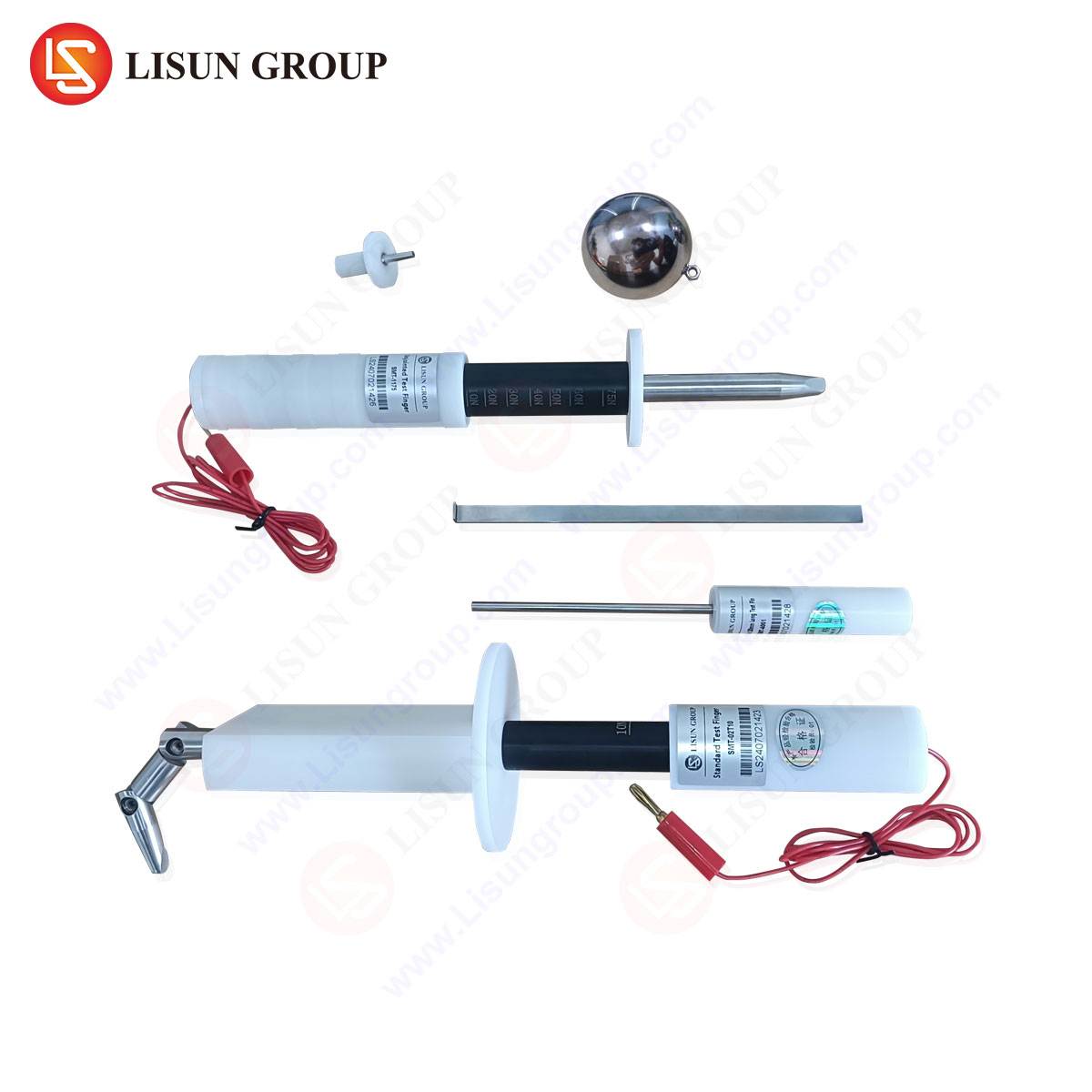
- Accessory Status: It is commonly supplied as part of a comprehensive LISUN Test Pin and probe kit, which includes other accessibility probes (test finger, ball probes, etc.) for a complete safety evaluation suite.
Table 1: Key Dimensional Specifications of the SB0504A Knife Probe
| Parameter | Specification | Tolerance | Reference Standard |
| :— | :— | :— | :— |
| Blade Thickness | 0.23 mm | ±0.005 mm | IEC 61032 Fig. 4 |
| Blade Width | 5.0 mm | ±0.05 mm | IEC 61032 Fig. 4 |
| Tip Radius | 0.2 mm | ±0.05 mm | IEC 61032 Fig. 4 |
| Standard Test Force | 1 N | ±0.1 N | IEC 61032, IEC 60529 |
| Maximum Test Force | 10 N | – | Specific clause evaluation |
Operational Methodology and Testing Protocol
The application of the SB0504A follows a rigorous protocol. The product under test (EUT) is de-energized for setup but may be electrically live during the actual test if the standard requires verification under operating conditions, with appropriate safety precautions for the test operator. The probe is inserted into every external opening, gap, joint, or aperture of the enclosure. This includes seams between plastic housings, ventilation slots, openings around knobs or buttons, and interfaces between removable covers and the main body.
The probe is applied with the specified force (initially 1 N). If partial entry is achieved, the force may be increased to 10 N in a controlled manner, as per specific standard clauses. The test is considered failed if the probe contacts a hazardous-live part, defined as a part carrying a voltage above a specified safety extra-low voltage (SELV) limit, typically 30 Vrms or 60 Vdc. A common supplementary test involves using an “indicator” or “contact detection circuit” connected to the probe tip and the hazardous part. This circuit, often set to a sensitive current threshold (e.g., 40-50 mA), provides a clear visual or audible signal upon contact, removing subjectivity.
Cross-Industry Application Scenarios and Use Cases
The knife probe test is indispensable in sectors where product integrity and user safety are paramount.
- Household Appliances & Consumer Electronics: Testing openings in food processor housings, air conditioner vents, power tool casings, and the seams of television or audio equipment to ensure children cannot insert objects to reach internal mains wiring.
- Automotive Electronics: Evaluating control units (ECUs), infotainment systems, and charging port assemblies installed in passenger compartments to prevent access to high-voltage or 12V battery lines through service panels or connector openings.
- Lighting Fixtures: Assessing the enclosure of LED drivers, the joint between the diffuser and body of a downlight, and the wiring compartment of streetlights to ensure the probe cannot bypass basic insulation.
- Industrial Control Systems & Telecommunications Equipment: Verifying the robustness of server rack panels, PLC enclosures (IP ratings), and network switch housings against intrusion by tools used in dense installation environments.
- Medical Devices: Ensuring that battery compartments, sensor ports, and external housings of patient-connected equipment (e.g., monitors, infusion pumps) prevent accidental access to internal circuits.
- Aerospace and Aviation Components: Testing in-flight entertainment system housings and control panel assemblies for resistance to probing from pens, tools, or other objects in a confined cabin environment.
- Electrical Components: Critically evaluating switches, sockets, and connector housings. A standard LISUN Test Finger may not penetrate a socket shutter, but the knife probe tests its resistance to a thin object, a key safety feature.
- Toy and Children’s Products Industry: A primary application, ensuring that battery compartments in motorized toys or electronic learning devices cannot be opened or probed by a child using a slender object, preventing access to button cells or internal circuits.
Comparative Analysis with Other Standardized Test Probes
The SB0504A occupies a specific niche within the ecosystem of safety probes. The LISUN Test Finger (IEC 61032 Fig. 2) simulates a child or adult finger for basic accessibility and is the first-line test. The LISUN Test Probe family also includes ball probes (e.g., 12.5 mm diameter) for checking larger openings. The knife probe is more stringent than the test finger for long, thin openings. Conversely, for very small circular openings, a separate small-diameter pin probe may be used. The knife probe’s value is in its simulation of a specific, credible threat—the slender, rigid object—that bridges the gap between finger accessibility and the need for a tool. Its use is often conditional; for example, a product passing the test finger check may still require a knife probe test if an opening exceeds a certain length.
Metrological Traceability and Quality Assurance Considerations
For a test probe to be valid for compliance testing, its manufacturing and calibration must adhere to metrological principles. The LISUN SB0504A is machined from dimensionally stable materials, and its critical features (thickness, width, tip radius) are subject to quality control using calibrated optical measuring systems or laser micrometers. Regular calibration against reference gauges ensures long-term accuracy. This traceability is crucial for manufacturers whose internal testing may be audited by external certification bodies like UL, TÜV, or Intertek. Using a non-compliant probe can lead to false passes or failures, resulting in costly design changes or unsafe products reaching the market.
Integration within a Comprehensive Product Safety Testing Regime
The knife probe test is never performed in isolation. It is one element in a sequence of tests that may include:
- Enclosure Strength Tests (impact, drop).
- Accessibility Tests using the LISUN Test Finger and other probes.
- Electric Strength (Hi-Pot) Tests.
- Creepage and Clearance Measurements.
- Fault Condition Tests.
The data from the knife probe evaluation informs design decisions, such as increasing the overlap of mating enclosure parts, adding internal baffles behind vents, improving the rigidity of materials near openings, or redesigning snap-fit joints. In this context, the SB0504A is not merely a pass/fail tool but a diagnostic instrument that guides engineering improvements.
Frequently Asked Questions (FAQ)
Q1: When is the 10 N force applied with the knife probe instead of the standard 1 N force?
A1: The 10 N force is not universally applied. Specific clauses in standards, such as those evaluating the effectiveness of enclosures or covers that require a tool for removal, may stipulate the higher force. The test sequence typically starts at 1 N. If the probe partially enters an opening at 1 N, the standard may instruct the tester to apply 10 N to see if this allows contact with a hazardous part. Always consult the specific normative clause applicable to your product.
Q2: Can the SB0504A Knife Probe be used to verify IP (Ingress Protection) ratings?
A2: Yes, it is directly referenced in IEC 60529 for IP code testing. Specifically, it is used for the “access to hazardous parts” test (digit 2 of the IP code, e.g., IP2X). A successful test with the knife probe helps achieve certain IP ratings by proving that a slender object cannot access dangerous parts, which is a requirement for higher levels of protection against contact.
Q3: How does testing with a knife probe differ from testing with a standard test pin for small openings?
A3: They test for different failure modes. A small test pin (e.g., 1.0 mm diameter) is designed to probe very small circular openings to see if it can pass through and touch a live part. The knife probe is designed for elongated openings (slots, seams, joints). Its blade-like shape can lever into a long, thin gap that a round pin might not engage with, making it a more appropriate tool for testing seams and slots.
Q4: Is the knife probe test required for battery-operated products with low voltage?
A4: The requirement depends on the voltage level and the applicable safety standard. If the internal circuits are deemed “hazardous-live” (e.g., above SELV limits, which even some battery packs can exceed), the test is generally required. For products operating entirely at SELV, the test may not be required for electric shock hazard but could still be relevant for fire hazard or energy hazard assessment, as per standards like IEC 62368-1. The product’s risk assessment and normative references dictate its necessity.
Q5: How often should a knife probe like the SB0504A be calibrated or verified?
A5: As a critical dimensional tool, it should be included in a formal calibration program. A typical calibration interval is 12 months, or according to the laboratory’s quality management system (e.g., ISO 17025). Furthermore, it should be visually inspected for damage (e.g., tip deformation, nicks) before each use, as even minor damage can invalidate test results by altering its effective dimensions.