




Selecting the Right Sand and Dust Test Chamber for Your Industry Requirements
Introduction to Environmental Particulate Testing
The operational integrity and longevity of products across a multitude of sectors are critically dependent on their resilience to harsh environmental conditions. Among these, ingress of solid particulates—specifically sand and dust—poses a significant threat to mechanical functionality, electrical safety, and optical clarity. Environmental test chambers designed to simulate these conditions are therefore not merely quality assurance tools but essential instruments for validating product design, informing material selection, and ensuring compliance with international safety and reliability standards. The selection of an appropriate sand and dust test chamber, however, is a non-trivial engineering decision that must be predicated on a precise understanding of test standards, particulate dynamics, and the specific failure modes relevant to the device under test (DUT).
Deciphering International Standards: IEC 60529 and Beyond
The cornerstone of particulate ingress testing is the International Electrotechnical Commission (IEC) 60529 standard, which defines the Degrees of Protection provided by enclosures (IP Code). The relevant classifications for dust are IP5X (dust protected) and IP6X (dust tight). It is imperative to recognize that these standards prescribe not only the concentration and composition of test dust but also the chamber’s aerodynamic characteristics. For example, IP5X testing permits a limited ingress of dust, provided it does not interfere with normal operation, while IP6X requires that no dust enters the enclosure. A compliant chamber must generate a consistent, homogeneous dust cloud of specified density (e.g., 2 kg/m³ for IP6X) using Arizona Test Dust or equivalent calibrated particulates with a tightly controlled particle size distribution.
Beyond IEC 60529, industry-specific standards impose additional rigor. Military and aerospace components, governed by standards such as MIL-STD-810G Method 510.5, require testing under blowing sand and dust conditions that simulate both abrasive and clogging effects at varying wind velocities. Automotive electronics, referenced in ISO 20653, differentiate between protection against dust (IP5XK/6XK) and pressurized water jets, often necessitating sequential testing. A chamber selected for a multi-industry laboratory must therefore offer programmable control over air velocity, particulate concentration, temperature, and humidity to accommodate this spectrum of requirements.
Critical Engineering Parameters in Chamber Design
The efficacy of a sand and dust test is fundamentally governed by the chamber’s engineering design. Key parameters must be scrutinized during selection.
Airflow Dynamics and Recirculation: A uniform dust cloud is paramount. Chambers must employ a recirculating airflow system with strategically placed baffles and diffusers to eliminate dead zones and ensure every surface of the DUT is exposed to a consistent particulate concentration. Turbulence must be sufficient to keep particulates airborne but controlled to prevent unrepresentative settling patterns.
Particulate Injection and Filtration Systems: The mechanism for introducing and maintaining dust concentration is critical. Advanced systems use vortex or fluidized-bed feeders for consistent, clog-free delivery. Equally important is the high-efficiency filtration system on the exhaust or recirculation loop, which must capture particulates to protect the chamber’s blower and vacuum system and prevent laboratory contamination.
Environmental Conditioning: Many test protocols require elevated temperature or reduced humidity to simulate desert conditions, which can exacerbate electrostatic attraction of dust to components and alter sealing material properties. An integrated environmental conditioning system is thus a vital feature for comprehensive testing.
Instrumentation and Control: Precision demands accurate monitoring of dust concentration, air velocity, temperature, and humidity. Real-time sensors coupled with a Programmable Logic Controller (PLC) allow for closed-loop control, ensuring test parameters remain within tolerances throughout the often lengthy test cycles, which can extend to 8 hours or more for IP6X.
The LISUN SC-015 Dust Sand Test Chamber: A Technical Analysis
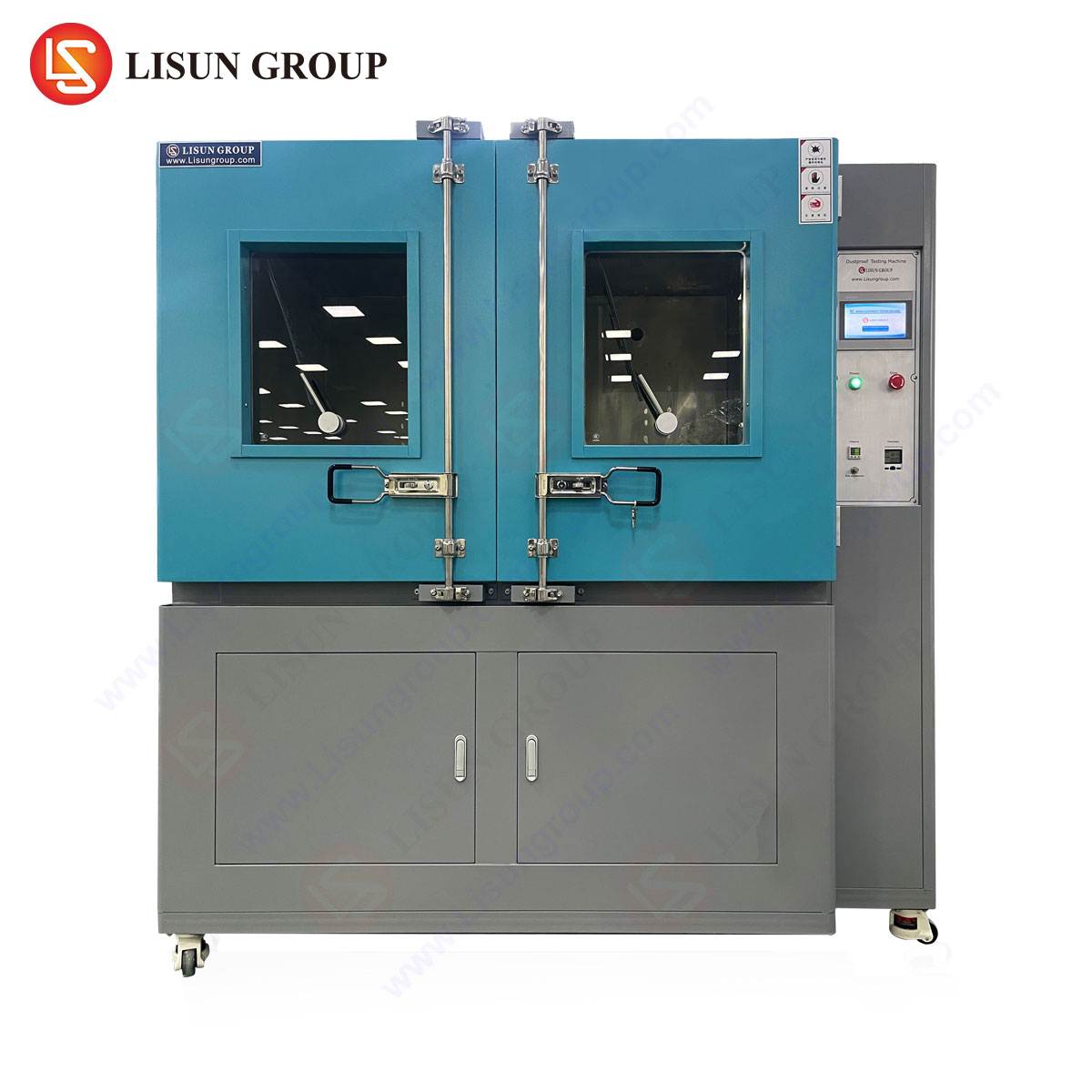
Meeting the complex demands of modern particulate testing, the LISUN SC-015 Dust Sand Test Chamber embodies a synthesis of precise engineering and user-centric design tailored to rigorous international standards. Its architecture is developed specifically to facilitate reproducible and compliant testing for IP5X and IP6X classifications, alongside adaptable configurations for other particulate-based evaluations.
Core Specifications and Testing Principle:
The chamber operates on a closed-loop vertical wind tunnel principle. A centrifugal blower generates a controlled vertical airflow that circulates through the test workspace, where the DUT is mounted. Arizona Test Dust (or equivalent) is injected into this airstream via a specialized vibrating feeder mechanism, ensuring a steady and uniform dispersion. The dust-laden air is then drawn through the test section, around the specimen, and back into the circulation path via a high-efficiency filter system, which cleans the air before it re-enters the blower. This recirculation maintains constant particulate concentration while protecting mechanical components. The SC-015 typically features a workspace volume designed for a range of product sizes, with standard dust concentration control up to 2 kg/m³ and airflow velocity adjustable to meet specific standard requirements.
Industry-Specific Use Cases:
The SC-015 finds application in validation labs across numerous sectors. For Electrical and Electronic Equipment and Industrial Control Systems, it verifies the integrity of enclosure seals for programmable logic controllers and drive systems, preventing internal short circuits. Automotive Electronics suppliers use it to validate sensors, control units, and connectors against the abrasive dust environments encountered in off-road or arid regions. In Lighting Fixtures and Aerospace and Aviation Components, the test ensures optical surfaces remain unobscured and moving parts, like actuator mechanisms, do not jam. Medical Devices and Telecommunications Equipment require dust-tight enclosures to maintain sterility and signal integrity, respectively. The chamber is equally critical for Electrical Components like switches and sockets, Cable and Wiring Systems (testing gland entries), and Consumer Electronics such as outdoor speakers or ruggedized tablets.
Competitive Advantages in Design:
Several design features of the SC-015 contribute to its operational superiority. Its fully stainless-steel interior and workspace resist abrasion and facilitate easy cleaning. The integrated dust recovery system simplifies post-test chamber maintenance. Most notably, its advanced control system, often featuring a touch-screen Human-Machine Interface (HMI), allows for the programming of complex test profiles, including cyclic variations in dust concentration and temperature. This programmability, combined with precise sensor feedback for closed-loop control, ensures exceptional repeatability and compliance audit trails—a critical factor for certified testing laboratories.
Integrating Test Requirements with Product Lifecycle
Selecting a chamber is not an isolated procurement event but a strategic decision integrated into the product development lifecycle. During the Design and Validation Phase, engineers utilize the chamber for rapid prototyping tests to evaluate gasket materials, vent designs, and PCB conformal coatings. In the Qualification and Certification Phase, formal tests are conducted to generate evidence for compliance with IEC, ISO, or MIL standards required for market access. Finally, in Production Quality Assurance, sampling tests can be performed to monitor manufacturing consistency, particularly in the sealing and assembly processes.
A chamber like the LISUN SC-015 supports this full lifecycle by offering both standard-compliant preset programs for certification and flexible custom program modes for investigative engineering tests. Its robust construction ensures longevity under continuous use, while comprehensive data logging capabilities provide the detailed evidence needed for technical construction files.
Economic and Operational Considerations for Laboratory Integration
Beyond technical specifications, total cost of ownership and laboratory integration are decisive factors. A chamber must be evaluated for its footprint, utility requirements (electrical power, compressed air if needed), and exhaust management. Operational costs include the consumption of standardized test dust, filter replacements, and energy usage. Chambers with efficient filtration and dust recovery systems, such as the SC-015, can reduce long-term consumable costs. Furthermore, supplier support—including installation qualification (IQ), operational qualification (OQ), calibration services, and availability of spare parts—directly impacts testing uptime and long-term reliability. A chamber that minimizes downtime through robust design and accessible service is a critical asset to any quality assurance or R&D laboratory.
Conclusion
The selection of a sand and dust test chamber is a critical investment in product reliability and regulatory compliance. It requires a meticulous alignment between the chamber’s technical capabilities—encompassing airflow uniformity, particulate control, environmental conditioning, and regulatory adherence—and the specific failure mode analyses dictated by the end-use environment of the product. By prioritizing chambers engineered to exacting standards with flexible, reliable, and user-maintainable systems, organizations across electronics, automotive, aerospace, and industrial manufacturing can ensure their products deliver performance and durability in the face of particulate contamination, thereby safeguarding brand reputation and reducing field failure rates.
FAQ Section
Q1: What is the difference between IP5X and IP6X testing in a chamber like the LISUN SC-015?
A1: IP5X (Dust Protected) testing allows a limited amount of dust ingress, provided it does not interfere with operation or safety. IP6X (Dust Tight) requires no dust ingress whatsoever. The test method in the SC-015 is similar, involving exposure to a dense dust cloud, but the pass/fail criteria are stricter for IP6X. The chamber is designed to create the controlled, uniform cloud specified for both tests, with the evaluation of the DUT determining the achieved rating.
Q2: Can the SC-015 chamber be used for testing beyond IEC 60529, such as for abrasive sand effects?
A2: While optimized for IEC 60529, the chamber’s core functionality of generating a controlled particulate flow can be adapted for other evaluations. For abrasive testing as per methods like MIL-STD-810, the key parameters are higher wind velocities and specific sand compositions. The SC-015’s programmable blower control allows for some adaptation, but users must confirm that its maximum velocity and particulate feed system meet the specific requirements of the alternative standard.
Q3: How is dust concentration measured and maintained during a long test cycle?
A3: In advanced chambers, dust concentration is not directly measured in real-time for standard compliance tests. Instead, it is maintained through calibrated, consistent feeding of dust into a known volume of recirculating air, achieving the prescribed nominal concentration (e.g., 2 kg/m³). The SC-015 utilizes a precision vibrating feeder for this purpose. The chamber’ design ensures homogeneous mixing, and validation of the concentration is typically performed during chamber commissioning and periodic reverification.
Q4: What maintenance is required for a sand and dust test chamber?
A4: Regular maintenance is crucial. Primary tasks include: emptying and cleaning the dust hopper and workspace after tests; inspecting and replacing high-efficiency particulate air (HEPA) or other exhaust filters as indicated by pressure differential gauges; checking and cleaning the blower fan and air ducts for dust accumulation; and verifying the calibration of sensors (temperature, humidity) annually. Proper maintenance ensures test repeatability and prolongs chamber life.
Q5: For testing a large automotive control unit, how do we ensure even dust exposure on all surfaces?
A5: The DUT should be mounted in the chamber’s workspace per the standard’s guidelines, typically on a turntable if provided. The SC-015’s design focuses on creating a uniform vertical airflow throughout the workspace. For large items, it may be necessary to conduct multiple tests with the unit reoriented to expose all faces to the primary airflow direction, as defined in the test standard. The chamber’s recirculating design helps minimize directional bias within the test cloud itself.