




Spring Impact Hammer Testing: A Critical Evaluation of Mechanical Robustness in Modern Electronics
Introduction to Impact Testing Methodologies
The relentless miniaturization and increased functional density of modern electronic and electromechanical components have precipitated a concomitant need for more rigorous and predictive reliability testing. Among the suite of mechanical integrity evaluations, impact testing occupies a pivotal role, simulating the sudden, high-energy forces devices may encounter throughout their lifecycle. The spring impact hammer test, standardized under clauses such as IEC 60068-2-75 and GB/T 2423.55, provides a controlled, reproducible method for assessing a product’s resistance to impacts from swinging or falling objects. This test is not merely a pass/fail checkpoint but a fundamental engineering analysis that informs design choices, material selection, and failure mode understanding across a vast spectrum of industries.
The principle involves a hammer head, mounted on a pendulum or spring-loaded arm, released from a predetermined height to strike the equipment under test (EUT) with a defined kinetic energy. The test severity is governed by the hammer’s mass, the strike velocity, and the impact point’s geometry. Unlike purely random field failure data, this laboratory method generates quantifiable, comparative data on a product’s ability to withstand mechanical shock without compromising safety, functionality, or insulation integrity. For enclosures, control panels, connectors, and illuminated components, the spring impact hammer test is a non-negotiable validation of their structural soundness.
The Underlying Physics and Standardization Framework
The kinetic energy (E_k) imparted during a test is the primary severity parameter, calculated as E_k = ½ m v², where m is the effective mass of the hammer and v is its velocity at the moment of impact. Standards meticulously define hammer designs (e.g., hemispherical, conical, or pendulum types), energy levels (typically ranging from 0.14J for small components to 5J or more for robust industrial equipment), and application procedures. The test evaluates several potential failure modes: fracture or deformation of enclosures, displacement of internal parts leading to short circuits, degradation of creepage and clearance distances, malfunction of switches or controls, and compromise of protective covers.
Key international and regional standards mandating or referencing this test include:
- IEC/EN 60068-2-75: Environmental testing – Part 2-75: Tests – Test Eh: Hammer tests.
- IEC/EN 60598-1: Luminaires – General requirements and tests.
- IEC/EN 60669-1: Switches for household and similar fixed electrical installations.
- IEC/EN 61058-1: Switches for appliances.
- GB/T 2423.55: Chinese national standard equivalent to IEC 60068-2-75.
Compliance with these standards is often a prerequisite for CE marking, UL certification, and other market access approvals, making the test a critical gate in the product development cycle.
Integrating Impact Testing within a Comprehensive Reliability Regimen
Spring impact hammer testing is rarely performed in isolation. Its true value is realized when integrated into a broader reliability testing sequence, particularly one that assesses the synergistic effects of combined environmental and mechanical stresses. A component may survive a standard impact at room temperature but fail catastrophically when subjected to the same force after exposure to thermal cycling or extreme humidity. This is because polymeric materials can become embrittled at low temperatures, metals may experience fatigue, and adhesives can lose bond strength under thermal stress.
Therefore, a best-practice approach involves preconditioning samples in environmental test chambers prior to mechanical impact. This sequence accurately replicates real-world scenarios: an automotive control unit mounted in an engine bay endures temperature extremes from -40°C to 125°C before being vulnerable to incidental impact during servicing; an outdoor telecommunications enclosure in a coastal environment faces constant humidity and salt spray, potentially weakening its structure before a physical strike.
The Critical Role of the HLST-500D Thermal Shock Test Chamber in Preconditioning
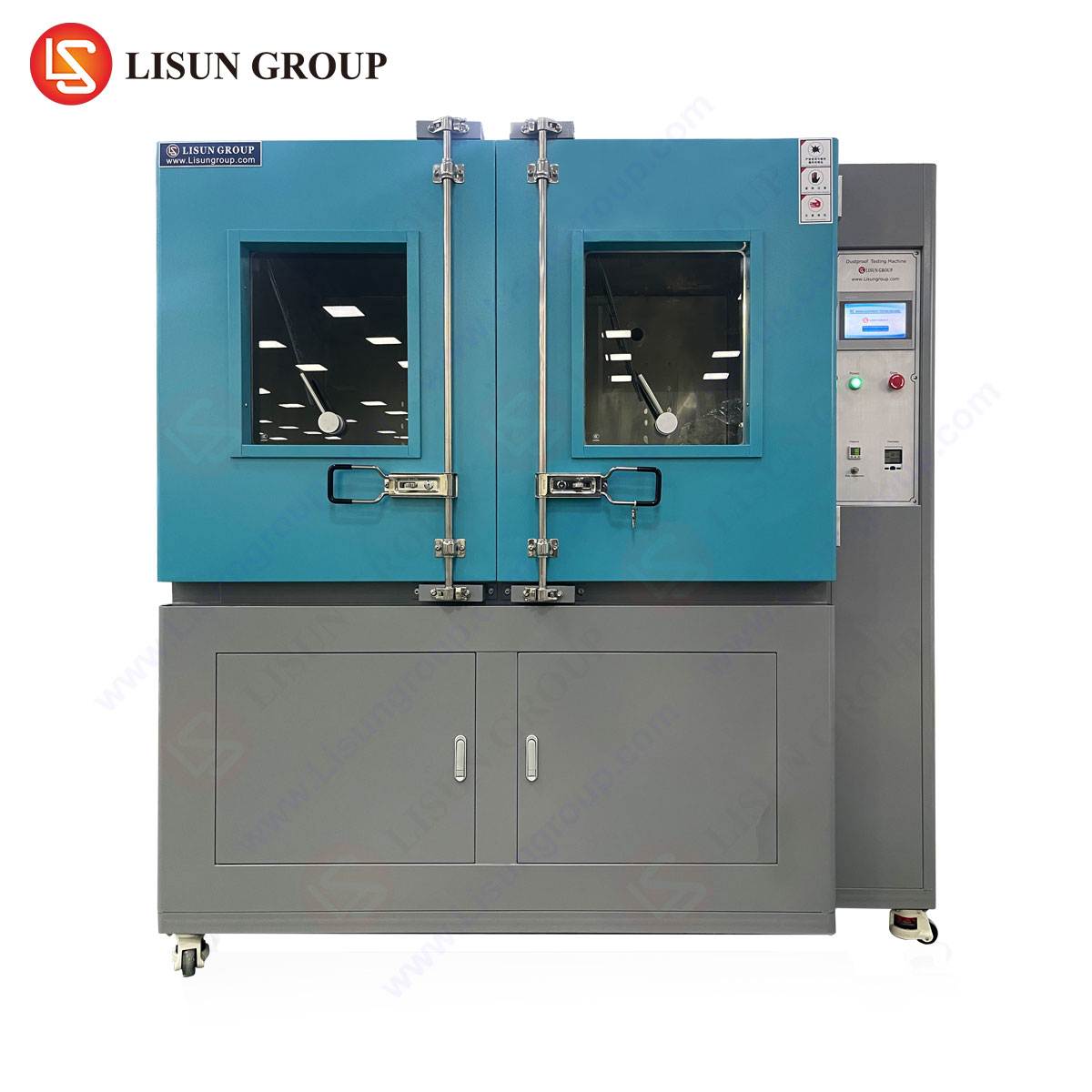
To execute the aforementioned combined stress testing with high precision and reproducibility, the LISUN HLST-500D Thermal Shock Test Chamber serves as an indispensable instrument. This three-zone chamber is engineered to subject products to rapid, extreme temperature transitions, exposing latent material weaknesses and interfacial failures that ambient testing would miss.
Testing Principle and Operation: The HLST-500D operates on a basket-transfer principle. Samples are placed in a moving basket that automatically shuttles between a high-temperature zone and a low-temperature zone. The transition time is minimized to induce severe thermal stress. For impact testing preconditioning, a batch of samples would undergo a prescribed number of cycles—for instance, 50 cycles between +150°C and -65°C with dwell times of 30 minutes—before being stabilized at room temperature and immediately subjected to the spring impact hammer test at specified points.
Key Specifications of the HLST-500D:
- Temperature Range: High Temperature Zone: +60°C to +200°C; Low Temperature Zone: -80°C to 0°C.
- Recovery Time: ≤ 5 minutes (from +150°C to -65°C or vice versa, meeting stringent standard requirements).
- Chamber Volume: 500 Liters (providing ample capacity for multiple test samples or larger assemblies).
- Temperature Fluctuation: ≤ ±0.5°C.
- Temperature Deviation: ≤ ±2.0°C.
- Basket Transfer Time: < 10 seconds (manual or automatic modes available).
- Control System: Programmable touchscreen controller allowing for complex multi-segment cycling profiles.
Industry Use Cases for Combined Thermal Shock and Impact Testing:
- Automotive Electronics: Testing electronic control units (ECUs), sensors, and connectors for resilience against thermal engine compartment cycles followed by vibration or impact during assembly.
- Aerospace and Aviation Components: Validating the integrity of cockpit avionics and in-flight entertainment systems after rapid temperature changes experienced during ascent/descent, prior to assessing robustness against accidental impacts.
- Lighting Fixtures (LED Drivers/Outdoor Luminaires): Ensuring the housing and electronics of an outdoor LED streetlight can withstand desert daytime heat and freezing nights before surviving a hail strike or vandalism.
- Medical Devices: Verifying that portable diagnostic equipment or surgical tool housings remain intact and safe after sterilization cycles (which involve thermal stress) and then accidental drops.
- Electrical Components: Evaluating circuit breakers, switches, and sockets for any degradation in insulating properties or mechanical operation after long-term thermal aging and a subsequent impact.
Competitive Advantages: The HLST-500D’s rapid recovery time and precise temperature control ensure the thermal shock profile is both severe and consistent, a necessity for generating reliable, comparable data. Its robust construction and programmable automation reduce operator intervention and enhance test repeatability, which is paramount for certification testing and competitive benchmarking.
Application Across Key Industrial Sectors
The universality of the spring impact hammer test is evidenced by its application across diverse sectors, each with unique failure consequences.
- Household Appliances & Consumer Electronics: Testing the robustness of external casings, control panels, and touch interfaces on washing machines, ovens, and smart home devices against impacts from dropped utensils or tools during cleaning.
- Industrial Control Systems: Validating the integrity of operator interface panels, emergency stop button enclosures, and PLC housings in factories where they may be struck by handheld tools or carried objects.
- Telecommunications Equipment: Ensuring outdoor cabinets, fiber optic terminal enclosures, and base station components can resist impacts from debris, maintenance activities, or vandalism without allowing moisture ingress.
- Cable and Wiring Systems: Assessing the crush resistance of cable conduits, junction boxes, and strain relief components.
- Office Equipment: Verifying the durability of printers, scanners, and copier housings against accidental bumps in busy office environments.
Data Interpretation and Failure Analysis
A successful test is not defined solely by the absence of visible rupture. Post-impact evaluation is multifaceted and must align with the product’s safety and performance standards. Inspectors must check for:
- Enclosure Integrity: No fracture or hole that would allow access to live parts or moving components.
- Internal Inspection: No detached parts that could bridge insulation distances or impede function.
- Functional Test: All controls and circuits must operate normally.
- Dielectric Strength Test: A post-impact hipot (high-potential) test is often required to verify insulation has not been compromised, particularly for Class I and Class II equipment.
- Measurement of Creepage and Clearance: Using appropriate gauges to ensure distances have not been reduced below minimum values specified in safety standards.
Documenting the exact impact energy, point of application, and resulting damage (if any) provides invaluable feedback to design engineers, enabling iterative improvements in ribbing design, material wall thickness, and fastener selection.
Conclusion
Spring impact hammer testing represents a fundamental and non-negotiable validation of mechanical robustness in product design. Its prescribed methodology removes subjectivity, providing a common language of durability across global supply chains. When strategically paired with preconditioning in advanced environmental test equipment like the LISUN HLST-500D Thermal Shock Test Chamber, it evolves from a standalone compliance check into a powerful tool for uncovering latent failure modes and enhancing product reliability. In an era where product longevity and safety are paramount competitive differentiators, mastering these combined stress tests is essential for manufacturers aiming to lead in the markets for electrical, electronic, and electromechanical equipment.
FAQ Section
Q1: At what stage in the product development cycle should spring impact hammer testing be performed?
This testing should be integrated during the design validation (DV) phase, using production-intent prototypes. It is also routinely performed as part of production line sampling (PS) for ongoing quality assurance. Early feasibility testing on engineering models can inform material and design choices.
Q2: Why is preconditioning with thermal shock, as enabled by the HLST-500D, considered a best practice before impact testing?
Materials exhibit different mechanical properties at different temperatures. Thermal cycling can induce embrittlement, fatigue, and delamination, which may not be apparent under ambient conditions. Preconditioning reveals whether a product will fail in real-world scenarios where environmental and mechanical stresses are combined, providing a more accurate and severe assessment of field reliability.
Q3: How do I select the appropriate impact energy level (e.g., 0.35J, 0.5J, 2J) for my product?
The required impact energy is typically dictated by the relevant product safety standard (e.g., IEC 60598-1 for lighting, IEC 60669-1 for switches). These standards classify products based on their application, accessibility, and potential hazard. The classification (e.g., “energy level 3” corresponding to 0.35J) specifies the test severity. Consulting the applicable end-product standard is mandatory.
Q4: Can the HLST-500D chamber be used for tests other than thermal shock preconditioning for impact tests?
Absolutely. The HLST-500D is a versatile environmental stress screening (ESS) and reliability testing tool. It is widely used for JEDEC, MIL-STD, and IEC standard testing of semiconductors, aerospace components, and military equipment. It is also ideal for testing material properties like glass transition temperature effects, solder joint integrity, and adhesive performance under rapid thermal change.
Q5: What is the significance of the “recovery time” specification in a thermal shock chamber like the HLST-500D?
Recovery time is the period required for the test zone to return to its target temperature after the sample basket transfer. A shorter recovery time (≤5 minutes for the HLST-500D) ensures the samples experience the intended extreme temperature for the full dwell duration, not a prolonged transition period. This guarantees the test profile’s severity and compliance with standards that specify maximum allowable recovery times.