






Standard Test Finger Compliance: A Foundational Element of Product Safety Engineering
The imperative to safeguard users from electrical hazards constitutes a non-negotiable tenet of modern product design and manufacturing. Among the most critical defenses against such hazards is the prevention of accidental contact with live parts or hazardous moving components. This principle is universally codified through standardized physical accessibility tests, commonly referred to as Standard Test Finger Compliance. This technical article delineates the engineering rationale, applicable standards, testing methodologies, and practical implementation of these tests across diverse industries, with a specific examination of the instrumentation required for precise and repeatable validation.
The Biomechanical and Electrical Rationale for Accessibility Probes
The genesis of the standard test finger lies in anthropometric data and the analysis of common user interactions. The human finger, particularly that of a child, represents the most probable point of inadvertent contact with an equipment’s interior. The standardized probe simulates this scenario, but with dimensions and articulation designed to probe for vulnerabilities that a real finger might not consistently exploit. The primary objectives are twofold: first, to evaluate protection against electric shock by ensuring adequate clearance and creepage distances or robust insulation barriers; second, to assess guarding against mechanical dangers from moving parts like fans, gears, or belts. A failure in this compliance test indicates a direct risk of injury, rendering the product non-compliant with international safety regulations. The test is not merely a check of static dimensions but a dynamic assessment of the product’s defensive architecture under a defined mechanical force.
International Standards Governing Probe Dimensions and Application
Compliance is not arbitrary but strictly governed by a suite of international standards, which specify the exact geometry, material, and application force of the test probes. Key standards include IEC 61032, “Protection of persons and equipment by enclosures – Probes for verification,” which serves as the umbrella document defining various probes (Test Probes A, B, C, etc.). For electrical equipment, IEC 60529 (IP Code – Degrees of Protection) and the ubiquitous IEC 60335 series for household appliances integrate these probe tests. In automotive electronics, ISO 20653 draws upon these principles, while medical devices adhere to IEC 60601-1. The most commonly referenced probe for finger safety is the “Test Probe B,” often termed the “jointed test finger.” Its specifications are precise: it must be 80mm in length, 12mm in diameter, with a 50mm radius semi-circular jointed end, and constructed of rigid, non-conductive material like polyamide. It is applied with a force of 10 N ± 1 N to every potential opening in an enclosure.
Instrumentation for Validated Compliance: The LISUN Test Finger, Test Probe, and Test Pin System
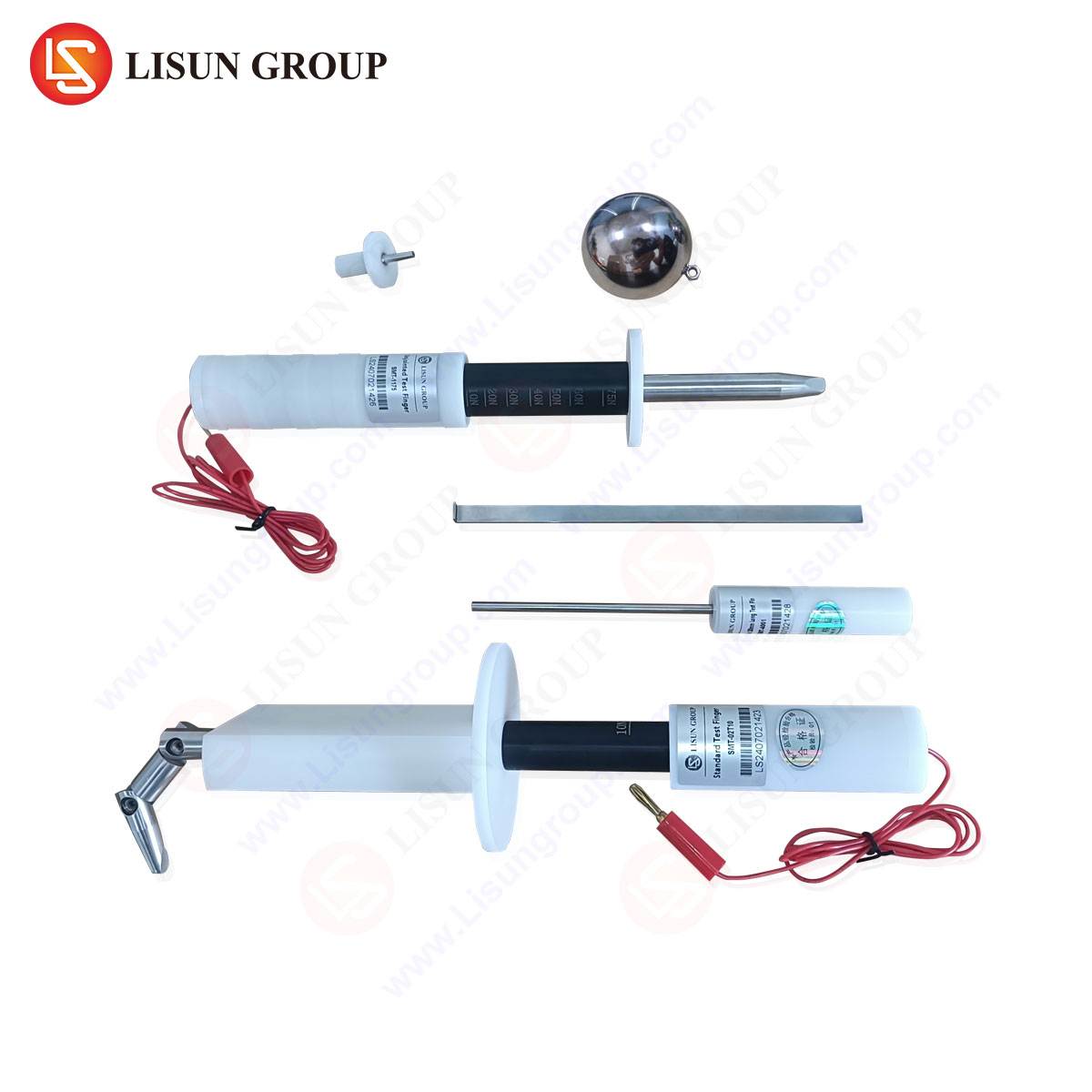
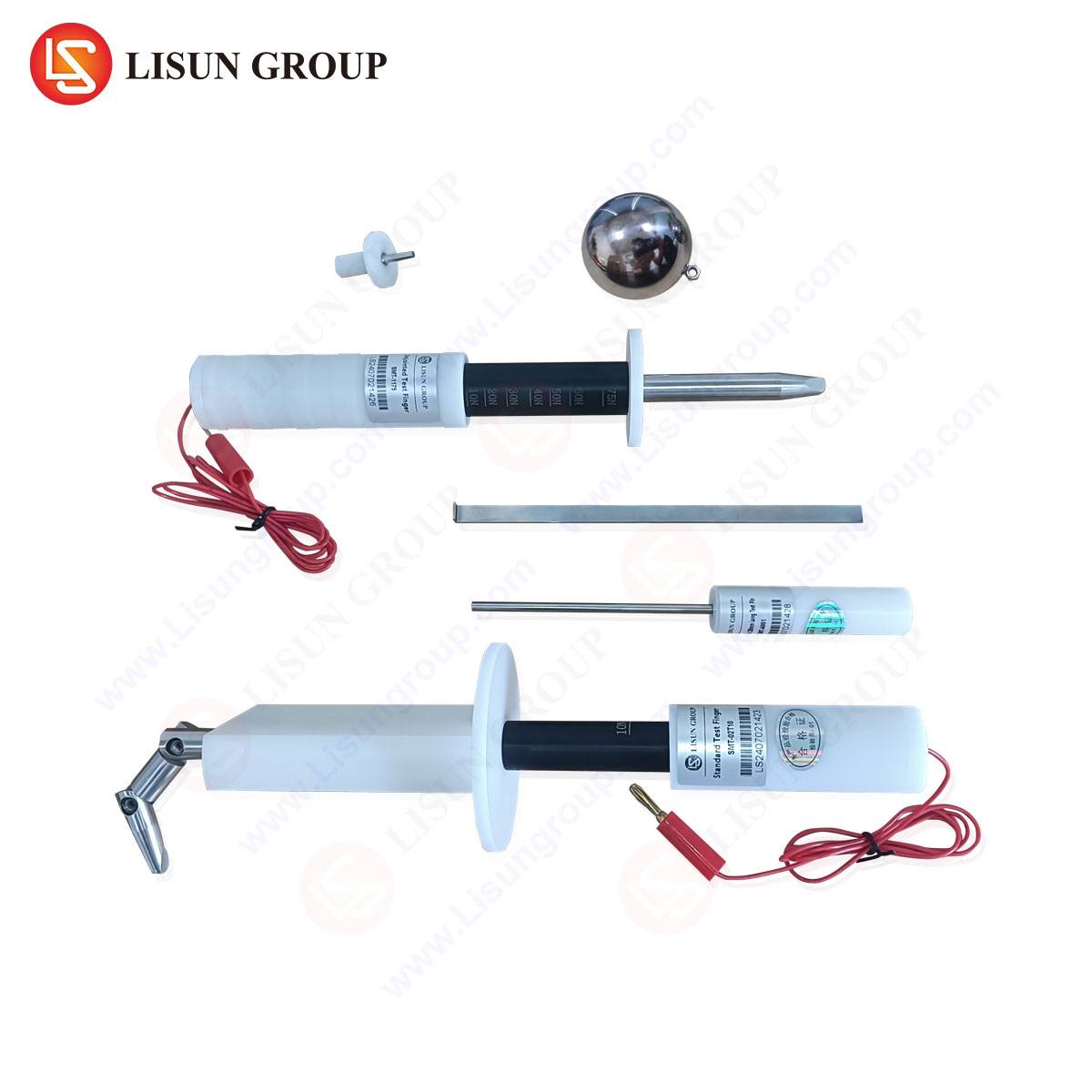
Accurate and auditable testing necessitates instrumentation that itself complies with the dimensional and force tolerances mandated by the standards. The LISUN Test Finger, Test Probe, and Test Pin system is engineered to meet this exacting requirement. This system typically comprises a comprehensive set of standardized probes, including the Jointed Test Finger (Probe B), the 75mm long Test Probe A (simulating a hand or tool), and various Test Pins (e.g., Probe 13 from IEC 61032) designed to test openings in grilles or meshes.
The LISUN Test Finger is machined to the critical dimensions of IEC 61032 Probe B, with a smooth, rigid joint ensuring consistent articulation. It is mounted to a calibrated force application mechanism, often a spring system or digital force gauge, guaranteeing the mandated 10N application force is neither exceeded nor under-delivered, a common point of failure in ad-hoc testing setups. The LISUN Test Probe set includes not only Probe B but also other essential probes like the straight wire probe for testing openings, ensuring a complete compliance toolkit. The inclusion of a Test Pin, such as the 3mm diameter pin, is vital for assessing protection against access to hazardous parts through smaller apertures, a key requirement in fan guards, ventilation slots, and connector housings.
Specifications & Competitive Advantages:
- Material Compliance: Constructed from specified rigid, insulating materials with appropriate surface finish.
- Dimensional Fidelity: CNC-machined to exceed the geometric tolerances of relevant standards (e.g., ±0.1mm on critical radii).
- Calibrated Force Application: Integrated or companion force application system provides traceable, repeatable force, a significant advantage over uncalibrated manual methods.
- Comprehensive Kit: A single system addresses multiple probe requirements (IEC 61032 Probes A, B, C, D, etc.), streamlining the laboratory’s workflow and audit readiness.
- Durability: Designed for repeated use in quality control environments without degradation of critical dimensions.
Testing Protocol and Failure Mode Analysis
The testing protocol is systematic. The appropriate probe is selected based on the standard and the nature of the opening. For general enclosure openings, the jointed test finger is applied with 10N force, attempting to contact live parts or hazardous moving components. The test is performed in all possible orientations and through every opening, including those that appear only when doors are opened, covers are removed, or components are in a service position. A failure is registered if the probe makes contact with a live part operating at hazardous voltage (typically > 30 Vrms, 42.4 Vpeak, or 60 Vdc) or with a dangerous moving part. Additionally, for live parts, a follow-up test using an “articulated probe” or a conductive foil wrapped around the test finger may be employed with a connection to a voltage detection circuit (the “contact indicator”) to verify that no contact is made even under flexure. The failure mode analysis is critical: a failure may necessitate a redesign involving improved enclosure baffles, internal barriers, increased creepage/clearance distances, or the addition of interlocked guards.
Industry-Specific Applications and Use Cases
The universality of the finger safety principle makes this test relevant across the industrial spectrum.
- Household Appliances & Consumer Electronics: From food processors and blenders with moving blades to routers and power supplies, the test ensures that user-accessible openings do not permit finger entry to live terminals or blades, even when attempting to dislodge a stuck item.
- Electrical Components & Lighting Fixtures: Switches, socket outlets, and LED driver enclosures must prevent finger access to live contacts. For lighting, the test verifies that a finger cannot touch live parts within a lampholder or through the luminaire’s housing apertures.
- Automotive Electronics & Industrial Control Systems: Control panels, battery management system enclosures, and PLC housings in vehicles or factories are tested to protect maintenance personnel from high-voltage traction systems or industrial power buses.
- Telecommunications & Office Equipment: Server racks, power distribution units, and network switches are tested to ensure that field technicians cannot accidentally contact backplane power or fan blades.
- Medical Devices & Aerospace Components: For patient-connected equipment, the test is paramount. It ensures that even if a casing is cracked or a port cover is missing, a patient or clinician cannot touch hazardous voltages. In aerospace, the same rigor applies to in-flight entertainment systems and control panel enclosures.
- Toy and Children’s Products Industry: This sector employs the test with particular severity, often using probes simulating smaller child fingers (like Probe 19 in IEC 62115) to ensure battery compartments and any openings are fully secure against access to small parts and electrical hazards.
Integration with Complementary Safety Evaluations
Standard Test Finger Compliance does not exist in isolation. It is a foundational input into a broader safety engineering assessment. Its results directly inform:
- Dielectric Strength (Electric Strength) Testing: If the test finger can touch a live part, the product fails before high-voltage testing even begins.
- Creepage and Clearance Measurements: The probe helps define the “accessible” side of an insulation barrier, determining which distances must be measured.
- IP Rating (Ingress Protection) Validation: The test finger is the tool used to verify the first numeral of the IP code (protection against solid objects). For example, IP2X requires the jointed test finger not to gain access.
- Risk Assessment per ISO 14971 (Medical Devices) or similar: The probability and severity of harm from accessible hazardous parts are formally assessed, with test finger compliance being a key mitigation verification.
Quantifying Risk: The Role of Calibration and Traceability
The scientific validity of the test hinges on metrological integrity. A probe applied with 15N of force may defeat a safe design that would pass at 10N, leading to unnecessary and costly redesigns. Conversely, a worn probe or one applied with only 5N force may miss a genuine hazard. Therefore, the calibration of the force application system and periodic dimensional verification of the probes are essential. Data from such calibrations should be traceable to national metrology institutes. For instance, a force gauge used with the LISUN system would have a calibration certificate indicating an uncertainty of, for example, ±0.2 N at 10 N, providing quantitative confidence in the test results. This traceability is a mandatory requirement for accredited testing laboratories (per ISO/IEC 17025) and is increasingly demanded by savvy manufacturers for in-house quality assurance.
Conclusion: A Non-Negotiable Pillar of Safe Design
Standard Test Finger Compliance represents a direct, physical simulation of a fundamental use-case scenario. Its implementation, governed by precise international standards, is a critical gate in the product development lifecycle. The utilization of precision-engineered, calibrated, and comprehensive testing systems, such as the LISUN Test Finger, Test Probe, and Test Pin kit, transforms this subjective check into an objective, repeatable, and auditable engineering measurement. As products across all sectors become more compact, powerful, and integrated, the intelligent design of enclosures and barriers—validated by rigorous probe testing—remains an indispensable discipline for ensuring user safety and achieving global market access.
FAQ: Standard Test Finger Compliance & Testing Instrumentation
Q1: Can a 3D-printed test finger be used for formal compliance testing?
A1: While useful for initial design verification, 3D-printed probes are generally not acceptable for formal type testing or certification purposes. The standards require specific rigid materials (like polyamide) with defined surface properties and dimensional tolerances that are difficult to guarantee with most additive manufacturing processes. Furthermore, the force application must be calibrated. For auditable results, a commercially produced, calibrated system like the LISUN set is necessary to ensure compliance with the standard’s metrological requirements.
Q2: How often should test probes and their force application mechanisms be calibrated?
A2: Calibration intervals should be determined based on usage frequency, risk assessment, and the requirements of any applicable quality management system (e.g., ISO 9001) or laboratory accreditation (ISO/IEC 17025). A typical interval is annual. However, probes should be inspected visually for damage, wear, or deformation before each use. Any physical damage necessitates immediate re-calibration or replacement.
Q3: Our product has a removable cover for service. Does the test finger need to be applied with the cover removed?
A3: Yes. Standards typically require testing in all “user-accessible” conditions, which includes any position intended for routine user operation, maintenance, or servicing—even if it requires the use of a tool. If a cover is removed by a service technician, the openings revealed must be tested with the appropriate probe(s) to ensure the technician is protected. The instructions-for-use define what is considered “accessible.”
Q4: What is the difference between the Test Finger (Probe B) and a Test Pin (e.g., Probe 13)? When is each used?
A4: The Jointed Test Finger (Probe B) simulates a finger and is used for larger openings to protect against shock or entanglement with moving parts. The Test Pin (like the 3mm diameter, 100mm long Probe 13) simulates a stiff wire or tool and is specifically used to evaluate protection against access to hazardous parts through smaller apertures, such as ventilation grilles, mesh, or gaps in enclosure joints. The applicable product safety standard will specify which probes are required for testing.
Q5: If our product passes the test finger check, does that automatically ensure compliance with electrical clearance requirements?
A5: No, it is a related but separate verification. Passing the test finger check confirms that a finger cannot directly touch a live part. However, electrical clearance (the shortest air distance between two conductive parts) and creepage (the shortest path along an insulating surface) are separate measurements that must be evaluated based on the working voltage, pollution degree, and material group. The test finger defines the boundary of “accessible,” but the actual distances must then be measured and compared to the tables in the relevant standard (e.g., IEC 60664-1).