




The Standard Test Probe: A Critical Instrument for Evaluating Accessible Hazardous Parts in Vacuum Cleaners and Beyond
The imperative to safeguard users from electrical, mechanical, and thermal hazards is a foundational principle in product design and manufacturing. Within the realm of household appliances, vacuum cleaners present a unique confluence of risks: they incorporate high-voltage mains connections, high-speed moving parts, thermally active motors, and accessible apertures that could be probed by users, either intentionally or inadvertently. To objectively evaluate these risks, standardized physical test probes, such as the Jointed Test Finger and the Test Probe, are indispensable tools. These devices provide a reproducible, scientifically valid means of assessing compliance with international safety standards, ensuring that live parts, dangerous moving components, or hot surfaces remain inaccessible under defined conditions. This article examines the technical specifications, application methodologies, and critical importance of these test probes, with particular focus on implementations like the LISUN Test Finger, Test Probe, and Test Pin, across a spectrum of industries including electrical equipment, automotive electronics, medical devices, and consumer products.
Defining the Standardized Test Probes for Safety Evaluation
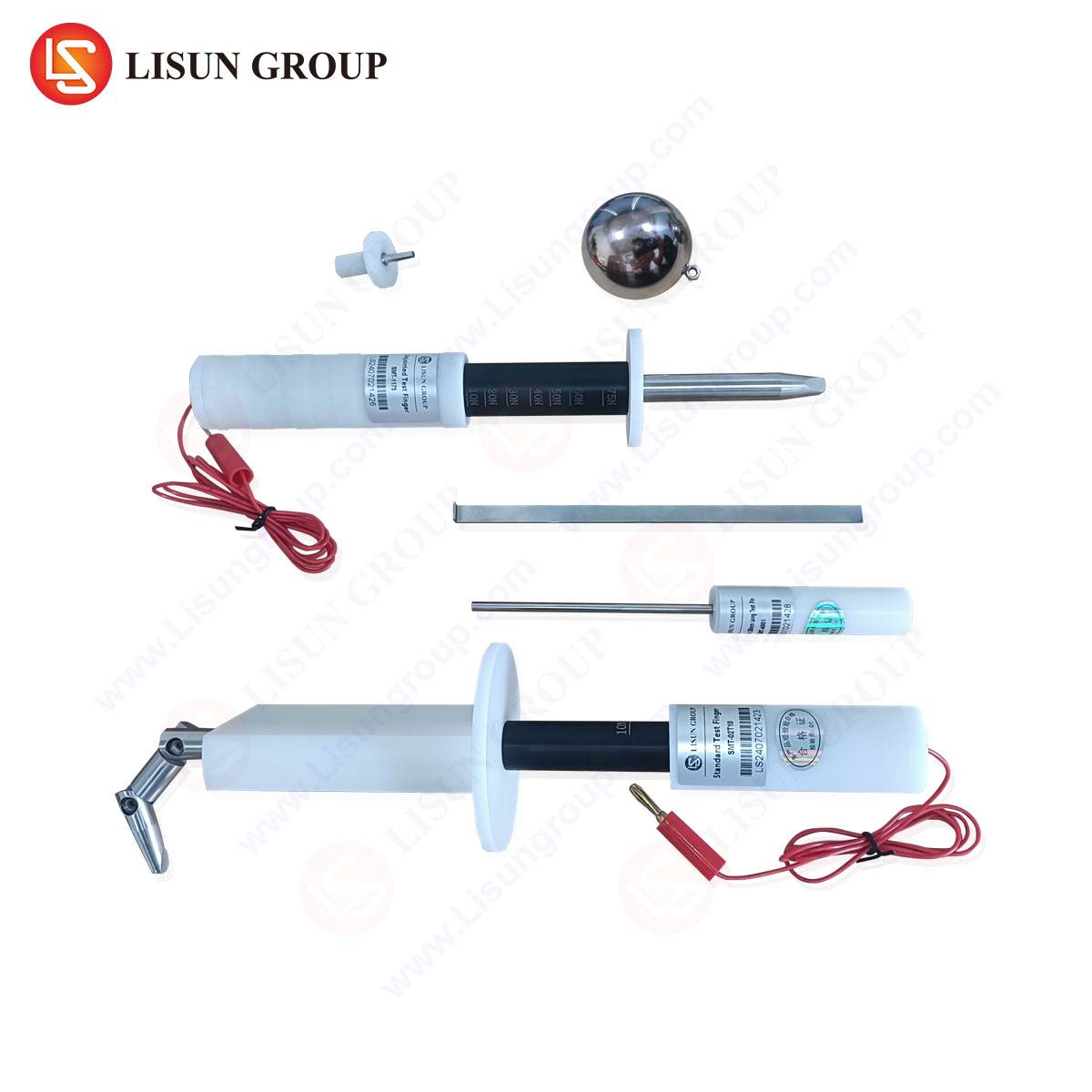
International safety standards, primarily the IEC 61032 “Protection of persons and equipment by enclosures – Probes for verification” and its regional derivatives (e.g., UL, CSA, EN), establish a suite of standardized test probes. These probes are dimensionally precise instruments designed to simulate parts of the human body or objects that might penetrate an enclosure. For vacuum cleaners and similar appliances, two probes are of paramount importance: the Jointed Test Finger (Test Probe B) and the Test Probe (Test Probe 13). The Jointed Test Finger, often colloquially termed the “test finger,” replicates the size and articulation of a human finger. It is employed to verify that openings in an enclosure do not permit access to hazardous live parts or dangerous mechanical components. The Test Probe, a rigid, straight rod, simulates a tool or wire that might be inserted into an opening, testing for protection against access to live parts with a more rigid object. The Test Pin, a smaller-diameter probe, is used to evaluate the effectiveness of barriers or openings intended to prevent probing by small objects, crucial for toy safety and certain electrical components.
Mechanical and Dimensional Specifications of Critical Probes
The efficacy of these test instruments hinges on their unwavering adherence to defined dimensional and mechanical tolerances. The LISUN Test Finger, conforming to IEC 61032 Figure 2 / Test Probe B, is typically constructed from robust, non-conductive materials such as polyamide or phenolic resin. Its design incorporates two joints, allowing it to mimic the natural articulation of a finger, with a specified reach and angle of articulation. Key dimensions include a finger-like diameter, a specific pivot point distance, and a total length. The probe must exert a defined force (typically 10 N ± 1 N) during application, and its articulation allows it to explore openings in every possible position and orientation.
The LISUN Test Probe (aligned with IEC 61032 Figure 13 / Test Probe 13) is a rigid, straight, non-conductive rod. Its diameter (e.g., 2.5 mm) and length are precisely specified to represent a potential probing object. It is applied with a force of 1 N ± 0.1 N. The LISUN Test Pin, often referenced in toy standards (e.g., ISO 8124-1) and for certain electrical socket tests, is a slender, rigid metal pin of a specified small diameter (e.g., 1.0 mm), applied with a minimal force (e.g., 1 N) to test for accessibility through small apertures.
Table 1: Representative Specifications for Standard Test Probes
| Probe Type | Standard Reference | Typical Dimensions | Application Force | Primary Simulation |
| :— | :— | :— | :— | :— |
| Jointed Test Finger | IEC 61032 Fig. 2 (Probe B) | Per standard drawing; two-jointed, ~80mm long | 10 N ± 1 N | Adult finger articulation |
| Test Probe | IEC 61032 Fig. 13 (Probe 13) | Rigid rod, φ2.5mm x ~100mm long | 1 N ± 0.1 N | Tool or stiff wire |
| Test Pin | IEC 61032 Fig. 1 (Probe 18) / ISO 8124 | Rigid pin, φ1.0mm x ~50mm long | 1 N ± 0.1 N | Small object (e.g., pin, paperclip) |
Application in Vacuum Cleaner Safety Assessment
The safety evaluation of a vacuum cleaner is a multi-faceted process where these probes are applied systematically. The primary standard governing this is IEC 60335-2-2 “Household and similar electrical appliances – Safety – Part 2-2: Particular requirements for vacuum cleaners and water-suction cleaning appliances.” The assessment begins with a visual inspection to identify all openings, grilles, seams, and joints. The Jointed Test Finger is then applied to every external opening with the specified force and articulation. It must not contact basic insulation, uninsulated live parts, or hazardous moving parts like the impeller fan. For example, the crevice tool inlet or the exhaust grille is rigorously tested. If the test finger can enter and potentially bridge conductive parts or contact a live part, the design fails.
Subsequently, the rigid Test Probe is applied to any opening that is deemed accessible and where the standard requires a higher degree of protection (e.g., openings that remain after removal of user-serviceable parts). This probe checks if a stiffer object could defeat flexible guards or wider-gap grilles. A vacuum cleaner’s internal circuitry, often containing printed circuit boards (PCBs) for motor control or sensors, must be positioned such that neither probe can make contact with tracks or components carrying hazardous voltages. Furthermore, for cleaners with thermal cut-offs or heating elements (for air drying), probe testing ensures adequate guarding against hot surfaces.
Cross-Industry Utilization of Standardized Probe Testing
The principles and tools defined for vacuum cleaners are universally applicable across the electrical and electronic manufacturing landscape. The LISUN Test Finger and Test Probe are not appliance-specific but are foundational safety validation instruments.
In Automotive Electronics, probes verify that infotainment systems, control units, and charging ports (e.g., for electric vehicles) prevent user access to high-voltage or high-current terminals, complying with standards like ISO 20653 (Ingress Protection) and LV 214.
For Lighting Fixtures, both indoor and outdoor, test probes ensure that live parts within a luminaire are inaccessible after installation or during lamp replacement, as per IEC 60598-1. The articulation of the test finger is critical for testing adjustable spotlight joints or diffuser retention mechanisms.
Industrial Control Systems and Telecommunications Equipment housed in enclosures use probe testing to validate IP ratings (e.g., IP2X for finger protection) and ensure maintenance personnel cannot accidentally contact dangerous voltages within control panels or server racks.
In the Medical Device sector, standards like IEC 60601-1 mandate probe testing to protect both patient and operator from accessible hazardous parts in devices ranging from patient monitors to surgical tools, where conductive fluids may also be present.
Aerospace and Aviation Components must undergo rigorous safety testing, where probe verification ensures that in-flight entertainment systems, cockpit controls, and galley equipment do not pose an electrical shock risk in the unique environmental conditions of an aircraft.
For Electrical Components such as switches, sockets, and connectors, probe testing is fundamental. Sockets must be designed to prevent the insertion of a single pin or finger into a live contact opening, a test directly performed with the Test Pin and Test Finger.
Toy and Children’s Products safety relies heavily on the Test Pin and a smaller “small parts cylinder” to ensure that batteries are secured in compartments inaccessible to children, and that no small, hazardous components can be dislodged.
The Testing Principle and Procedural Methodology
The underlying principle is one of simulated intrusion under defined mechanical conditions. Testing is not merely a “poke-and-see” exercise but a controlled, repeatable experiment. The apparatus, such as the LISUN test set, often includes a force gauge and a standardized mounting for the probe to ensure consistent application of the specified force (10N or 1N). The test is conducted on a non-energized, stationary product sample, though sometimes it must be performed with covers or doors in their most unfavorable position.
During the test with the Jointed Test Finger, the probe is articulated through its full range of motion at each opening. A crucial part of the validation is the “Electrical Contact Indicator.” This is a sensitive circuit (typically 40-50V, with a current limit) connected between the metallic tip of the test finger and the live parts of the equipment under test. If the probe makes electrical contact, the circuit closes, and an visual or audible signal activates, providing an unambiguous pass/fail result. For purely mechanical hazards, a physical check for contact is made, often using a thin strip of foil or a similar indicator on the probe tip.
Competitive Advantages of Precision-Engineered Test Probes
The market for safety test equipment is populated by offerings of varying quality. Precision-engineered probes, such as those from LISUN, offer distinct advantages that directly impact the reliability and legal defensibility of compliance testing.
Metrological Traceability and Certification: High-quality probes are supplied with individual calibration certificates from accredited laboratories, ensuring dimensional and force application traceability to national standards. This is not a luxury but a necessity for test laboratories seeking ISO/IEC 17025 accreditation.
Material Durability and Consistency: The use of specified, stable materials prevents deformation, wear, or electrostatic buildup over time. A worn or out-of-spec test finger can yield false passes or fails, compromising product safety and creating liability.
Ergonomic and Complete Test Systems: Competitive offerings provide not just the probe, but integrated systems—force application devices, contact indicators, and storage cases—that standardize the testing procedure across different technicians and laboratories, reducing human error.
Comprehensive Portfolio for Global Markets: A single supplier providing a full suite of probes (Finger, Probe 13, Pin, and others like the IEC 61032 Figure 9 probe for mesh testing) for all relevant global standards (IEC, UL, GB) simplifies procurement and ensures consistency in a manufacturer’s global safety qualification process.
Conclusion
The Standard Test Probe, in its various forms, is far more than a simple tool; it is the physical embodiment of a core safety philosophy. It translates abstract principles of hazard-based engineering into a concrete, repeatable test. For vacuum cleaner manufacturers, and indeed for producers across the electrical, electronic, and consumer goods spectrum, employing precision instruments like the LISUN Test Finger and Test Probe is a critical step in discharging their duty of care. It ensures that products placed on the market provide robust protection against foreseeable misuse, thereby preventing injury, reducing liability, and upholding the integrity of international safety standards. As product designs evolve, becoming more compact and integrated, the role of these definitive test instruments will only grow in importance, remaining a cornerstone of credible safety evaluation.
Frequently Asked Questions (FAQ)
Q1: Can a 3D-printed replica of a test finger be used for compliance testing?
A: No, for formal compliance testing leading to certification, 3D-printed replicas are not acceptable. Standards require the probe to be constructed from specific materials with defined electrical and mechanical properties (e.g., resistance, hardness, durability). Furthermore, certified test equipment must have documented metrological traceability through calibration, which cannot be guaranteed with informal replicas. They may be useful for initial design verification, but not for final type testing.
Q2: How often should a standard test probe be calibrated or verified?
A: The calibration interval depends on usage frequency, handling conditions, and the requirements of the laboratory’s quality system (e.g., ISO 17025). A typical recommendation is annual calibration. However, the probe should be inspected visually for damage, wear, or deformation before each use. Any sign of damage necessitates immediate recalibration or replacement.
Q3: What is the significance of the 10N force applied with the Jointed Test Finger?
A: The 10 Newton force (approximately 1 kilogram-force) is a standardized simulation of the force a typical user might inadvertently apply when probing an opening. It represents a reasonable upper limit for casual probing without intentional use of tools. This force ensures that guards, grilles, and flexible barriers are mechanically robust enough to resist such probing.
Q4: If my product passes the test finger test but fails the rigid test probe test, what does this indicate?
A: This result indicates that the product’s openings are adequately guarded against finger access but are vulnerable to penetration by a stiffer, narrower object like a tool or wire. The standard often requires the rigid probe test for openings that are considered “accessible” under specific conditions (e.g., after removing a cover with a tool). A failure necessitates a redesign, such as adding a finer mesh, reducing the opening size, or incorporating a baffle system to block straight-line access.
Q5: Are there different test finger designs for different regions or standards?
A: While the IEC 61032 Test Probe B is the most widely recognized, some historical or regional standards had slight variations. For instance, older versions of UL standards referenced slightly different dimensions. Modern harmonization efforts have largely converged on the IEC standard. However, it is crucial to specify the exact standard (e.g., IEC 61032 Fig. 2, UL 60950-1 Annex U) when procuring test equipment to ensure the correct probe is used for your target market. Reputable suppliers like LISUN clearly identify the standards compliance of each probe.