




A Comprehensive Step-by-Step Guide to IP6X Dustproof Testing: Principles, Procedures, and Equipment
Introduction to Ingress Protection and the IP6X Rating
The Ingress Protection (IP) rating system, codified in international standards such as IEC 60529, provides a standardized classification for the degree of protection offered by enclosures against the intrusion of solid foreign objects, dust, accidental contact, and water. The first digit of the IP code denotes the level of protection against solids, with a rating of “6” representing the highest achievable level: complete protection against dust ingress. An IP6X rating signifies that the enclosure is “dust-tight,” a critical requirement for equipment intended to operate reliably in environments where particulate contamination can lead to catastrophic failure. This rating is not merely a marketing specification but a rigorous performance benchmark validated through controlled laboratory testing. The following guide provides a detailed, procedural examination of the IP6X dustproof testing methodology, its underlying principles, and the specialized apparatus required for its execution.
Fundamental Principles of Dust Ingress and Test Simulation
Dust ingress poses multifaceted threats to electrical and electronic systems. Particulate matter can obstruct moving parts, such as cooling fans in telecommunications equipment or actuators in industrial control systems. Conductive dust can bridge isolated traces on printed circuit boards within automotive electronics or medical devices, leading to short circuits. Hygroscopic dust can absorb moisture, promoting corrosion on the contacts of electrical components like switches and sockets. Furthermore, dust accumulation can impair thermal dissipation in lighting fixtures and power supplies, causing overheating and premature component degradation. The objective of IP6X testing is to simulate a severe dust-laden environment under negative pressure, forcing fine talcum powder into any potential entry point. The test is predicated on creating a sustained vacuum inside the test specimen relative to the ambient test chamber, thereby establishing a pressure differential that drives the dust particles toward any leakage path. The pass/fail criterion is stringent: no dust must enter the enclosure in a quantity that would interfere with normal operation or compromise safety.
Essential Apparatus: The LISUN SC-015 Dust Sand Test Chamber
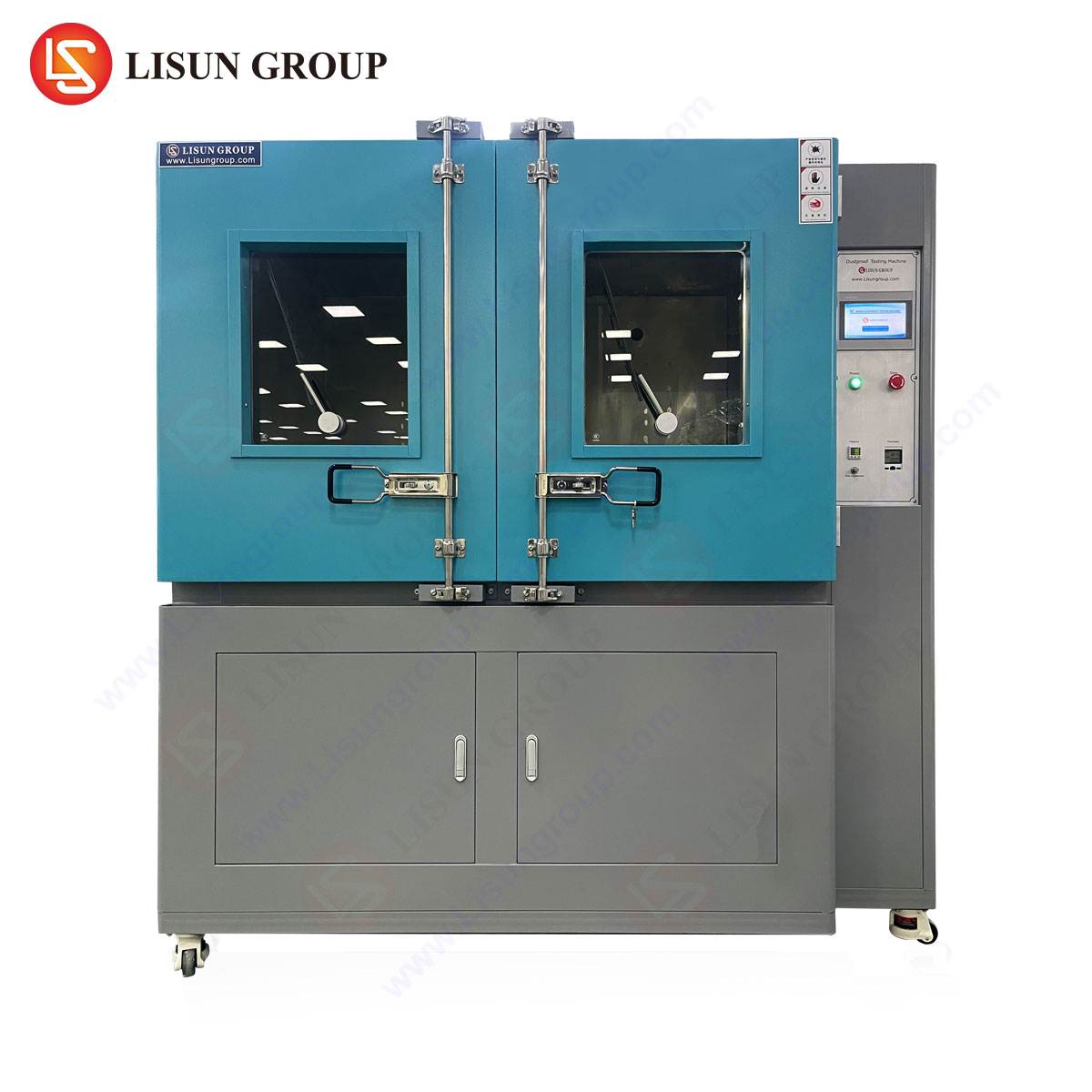
Conforming to the exacting requirements of IEC 60529, ISO 20653, and other derivative standards, the LISUN SC-015 Dust Sand Test Chamber is engineered specifically for IP5X and IP6X testing. This instrument is not a generic environmental chamber; it is a purpose-built system designed to generate, control, and contain the precise test conditions mandated by the standards. Its operation automates the critical and repetitive cycles of dust circulation and pressure differential management, ensuring test reproducibility—a cornerstone of reliable quality assurance.
The chamber’s core specifications and functional components include:
- Test Dust: Utilizes finely ground talcum powder, with particles sized to pass through a square mesh of 75 µm and a nominal diameter of 50 µm. This simulates a severe, fine dust condition.
- Dust Circulation System: A closed-loop vortex blower or equivalent mechanism fluidizes and circulates the talcum powder uniformly throughout the test chamber volume, ensuring a homogenous dust cloud envelops the test specimen.
- Vacuum System: An integrated vacuum pump and regulation system is used to draw air from the interior of the device under test (DUT). This creates the internal underpressure specified by the standard, typically between 1.96 kPa (200 mm H₂O) and 7.85 kPa (800 mm H₂O), depending on the DUT’s design and porting.
- Control and Monitoring: A programmable logic controller (PLC) or microprocessor-based interface allows for precise setting of test duration, vacuum level, and dust circulation cycles. It typically includes a flowmeter or pressure gauge to monitor the suction rate, which must be maintained at 40-60 times the DUT’s internal volume per hour, or as dictated by the vacuum pressure stability.
- Construction: The chamber itself is constructed of corrosion-resistant materials (e.g., stainless steel) with a transparent viewing window for observation. It includes safety features for operator protection from dust exposure.
Pre-Test Preparation and Specimen Conditioning
Prior to testing, meticulous preparation is paramount. The device under test must be in its final, usable form as intended by the manufacturer. For electrical and electronic equipment, this typically means all seals, gaskets, cable glands, and covers are installed per the assembly instructions. If the device has moving parts or vents intended for operation (such as a fan in office equipment or an exhaust port on an industrial controller), these may be tested in both operational and non-operational states, as specified in the product’s test plan derived from its classification standard.
The specimen is then conditioned. For many standards, this involves placing the DUT in a temperature-controlled cabinet at a “dry heat” condition, often 40°C ± 2°C, for a sufficient duration (e.g., 2 hours) to drive off internal moisture. This conditioning ensures that any ingress observed is due to particulate matter and not condensation. Following conditioning, the DUT is allowed to cool to ambient temperature within the test laboratory, typically 15°C to 35°C, before being placed in the dust chamber. All external openings that are not part of the permanent enclosure (e.g., ports for user connections) must be sealed for the test, unless the test is evaluating the protection offered by those specific ports with their associated plugs or caps installed.
Step-by-Step Testing Procedure within the LISUN SC-015 Chamber
- Specimen Placement and Connection: The conditioned DUT is securely mounted inside the LISUN SC-015 test chamber on a support that does not obstruct dust flow. A vacuum hose is connected from the chamber’s internal vacuum port to a dedicated opening in the DUT’s enclosure. This opening is created solely for the test; in practice, it simulates a potential leak path that might exist at a seal or joint. If the device has multiple separate compartments (like some aerospace and aviation components or complex medical devices), each must be tested individually or simultaneously with separate vacuum lines.
- Chamber Sealing and Initialization: The chamber door is closed and sealed. The test parameters are entered into the LISUN SC-015’s control system: test duration (standard duration is 8 hours for IP6X), desired internal underpressure for the DUT, and the duty cycle for the dust circulation fan.
- Vacuum Establishment and Stabilization: The vacuum pump is activated. The system draws air from the interior of the DUT until the prescribed underpressure is achieved and stabilized. The flowmeter is monitored to ensure the suction rate is within the required range, confirming that the test is imposing the correct stress on the enclosure’s boundaries.
- Dust Circulation Cycle Activation: Once vacuum stability is confirmed, the dust circulation system is engaged. The blower fluidizes the talcum powder, creating a dense, opaque cloud that completely surrounds the DUT. The standard requires that the dust is re-circulated continuously or intermittently to maintain the cloud for the test’s entirety.
- Test Duration and Monitoring: The combined stress of sustained internal vacuum and enveloping dust cloud is maintained for the full test period, typically 8 hours. For certain applications, such as automotive electronics per ISO 20653, longer durations (e.g., 24 hours) may be specified. The LISUN SC-015 automates this process, maintaining parameters without manual intervention. The viewing window allows for periodic visual confirmation of dust cloud density.
- Test Termination and Specimen Recovery: After the set time elapses, the dust circulation system is deactivated. It is common practice to allow the dust to settle for a period (e.g., 30 minutes) before opening the chamber to prevent excessive airborne release. The vacuum is then released, and the DUT is carefully disconnected and removed.
Post-Test Examination and Acceptance Criteria
The evaluation phase is critical and requires a methodical approach. The external surfaces of the DUT will be coated with dust, which is to be expected. The assessment focuses on the interior.
- External Cleaning: Loose dust is gently removed from the exterior using a soft brush or low-pressure air stream, taking care not to force dust into seams or openings.
- Internal Inspection: The enclosure is opened in a clean, dust-controlled environment. A thorough visual inspection is conducted using adequate lighting, and often magnification. The examiner looks for any trace of talcum powder inside the enclosure.
- Functional Check (if applicable): For many product categories—including household appliances, consumer electronics, and lighting fixtures—a functional operational test is performed. The device is powered on and checked for normal operation. Any malfunction, even in the absence of visible dust, can constitute a failure if it is determined to be caused by internal contamination.
- Acceptance Determination: The IP6X acceptance criterion is absolute for dust ingress: no dust shall have entered the enclosure. The presence of any visible dust deposit on internal components, wiring, or PCB assemblies constitutes a test failure. Some standards allow for negligible dust accumulation that does not affect performance, but for a true IP6X “dust-tight” claim, the requirement is typically zero ingress.
Industry Applications and the Imperative for IP6X Certification
The demand for IP6X protection spans industries where reliability cannot be compromised by environmental contamination.
- Automotive Electronics & Aerospace: Control units, sensors, and connectors mounted in wheel wells, engine compartments, or aircraft landing gear bays are exposed to extreme dust and sand. IP6X validation is often a prerequisite in standards like ISO 20653 for road vehicles or DO-160 for airborne equipment.
- Industrial Control Systems & Telecommunications: Equipment deployed in manufacturing plants, mining operations, or outdoor telecom cabinets must withstand pervasive industrial dust and particulate to ensure continuous process control and network integrity.
- Medical Devices & Electrical Components: Surgical devices, diagnostic equipment, and critical care monitors require dust-tight enclosures to maintain sterility and prevent internal contamination that could lead to erroneous readings or failures. Similarly, switches and sockets used in harsh environments benefit from this rating.
- Lighting Fixtures & Outdoor Equipment: Luminaires for tunnels, industrial facilities, or street lighting, as well as outdoor CCTV cameras, use IP6X seals to prevent lumen depreciation and failure caused by dust accumulation on reflectors, lenses, and electronics.
Advantages of Automated Testing with the LISUN SC-015 System
Employing a dedicated, automated chamber like the LISUN SC-015 offers significant advantages over improvised or manual test setups. First, it ensures standard compliance by providing repeatable control over all critical variables: dust density, circulation, vacuum level, and timing. This eliminates operator-induced variables and generates auditable test reports. Second, it enhances laboratory efficiency and safety. The closed system contains the hazardous talcum powder, protecting technicians from respiratory exposure. Automated cycles free personnel for other tasks during the often lengthy test durations. Finally, it provides defensible data for product certification. The consistent, reproducible conditions generated by such a chamber yield test results that are trusted by certification bodies (UL, TÜV, Intertek, etc.) and customers alike, solidifying the manufacturer’s claims of product robustness.
Frequently Asked Questions (FAQ)
Q1: Can the LISUN SC-015 chamber be used for both IP5X and IP6X testing?
Yes, the LISUN SC-015 is explicitly designed to perform both tests. The fundamental difference between IP5X (dust-protected) and IP6X (dust-tight) lies in the test conditions and acceptance criteria. IP5X testing may be conducted without a vacuum (unless specified) and allows a limited amount of dust ingress provided it does not interfere with operation or safety. The same chamber can be configured to apply or omit the internal vacuum, making it suitable for the full range of dust protection testing per IEC 60529.
Q2: How often does the talcum powder test medium need to be replaced in the chamber?
The talcum powder is a consumable material. Replacement frequency depends on usage volume and contamination. Powder that has become damp, clumped, or contaminated with debris from previous test specimens must be replaced to ensure consistent dust cloud density and particle size distribution. Regular inspection of the powder’s fluidity is recommended as part of laboratory quality control.
Q3: Our product has a small breather vent for pressure equalization. Can it achieve IP6X?
Typically, no. A standard breather vent is an intentional opening that would allow dust ingress under the vacuum test. To achieve IP6X while allowing pressure equalization, a specialized membrane breather valve that is impermeable to solid particles but permeable to air must be used. The entire assembly, including this valve, would then be tested as part of the enclosure.
Q4: Is an 8-hour test duration always sufficient for IP6X certification?
While 8 hours is the default duration specified in IEC 60529, it is a minimum requirement. Specific product family standards or customer-specific test plans may mandate longer durations to simulate a lifetime of exposure. For instance, automotive specifications frequently require 24-hour dust tests. The test plan, derived from the product’s end-use environment and applicable standards, must be reviewed to determine the appropriate duration.
Q5: What is the recommended maintenance schedule for the LISUN SC-015 chamber to ensure accurate results?
Preventive maintenance is crucial. Key activities include: regular cleaning of the interior and viewing window to prevent caked dust from affecting operation; inspection and replacement of seals on the chamber door and vacuum lines; calibration of the vacuum gauge and flowmeter at intervals defined by the laboratory’s quality system (often annually); and verification of the dust circulation system’s performance to ensure uniform cloud generation.