







Technical Specifications and Methodologies for Accessibility Testing in Hazardous-Live-Parts Evaluation
The evaluation of protection against electric shock remains a paramount concern in the design, certification, and manufacture of electrical and electronic equipment. A foundational element of this safety paradigm is the assessment of accessibility to hazardous-live-parts, a process governed by stringent international standards such as IEC 61032, IEC 60529 (IP Code), and their regional derivatives (e.g., UL, CSA, GB). This article delineates the technical specifications, operational principles, and critical applications of standardized test probes—specifically the Test Finger, Test Probe, and Test Pin—as essential tools for verifying compliance with these safety mandates. The analysis focuses on the implementation of these tools, exemplified by the LISUN series of compliance test equipment, across a diverse spectrum of industries.
Anthropomorphic and Mechanical Probes: Defining the Standards
The philosophy underpinning accessibility testing is the simulation of both intentional and unintentional human interaction with equipment. Standards bodies have therefore codified a suite of test probes, each representing a specific threat model.
The Articulated Test Finger (IEC 61032, Probe 11-B) serves as a simulated adult finger. Its design is anthropomorphic, featuring two articulated joints that allow it to pivot and probe openings with a motion approximating a human finger’s natural curl. The distal end is a semi-rigid representation of a fingertip. Its primary metric is the 75 N (approximately 7.5 kg) force applied during testing. The objective is to ascertain that under this force, the probe cannot contact hazardous-live-parts, defined as parts carrying a voltage exceeding specified safety extra-low voltage (SELV) limits, typically above 50 V AC or 120 V DC. The test also evaluates whether the probe can bypass protective covers, open hinged doors, or depress interlock switches without appropriate safety sequencing.
The Straight Test Probe (IEC 61032, Probe 13) is a rigid, unjointed rod. It represents a more deliberate probing action, such as with a tool or a stiff wire. Its dimensions are precisely defined, and it is applied with a force of 30 N. This probe is crucial for testing the effectiveness of barriers and the integrity of smaller openings that might be accessible with a straightened paperclip or similar object. It is a key tool in validating the “proof” aspect of protection offered by enclosures (IP Code testing for protection against access to hazardous parts, denoted by the first characteristic numeral).
The Test Pin (IEC 61032, Probe 19) represents the most severe threat model for small apertures: a child’s probing finger or a thin, rigid object. It is a slender, rigid pin applied with a minimal force, typically 1 N. Its purpose is to verify that even small openings, often found in ventilation grilles, connector ports, or between assembly joints, do not permit access to internal live parts. Failure to resist the test pin indicates a direct and unacceptable risk of electric shock.
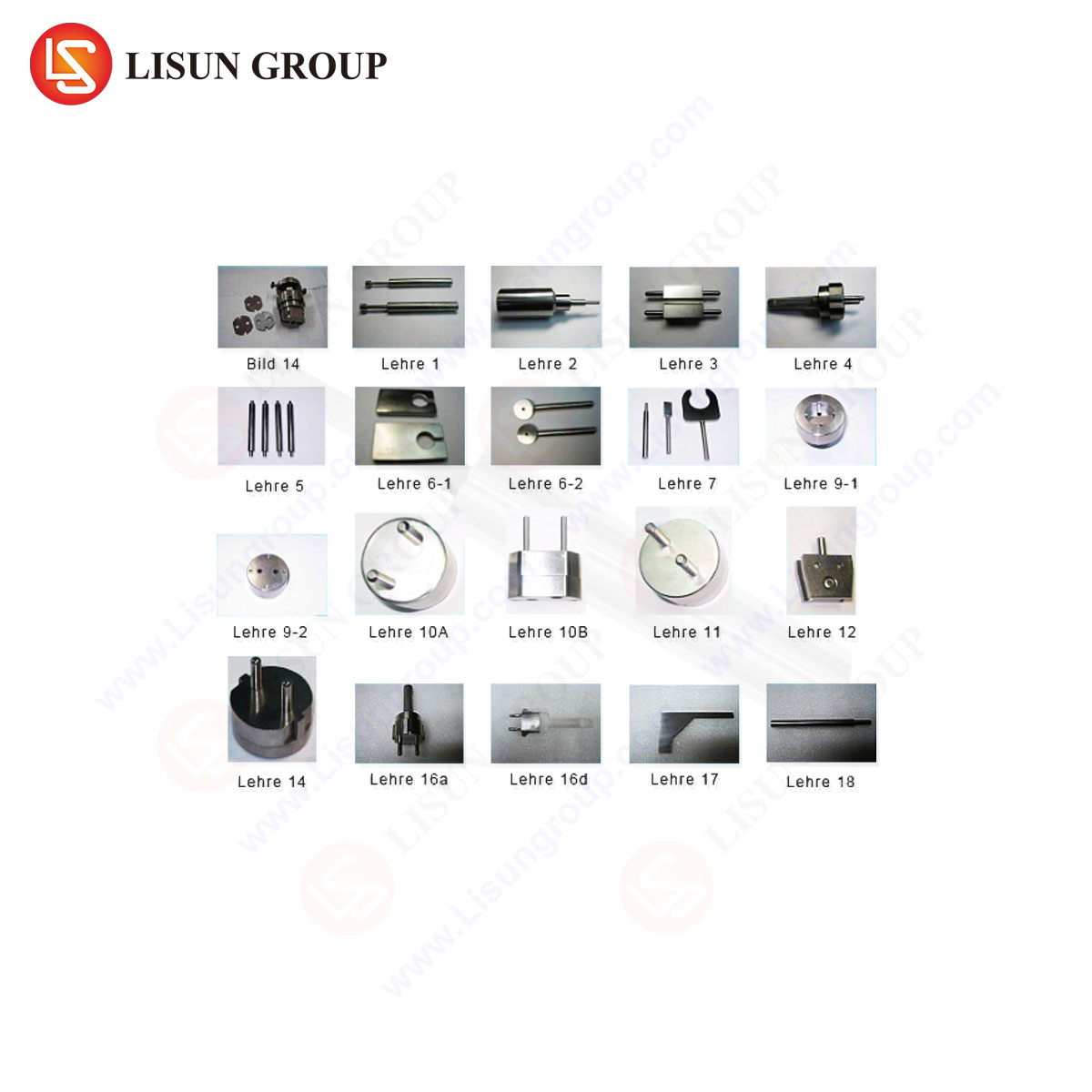
The LISUN series of these probes are manufactured to the exacting dimensional and material tolerances stipulated in IEC 61032. For instance, the LISUN LS-TF-01 Test Finger is constructed from heat-resistant, non-conductive polymer with metal joint pins, ensuring it does not deform under the 75 N test force and maintains accurate articulation. The LISUN LS-TP-01 Test Probe and LS-TPN-01 Test Pin are machined from hardened steel to specified diameters and lengths, guaranteeing dimensional integrity over repeated use.
Electromechanical Verification and Testing Protocols
The testing procedure is not merely mechanical; it incorporates an electromechanical verification step to definitively confirm contact or non-contact. During a test, the probe is connected to a detection circuit. A low-voltage (not exceeding 40 V) signal, often from a visible or audible indicator, is passed through the probe. The equipment under test (EUT) is energized at its normal operating voltage. The probe is manipulated as per the standard—articulated, pushed, or angled—across all user-accessible openings and joints.
A positive indication (e.g., a light illuminating or a buzzer sounding) signifies that the probe has bridged the gap to a live part, completing the detection circuit through the EUT’s internal circuitry to earth. This constitutes a test failure. The absence of an indication demonstrates that the enclosure or barrier has successfully prevented access, thereby passing the test. This methodology provides an objective, binary result, eliminating subjective interpretation.
Table 1: Summary of Key Test Probe Specifications and Applications
| Probe Type (IEC 61032) | Representative Threat | Test Force | Primary Application | Example Industry Use Case |
| :— | :— | :— | :— | :— |
| Probe 11-B (Test Finger) | Adult finger, intentional probing | 75 N | Accessibility of openings, stability of covers, interlock defeat. | Verifying a household washing machine’s service panel cannot be opened without a tool to expose mains terminals. |
| Probe 13 (Test Probe) | Tool, wire, deliberate insertion | 30 N | Integrity of smaller openings and barriers. | Testing that the ventilation slots on an industrial PLC (Programmable Logic Controller) do not allow a rigid rod to contact internal 24V DC control boards or 120V AC power supplies. |
| Probe 19 (Test Pin) | Child’s finger, thin object | 1 N | Protection through very small apertures. | Ensuring the gaps in a toy’s battery compartment door are narrow enough to prevent a child from inserting a pin and contacting battery terminals. |
Cross-Industry Deployment and Compliance Imperatives
The application of these test probes is ubiquitous across all sectors manufacturing electrical goods. Compliance is not optional; it is a legal and liability requirement for market access.
- Electrical and Electronic Equipment & Household Appliances: This is the foundational domain. For a kitchen blender, the test finger ensures the motor housing seal prevents access to live windings. The test pin validates the safety of the control button membrane. For an ITE (Information Technology Equipment) power supply, the test probe checks the security of the fan guard.
- Automotive Electronics: Modern vehicles are networks of electronic control units (ECUs). Probes test the IP-rated connectors for engine bay sensors, the housings for infotainment systems, and the charging ports for electric vehicles to ensure they are “finger-safe” before voltage is applied.
- Lighting Fixtures: From high-bay industrial LED luminaires to recessed residential downlights, testing verifies that once installed, live parts within the driver compartment or lamp holder are inaccessible, even when attempting to manipulate diffusers or housing seams.
- Medical Devices: Patient safety is critical. Probes test dialysis machines, patient monitors, and surgical tools to ensure no accessible live parts, even during routine cleaning or when covers are slightly ajar, mitigating risk in often wet environments.
- Aerospace and Aviation Components: In-flight entertainment systems, cockpit instrumentation, and galley equipment must withstand rigorous testing to ensure no amount of vibration or passenger interaction can expose hazardous voltages.
- Cable and Wiring Systems: Connectors, junction boxes, and cable glands are tested to ensure their IP rating against finger and tool access is valid, guaranteeing safety during handling and installation.
- Toy and Children’s Products Industry: This sector has particularly stringent requirements. The test pin is employed extensively to ensure battery compartments, speaker grilles, and charging ports are completely inaccessible to a child’s probing, often requiring additional safeguards beyond basic enclosure design.
Metrological Traceability and Competitive Differentiation
The efficacy of compliance testing hinges entirely on the precision and traceability of the test equipment. A probe that is even marginally out of specification can yield false passes (creating unsafe products) or false fails (incurring unnecessary redesign costs). Competitive advantages in this field are derived from several technical factors:
- Metrological Certification: Superior products, such as the LISUN series, are supplied with individual calibration certificates traceable to national metrology institutes (NMIs). This documentation is often required by accredited testing laboratories and quality auditors.
- Material Durability: Probes are subjected to repeated mechanical stress. The use of hardened steel for rigid probes and high-strength, creep-resistant polymers for articulated fingers ensures dimensional stability over thousands of test cycles, maintaining compliance.
- Ergonomic and Functional Design: Features like knurled handles for secure grip, integrated connection points for detection circuits, and clearly marked application force indicators (e.g., a spring-loaded force gauge on the test finger) reduce operator error and improve test repeatability.
- Comprehensive Kit Solutions: Providing a complete set of probes (Finger, Probe, Pin) with a dedicated detection circuit indicator and carrying case, as seen with the LISUN LS-TK-01 kit, offers laboratories and manufacturers a single, validated source for all accessibility testing needs, streamlining their compliance workflow.
In conclusion, the Test Finger, Test Probe, and Test Pin are not simple tools but calibrated instruments that embody a critical safety philosophy. Their precise application, as governed by international standards, forms an indispensable barrier between users and electrical hazards. The rigorous design and manufacture of these probes, ensuring traceable accuracy and durability, directly contribute to the safety ecosystem of virtually every electrically powered product on the global market. As technology evolves, with trends toward miniaturization and higher power densities in devices, the role of these fundamental accessibility tests will only grow in importance, demanding continued precision in both the standards and the tools used to enforce them.
FAQ: Accessibility Testing with Standardized Probes
Q1: Can a product pass the Test Finger (75 N) but fail the Test Pin (1 N) probe?
Yes, this is a common and critical scenario. The Test Finger evaluates larger openings and the mechanical strength of guards. A product may have a robust grill that withstands finger probing but feature smaller, separate apertures—like those for microphone ports or between assembly seams—that permit the slender Test Pin to penetrate and contact live parts. Both tests are independently necessary and address distinct threat models.
Q2: How often should test probes be recalibrated?
Recalibration intervals depend on usage frequency, material wear, and quality system requirements (e.g., ISO/IEC 17025). For high-volume testing laboratories, an annual calibration cycle is typical. Manufacturers with internal compliance labs may opt for biannual checks. Any physical damage or drop impact necessitates immediate verification. The calibration checks for dimensional wear, joint stiffness (for articulated fingers), and straightness.
Q3: In IP Code testing (e.g., IP20, IP4X), which probes are used?
The first characteristic numeral in the IP Code denotes protection against solid object ingress, which includes protection against access to hazardous parts. Specifically:
- Numeral 2: Requires protection from a 12.5mm diameter sphere (simulating a finger). The Test Finger (Probe 11-B) is used to verify that it cannot access hazardous parts.
- Numeral 3: Protection from a 2.5mm diameter tool. The Straight Test Probe (Probe 13) is used.
- Numeral 4: Protection from a 1.0mm diameter wire. The Test Pin (Probe 19) is used.
Thus, a rating of IP2X is verified with the Test Finger, IP3X with the Test Probe, and IP4X with the Test Pin.
Q4: What is the purpose of the detection circuit’s low voltage? Why not use the equipment’s own operating voltage for detection?
Using a low-voltage (≤40V), current-limited detection circuit is a fundamental safety precaution for the test operator. It allows for the safe detection of electrical contact without the risk of the operator being exposed to the full hazardous voltage of the EUT during the probing process. The circuit is sensitive enough to indicate contact through the EUT’s internal impedance to earth.
Q5: Are there industry-specific adaptations of these standard probes?
While IEC 61032 provides the core standards, certain industries have supplementary requirements. The toy industry, governed by standards like IEC 62115 or ASTM F963, may mandate even more stringent probing requirements for certain accessible compartments. Similarly, medical device standards (IEC 60601-1) incorporate the probes but within the context of “means of patient protection” (MOPP), requiring specific clearance and creepage distances that are validated by the probe’s inability to make contact. The fundamental probe designs, however, remain the consistent reference.