







The Role of Terminal Probes in Modern Product Safety and Compliance Verification
The relentless miniaturization and increased functional density of modern electrical and electronic equipment have elevated the critical importance of verifying safety against accidental contact with hazardous live parts. Terminal probe applications, governed by a stringent framework of international standards, serve as a fundamental methodology for this verification. These tests simulate scenarios where a user, particularly a child, might interact with a product using conductive objects like fingers, tools, or jewelry. The precision of the test apparatus is paramount, as it directly correlates to the reliability of the safety assessment. This article examines the technical principles, industry applications, and implementation requirements of terminal probe testing, with a detailed focus on the instrumentation required for compliant and repeatable results.
Defining the Anthropomorphic Simulation: Probes, Pins, and Fingers
Terminal probe testing is not a singular activity but a suite of evaluations employing geometrically defined test pieces. Each piece is designed to simulate a specific interaction threat. The Test Finger, standardized as the “articulated test finger” in documents like IEC 61032 and UL 507, is a jointed, metallic simulation of a human finger. Its primary function is to assess protection against access to hazardous parts through openings in an enclosure. A probe that enters an opening and contacts a live part at hazardous voltage fails the test, indicating a design flaw.
The Test Probe represents a broader category of objects, typically rigid and of specified dimensions, intended to probe openings for accessibility. A common example is the IEC 61032 Figure 2 test probe, simulating a tool or wire. The Test Pin, often the smallest and most stringent probe (e.g., the “checking pin” from IEC 60112 or simulated by the “test pin B” from IEC 61032), is designed to evaluate the effectiveness of insulation barriers and creepage distances. Its small diameter (0.5mm is typical) allows it to challenge gaps that larger probes cannot, ensuring that even minute apertures do not compromise safety.
The physical execution of these tests requires apparatus that applies the specified force (typically 10N for test fingers, 1N for test pins) without deformation and with perfect electrical continuity. Inconsistent application force or probe flexure introduces unacceptable variables into the assessment. This is where dedicated, calibrated equipment becomes indispensable for laboratories seeking accreditation and manufacturers requiring definitive design validation.
LISUN Test Apparatus: Specifications and Operational Principles
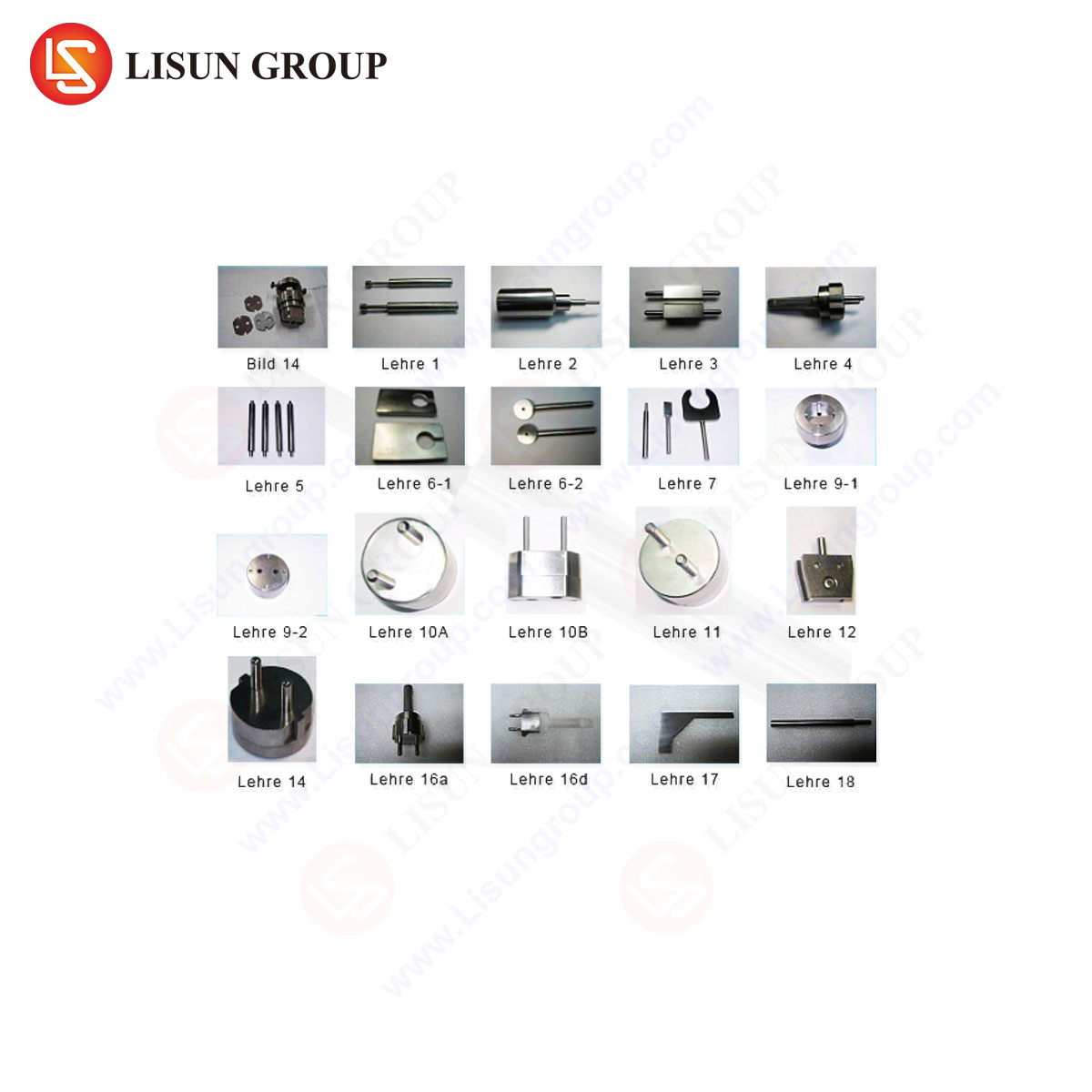
LISUN’s suite of terminal test apparatus, including the LS-TF01 Test Finger, LS-TP01 Test Probe, and LS-TPin01 Test Pin, provides a calibrated, standardized solution for implementing these critical safety checks. These devices are engineered to meet the exact dimensional and functional criteria outlined in major international standards, including IEC 61032, IEC 60529 (IP Code), UL 507, GB 4706.1, and others relevant to specific product families.
The LS-TF01 Articulated Test Finger is constructed from heat-treated aluminum alloy, providing the necessary rigidity to maintain its shape under the 10N (±0.5N) application force. Its joints are designed to replicate the articulation range of a human finger, allowing it to explore openings with a natural bending motion. An integrated indicator circuit, typically a 40-50V low-voltage supply with a series indicator lamp or buzzer, provides a clear, unambiguous signal upon contact with a live part. The device includes a calibrated spring mechanism to ensure the applied force remains within the standard’s tolerance band throughout the test procedure.
For more rigid probing applications, the LS-TP01 Test Probe offers a robust, straight shaft of specified length and diameter, often with a rounded end of a defined radius. It is used to verify that openings cannot be used to bypass protective barriers with a stiff object. The LS-TPin01 Test Pin, with its 0.5mm nominal diameter hemispherical tip, is the tool of choice for the most demanding accessibility checks. It applies a precise 1N (±0.1N) force to challenge small gaps, slots, and openings in insulation or enclosures. The pin is electrically connected to the same indicator circuit, ensuring immediate detection of contact.
The competitive advantage of such integrated systems lies in their metrological traceability and repeatability. Manual application of a makeshift probe cannot guarantee the consistent force or geometric accuracy required for a legally defensible compliance test. LISUN’s apparatus, when used with its optional force gauge (e.g., LS-PF01) for periodic verification, provides an auditable chain of calibration that satisfies the requirements of ISO/IEC 17025 accredited testing laboratories.
Industry-Specific Applications and Risk Mitigation
The application of terminal probe tests spans virtually every sector producing electrical goods. The specific risks and standards vary, but the underlying principle of simulating human interaction remains constant.
Electrical and Electronic Equipment & Consumer Electronics: For IT equipment (IEC 60950-1, now superseded by IEC 62368-1), audio/video gear (IEC 60065, also superseded by IEC 62368-1), and general household electronics, test fingers and probes verify that ventilation slots, battery compartments, and openings for connectors cannot be used to touch mains-voltage components, hazardous energy levels, or moving parts like fans. A test pin might be used to check the integrity of a molded plastic barrier between primary and secondary circuits on a power supply PCB.
Household Appliances: Standards like IEC 60335-1 mandate rigorous probe testing. A test finger must not be able to touch heating elements, live terminals, or dangerous moving blades in food processors through apertures in the housing. The probe tests ensure that even when adjusting a knob or cleaning a filter opening, the user is protected.
Automotive Electronics: While in-vehicle voltage is typically lower (12V/24V DC), functional safety standards like ISO 26262 and electrical safety requirements still mandate protection against short circuits. Probe tests ensure that connectors in the passenger compartment are finger-safe and that maintenance points under the hood are protected against accidental tool contact that could cause a short circuit or fire.
Lighting Fixtures: For luminaires (IEC 60598-1), the test finger is crucial for checking that during lamp replacement or cleaning, a person cannot touch live lamp pins or terminals through the lampholder opening. This is especially critical for GU10 and other bi-pin bases where live parts are exposed within the holder.
Medical Devices (IEC 60601-1): Patient safety is paramount. Probe testing verifies that even in the event of a single fault, accessible parts of the device enclosure do not become hazardous live. This includes checking openings for cables, controls, and displays. The test pin is often used to verify the effectiveness of insulation in applied parts.
Aerospace and Aviation Components (DO-160, AS/EN 9100): While environmental testing is dominant, electrical safety for ground handling and maintenance is assessed. Probe tests ensure that external connectors and access panels on black boxes and in-flight entertainment systems are designed to prevent accidental contact with internal power distribution units.
Toys and Children’s Products (IEC 62115, ASTM F963): This represents one of the most stringent applications. Given the target user, probes simulating a child’s finger (sometimes a “small object” probe) are used to ensure battery compartments cannot be opened to expose button cells, and that no openings in a toy’s body allow access to motor terminals or circuit boards, even when subjected to reasonable abuse.
Integration into a Comprehensive Safety Testing Regime
Terminal probe testing is rarely an isolated activity. It is a component within a larger safety engineering workflow. It typically follows dielectric strength (hipot) and insulation resistance tests, which verify the intrinsic insulation properties. The probe test then validates the physical construction that supports that insulation. It often precedes fault condition tests, as a probe-induced short could be considered a fault scenario.
Data recording is essential. A compliant test report does not merely state “pass/fail.” It documents the standard clause (e.g., IEC 61032, Fig. 2), the probe used, the force applied, the points of application, and the result (no contact indicated). For accredited labs, the calibration certificates of the probe apparatus and force gauge are appended as evidence of measurement uncertainty control.
The selection of the correct probe is dictated by the product standard. A telecommunications equipment tester (using IEC 62368-1) may need a different set of probes than a toy tester (using IEC 62115). Therefore, a comprehensive test lab’s inventory must be aligned with the standards for its scope of accreditation.
FAQ Section
Q1: What is the primary difference between a Test Finger and a Test Pin in application?
The articulated Test Finger (e.g., LISUN LS-TF01) simulates the probing action of a human finger and is used to check for accessibility through larger openings, joints, or gaps in enclosures, applying a force of 10N. The Test Pin (e.g., LISUN LS-TPin01) is a rigid, small-diameter (0.5mm) probe applying only 1N of force. Its purpose is to challenge narrow gaps, slots in insulation, or openings in barriers to verify that even a very thin object cannot bypass protective measures and contact a hazardous part.
Q2: Why is a calibrated, dedicated apparatus necessary instead of a manually fabricated probe?
International safety standards specify not only the dimensions but also the application force and material rigidity of test probes. A handmade probe cannot guarantee the geometric tolerances (e.g., joint articulation, tip radius) or the consistent application of the specified force. This introduces significant measurement uncertainty, rendering test results non-repeatable and potentially non-compliant with accreditation body requirements. Calibrated apparatus like the LISUN series provides traceable, repeatable, and legally defensible data.
Q3: How frequently should terminal probe apparatus be calibrated?
Calibration intervals should be determined based on the equipment’s usage frequency, the criticality of the tests, and the requirements of the lab’s quality management system (e.g., ISO/IEC 17025). A typical interval is 12 months. However, the force application mechanism should be verified more frequently—before each use or daily in a high-throughput lab—using a calibrated force gauge. Any mechanical damage or drop impact necessitates immediate recalibration.
Q4: Can the same test finger be used for IP Code (Ingress Protection) testing and for accessibility to hazardous parts testing?
While the physical probe may appear similar, the test purposes and standards are different. IP testing (IEC 60529) uses probes to verify protection against solid object ingress (e.g., IP2X uses a finger-like probe). Accessibility testing (IEC 61032) uses probes to check for electrical safety. Although a single apparatus like the LS-TF01 is often designed to meet the dimensional specs of both standards, the test procedure, applied force, and pass/fail criteria (object ingress vs. electrical contact) are distinct. The apparatus is versatile, but the test engineer must apply the correct standard’s protocol.
Q5: For a product with a rechargeable battery compartment accessible without a tool, which probes are most relevant?
This scenario requires a multi-probe approach. First, the articulated test finger should be applied to ensure a finger cannot touch battery terminals that could be hazardous (e.g., short-circuit current, temperature). Second, a test probe simulating a tool or key (like the LS-TP01) may be used if the standard requires checking for tool access. Most critically, for toys or products used by children, a “small parts” cylinder or a test pin may be mandated to ensure a child cannot access the battery compartment itself or touch terminals through ventilation holes in the compartment. The specific product standard dictates the exact suite of tests.