




The UL 1278 Bar Probe: A Critical Instrument for Evaluating Accessibility of Hazardous Live Parts
Abstract: The verification of protective enclosures against unauthorized access to hazardous live parts constitutes a fundamental tenet of product safety engineering. This article provides a comprehensive technical examination of the UL 1278 Bar Probe, a standardized test apparatus mandated for assessing the effectiveness of openings in electrical equipment enclosures. We will delineate its specifications, operational principles, and its pivotal role across diverse industries governed by safety standards such as UL, IEC, and CSA. Furthermore, the discussion will encompass the implementation of this testing methodology using modern instrumentation, exemplified by the LISUN Test Finger, Test Probe, Test Pin family of compliance tools, highlighting their precision, calibration integrity, and application-specific configurations.
Defining the UL 1278 Bar Probe and Its Regulatory Genesis
The UL 1278 Bar Probe is a precisely dimensioned test tool defined within the standard UL 1278, “Movable and Wall- or Ceiling-Hung Electric Room Heaters,” and subsequently referenced and adapted across a broader spectrum of safety standards, including UL 507 (Electric Fans), UL 859 (Personal Grooming Appliances), and UL 1310 (Class 2 Power Units). Its primary function is to simulate the probing action of a rigid object, such as a tool, stick, or child’s toy, that could be inserted through an opening in an appliance or equipment enclosure. The probe’s design is intentionally stringent; it is not intended to replicate a human finger but rather to represent a more rigid, slender object that could bypass basic finger guards.
The probe consists of a cylindrical metal bar with a hemispherical end. Its critical dimensions—a diameter of 3.00 mm (±0.05 mm) and a length sufficient to apply the requisite force—are non-negotiable for compliance testing. The test procedure involves applying the probe with a force of 1.0 N (approximately 102 grams-force) to any external opening of the equipment. If the probe can penetrate the opening and make contact with hazardous live parts or uninsulated moving parts (like a fan blade), or if it can bridge a creepage or clearance distance to reduce it below the mandated minimums, the design fails the evaluation. This test is often performed in conjunction with the standardized test finger (the “articulated probe,” simulating a child’s finger) to provide a layered assessment of accessibility.
Dimensional Tolerances and Material Considerations for Test Fidelity
The integrity of any compliance test hinges on the physical and geometric accuracy of the test apparatus. For the UL 1278 Bar Probe, material selection and manufacturing tolerances are paramount. The probe is typically fabricated from hardened steel or another rigid, non-conductive material with sufficient structural integrity to prevent bending during application of force. While the probe itself is metallic, its application is to assess accessibility; contact with live parts is detected electrically or visually. Some test configurations may utilize a non-conductive version for specific assessments, but the standard dimensional requirements remain invariant.
The hemispherical tip radius is precisely controlled to prevent sharp edges that could damage the equipment under test (EUT) or create an unrealistic test condition. The 3.00 mm diameter represents a deliberate engineering judgment, derived from historical incident data and risk analysis, defining a lower bound for openings that could permit a hazardous object to enter. Tolerances tighter than ±0.05 mm are generally sought in high-quality commercial probes to ensure inter-laboratory reproducibility and audit compliance. The use of improperly dimensioned or worn probes can yield false negatives, permitting unsafe products to reach the market, or false positives, leading to unnecessary and costly design modifications.
Operational Methodology and Integration with Electrical Detection Circuits
The application of the bar probe is a systematic process. The equipment under test is de-energized for the initial mechanical probing phase. The probe is applied gently, without forcing it, to every external opening—grilles, vents, seams, joints, and slots—from all directions that simulate foreseeable use or misuse. The 1.0 N force is applied, often via a spring mechanism integrated into the probe handle or a calibrated force gauge, to ensure consistency. This force is sufficient to overcome light, flexible baffles but not to deform rigid, well-designed guards.
Following the mechanical check, the critical phase involves verifying electrical contact. The equipment is energized to its normal operating voltage. A detection circuit, often integrated into sophisticated test systems, is connected between the probe and the live parts inside the enclosure. If the probe, upon re-application, contacts a live part, the circuit completes, triggering a visual or audible alarm. This circuit must be sensitive enough to detect contact through high impedance, simulating a plausible path to ground (e.g., through a human body). Advanced systems, such as those in the LISUN Test Probe series, incorporate these detection circuits with adjustable sensitivity, voltage monitoring, and automatic shut-off features to protect both the operator and the EUT. The system’s ability to distinguish between actual electrical contact and mere proximity is essential for accurate, reliable testing.
Cross-Industry Applications and Risk Mitigation Scenarios
The universality of the “foreign object ingress” hazard makes the UL 1278 Bar Probe relevant across an extensive range of sectors.
- Household Appliances & Consumer Electronics: For table fans, space heaters, air purifiers, and gaming consoles, vents are necessary for thermal management. The bar probe ensures that internal heating elements or fan blades cannot be touched with a slender object. In personal grooming devices like hair dryers or electric shavers, it validates the safety of openings near charging ports or motor housings.
- Lighting Fixtures: Recessed lighting, track lights, and outdoor fixtures often have gaps between the housing and the trim or lens. The probe tests whether live terminal blocks or splices within the junction box are accessible, a critical check for fixtures installed in accessible ceilings.
- Industrial Control Systems & Electrical Components: Enclosures for programmable logic controllers (PLCs), motor drives, and circuit breaker panels feature ventilation slots and cable entry points. The bar probe verifies that these openings do not compromise the mandated “finger-safe” protection of terminals and busbars, even when a tool is inadvertently inserted.
- Automotive Electronics & Aerospace Components: In the harsh vibrational environments of vehicles and aircraft, connectors and component housings must maintain integrity. Testing with the bar probe ensures that vibration will not cause relative movement that opens a gap large enough to permit ingress of a foreign object, which could lead to short circuits in critical systems.
- Medical Devices & Telecommunications Equipment: Patient-facing devices like monitors or infusion pumps, and network equipment in offices, must prevent ingress of paper clips, styluses, or other small conductive items. The bar probe is a key tool in validating IP1X or IP2X ingress protection ratings per IEC 60529, specifically addressing protection against solid objects greater than 50mm and 12.5mm, respectively.
- Toy and Children’s Products Industry: This is a particularly sensitive application. Battery compartments and any openings in electronic toys must be designed to prevent a child from inserting a rigid stick or rod that could contact battery terminals or internal circuitry, posing fire, shock, or choking hazards. The UL 1278 probe is a standard compliance tool in this domain.
The LISUN Compliance Instrumentation Suite: Precision Engineering for Standardized Testing
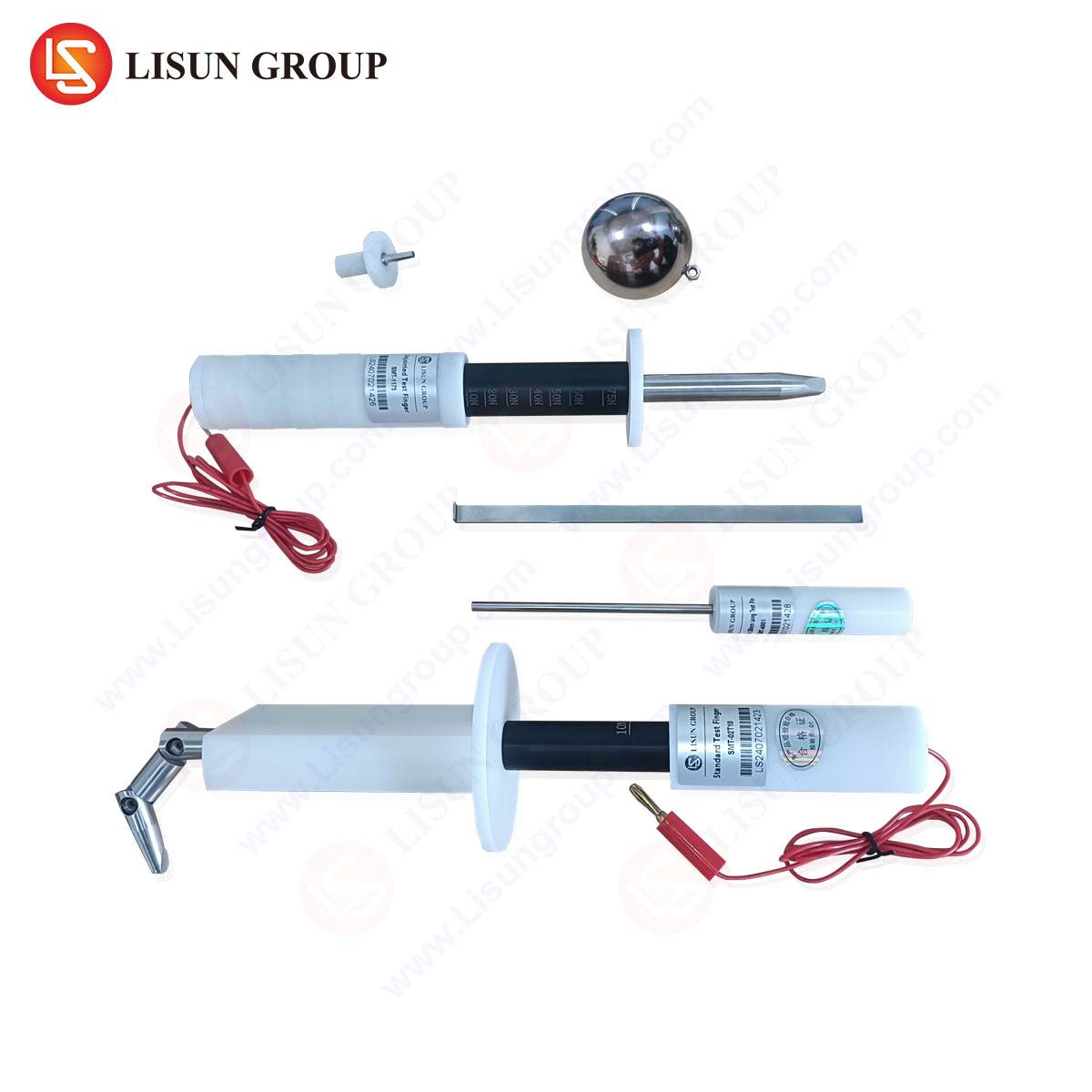
Implementing UL 1278 testing with manual, uncalibrated tools introduces significant measurement uncertainty. Specialized manufacturers like LISUN provide engineered solutions that enhance accuracy, repeatability, and laboratory efficiency. The LISUN Test Finger, Test Probe, Test Pin system is designed as a modular, comprehensive kit for accessibility testing.
The LISUN Test Finger (articulated probe, per IEC 61032 Figure 2) is constructed from aluminum alloy with brass joint components, offering durability and precise articulation to simulate the probing action of a child’s finger. It is available in standard dimensions for global compliance (IEC, UL, GB). The LISUN Test Probe (the UL 1278 Bar Probe) is machined from stainless steel to exacting tolerances, often supplied with a calibrated spring mechanism to apply the specified 1.0 N force consistently. For more stringent tests, such as those requiring a 1.0 mm diameter probe (e.g., for certain medical standards or IP4X testing), the LISUN Test Pin provides the necessary precision.
Competitive advantages of such integrated systems include:
- Metrological Traceability: Each probe is manufactured against master gauges and can be supplied with a calibration certificate from an accredited laboratory, a requirement for ISO/IEC 17025 accredited test facilities.
- Ergonomic and Functional Design: Handles are designed for consistent grip and force application, reducing operator-induced variability. Many probes feature integrated electrical contact indicators (LEDs) and can be connected to external detection units.
- Comprehensive Configuration: Kits are available that contain not only the UL 1278 probe but also the articulated test finger, the 1.0 mm test pin, the 75N nail probe (IEC 61032 Figure 4), and others, covering a full spectrum of IEC 61032 and related UL requirements in one package.
- Durability: High-quality materials resist wear and deformation, ensuring the probe remains within specification through thousands of test cycles, protecting the laboratory’s investment and ensuring long-term compliance.
Interplay with Complementary Standards and Test Probes
The UL 1278 Bar Probe does not exist in a vacuum. It is part of a hierarchy of accessibility probes defined in IEC 61032, “Protection of persons and equipment by enclosures – Probes for verification.” Its direct counterpart is Probe 13 in Figure 13 of that standard. Understanding its place is crucial for engineers.
A typical compliance verification sequence might involve:
- Test Finger (IEC 61032 Probe 11): To assess protection against contact with hazardous parts by large body parts.
- Bar Probe (UL 1278 / IEC 61032 Probe 13): To assess protection against contact by solid, rigid objects.
- Test Pin (IEC 61032 Probe 12): A more stringent 1.0 mm diameter probe for evaluating smaller openings, often required for higher IP codes or specific toy safety standards.
The selection of probe and applied force is dictated by the end-product standard. For example, a standard for office equipment might require the 3mm bar probe with 1N force, while a standard for industrial machinery might require a stiffer 35N “wire probe” (IEC 61032 Probe 18) to simulate a tool. The LISUN product suite is explicitly designed to address this full matrix of requirements, allowing a single lab to configure tests for multiple industries.
Conclusion
The UL 1278 Bar Probe embodies a fundamental engineering control in product safety—the principle of physical isolation of hazards. Its simple geometry belies its critical importance in a global framework of safety standards. For design engineers, it represents a clear, quantifiable design target for enclosure openings. For testing laboratories and certification bodies, it is an indispensable, non-negotiable tool for objective compliance assessment. The evolution from simple manual probes to integrated, calibrated systems like the LISUN Test Finger, Test Probe, Test Pin portfolio reflects the increasing rigor and standardization of global safety testing. By ensuring these tools are applied with precision and traceability, manufacturers across the electrical, electronic, consumer, and industrial sectors can confidently validate that their products provide a fundamental barrier against a common and potentially dangerous misuse scenario.
Frequently Asked Questions (FAQ)
Q1: Can the UL 1278 Bar Probe be used to certify compliance with IEC standards?
A1: Yes, but with careful attention to the specific standard’s wording. The UL 1278 Bar Probe is dimensionally identical to the “Test Probe 13” described in IEC 61032. Most IEC product standards (e.g., IEC 60335 for household appliances) reference IEC 61032 and specify the use of “Probe 13.” Therefore, a properly calibrated UL 1278 probe is functionally equivalent for testing to these IEC standards. Always verify the exact probe designation and applied force in the normative annex of the specific end-product standard.
Q2: How often should a bar probe be calibrated, and what does calibration involve?
A2: Calibration intervals are typically annual for active test equipment in an accredited laboratory, following internal quality procedures or external audit requirements. Calibration involves verifying the critical dimensions (diameter, tip radius, straightness) using precision measuring equipment like optical comparators or coordinate measuring machines (CMMs). The force application mechanism, if integrated, is also calibrated against a standard force gauge. Using a probe like those from LISUN, which are supplied with initial certification and are built for dimensional stability, helps maintain accuracy between formal calibrations.
Q3: What is the most common reason for failure in a UL 1278 Bar Probe test, and how can it be addressed in design?
A3: The most common failure is the probe making contact with live parts through a ventilation opening. Design mitigation strategies include:
- Internal Baffling: Using an offset or labyrinthine vent path that allows airflow but prevents a straight-line insertion of the probe.
- Mesh or Grille with Reduced Aperture: Installing a perforated screen with holes smaller than the probe diameter on the inside of the outer opening.
- Increased Creepage/Clearance: Ensuring that even if the probe enters, it cannot bridge the isolation distances between live parts and accessible metal parts or earth.
- Recessing: Placing the hazardous part sufficiently deep within the enclosure so that the probe’s length cannot reach it.
Q4: In the context of IP (Ingress Protection) ratings, which code does the UL 1278 Bar Probe relate to?
A4: The UL 1278 Bar Probe (3mm diameter) is specifically used to verify the first digit “2” in an IP2X rating. The “2” denotes protection against solid objects greater than 12.5mm in diameter (like a finger), but it also includes a test for objects like the 3mm bar probe. For higher levels of protection, smaller probes are used: a 1mm probe (like the LISUN Test Pin) for IP4X, and a 1mm probe with a different force for IP5X and IP6X (which are dust ingress tests).