




Technical Evaluation of the UL 1278 Cone Probe Testing Accessory for Hazard Mitigation in Enclosed Equipment
Introduction to Enclosure Integrity and Hazard Mitigation
The operational safety of electrical and electronic equipment is fundamentally predicated on the integrity of its enclosures. These protective barriers serve as the primary defense against incidental contact with hazardous live parts, the ingress of foreign objects, and the potential for short-circuiting. International safety standards, therefore, establish stringent requirements for the construction of enclosures, mandating that openings must not permit access to dangerous components. The verification of this requirement necessitates specialized, standardized test tools that simulate real-world probing scenarios. The UL 1278 Cone Probe Testing Accessory, a precisely engineered device, serves as the critical apparatus for this evaluation, ensuring compliance with clause 8.1.1 of UL 1278 and analogous clauses in standards such as IEC 61032, which details the test probe family. This article provides a technical examination of the probe’s design, application methodology, and its indispensable role across multiple industrial sectors.
Anatomic and Dimensional Specifications of the Standardized Probe
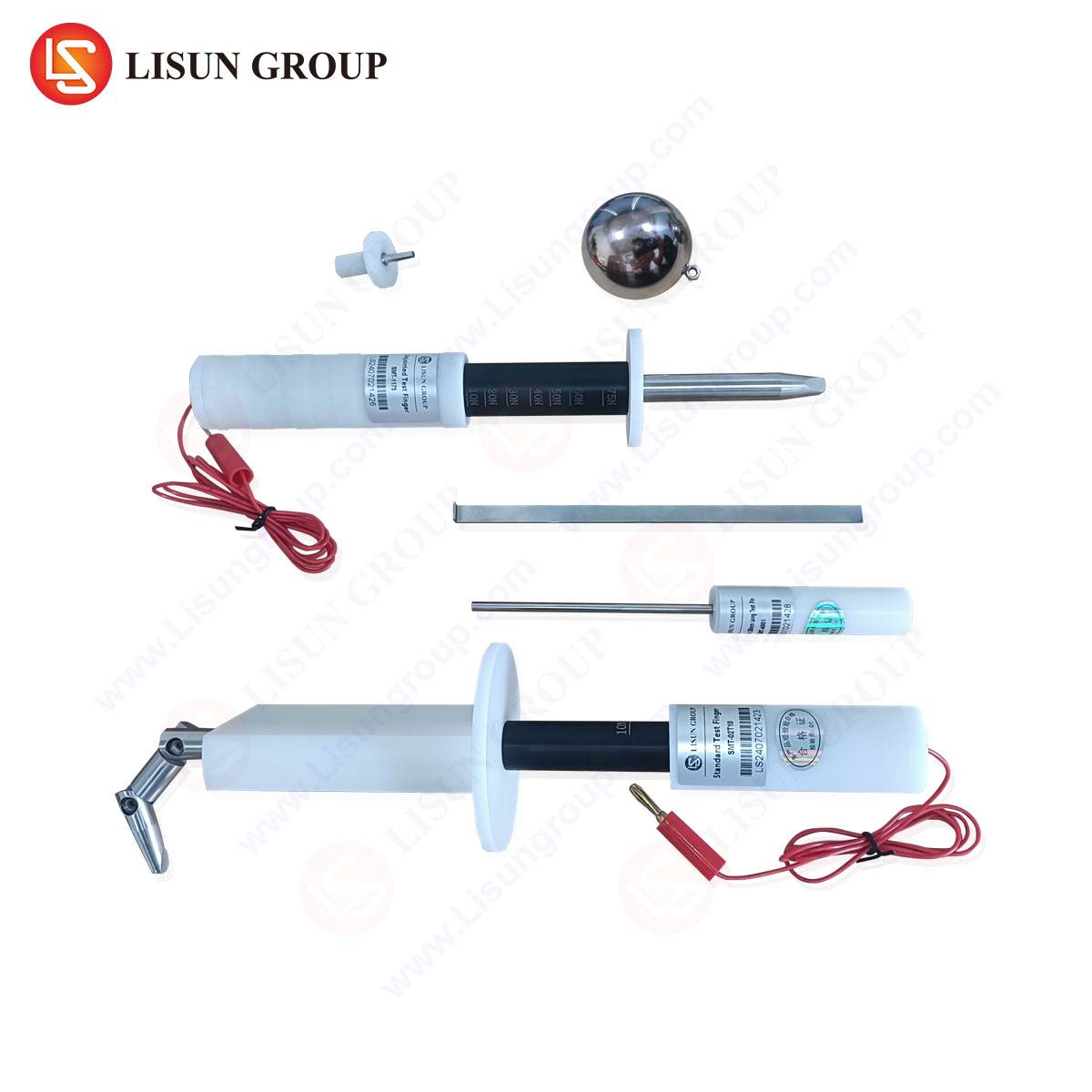
The efficacy of any test tool lies in its adherence to exacting dimensional and material specifications. The UL 1278 Cone Probe, often commercially realized in products like the LISUN Test Finger, Test Probe, Test Pin, is not a generic implement but a geometrically defined artifact. Its primary component is a rigid, conical test finger, typically fabricated from insulating materials such as high-impact polycarbonate or phenolic resin to prevent electrical conductivity during testing. The critical dimensions are non-negotiable: a length of 100 mm, a diameter of 12 mm at the handle, tapering to a hemispherical end of 4 mm radius. This specific geometry is designed to simulate the dimensions of a small child’s finger or a slender, rigid tool that might be inserted through an opening.
A supplementary, articulated jointed test finger may also be referenced in broader standards (like the IEC 61032 Figure 2 test probe B), but for the UL 1278 cone probe requirement, the rigid design is specified. The LISUN Test Finger, Test Probe, Test Pin product line ensures these tolerances are held within microns, as any deviation could yield non-conservative test results, falsely indicating safety where a hazard exists. The probe may incorporate a recess for a contact indicator, such as a voltage-sensitive LED or a simple electrical circuit, to definitively signal contact with a live part during testing without reliance on visual observation alone.
Biomechanical Simulation and Applied Testing Protocol
The testing principle is a simulation of inadvertent or exploratory contact. The probe is applied to every external opening of an equipment enclosure—including ventilation slots, seams, gaps around controls, and openings for connectors—with a defined force. The standard specifies applying a force of 30 N ± 3 N. This force is significant; it represents a substantial push or poke, far exceeding casual touch, to assess robustness against determined probing. The probe is manipulated in every possible orientation and angle to seek out any potential access path.
During the test, the equipment is energized under normal operating conditions. If the probe makes electrical contact with a live part or a hazardous moving component (like a fan blade), the test is failed. The use of a LISUN Test Finger, Test Probe, Test Pin with an integrated contact indicator provides an unambiguous, objective pass/fail criterion. The test sequence is methodical and exhaustive, leaving no external aperture untested. This process validates that the “finger-safe” or “tool-safe” design claims of a product are empirically substantiated.
Cross-Industrial Application for Risk Management
The application of the UL 1278 Cone Probe transcends a single industry, forming a common thread in the safety validation of virtually any product with an accessible enclosure and electrical energy.
- Electrical and Electronic Equipment & Industrial Control Systems: Panel builders and manufacturers of motor drives, PLCs, and switchgear utilize the probe to verify that terminal blocks, circuit breaker handles, and communication port openings prevent access to mains-voltage connections, even when a tool is used to fish for a misplaced cable.
- Household Appliances and Consumer Electronics: From kitchen blenders and air purifiers to gaming consoles and set-top boxes, the probe tests openings for buttons, air intakes, and cable ports to ensure user safety during everyday interaction and cleaning.
- Automotive Electronics and Aerospace Components: In the harsh vibrational environments of vehicles and aircraft, connectors must remain secure. The probe tests the shrouding of in-cabin infotainment systems, power ports, and under-hood electronic control units (ECUs) to ensure vibration cannot create a hazardous accessible gap.
- Lighting Fixtures: Both consumer-grade and commercial luminaires have openings for heat dissipation and wiring. The probe assesses whether a person installing or cleaning a light fixture could contact live parts within the housing through these openings.
- Telecommunications and Office Equipment: Network switches, routers, servers, and photocopiers contain high-density, accessible ports. The probe verifies that the design of RJ45, USB, or power inlet housings prevents the metal contacts inside from being touched by a conductive object inserted at an angle.
- Medical Devices and Toy Safety: These highly regulated sectors demand utmost safety. The probe is used on battery compartments, control interfaces, and accessory ports of medical monitors and children’s electronic toys to eliminate any risk of electrical shock, a critical consideration for vulnerable users.
- Electrical Components and Wiring Systems: Manufacturers of sockets, switches, and connector housings perform probe testing as a fundamental part of component-level certification, ensuring their products contribute to the overall safety of the end-item equipment.
Comparative Analysis and Material Advantages
While several manufacturers produce test probes, a product like the LISUN Test Finger, Test Probe, Test Pin distinguishes itself through attributes critical for laboratory accuracy and durability. Competitive advantages often manifest in material science and construction quality. The probe must possess sufficient mechanical strength to resist deformation under the 30N force; a substandard probe that flexes or cracks provides invalid results. The insulating material must have a proven dielectric strength and not exhibit static charge retention that could influence sensitive electronic equipment during testing.
Furthermore, precision-machined metal versions of related test pins (like the IEC 61032 test probe 13) for evaluating openings in insulating materials must have exact radii and surface finishes as per standard. The LISUN Test Finger, Test Probe, Test Pin suite typically guarantees this through CNC machining and post-process finishing, accompanied by calibration certificates traceable to national standards. This traceability is a paramount requirement for accredited testing laboratories (e.g., ISO/IEC 17025). Ease of use, such as an ergonomic handle for consistent force application and a reliable, low-voltage contact indicator system, also differentiates professional-grade accessories from generic imitations.
Interpretation of Test Results and Design Implications
A failed probe test carries significant design implications. It is not merely a compliance checkbox but an indicator of a tangible hazard. Upon failure, design engineers must re-evaluate the enclosure. Mitigation strategies may include:
- Redesigning the geometry of an opening (e.g., using a honeycomb mesh instead of parallel slots).
- Adding internal baffles or shrouds behind ventilation openings.
- Increasing the depth of a creepage/clearance path behind an opening.
- Specifying a different connector with a deeper, insulated shroud.
A passed test, conversely, provides robust empirical evidence for the safety dossier of the product, supporting regulatory submissions to bodies like UL, Intertek (ETL), TÜV, and national authorities.
Integration within a Comprehensive Safety Testing Regimen
The cone probe test is rarely performed in isolation. It is a component of a holistic safety assessment that may include:
- Ball Pressure Test: For evaluating the stability of insulating materials under heat.
- Glow-Wire Test: To assess flammability resistance.
- Ingress Protection (IP) Testing: For dust and water resistance.
- Electric Strength (Hi-Pot) Test: For dielectric integrity.
The data from the probe test complements these others. For instance, a material that passes the ball pressure test but becomes brittle over time could later fail a probe test if it cracks and creates a new opening. Therefore, the probe test is often performed both initially and as part of post-stress testing (e.g., after humidity conditioning or impact tests).
Frequently Asked Questions (FAQ)
Q1: Can the UL 1278 Cone Probe be used interchangeably with the IEC 61032 Test Probe B (the jointed test finger)?
A1: No, they are distinct test tools for different simulations. The rigid UL 1278 cone probe (similar to IEC 61032 Probe 18) simulates a rigid finger or tool. The jointed test finger (IEC 61032 Probe B) simulates the articulation of a human finger. Standards specify which probe is applicable for a given test. Using the wrong probe invalidates the test results.
Q2: How often should a test probe be calibrated or verified?
A2: While the probe itself is a passive mechanical tool, its critical dimensions should be verified annually or per the quality manual of the testing laboratory. Any damage, such as a chip on the hemispherical end or deformation, necessitates immediate verification or replacement. The associated force gauge used to apply the 30N force requires regular calibration traceable to a national metrology institute.
Q3: Our product has a very small opening (less than 4mm diameter). Is the probe test still required?
A3: The geometric specification of the probe means it cannot physically enter an opening with a diameter or slot width less than 4mm. Therefore, such an opening is generally considered to meet the requirement by construction. However, the standard may still require assessment if multiple small openings, when considered together, could allow access. The probe is applied to any opening it can partially or fully enter.
Q4: What is the consequence of applying incorrect force during the test?
A4: Applying less than the specified force (e.g., 20N instead of 30N) is non-conservative and constitutes an invalid test, as it may not detect a hazard that would be accessible with greater force. Applying excessive force may damage the equipment under test and yield a false positive failure. Consistent, calibrated application of the 30N ± 3N force is essential for repeatable and legally defensible results.
Q5: For battery-operated low-voltage devices, is this test still relevant?
A5: Yes. While the risk of electric shock may be lower with, for example, a 12V DC system, the standard’s scope often includes prevention of fire hazards and short-circuits. A metallic probe bridging two battery terminals could cause high current discharge, overheating, and potential fire. The test therefore remains relevant for evaluating enclosure integrity against creating such hazardous conditions.