




Technical Evaluation of the UL 1278 Cone Probe Testing Accessory for Hazard Mitigation in Enclosed Equipment
Introduction to Enclosure Integrity and Accessibility Testing
The evaluation of enclosure integrity for electrical and electronic equipment constitutes a fundamental pillar of product safety engineering. A primary objective is to prevent user contact with hazardous live parts or moving components, thereby mitigating risks of electric shock, thermal injury, or mechanical harm. Standardized test probes, designed to simulate human interaction or the intrusion of foreign objects, serve as critical tools for this verification. Among these, the accessory defined by UL 1278, commonly termed the Cone Probe, addresses a specific but vital scenario: assessing the protection offered by openings in enclosures, particularly those intended for ventilation or cable egress. This article provides a technical analysis of the UL 1278 Cone Probe Testing Accessory, its governing standards, application methodologies, and its implementation within modern testing regimes, with specific reference to the LISUN Test Finger, Test Probe, Test Pin system.
Anatomic Rationale and Standardized Dimensions of the UL 1278 Probe
The UL 1278 Cone Probe is not anthropomorphic like the standardized test finger (IEC 61032 Probe 11). Instead, it is derived from a geometric and probabilistic assessment of what objects might reasonably penetrate an opening. Its design is stipulated in UL 1278, “Movable and Wall- or Ceiling-Hung Electric Room Heaters,” and referenced in other standards including UL 507, “Electric Fans,” and UL 859, “Personal Grooming Appliances.” The probe consists of a conical body with a specific, truncated geometry.
The critical dimensions are as follows: the cone features a larger diameter of approximately 19.1 mm (0.75 in) and a smaller diameter of 12.7 mm (0.5 in) over a length of 100 mm (3.94 in). This tapers to a hemispherical end of 3.18 mm (0.125 in) radius. A spring mechanism applies a standardized force, typically 30 N (±10%), to the probe during testing. This combination of dimension and force models a rigid, slender object that could be inserted into an opening with significant pressure, probing for potential contact with internal hazards. The LISUN UL 1278 Cone Probe is manufactured to these exacting tolerances, utilizing durable, insulating materials such as polyamide to ensure consistent mechanical properties and prevent accidental conductivity during testing.
Contrasting Probe Geometries: Finger, Cone, and Pin Applications
Understanding the UL 1278 probe necessitates its placement within the broader ecosystem of standardized accessibility probes. Each serves a distinct, standards-mandated purpose.
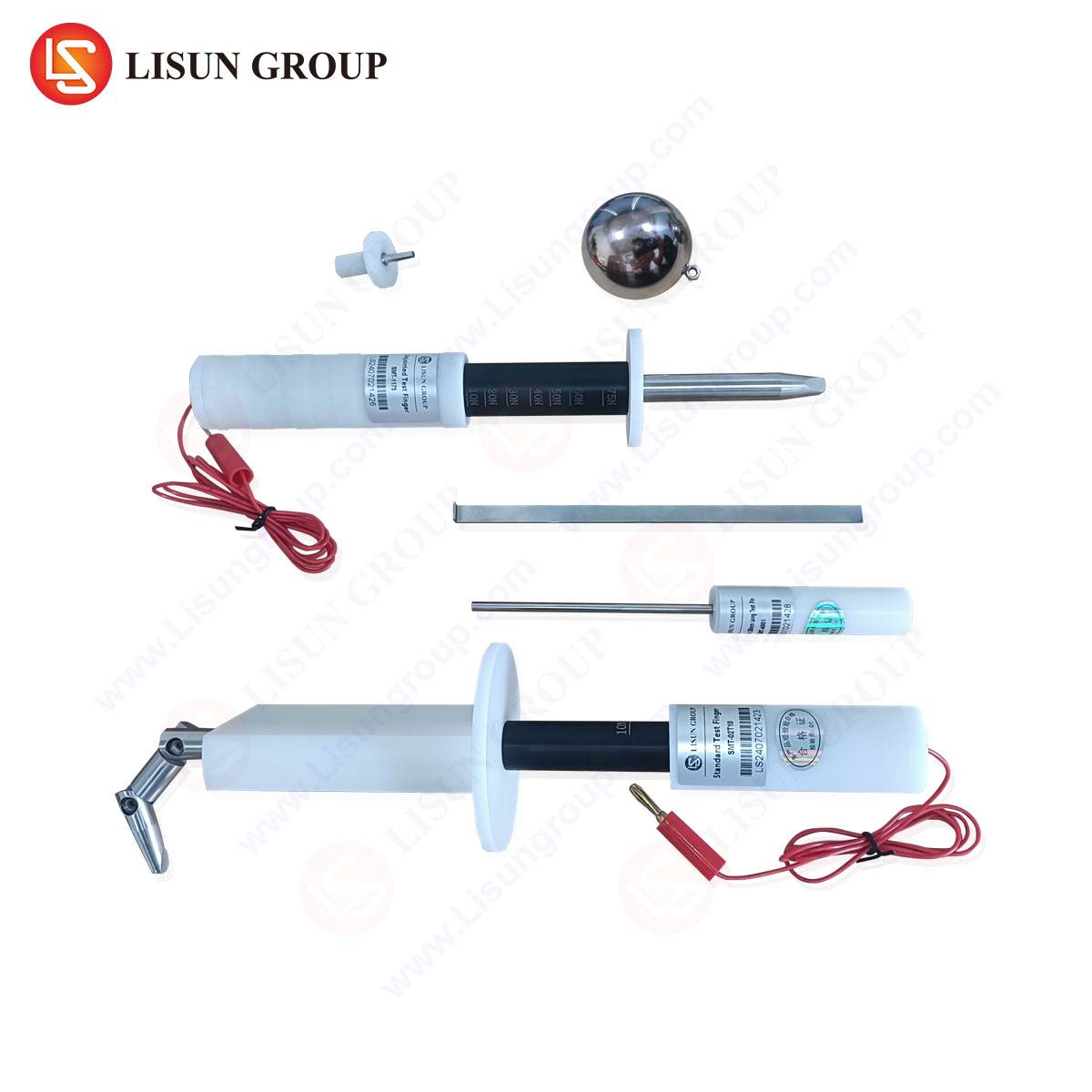
- IEC 61032 Probe 11 (Test Finger): Simulates a child’s or adult’s finger. It is jointed and used with a 10 N force to check for contact with hazardous parts through openings in enclosures. It is ubiquitous in standards like IEC 60529 (IP Code), IEC 60335 (household appliances), and IEC 60601 (medical equipment). The LISUN Test Finger is a precision-engineered implementation of this probe, essential for evaluating products from household appliances to medical device enclosures.
- UL 1278 Cone Probe: As described, simulates a rigid, pointed object. Its application is more targeted, focusing on the safety of specific openings where a finger might not fit, but a tool, wire, or child’s toy could be inserted. It is a key tool for products like fan guards, heater grilles, and ventilation slots in power supplies.
- IEC 61032 Probe 13 (Test Pin): A slender, straight pin with a defined radius on its tip, applied with a 1 N force. It assesses protection against access to hazardous parts with very small openings (e.g., “tool-proof” openings). The LISUN Test Pin is critical for testing socket outlets, connector ports, and small apertures in industrial controls or telecommunications equipment.
The selection of probe is dictated by the product standard. A single product, such as an industrial variable frequency drive, may require evaluation with all three: the Test Finger for service doors, the Cone Probe for cooling vents, and the Test Pin for communication port covers.
Operational Methodology and Pass/Fail Criteria
The testing procedure using the UL 1278 Cone Probe is methodical. The probe is inserted into every external opening, grill, slot, or gap in the equipment enclosure with the specified force (30 N) and in every possible orientation. The test is conducted with the equipment both energized and in a simulated fault condition, as per the relevant standard.
The pass/fail criterion is binary and critical: The probe must not contact any hazardous live part or unprotected moving part (like a fan blade). A “contact” is typically determined electrically, using a sensitive indicator lamp or circuit (40-50 V) connected to the probe tip, or physically observed for mechanical interference. The probe’s hemispherical tip is designed to “feel” for edges; if it can slip past a baffle or guard and make contact, the design fails. This test is particularly stringent for openings in lighting fixtures where users might attempt to dislodge a diffuser, or in automotive electronics mounted in passenger compartments where objects may be poked into vents.
Industry-Specific Applications and Risk Mitigation
The Cone Probe finds application across a diverse range of industries, addressing unique risk profiles.
- Household Appliances & Electrical Equipment: For electric heaters (UL 1278’s origin) and fans, the probe verifies that guarding over heating elements or fan blades is sufficient. In kitchen appliances with ventilation slots, it ensures utensils cannot contact internal wiring.
- Lighting Fixtures: Recessed lighting, track lights, and outdoor fixtures often have gaps between the housing and lens or ventilation holes. The probe tests whether live solder connections or terminals are accessible.
- Automotive Electronics: Infotainment systems, control modules, and charging ports within the vehicle cabin must prevent intrusion of objects like keys or styluses into hazardous areas.
- Industrial Control Systems & Telecommunications Equipment: Enclosures for PLCs, routers, and switches have cable ports and cooling vents. The probe ensures that even when a cable is removed, a foreign object cannot be inserted to contact busbars or power supplies.
- Medical Devices: For patient-connected equipment, ensuring no unintended access to internal circuits via service panels or connectors is vital for both operator and patient safety.
- Aerospace and Aviation Components: In-flight entertainment units and control panel enclosures must withstand inquisitive probing without compromising electrical isolation, especially in low-pressure environments.
- Toys and Children’s Products: Products incorporating electrical functions (e.g., interactive toys, charging stations) require rigorous checking to ensure battery compartments or speaker grilles do not allow access to circuits.
Technical Specifications and Calibration Imperatives
For test results to be valid and reproducible, the physical and mechanical specifications of the probe are non-negotiable. A probe like the LISUN UL 1278 Cone Probe is characterized by:
- Material: High-strength, rigid insulating material (e.g., Type 6/6 polyamide) with excellent dimensional stability.
- Dimensions: Conformity to the exact diameters, taper, and tip radius as defined in the standard. Even minor deviations can invalidate testing.
- Force Mechanism: An integrated or attached spring system calibrated to apply 30 N (±10%). The force must be applied linearly and consistently.
- Electrical Indicator: If the probe is part of a complete test assembly, the contact indicator circuit must have specified sensitivity (e.g., activate at ≤ 40V).
Regular calibration of the force application system and periodic dimensional verification are essential components of a quality assurance program for any testing laboratory. Using a non-conforming probe can lead to false passes (safety risk) or false fails (unnecessary design cost).
Integration within a Comprehensive Safety Testing Regime
The Cone Probe is rarely used in isolation. It is one instrument in a suite of accessibility evaluations. A complete safety assessment for an enclosure might follow this sequence:
- Visual Inspection: Identify all openings.
- IEC Test Finger (Probe 11): Evaluate for finger access to hazardous parts.
- UL 1278 Cone Probe: Evaluate smaller openings for rigid object access.
- Test Pin (Probe 13): Evaluate very small openings (e.g., >1mm) for tool access.
- IP Code Testing (if applicable): Follow with dust and water ingress tests.
The LISUN Test Finger, Test Probe, Test Pin kit provides a unified, calibrated system for executing this sequence efficiently, ensuring all probes are traceable to the same quality standard and are compatible with standard force gauges and indicator circuits.
Design Implications and Competitive Advantages of Precision Probes
The existence of the UL 1278 test directly influences product design. Engineers must consider not just finger-sized openings, but also the geometry of smaller vents and slots. This leads to design features such as:
- Internal Baffling: Vents designed with an offset internal grill.
- Depth Requirements: Ensuring a sufficient “creepage distance” from any opening to a live part.
- Reinforced Grilles: Using mesh with openings smaller than the probe’s small diameter.
From a testing and manufacturing perspective, using a precision accessory like the LISUN system offers distinct advantages:
- Standards Compliance Assurance: Guarantees that testing is performed with a tool recognized by NRTLs (Nationally Recognized Testing Laboratories) like UL, Intertek, and TÜV.
- Repeatability and Reduced Uncertainty: Precision machining and calibration minimize measurement variation, leading to more reliable and defensible test reports.
- Durability and Long-Term Cost Efficiency: Robust construction withstands repeated use without degradation of dimensions or spring force, reducing recalibration frequency and replacement costs.
- Operational Efficiency: Ergonomic design and clear marking speed up the testing process in high-throughput laboratory environments.
Conclusion: The Role of Specialized Probes in Evolving Safety Landscapes
As electrical and electronic equipment becomes more compact and integrated into diverse environments, the challenges of ensuring enclosure safety grow more complex. The UL 1278 Cone Probe Testing Accessory addresses a specific, non-anthropomorphic but empirically relevant hazard. Its disciplined application, as part of a holistic testing strategy using calibrated tools like the LISUN Test Finger, Test Probe, Test Pin system, is indispensable for verifying that products—from consumer gadgets to critical aerospace components—meet their mandated safety objectives. By simulating plausible intrusion scenarios, these tools bridge the gap between theoretical design and real-world user interaction, providing a quantifiable metric for one of safety engineering’s primary goals: the prevention of accidental contact.
Frequently Asked Questions (FAQ)
Q1: Can the UL 1278 Cone Probe be used to satisfy IP Code (IEC 60529) testing requirements?
No, the IP Code has its own set of defined probes. IP1x uses a 50mm sphere, and IP2x uses the articulated test finger (IEC 61032 Probe 11). The UL 1278 Cone Probe is for specific product safety standards (UL 507, UL 1278, etc.) and is not a substitute for IP Code probes, though a product may be tested to both sets of requirements.
Q2: How often should a UL 1278 Cone Probe be calibrated?
Calibration frequency depends on usage and laboratory quality procedures. A common interval is annual calibration for the force application mechanism. Dimensional verification should also be performed periodically, especially if the probe is subjected to impact or heavy use. Manufacturers like LISUN provide calibration certificates traceable to national standards.
Q3: Our product has a ventilation slot that is narrower than the small end (12.7mm) of the cone probe. Is testing still required?
If the governing standard for your product mandates the test, the probe must be attempted to be inserted. The hemispherical tip (3.18mm radius) may still enter a narrow slot. If the slot geometry physically prevents the conical body from entering at all, and the standard’s intent is met (e.g., no rigid object access), it may be deemed acceptable, but this requires formal evaluation by the testing body.
Q4: What is the consequence of a failed UL 1278 Cone Probe test?
A failure indicates a non-compliance with the safety standard. The product design must be modified to eliminate the access path. Modifications could include adding an internal barrier, reducing the opening size with a different grill pattern, or relocating the hazardous part further inside the enclosure. The modified unit must then be re-tested.
Q5: Are there international equivalents to the UL 1278 Cone Probe?
While the UL 1278 probe is distinctly North American, similar concepts exist. IEC 61032 Probe 18 is a “cone probe” with different dimensions. Some IEC-based product standards may specify similar rigid rod tests. It is crucial to apply the exact probe specified in the target market’s harmonized standard. A comprehensive test kit will include probes for multiple geographies.