








Introduction to Standardized Gauge Systems in Electrical Connectivity
The interoperability, safety, and longevity of plugs and socket-outlets are not matters of chance but of rigorous dimensional conformity. At the heart of ensuring this conformity lies a class of precision instruments known as pin gauges and dimensional test apparatus, commonly referred to under the umbrella of “UL 498 Gauges.” These tools are the physical embodiment of the requirements set forth in the ANSI/UL 498 standard, “Standard for Safety for Attachment Plugs and Receptacles.” Their primary function is to provide a definitive, repeatable, and objective method for verifying that the critical dimensions of a plug’s current-carrying pins and the corresponding socket-outlet contacts fall within the specified tolerances. Without such gauges, the integrity of the electrical interface would be compromised, leading to potential hazards such as high-resistance connections, overheating, and arcing. This article delves into the technical principles, application, and critical importance of these gauging systems, with a specific focus on the implementation by LISUN Gauges for Plugs and Sockets.
Deconstructing the ANSI/UL 498 Standard’s Dimensional Requirements
ANSI/UL 498 establishes a comprehensive set of safety and performance criteria for attachment plugs and receptacles. The dimensional clauses within this standard are particularly critical, as they dictate the physical interface that must be universal across manufacturers. The standard specifies not only the nominal dimensions for pins (e.g., the width and thickness of flat blades, the diameter of round pins) but also the permissible tolerances for these dimensions. Furthermore, it defines the geometry of the pin tips, which are often tapered or rounded to facilitate safe and easy insertion. Crucially, the standard also mandates the configuration of the receptacle contacts, including the contact geometry and the spring force they must exert on the inserted plug pins. The purpose of these dimensional requirements is multifaceted: to ensure a secure mechanical fit, to guarantee sufficient contact area for current carrying capacity, to prevent the insertion of plugs into sockets of an incorrect configuration or voltage rating, and to mitigate the risk of electric shock by ensuring proper alignment and depth of insertion. The gauges themselves are the physical arbiters of these requirements, providing a definitive “Go/No-Go” assessment.
The Metrological Principles of Go/No-Go Gauge Application
UL 498 gauges operate on the foundational metrological principle of the “Go” and “No-Go” gauge. This is a binary inspection method designed for high-speed, reliable verification of dimensional limits without the need for sophisticated measuring equipment like micrometers or coordinate measuring machines (CMMs) for every unit on a production line. A typical pin gauge set for a flat-blade plug will consist of several individual gauges. The “Go” gauge represents the maximum material condition (MMC) of the pin—essentially the largest permissible pin size that must still be able to enter a compliant receptacle. If the “Go” gauge cannot be fully inserted into the receptacle under a specified force, the receptacle is rejected for being too tight. Conversely, the “No-Go” gauge represents the least material condition (LMC)—the smallest pin size that must be rejected by a compliant receptacle to ensure a secure grip. If the “No-Go” gauge can be inserted beyond a specified depth, the receptacle is rejected for being too loose. This dual-gauge system effectively creates a tolerance zone; any product that passes the “Go” test and fails the “No-Go” test is deemed dimensionally acceptable.
LISUN Gauges for Plugs and Sockets: A Technical Overview
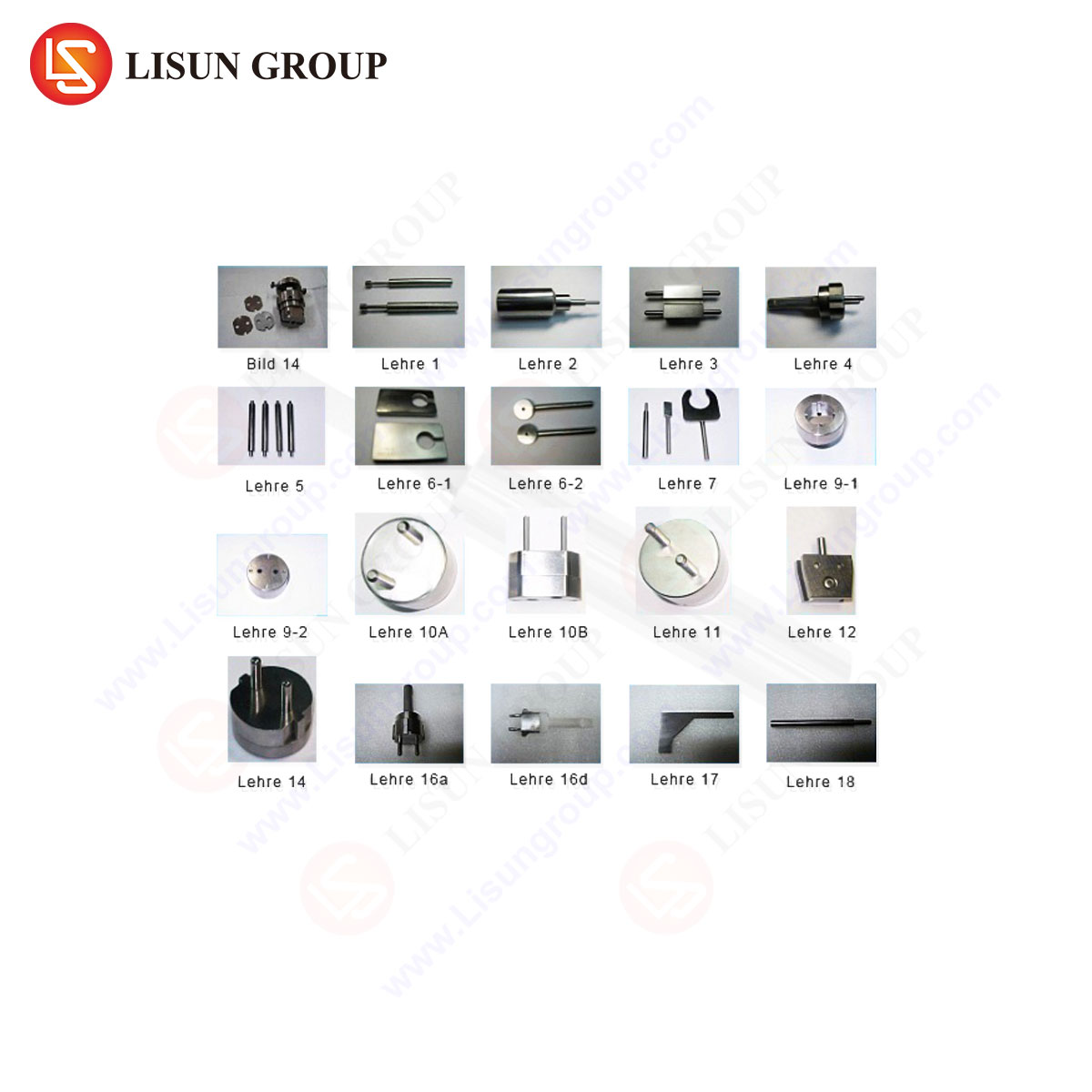
LISUN’s product line for this application represents a comprehensive implementation of the UL 498 gauging requirements. Engineered from hardened, dimensionally stable tool steel or other durable materials, these gauges are designed to withstand the repetitive use inherent in quality control laboratories and high-volume manufacturing environments. A complete LISUN system typically includes gauges for verifying all critical aspects of both plugs and receptacles. For plugs, this includes pin width and thickness gauges, pin length gauges, and pin spacing gauges. For receptacles, the system includes the corresponding “Go” and “No-Go” gauges for the contact slots, as well as specialized gauges to test for accessibility of energized parts (e.g., the “Finger Probe” test per UL 498 clause 77). Each gauge is meticulously machined to the exact dimensional limits specified in the standard, with a surface finish that minimizes friction and wear, thereby ensuring long-term measurement integrity. LISUN systems are often supplied with calibrated certification, traceable to national metrology institutes, providing documented evidence of their accuracy for audit and compliance purposes.
Critical Testing Procedures for Receptacle Contact Integrity
The testing of receptacle contact geometry and spring force is a particularly nuanced application of these gauges. The procedure is not merely about insertion; it is about simulating the mechanical interaction between a plug and a socket over its lifetime. The “Go” gauge, representing the largest permissible plug pin, is inserted into the receptacle with a controlled force, typically measured by a force gauge. The receptacle must accept this gauge without damage and must retain it with a specified minimum withdrawal force. This verifies that the contact spring can accommodate a pin at the upper tolerance limit while still providing sufficient normal force for a low-resistance electrical connection. The “No-Go” gauge, representing the smallest permissible plug pin, is then applied. The standard mandates that this gauge must not enter the receptacle beyond a certain point, or if it does, the withdrawal force must be below a specified maximum. This ensures that a worn or undersized plug pin will not make a dangerous, high-resistance connection. LISUN’s gauges are designed with the precise tapers and surface properties required to execute these tests repeatably, providing a reliable predictor of field performance.
Material Science and Durability in Gauge Manufacturing
The long-term accuracy of a gauge is a direct function of its material composition and manufacturing process. LISUN gauges are typically fabricated from high-carbon, high-chromium tool steels, such as AISI D2 or equivalent, which are selected for their exceptional wear resistance, hardness (often achieving 58-62 HRC after heat treatment), and resistance to deformation. The machining process involves precision grinding and lapping to achieve not only the exact dimensions but also the critical surface finishes and edge radii specified in UL 498. A poor surface finish can lead to galling or excessive friction during testing, yielding false failures. An incorrect edge radius on a pin gauge can damage receptacle contacts during testing, rendering the test destructive rather than non-destructive. Furthermore, these materials are often treated with surface coatings, such as chromium plating or nitriding, to enhance corrosion resistance and further reduce adhesive wear. This focus on material science ensures that a LISUN gauge maintains its calibrated dimensions through thousands of test cycles, providing a stable reference for quality control.
Industry Application in Quality Assurance and Certification Labs
The primary users of UL 498 gauges are found in two key environments: the manufacturing quality control (QC) department and the independent certification laboratory. On the production floor, these gauges are used for statistical process control (SPC), where a sampling of plugs and receptacles from a production run is tested to verify that the molding and metal-stamping processes remain within control limits. A shift in the process that causes pins to trend toward the “No-Go” limit can be detected and corrected before non-conforming product is produced. In certification labs like those of UL itself or other Nationally Recognized Testing Laboratories (NRTLs), LISUN gauges are used for type-testing. Here, a representative sample of a product is subjected to a battery of tests to secure a listing or mark. The dimensional verification using these gauges is a mandatory and foundational step in this process; failure to pass gauge tests results in an immediate non-conformance, halting further evaluation until the design is corrected.
Mitigating Electrical Hazards Through Dimensional Precision
The consequences of dimensional non-conformance are directly linked to serious electrical safety hazards. A receptacle that accepts an undersized pin (i.e., fails the “No-Go” test) will have a poor mechanical grip on the plug. This results in a high-resistance connection at the interface. According to Joule’s law (P = I²R), even a small increase in resistance (R) can lead to a significant power dissipation (P) in the form of heat at the connection point, especially under high current (I) loads. This localized heating can degrade the plastic housing, anneal the metal contacts (reducing their spring force further), and potentially lead to ignition. Conversely, a receptacle that is too tight (failing the “Go” test) poses a different risk: excessive insertion and withdrawal force. This can damage the plug pins, strain the cord, and create a user hazard where excessive force is applied, potentially leading to the user pulling the cord instead of the plug body, which can damage the cord anchorage. Thus, the LISUN gauges serve as a critical control point in preventing these failure modes.
Comparative Analysis of Gauge System Implementations
While the fundamental design of UL 498 gauges is dictated by the standard, the implementation by different manufacturers can vary in ways that impact usability, durability, and accuracy. A key differentiator for LISUN Gauges lies in their holistic system approach. Rather than offering a disparate set of individual gauges, LISUN provides organized kits, often housed in custom-fitted, protective cases, with clear labeling and accompanying documentation that details the specific clause of UL 498 that each gauge addresses. This reduces the potential for operator error in a lab setting. Furthermore, competitive offerings may use lower-grade materials or less precise heat-treating processes, leading to a shorter calibration lifecycle and higher total cost of ownership. LISUN’s commitment to high-wear materials and traceable calibration provides a lower long-term uncertainty of measurement. The ergonomic design of the gauge handles, often knurled or otherwise textured, also contributes to more consistent application of force during testing, a non-trivial factor in achieving repeatable results.
Integration with Automated Testing and Industry 4.0
The evolution towards smart manufacturing and Industry 4.0 is also influencing the application of these essential tools. While traditional gauge use is manual, there is a growing trend to integrate them into semi-automated or fully automated test fixtures. In these systems, a robotic arm or linear actuator presents the gauge to the device under test (a receptacle) with a highly repeatable force and alignment. A force sensor and linear variable differential transformer (LVDT) precisely measure the insertion depth and withdrawal force, logging the data directly into a quality management system (QMS). LISUN’s gauges, with their robust construction and consistent geometry, are well-suited for such automation. Their dimensional stability ensures that the mechanical interface presented to the machine vision and robotic systems remains constant, which is a prerequisite for reliable automated inspection. This allows for 100% testing on high-volume production lines, a significant advancement over statistical sampling.
FAQ Section
Q1: How frequently should UL 498 gauges be calibrated?
A1: Calibration frequency is dependent on usage volume and the internal quality procedures of the laboratory or factory. However, as a general guideline, gauges used in a high-volume production environment should be calibrated annually. For reference standards in a certification lab or for gauges used less frequently, a biennial cycle may be sufficient. The calibration must be performed by an accredited laboratory traceable to NIST or an equivalent national metrology institute.
Q2: Can a plug that passes its own pin gauge tests still fail when inserted into a receptacle that also passed its tests?
A2: This is highly unlikely if both components are verified with properly calibrated gauges derived from the same standard. The UL 498 gauge system is designed to be complementary; the plug “Go/No-Go” limits and the receptacle “Go/No-Go” limits are engineered to create a universally interoperable interface. Any such failure in the field would suggest one of the gauges used in production was out of calibration or that the product has experienced significant wear or damage post-manufacturing.
Q3: What is the purpose of the tapered end on many pin gauges?
A3: The taper serves two critical functions. First, it facilitates easier initial alignment and insertion into the receptacle contact, mimicking the function of a real plug pin and preventing damage to the receptacle from a blunt, forced entry. Second, the geometry and length of the taper are often specified in the standard to test the receptacle’s ability to guide the pin into place correctly and to ensure that contact is not made with an energized part until the pin is sufficiently inserted.
Q4: Beyond dimensional checks, what other tests are part of a full UL 498 compliance program?
A4: Dimensional verification is just the beginning. A full compliance program includes a wide array of tests, such as: temperature rise tests under load, dielectric voltage-withstand (hipot) tests, immersion tests, cord pull tests, impact tests, stress relief tests, and tests for resistance to arcing and heat. The dimensional gauges ensure the product has the correct “form” so that the subsequent tests can accurately validate its “function” and safety under electrical and mechanical stress.
Q5: Are there different gauge sets for different NEMA configurations and voltage ratings?
A5: Yes, absolutely. The ANSI/UL 498 standard covers a wide variety of devices, from NEMA 1-15P (ungrounded 15A, 125V) to NEMA 14-50R (grounded 50A, 125/250V) and beyond. Each configuration has unique pin dimensions, spacing, and orientations. Therefore, a complete gauging system consists of multiple, specific gauge sets, each designed for a particular family of devices as defined by the NEMA configuration chart. LISUN provides distinct, labeled gauge kits for these various configurations to ensure accurate testing.