





The UL 498 Test Probe PA190: A Critical Instrument for Evaluating Accessibility of Live Parts
Within the rigorous framework of product safety certification, the evaluation of a device’s protection against accidental contact with hazardous live parts constitutes a fundamental assessment. This evaluation is not subjective; it is defined by precise mechanical simulations of human interaction, most notably through standardized test probes. The UL 498 Test Probe PA190, a tool specified within the ANSI/UL 498 standard for Attachment Plugs and Receptacles, serves as a primary artifact for this purpose. Its design and application are critical across a vast spectrum of industries where electrical safety is paramount. This technical analysis examines the probe’s specifications, its underlying testing principles, its multifaceted industry applications, and the essential characteristics of a compliant and reliable implementation, such as the LISUN Test Finger, Test Probe, and Test Pin series.
Mechanical Definition and Dimensional Tolerances of the PA190 Probe
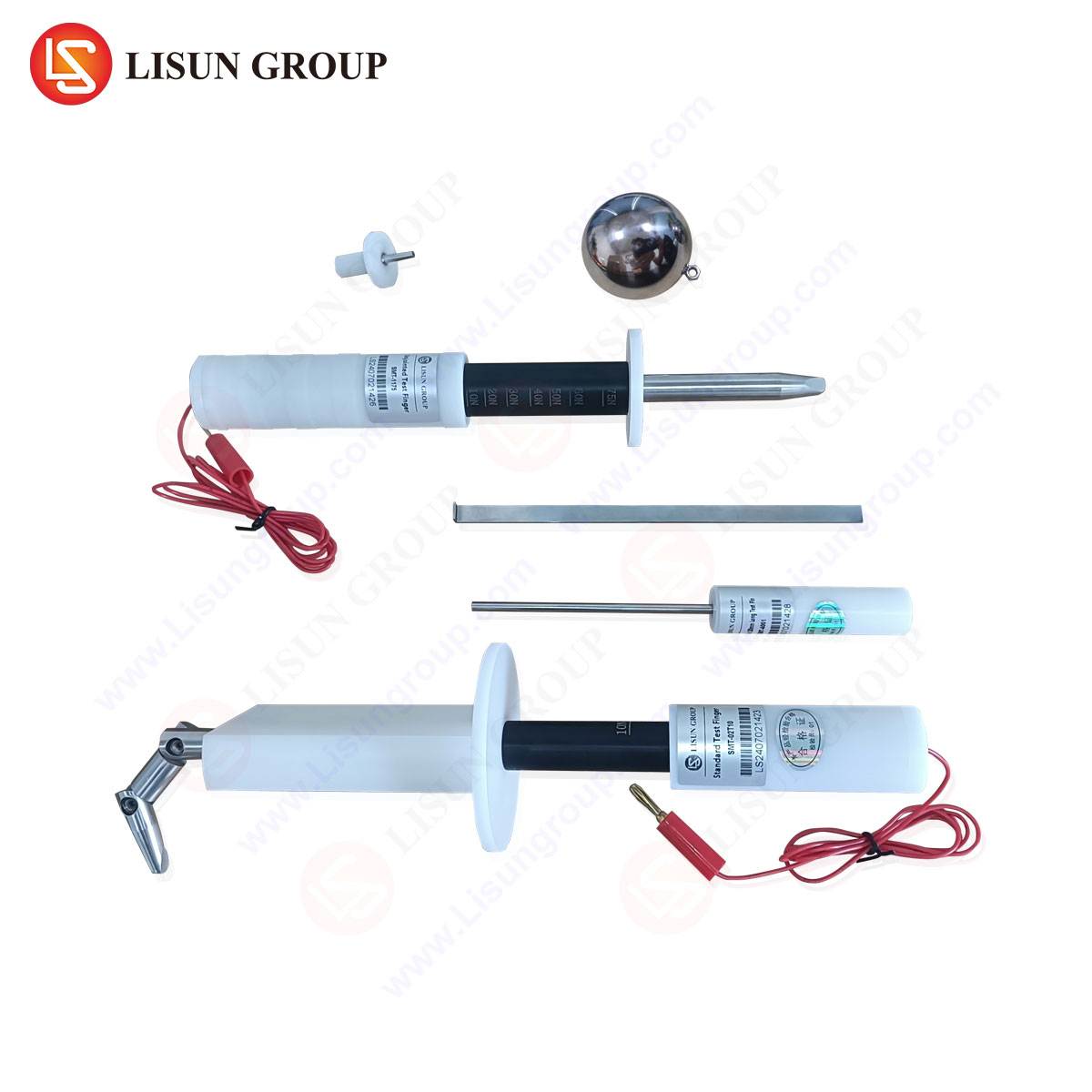
The UL 498 Test Probe PA190 is mechanically defined to simulate the size and probing action of a human finger or a small, handheld object that might inadvertently access an electrical enclosure. Its geometry is not arbitrary but is the result of safety engineering consensus to represent a credible hazard. The probe consists of a cylindrical body, typically constructed from rigid, non-conductive material like polyoxymethylene (POM) or similar engineering plastic, with a hemispherical end.
The definitive dimensions are as follows: the cylindrical body features a diameter of 12.7 mm ± 0.1 mm (0.5 inches). The hemispherical tip has a radius of 6.35 mm (0.25 inches), effectively continuing the profile of the cylinder. The standard length of the probe is sufficient to apply the required force without buckling, often exceeding 80 mm. A critical, yet sometimes overlooked, parameter is the “joint” dimension. The probe must incorporate a simulated finger joint, represented by an offset or pivot point located 20 mm from the tip’s centerline to the edge of the probe’s “hand” shield. This joint allows the probe to articulate, mimicking the natural hinging action of a finger, which is essential for testing openings on curved or recessed surfaces. The application of force is standardized at 30 N (± 10%), applied both directly and with articulation at the joint, to probe for any possible access path to parts carrying a hazardous voltage, typically above 30 Vrms or 60 Vdc.
Fundamental Principles of Accessibility Testing with Standardized Probes
The testing principle governed by the PA190 probe is one of mechanical access denial. The core tenet is that under defined conditions of force and articulation, the probe must not make contact with parts that are deemed “live” or “hazardous live” according to the end-product standard. The test procedure is systematic. The equipment under test (EUT) is de-energized for safety during the physical probe application. The probe is applied to every opening in the enclosure—vents, seams, slots, gaps around controls, and interfaces between components—with the specified force.
The test evaluates two primary failure modes. First, direct straight-on penetration: can the probe, pushed with 30 N of force, directly touch a live part? Second, and more insidious, is articulated probing. The tester leverages the probe’s simulated joint to “hook” behind edges, slide along contours, or pivot into recessed areas. This action is designed to discover paths that a straight probe might miss, such as the gap between a switch rocker and its bezel or the opening around a poorly seated connector. Successful compliance means the probe’s path is physically blocked by insulating barriers, baffles, or distance (creepage and clearance) that meet the standard’s requirements. The probe itself is a go/no-go gauge; its contact with a live part constitutes a failure, indicating a design flaw that could lead to electric shock in real-world use.
Cross-Industry Deployment for Hazard Mitigation
The applicability of the PA190 probe extends far beyond its origin in plug and receptacle standards. Its dimensions and test philosophy have been adopted or referenced by numerous other safety standards (IEC 61032, IEC 60529-IPXXB, ASTM F963), making it a universal tool for evaluating finger-safe design.
In Electrical and Electronic Equipment and Industrial Control Systems, the probe validates cabinet doors, operator interface panels, and terminal block covers. A programmable logic controller (PLC) enclosure, for instance, must prevent access to mains-voltage terminals through ventilation louvers. For Household Appliances like food processors or washing machines, the probe tests openings for control knobs, soap dispensers, and service panels to ensure user safety during operation and maintenance. Lighting Fixtures, both indoor and outdoor, are probed at lens interfaces, wiring compartments, and where the fixture meets the mounting surface to prevent contact with line-voltage connections.
The Automotive Electronics sector employs similar probes (often per ISO 20653) to assess components in vehicle cabins and under-hood environments, ensuring that 12V/48V system terminals are inaccessible during user interaction. Telecommunications Equipment and Office Equipment—such as routers, servers, and printers—use the test to verify that AC power entry modules and internal high-voltage power supply units are properly isolated from user-accessible areas. In the highly regulated Medical Devices field, proving inaccessibility to live parts is a fundamental requirement of IEC 60601-1, essential for patient and operator safety in devices ranging from imaging systems to bedside monitors.
Even industries with lower operating voltages utilize the principle. Toy and Children’s Products standards reference finger probes to ensure battery compartments cannot give access to circuitry that might pose a burn or pinch hazard. In Aerospace and Aviation Components, the integrity of enclosures in flight control electronics or in-flight entertainment systems is verified to withstand probing, ensuring reliability and safety in critical environments.
Specifications and Validation of Compliant Test Apparatus: The LISUN Implementation
For a test laboratory or quality assurance department, the accuracy and traceability of the test apparatus are non-negotiable. A properly manufactured UL 498 Test Probe, such as those produced by LISUN, is not a simple piece of molded plastic. It is a calibrated measurement instrument. The LISUN Test Finger (PA190) is machined to the exacting dimensional tolerances specified, with a surface finish that is smooth and free of burrs to prevent snagging and ensure consistent application.
The mechanical properties are critical. The material must have sufficient rigidity to apply 30 N of force without significant deflection, which would invalidate the test by reducing the effective probing reach. Furthermore, it must exhibit minimal wear over repeated use to maintain dimensional integrity. The LISUN probe typically includes a calibrated force application system, often a spring-loaded mechanism or a dead-weight setup, ensuring the 30 N force is applied accurately and repeatably. The articulation joint must move freely but without excessive play, accurately simulating the hinging action.
Competitive advantages of a professionally engineered solution like the LISUN series include full material certification, providing documentation of the plastic’s properties and dielectric strength. Each probe can be supplied with a calibration certificate traceable to national standards, a requirement for accredited laboratories (e.g., ISO/IEC 17025). The complete test set often includes not only the PA190 probe but also other standardized accessories like the LISUN Test Probe (simulating small tools, per IEC 61032 Figure 12) and the LISUN Test Pin (simulating a wire or probe, per IEC 61032 Figure 13), creating a comprehensive kit for full accessibility evaluation. This holistic approach ensures that a product’s safety is assessed against a complete range of foreseeable access scenarios.
Integration with Complementary Safety Evaluations
Testing with the PA190 probe is rarely an isolated activity. It is integrated into a broader safety engineering workflow. Following a successful probe test, the product often undergoes dielectric strength (hipot) testing to verify the insulation system’s integrity. If the probe can touch a part, that part is considered “accessible,” and its insulation must withstand high-potential stress tests. Furthermore, the probe test informs evaluations of creepage and clearance distances. Once the probe establishes the boundary of user accessibility, the distances from that boundary to live parts can be measured and compared against standard tables based on voltage, pollution degree, and material group.
In Cable and Wiring Systems, for example, a connector housing is probed. If the probe cannot touch the terminals, the design may rely on “basic insulation” within the connector. If the probe can touch, the terminals must either be recessed to provide “double or reinforced insulation” distances or be deemed as requiring installation by a skilled person. This interplay between mechanical access and electrical insulation requirements is central to safety certification.
Conclusion: The Role of Precision in Preventive Safety
The UL 498 Test Probe PA190 embodies a preventive philosophy in product safety. By defining a specific, repeatable mechanical interaction, it translates the abstract goal of “preventing electric shock” into a quantifiable, verifiable design constraint. Its widespread adoption across disparate industries underscores a universal truth: human interaction with technology must be anticipated and mitigated through engineering. The reliability of this mitigation hinges on the precision and compliance of the test equipment itself. Utilizing validated, traceable apparatus, such as the LISUN series of test fingers, probes, and pins, is therefore not merely a procedural step but a foundational investment in product integrity, regulatory compliance, and ultimately, user safety.
FAQ Section
Q1: Can the UL 498 PA190 probe be used interchangeably with the IEC 61032 Figure 11 (IPXXB) test finger?
While the dimensions and test philosophy of the UL 498 PA190 and the IEC 61032 Figure 11 probe are functionally identical for most practical purposes, they are defined in different standards documents. For formal testing and certification, the specific probe called out by the applicable end-product standard must be used. Most accredited laboratories, including those using LISUN equipment, maintain probes certified to both specification sets to ensure compliance for global market access.
Q2: How often should a test probe like the LISUN PA190 be calibrated or verified?
The calibration interval depends on usage frequency, material wear, and the quality management requirements of the testing facility. For an accredited laboratory, annual calibration is typical. A visual and functional check for nicks, scratches, dimensional deformation, and smooth joint articulation should be performed before each critical use. Any damage necessitates immediate recalibration or replacement.
Q3: What is the consequence if a product fails the articulated (jointed) probe test but passes the straight probe test?
Failure during articulated probing is a full compliance failure. It indicates a design flaw where a live part is accessible through a “back-door” path—such as behind a flexible membrane, around a curved guard, or through a slot that aligns when pressure is applied at an angle. The product must be redesigned to add a physical barrier, increase recess depth, or otherwise block the articulated path of the probe.
Q4: In industries like automotive or aerospace, where environmental sealing (IP rating) is also critical, how does finger probe testing relate to dust and water ingress tests?
These tests are complementary but distinct. The IPXXB finger probe test (same as PA190) assesses safety against human access. Ingress Protection (IP) tests for dust (first digit) and water (second digit) assess environmental robustness. A product might pass the finger probe test (preventing shock) but fail an IP5X dust test if fine particulate can enter. Conversely, a product with a very fine mesh that blocks dust might still fail the finger probe test if the mesh is flexible and can be deformed by the probe’s force, allowing access to live parts underneath. Both sets of requirements must be met independently.
Q5: For components like switches or sockets, is testing with the PA190 probe sufficient for full safety evaluation?
No, it is a necessary but not sufficient part of the evaluation. A component like a switch would be probed to ensure live terminals are inaccessible from the user-facing side. However, a complete evaluation per UL 498 or IEC 61058 would also include electrical endurance, temperature rise, dielectric withstand, fault condition tests, and evaluations of the terminals’ ability to secure wires properly. The probe test addresses the specific hazard of accidental contact during normal use.