




Evaluating Material Flammability: A Technical Examination of UL 746A and Compliance Testing Methodologies
Introduction to the UL 746A Standard and Its Regulatory Framework
The UL 746A Standard for Safety for Polymeric Materials – Short Term Property Evaluations constitutes a foundational protocol within the broader UL 746 series, which governs the evaluation of polymeric materials employed in electrical equipment. Its primary objective is the assessment of a material’s flammability characteristics and its comparative tracking index (CTI), providing quantifiable data on ignition resistance and flame propagation under controlled laboratory conditions. Unlike standards prescribing end-product performance, UL 746A focuses on the intrinsic properties of the raw material or compound itself. This data is critical for manufacturers, specifiers, and certification bodies, as it informs decisions regarding material selection for components where fire risk mitigation is paramount. Compliance with UL 746A is not merely a procedural step but a fundamental engineering input, influencing product safety, design longevity, and regulatory acceptance across global markets. The standard’s methodologies are designed to yield reproducible results that correlate with real-world fire initiation scenarios, such as those caused by electrical arcing, overheating components, or external ignition sources.
Methodological Foundations of Flammability Testing Under UL 746A
UL 746A specifies several test methods to evaluate different aspects of material flammability. The two principal vertical flame tests are the Horizontal Burning (HB) and Vertical Burning (V) tests, which classify materials based on their burning rate, extinguishing time, and propensity for dripping flaming particles. The HB test, conducted with a specimen in a horizontal orientation, subjects one end to a defined flame for 30 seconds. Materials are classified as HB if the burning rate does not exceed 40 mm per minute for thicknesses below 3 mm, or 75 mm per minute for thicker specimens. The more stringent Vertical Burning test involves suspending a specimen vertically and applying a specified flame twice for 10 seconds each. Criteria for V-0, V-1, and V-2 ratings are based on the total after-flame time, afterglow time, and whether dripping particles ignite a cotton indicator. A critical ancillary test is the Hot-Wire Ignition (HWI) test, which evaluates a material’s resistance to ignition from a glowing wire simulating an overheated electrical component. The High-Current Arc Ignition (HAI) test assesses the number of arc strokes needed to ignite the material via carbonized tracking. These tests collectively create a profile of a material’s behavior under thermal stress, informing its suitability for specific applications and enclosure types.
The Needle Flame Test: Simulating Fault Conditions from Small Ignition Sources
A pivotal component within the UL 746A evaluation suite is the Needle Flame Test, detailed in clause 7. This procedure is engineered to simulate the effect of small flames that may arise from fault conditions within equipment, such as from an overheated component, a failing capacitor, or an electrical short circuit of limited energy. The test employs a prescribed flame from a burner fed with butane, applied to the test specimen at a 45-degree angle for a defined period (typically 30 seconds). The critical pass/fail criteria are not solely based on the specimen’s after-flame time but, more importantly, on the spread of flame and the production of burning or glowing debris that could propagate a fire. The specimen is mounted above a layer of tissue paper to detect ignition from falling particles. This test is particularly relevant for materials used in compact, densely packed assemblies where a localized fault must not escalate into a full enclosure fire. It provides a more severe and localized ignition challenge than some horizontal burning tests, making it a key differentiator for materials intended for high-reliability or confined applications.
Operational Principles and Specifications of the LISUN ZY-3 Needle Flame Tester
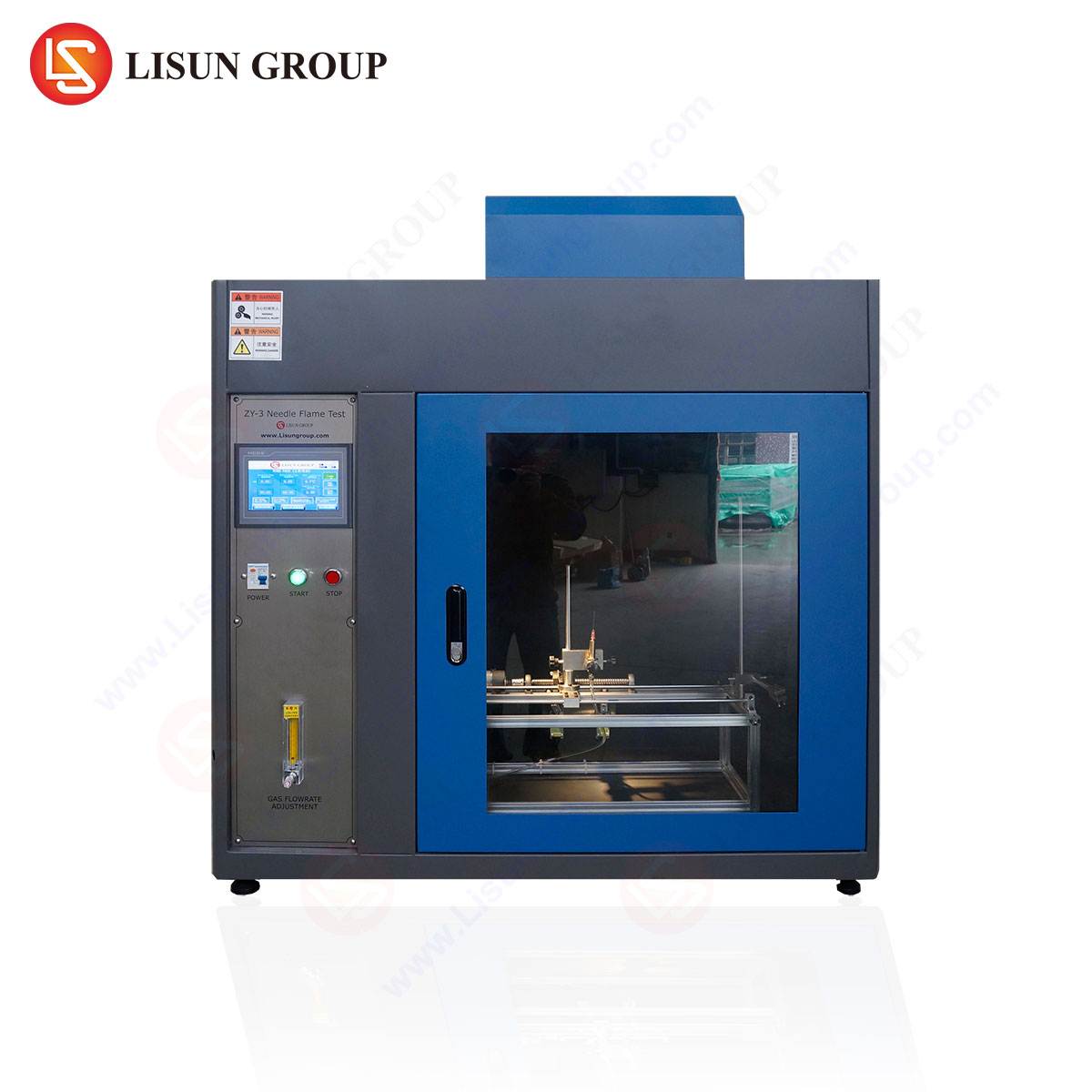
The LISUN ZY-3 Needle Flame Test Apparatus is engineered to execute the needle flame test with a high degree of precision and repeatability, adhering strictly to the parameters set forth in UL 746A, IEC 60695-11-5, and related standards. The apparatus generates a test flame via a specific burner nozzle, with flame height adjustable and verifiable through a calibrated gauge. A key operational principle is the consistent control of the fuel (99% purity butane) supply pressure and flow rate, ensuring the flame’s thermal output remains within the standard’s specified energy range of approximately 1W. The specimen holder allows for precise positioning of the test sample at the mandated 45-degree angle relative to the flame applicator. The integrated timing mechanism automatically controls the flame application duration. Following ignition, the apparatus facilitates observation and measurement of after-flame and afterglow times, while the underlying layer of tissue paper provides a clear indicator of whether flaming droplets or particles cause secondary ignition. The ZY-3’s design emphasizes operator safety, with enclosures to contain the test and exhaust systems to remove combustion products, alongside robust construction for laboratory durability.
Industry-Specific Applications and Material Selection Implications
The data derived from UL 746A testing, including needle flame performance, directly informs material selection across a diverse spectrum of industries. In Electrical and Electronic Equipment and Industrial Control Systems, enclosures, terminal blocks, and relay housings must resist ignition from internal arcing. A V-0 or 5VA rating (from the more severe UL 94 vertical flame test) is often a minimum requirement, with needle flame compliance ensuring resilience against small fault flames. For Household Appliances and Office Equipment, materials surrounding motors, heating elements, or power supplies are scrutinized; a failed needle flame test could indicate an unacceptable risk in a dishwasher control board or a printer’s power unit.
The Automotive Electronics sector, particularly for components under the hood or within passenger compartments, demands materials that withstand elevated temperatures and resist ignition from electrical faults. Connectors, sensor housings, and control module casings are common applications. Lighting Fixtures, especially LED drivers and housings for high-intensity lamps, require materials that prevent flame propagation from a failed ballast or driver component. In Telecommunications Equipment and Data Center Hardware, where equipment is densely racked, a fire in one unit must not easily spread; flame-retardant materials for chassis and internal barriers are critical.
Medical Devices present a unique challenge, balancing flammability resistance with biocompatibility and chemical resistance for enclosures and internal components. Aerospace and Aviation Components are subject to extremely rigorous standards, where weight-saving polymers must also meet stringent flame, smoke, and toxicity (FST) requirements, with needle flame testing as part of a broader qualification suite. For Electrical Components like switches and sockets, and Cable and Wiring Systems (for insulation and jacketing), these tests ensure that a fault at a connection point does not lead to sustained combustion.
Comparative Advantages of the LISUN ZY-3 in Compliance Verification
The LISUN ZY-3 apparatus offers several distinct advantages for laboratories engaged in material qualification and quality assurance. Its primary benefit lies in its calibrated precision and adherence to standardized geometries, which minimizes inter-laboratory variability—a critical factor for manufacturers supplying global markets where test data must be accepted by multiple certification bodies. The integrated flame height gauge and fine-control fuel system ensure the flame energy is consistently applied, a variable that, if uncalibrated, can lead to false passes or failures. The robust mechanical design and safety features reduce operational risk and increase equipment uptime in high-throughput testing environments common in material compounding plants or large OEM labs. Furthermore, its compliance with both UL and IEC test methods makes it a versatile tool for companies developing products for international markets, allowing them to generate a single set of data applicable to multiple regional safety standards. This dual-compliance capability streamlines the product development cycle and reduces the cost and complexity of certification.
Data Interpretation and Integration into Product Safety Files
The results from the LISUN ZY-3, as part of a full UL 746A assessment, are not standalone verdicts but integral pieces of a product’s safety engineering file. A “pass” indicates the material, in its tested form and thickness, did not allow flame to spread or produce ignitable debris under the specific needle flame conditions. This data point is combined with HB/V ratings, HWI, HAI, and CTI values to create a material’s Recognized Component Index page within the UL system. Engineers use this index to select materials appropriate for the specific fire hazard of a component’s end-use. For instance, a material with a V-2 rating that passes the needle flame test may be acceptable for a non-enclosed, low-current switch, but a power supply unit housing might require a V-0 material with a documented needle flame pass. The quantitative data—after-flame times, extent of burning, and observations of dripping—must be meticulously recorded and reported, as they provide a benchmark for ongoing quality control and for assessing the impact of any changes in material formulation or supply chain.
FAQ: Needle Flame Testing and the LISUN ZY-3 Apparatus
Q1: How does the needle flame test differ from the standard UL 94 vertical burning (V) test?
The UL 94 V-test applies a larger Bunsen burner flame to the bottom edge of a vertically suspended specimen and evaluates after-flame time and dripping. The needle flame test uses a smaller, lower-energy flame (approx. 1W) applied at a 45-degree angle to a specific point on the specimen, simulating a small internal fault. It places greater emphasis on whether the localized flame causes the specimen to ignite fully and produce flaming droplets that ignite a surrounding material (tissue paper).
Q2: For which industries or product types is needle flame testing considered mandatory or highly recommended?
It is often a mandatory requirement for components in information technology equipment (ITE), household appliances, and audio/video gear as per safety standards like IEC 62368-1. It is highly recommended for any electrical product where components like transformers, resistors, or connectors could overheat and create a small, localized flame, particularly in confined or densely packed enclosures common in industrial controls, telecommunications, and automotive electronics.
Q3: What are the most common causes of failure in a needle flame test, and how can they be addressed?
Failure typically results from either sustained flaming of the specimen beyond the allowed time or from flaming droplets that ignite the tissue indicator. This is often a function of the base polymer resin and the efficacy of its flame-retardant (FR) additive package. Addressing failure usually involves reformulating the material with alternative or higher loadings of FR additives, selecting a more inherently flame-resistant polymer (e.g., switching from standard ABS to a FR polycarbonate blend), or increasing the wall thickness of the part, if design allows.
Q4: Can the LISUN ZY-3 be used for testing other than UL 746A?
Yes. The ZY-3 is designed to meet the technical parameters of multiple international standards, including IEC 60695-11-5, GB/T 5169.5, and others that specify an identical or very similar needle flame test methodology. This allows a single apparatus to support compliance testing for products destined for North American (UL), European (IEC), and Asian (GB) markets.
Q5: What are the key calibration and maintenance requirements for the ZY-3 to ensure ongoing test accuracy?
Regular verification of the flame height using the supplied gauge is essential before each test session. The fuel flow and pressure should be periodically checked against manufacturer specifications. The burner orifice must be kept clean and free of soot or debris to maintain a consistent flame geometry. An annual full calibration by a qualified technician, checking timing accuracy, temperature parameters, and mechanical alignments, is recommended to maintain traceable compliance data.