




A Technical Examination of UL 746A Compliance and the Role of Needle Flame Testing in Material Safety Evaluation
Introduction: The Imperative of Material Flammability Assessment
Within the engineering and manufacturing sectors, the selection of polymeric materials extends far beyond mechanical and electrical properties. A paramount consideration, particularly for components utilized in electrical and electronic applications, is the material’s behavior under thermal stress and its propensity to ignite and propagate flame. The consequences of material failure in this regard range from equipment damage and service interruption to catastrophic fire events posing significant risk to life and property. Consequently, rigorous standardized testing forms the cornerstone of product safety and reliability. UL 746A, the Standard for Safety for Polymeric Materials – Short Term Property Evaluations, provides a critical framework for this assessment. Compliance with UL 746A is not merely a regulatory hurdle but a fundamental engineering discipline, ensuring that materials employed in a vast array of products possess adequate resistance to ignition and limited flame spread. This article provides a detailed technical analysis of the UL 746A standard, with particular focus on the needle flame test as a pivotal evaluation method, and examines the instrumentation required to perform such testing with precision and repeatability.
Deciphering the Scope and Intent of UL 746A
UL 746A is a component standard within the broader UL 746 series, which collectively addresses the evaluation of polymeric materials. Specifically, UL 746A concentrates on “Short Term Property Evaluations,” which are tests designed to simulate specific, severe, but short-duration thermal and electrical stresses a material may encounter in service. The standard’s primary objective is to assess the flammability characteristics of polymeric materials when subjected to a small ignition source, thereby evaluating their contribution to fire hazard within an end-product. It is crucial to understand that UL 746A evaluates materials, not finished products. The data derived—typically a flammability classification (e.g., HB, V-0, V-1, V-2, 5VA, 5VB, HF-1, HF-2, HBF)—is used by component and product manufacturers to select appropriate materials that will subsequently be investigated within the context of a complete product evaluation to a relevant end-product standard, such as UL 60950-1 for IT equipment or UL 60730 for automatic controls.
The standard encompasses several test methods, each designed to probe different aspects of flammability under controlled laboratory conditions. These include the well-known horizontal and vertical flame tests (UL 94), the hot wire ignition test (HWIT), the high-current arc ignition test (HAI), the high-voltage arc tracking rate test (HVTR), and the needle flame test. The selection of which tests apply is dictated by the material’s intended end-use, its composition, and the specific hazards associated with its application.
The Needle Flame Test: Simulating Fault-Induced Ignition Sources
Among the various tests prescribed in UL 746A, the needle flame test holds distinct importance for its simulation of a specific real-world failure mode. The test is designed to assess the flammability of a material, and by extension a component, when exposed to a small flame that may result from an electrical fault condition, such as an overheated or arcing connection, or from the malfunction of an adjacent component. Unlike the larger, more standardized flames used in UL 94 vertical burning tests, the needle flame is intended to represent a small, localized ignition source that is plausible in equipment under fault conditions.
The test principle involves applying a defined flame from a specified burner (the “needle flame”) to a test specimen for a predetermined period (typically 30 seconds). Following flame application, observations are meticulously recorded: whether the specimen ignites, the duration of any subsequent flaming combustion, whether dripping particles occur and if they ignite a surgical cotton indicator placed below, and the extent of material damage. Pass/fail criteria are strictly defined, often relating to the total flaming time after removal of the test flame, the length of specimen consumed, and whether indicator cotton is ignited by flaming drops or particles.
This test is particularly relevant for industries where internal faults are a recognized risk. For example, in Industrial Control Systems, an overloaded relay terminal could overheat; in Automotive Electronics, chafed wiring could cause a short-circuit arc; in Household Appliances, a failed motor winding could smolder. The needle flame test evaluates whether the surrounding polymeric material (e.g., connector housings, wire insulation, structural supports) would ignite from such a small source and contribute to a growing fire.
Instrumentation for Precision: The LISUN ZY-3 Needle Flame Test Apparatus
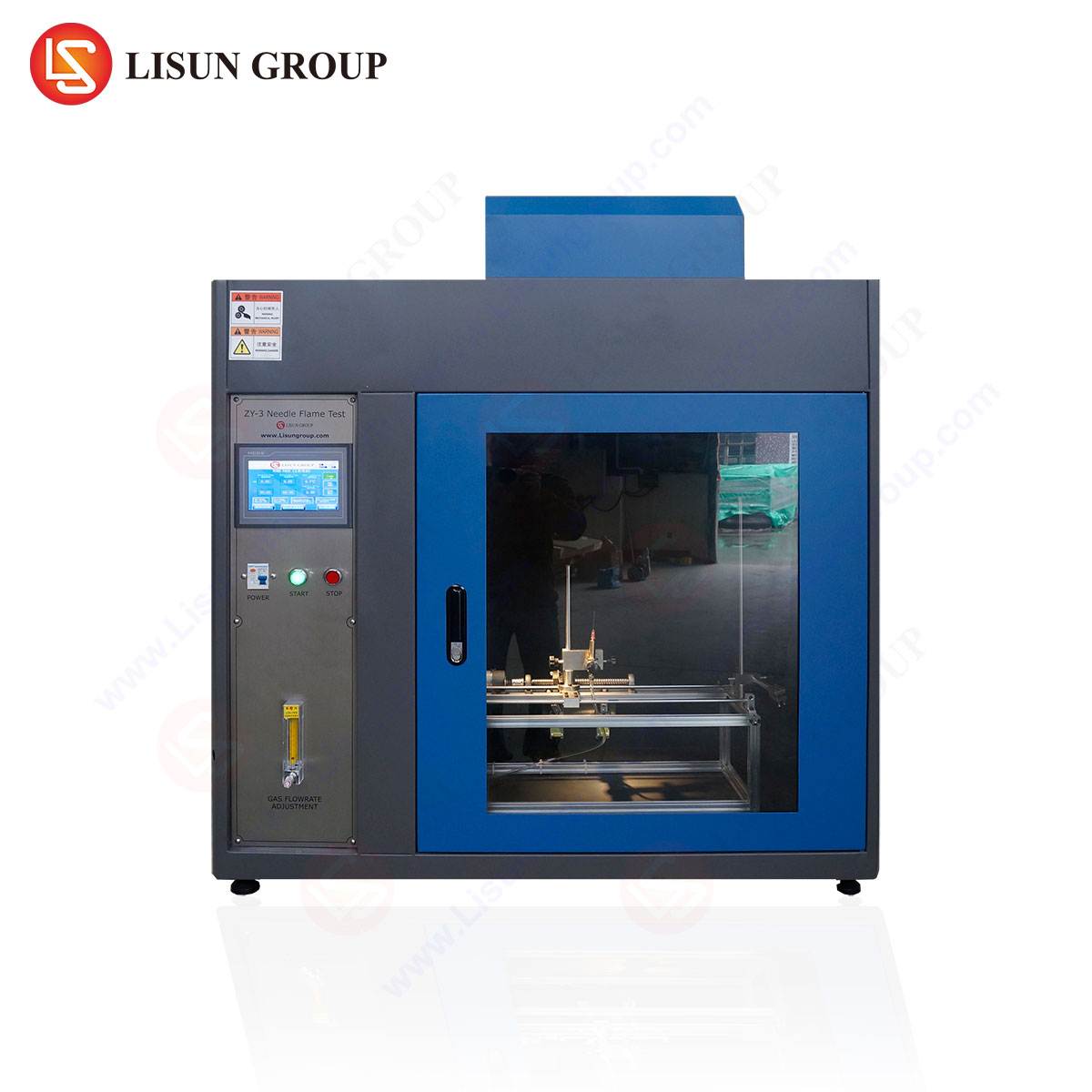
Accurate and repeatable execution of the needle flame test, as with all standardized flammability assessments, is wholly dependent on the precision, reliability, and compliance of the test apparatus. The LISUN ZY-3 Needle Flame Test Apparatus is engineered specifically to meet the exacting requirements of IEC 60695-11-5, ISO 9773, and the relevant clauses within UL 746A. Its design prioritizes the controlled generation and application of the test flame, along with precise environmental and specimen conditioning, to ensure that results are reproducible and directly comparable across different materials and laboratories.
The core of the ZY-3 system is its burner assembly, which utilizes a precision needle valve to regulate the flow of a specified gas (typically 99% purity methane) to produce a consistent flame. The apparatus includes a calibrated thermocouple and temperature measurement system to verify that the flame, when adjusted to a specific height (typically 12mm ± 1mm), generates a required temperature of 1000°C ± 50°C at a defined reference point. This calibration step is non-negotiable for test validity. The specimen holder is adjustable to accommodate various test specimen geometries and orientations as mandated by the standard. A key feature is the integrated timing system, which automates the critical test sequence: application of the flame for the set duration (e.g., 30s), followed by accurate measurement of after-flame and after-glow times.
Technical Specifications and Operational Advantages of the ZY-3 System
The LISUN ZY-3 is characterized by a suite of technical specifications that translate into operational advantages for testing laboratories.
- Calibrated Flame System: The inclusion of a built-in platinum-rhodium thermocouple and digital temperature display allows for real-time flame temperature verification and adjustment, a fundamental requirement for test consistency.
- Automated Test Sequencing: Microprocessor-controlled timing eliminates human error in starting/stopping flame application and measuring combustion durations, enhancing repeatability.
- Integrated Safety Features: The system includes flame-out protection and gas leak detection, safeguarding laboratory personnel and equipment.
- Robust Construction: The apparatus is built from stainless steel and other durable materials to withstand the rigors of repeated testing, ensuring long-term calibration stability.
- Comprehensive Compliance: The design adheres strictly to the dimensional and procedural mandates of the governing standards, providing laboratories with confidence in the validity of their generated data.
For a manufacturer of Electrical Components such as switches or sockets, using the ZY-3 to qualify material options provides defensible data for safety certification. A Telecommunications Equipment producer can use it to validate that the plastic housing of a router will not sustain a flame from a small internal fault. The apparatus’s reliability makes it suitable for both high-volume quality assurance checks and rigorous research and development material screening.
Industry-Specific Applications and Material Considerations
The applicability of UL 746A and the needle flame test spans a diverse cross-section of modern technology sectors. In each, the specific material properties and failure modes guide the testing protocol.
- Medical Devices: For patient-connected monitoring equipment or internal diagnostic tools, materials must not propagate flame from an internal electrical fault, which could occur in power supplies or motor drives. Non-dripping behavior (to prevent ignition of other materials) is often a critical pass criterion.
- Aerospace and Aviation Components: The extreme weight-saving and performance demands in this sector lead to extensive use of advanced polymers. Testing to UL 746A (often as a precursor or complement to specific aerospace standards like DO-160) ensures materials in wire harnesses, cabin interior components, and electronic enclosures have predictable flammability characteristics.
- Lighting Fixtures: Particularly for LED drivers and electronic ballasts housed within luminaires, the needle flame test assesses whether a fault in a capacitor or semiconductor could ignite the surrounding plastic enclosure or wiring insulation.
- Cable and Wiring Systems: While cables have their own vertical flame tests (e.g., UL 1581), the needle flame test may be applied to connector bodies, cable glands, or other polymeric components integral to the wiring system to evaluate localized ignition resistance.
- Office Equipment & Consumer Electronics: In products like printers, laptops, and power adapters, dense packaging of electronics increases thermal load and fault potential. Material selection informed by UL 746A testing mitigates the risk of fire initiation and spread.
Interpreting Test Data and the Path to Compliance
Achieving a “pass” in the needle flame test, or any UL 746A evaluation, is not the end goal but a critical data point. The results feed into a material’s overall flammability classification. A material that passes the needle flame test under specified thicknesses and conditions demonstrates a level of inherent safety. However, compliance is a holistic process. Manufacturers must consider the full battery of applicable tests from UL 746A (and other standards like UL 746B for long-term properties) and then integrate the qualified material into a product that is evaluated as a whole system.
The data generated by precise instruments like the LISUN ZY-3 provides the empirical evidence needed for this process. It allows material scientists to compare formulations, design engineers to make informed specification choices, and certification bodies to verify safety claims. In an audit or certification submission, documented calibration records of the test apparatus and strict adherence to the standard’s procedural details are as important as the test results themselves.
Conclusion
UL 746A establishes a vital technical foundation for evaluating the short-term flammability properties of polymeric materials. Its prescribed tests, including the needle flame test, simulate credible fault conditions to assess a material’s contribution to fire risk. As technology advances and products become more compact and complex, the importance of this predictive evaluation only intensifies. Reliable, standards-compliant test equipment, such as the LISUN ZY-3 Needle Flame Test Apparatus, is an indispensable tool in this safety-critical ecosystem. It enables manufacturers across industries—from Industrial Control Systems to Medical Devices—to generate accurate, repeatable data, driving the selection of safer materials and ultimately contributing to the integrity and safety of the global product landscape.
Frequently Asked Questions (FAQ)
Q1: How does the needle flame test differ from the standard UL 94 vertical burning test?
The UL 94 V-0, V-1, V-2 tests use a larger Bunsen burner flame (approx. 20mm blue flame) applied twice for 10 seconds to vertically oriented specimens. It primarily ranks materials based on their self-extinguishing characteristics. The needle flame test uses a smaller, calibrated flame (approx. 12mm) applied typically once for 30 seconds and is designed to simulate ignition from a small, localized fault. The pass/fail criteria also differ, with the needle flame test often considering the ignition of cotton indicator by drips.
Q2: For a new electronic component design, at what stage should UL 746A material testing be initiated?
Material testing should be initiated during the design and prototyping phase, concurrent with mechanical and electrical validation. Selecting a material with a known and suitable UL 746A classification (or performing tests on candidate materials) prevents costly redesigns later. It is a prerequisite before submitting the finished product for final safety certification to an end-product standard.
Q3: Can the LISUN ZY-3 apparatus be used for tests other than the needle flame test described in UL 746A?
The ZY-3 is specifically designed for the needle flame test per IEC 60695-11-5/ISO 9773, which is the test method referenced by UL 746A for this hazard. It is not configured for other tests within UL 746A like the horizontal/vertical flame (UL 94) or hot wire ignition (HWIT) tests, which require fundamentally different apparatuses.
Q4: How often does the needle flame test apparatus require calibration, and what does it entail?
Calibration frequency should follow the laboratory’s quality procedure, typically annually or biannually, and whenever the apparatus is moved or serviced. Critical calibration steps for the ZY-3 include verifying the gas flow rate, ensuring the burner produces the correct flame height, and using the built-in thermocouple to confirm the flame temperature reaches 1000°C ± 50°C at the specified measurement point. A traceable reference thermocouple may be used for periodic verification of the built-in system.
Q5: If a material passes the needle flame test at a 3.0mm thickness, is it automatically approved for use in a thinner section (e.g., 1.5mm) in the same application?
No. Flammability performance is highly thickness-dependent. A material that achieves a specific rating at one thickness may perform very differently at a reduced thickness, often burning more readily. The material must be tested at the minimum thickness intended for use in the end product. The test report and material classification are always valid only for the thicknesses that were actually evaluated.