






An Examination of the UL 921 Standard and the Role of Accessibility Probes in Product Safety Evaluation
The evaluation of electrical and electronic equipment for potential safety hazards is a foundational pillar of modern product design and manufacturing. Among the myriad tests prescribed by international safety standards, the assessment of accessibility to live parts and hazardous moving components is paramount. This evaluation is not predicated on the actions of a knowledgeable technician but on the potential for injury to an ordinary person, including a child. The UL 921 Standard, along with its counterparts such as IEC 61032, provides the definitive framework for these assessments, specifying the use of geometrically defined test probes to simulate access by fingers, hands, and tools. The integrity of this safety verification process is wholly dependent on the precision, durability, and dimensional conformity of these test instruments. This article provides a detailed technical analysis of the test probes mandated by UL 921, with a specific focus on the implementation and critical importance of the LISUN Test Finger, Test Probe, and Test Pin in ensuring global regulatory compliance.
Dimensional Tolerances and Material Specifications of Standardized Probes
The efficacy of an accessibility probe is a direct function of its adherence to the exacting dimensional and material specifications outlined in the governing standard. Even minor deviations can lead to false negatives, where a hazardous opening is incorrectly deemed safe, or false positives, which can unnecessarily drive up product costs through redesign. The probes are engineered to replicate specific parts of the human anatomy or common objects.
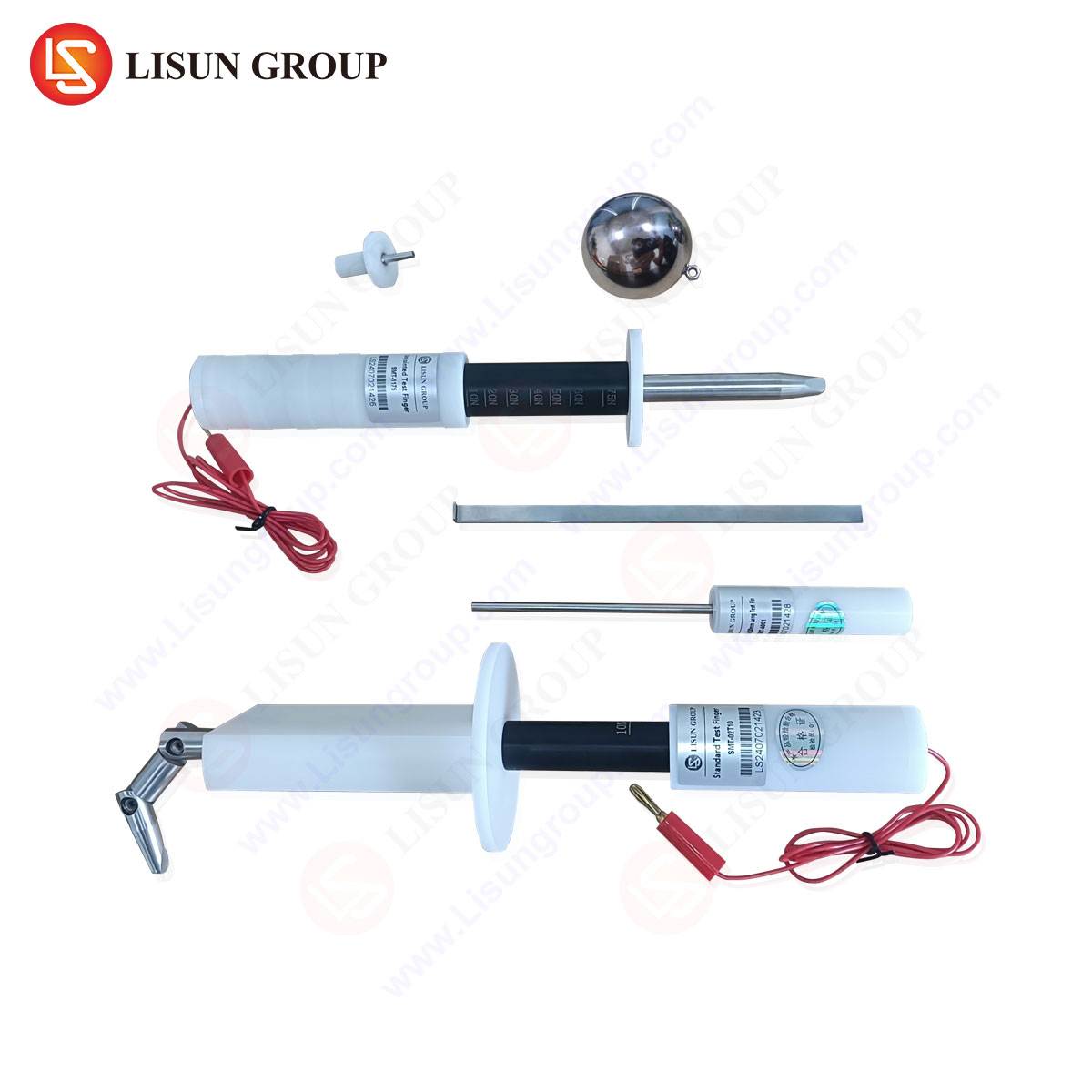
The LISUN Test Finger, often designated as Probe 11 or the “jointed test finger,” is a quintessential example. It is designed to simulate the finger of a child or a small adult. Its construction typically involves a robust aluminum alloy or stainless-steel skeleton, providing the necessary structural integrity for repeated application of the specified force—typically 30 N for equipment or 10 N for toys as per IEC 62115. The finger itself is often manufactured from a durable, heat-resistant material like vulcanized fiber or a proprietary polymer composite, ensuring it does not deform under test conditions and provides a consistent, non-conductive interface. The critical dimensions, including the 12mm diameter of the fingertip, the 80mm length of the finger, and the specific 90° ±5° articulation of the joints, are machined to tolerances within ±0.1mm. This precision ensures that the probe will ingress into an opening in a manner that is statistically representative of a human finger.
Similarly, the LISUN Test Probe (aligned with Probe 13 of IEC 61032) and Test Pin (aligned with Probe 12) are manufactured with equivalent rigor. The Test Probe, a slender, 100mm long rod with a 3mm diameter spherical end, is machined from hardened steel to prevent bending. The Test Pin is a stark, 30mm long cylinder with a 3mm diameter, featuring a hemispherical end and a handle. The material choice for these probes, often high-carbon steel or stainless steel, is critical to prevent wear on the tip, which could alter its effective diameter over time and compromise test results.
Biomechanical Simulation and the Application of Test Probes
The application of these probes is not a simple mechanical exercise; it is a simulated biomechanical interaction. The testing protocol requires the probe to be applied to every external opening of an equipment enclosure with a defined force and in every possible orientation. The objective is to determine if a live part at hazardous voltage, a hazardous moving part like a fan blade, or an uninsulated heating element becomes accessible.
For the LISUN Test Finger, the test involves articulating the jointed finger to explore openings, mimicking the natural probing action of a human. A standard 30 N force is applied, and the probe must not contact a live part or a hazardous moving part. To verify contact, a “touch indicator” circuit is employed. This often involves connecting the probe to one side of a low-voltage (e.g., 40V to 50V) circuit, with the live parts of the Equipment Under Test (EUT) connected to the other. An indicator lamp or ammeter in the circuit illuminates or registers current flow upon contact, providing an unambiguous pass/fail criterion. The LISUN Test Probe is used for smaller openings where a finger cannot enter but a tool or wire might. It is used to probe openings and, with its smaller diameter, can often reach further into an enclosure. The LISUN Test Pin represents the most stringent test for small openings, simulating the insertion of a wire, stick, or key. Its rigid construction ensures it can be pushed with significant force (up to 30 N) without deflection, testing the robustness of grilles, vents, and slot openings.
Ensuring Compliance Across a Spectrum of Industries
The deployment of UL 921-compliant probes is a universal requirement across the electrical and electronics manufacturing landscape. The consequences of inadequate accessibility testing can be severe, ranging from electric shock and burns to mechanical injury.
In the Household Appliances sector, the LISUN Test Finger is used to verify that the slots in a toaster, the gap around a blender’s base, or the ventilation grilles of an oven cannot be penetrated to touch live heating elements or mains-voltage connections. The Automotive Electronics industry employs these probes to test infotainment systems, control modules, and charging ports installed within the vehicle’s cabin, ensuring they are safe for interaction by occupants. For Lighting Fixtures, both indoor and outdoor, probes verify that after removing a light bulb, a person cannot reach into the socket and contact live terminals. The Test Pin is particularly relevant for testing the gaps in GU10 and other bayonet-style bulb holders.
Industrial Control Systems and Telecommunications Equipment often reside in enclosures with numerous vents and cable ports. The LISUN Test Probe and Test Pin are critical for ensuring that these necessary openings do not compromise the safety of the high-voltage power supplies and distribution systems within. In the highly regulated Medical Devices field, patient safety is paramount. Probes are used to test everything from MRI control panels to home-use dialysis machines, ensuring that even a disoriented patient cannot inadvertently access a hazardous part. The Aerospace and Aviation Components industry demands the highest level of reliability; the use of certified test probes is part of the rigorous qualification process for any electronic component used in an aircraft, where failure could be catastrophic.
Furthermore, the testing of basic Electrical Components such as switches, sockets, and circuit breakers is a primary application. A standard wall socket must be designed to prevent the insertion of the Test Finger while allowing a plug. The Toy and Children’s Products Industry has perhaps the most stringent requirements, often applying a 10 N force with the test finger to simulate a child’s weaker push, making the precision and correct application force of the LISUN probe absolutely critical.
Calibration and Metrological Traceability in Probe Maintenance
The precision of a test probe is not a permanent attribute. With repeated use, especially the Test Pin and Test Probe, the tips can experience wear, and the articulated joints of the Test Finger can develop play. Consequently, a robust calibration regime is non-negotiable for any accredited testing laboratory or quality assurance department. Metrological traceability to national or international standards is essential.
Calibration of the LISUN Test Finger involves verifying its critical dimensions using high-precision tools such as optical comparators or coordinate measuring machines (CMM). The diameter of the finger sections, the pin diameters of the joints, and the overall lengths are measured and compared against the standard’s specifications. The freedom of movement and the angle of articulation are also checked to ensure they fall within the permitted tolerances. For the LISUN Test Probe and Test Pin, the calibration process focuses on the diameter and spherical radius of the tip, the straightness of the shaft, and the overall length. A go/no-go gauge or a high-accuracy micrometer is typically employed. The calibration interval is typically annual, but it may be shortened based on frequency of use. A calibration certificate, documenting the “as-found” and “as-left” conditions of the probe, provides the necessary audit trail for regulatory compliance.
Comparative Analysis of Probe Design and Functional Longevity
While the geometric specifications for UL 921 probes are standardized, the execution of these designs in physical products can vary significantly, impacting their functional longevity and measurement certainty. The competitive advantage of a well-engineered probe like those from LISUN lies in the details of its construction.
A critical differentiator is the choice of material for the jointed test finger. Lower-cost alternatives may use standard plastics or inferior metals that can deform under the 30 N test force or become brittle over time, leading to dimensional instability. The use of vulcanized fiber or advanced engineering polymers in the LISUN Test Finger ensures consistent performance and high dielectric strength, preventing a false electrical contact reading. The design of the articulation joints is another area of differentiation. Joints must be free-moving enough to simulate a human finger but must not have excessive play, which would introduce an unacceptable degree of variability into the test. Precision-machined bearings or low-friction bushings in the LISUN design ensure smooth, repeatable articulation without slop.
For the Test Pin and Test Probe, the hardness of the steel is a primary factor. Softer metals will develop a flat spot on the hemispherical tip after repeated use against hard enclosure materials, effectively increasing its diameter and causing it to fail to enter openings that a new, compliant probe would. The LISUN probes are manufactured from hardened tool steel, often with a surface hardness exceeding 60 HRC, to resist deformation and maintain their calibrated dimensions through thousands of test cycles. This focus on material science and precision engineering translates directly into reduced long-term cost of ownership and enhanced confidence in test results.
Integration of Accessibility Testing within a Broader Safety Framework
It is crucial to recognize that accessibility testing with the LISUN Test Finger, Test Probe, and Test Pin is not an isolated activity. It is an integral component of a comprehensive product safety evaluation framework that includes dielectric strength testing, ground bond continuity, temperature rise, and fault condition testing. The results from probe testing often inform other aspects of the validation process.
For instance, if the Test Finger can contact a live part, the product fails the accessibility test and must be redesigned. A subsequent dielectric strength test on the reinforced insulation between that live part and the user-accessible surface would then be required. Similarly, if the Test Pin can bypass a protective interlock switch, the interlock’s design and the circuitry it controls must be re-evaluated. In the context of Office Equipment like printers and copiers, the probes ensure safety during paper jam clearance procedures. In Consumer Electronics, they validate the safety of USB ports, headphone jacks, and ventilation slots on devices like gaming consoles and set-top boxes. For Cable and Wiring Systems, probes are used to test the accessibility of conductors at connection points and within distribution panels.
This interconnectedness underscores the necessity for reliable, standardized test equipment. An error introduced at the accessibility testing phase, due to a non-compliant or worn probe, can cascade through the entire certification process, leading to either an unsafe product reaching the market or a safe product being subjected to costly and unnecessary redesigns.
Frequently Asked Questions (FAQ)
Q1: What is the difference between the UL 921 test probe and the IEC 61032 test probes?
The standards are largely harmonized. UL 921 is a U.S. standard, while IEC 61032 is an international standard. They specify functionally identical probes for evaluating protection against electric shock. For example, the “jointed test finger” in both standards has the same critical dimensions. The LISUN Test Finger, Test Probe, and Test Pin are designed to meet the specifications of both UL 921 and IEC 61032, making them suitable for global product certification.
Q2: How often should our laboratory’s test probes be calibrated?
The standard calibration interval for test probes is 12 months. However, this interval should be risk-based. If a probe is used frequently, subjected to high force, or shows any visible signs of wear or damage, it should be calibrated more frequently. A good practice is to perform a routine visual inspection before each critical test series.
Q3: Can a 3D-printed test probe be used for official compliance testing?
No. While 3D printing is useful for prototyping, it cannot guarantee the material properties, dimensional accuracy, or structural integrity required for official compliance testing. The standards specify material types and hardness to ensure the probe does not deform during testing. A 3D-printed part would lack the necessary durability and metrological traceability, rendering any test results invalid for certification purposes.
Q4: Our product has a small ventilation slot. Which probe should we use first?
The testing hierarchy typically starts with the largest plausible probe. First, attempt to use the LISUN Test Finger (Probe 11). If it cannot access hazardous parts, proceed to the LISUN Test Probe (Probe 13). If that also cannot access hazardous parts, finally use the LISUN Test Pin (Probe 12). This sequence ensures that the product is evaluated against the most representative human interaction before moving to more intrusive, tool-like probes.
Q5: What constitutes a “pass” in a test finger accessibility test?
A “pass” is achieved when the test probe, applied with the specified force and in every possible orientation, does not make contact with a live part at hazardous voltage or a hazardous moving part. Contact is typically determined by an electrical circuit (a “touch indicator”) that signals when the probe bridges the gap to the live part. No illumination of the indicator signifies a pass.