




An Analytical Examination of the UL Rain Test Procedure: Ensuring Enclosure Integrity Against Ingressing Precipitation
Introduction to Ingress Protection and the UL 50/50E Standard
The proliferation of electrical and electronic equipment across diverse and demanding environments necessitates rigorous validation of enclosure integrity. Among the most prevalent environmental threats is water, specifically precipitation in the form of rain, sleet, and snow. The Underwriters Laboratories (UL) Rain Test Procedure, formally outlined within UL 50 and UL 50E standards for enclosures for electrical equipment, provides a standardized, reproducible methodology for simulating these conditions. This procedure is not a singular test but a defined set of conditions—water application rate, nozzle configuration, test duration, and acceptance criteria—designed to verify that an enclosure will not permit the ingress of moisture to a degree that could impair safety or operational functionality. Compliance with this procedure is a critical benchmark for products in sectors ranging from automotive electronics and telecommunications infrastructure to industrial control systems and outdoor lighting fixtures, serving as a key indicator of reliability and longevity in field deployments.
Deconstructing the UL Rain Test Methodology
The UL Rain Test is predicated on simulating a specific, severe rainfall condition. The core apparatus involves a calibrated spray nozzle or nozzle array that delivers water at a prescribed flow rate and pressure. The standard specifies the use of a “Type I” or “Type II” nozzle, with the selection and orientation detailed in the test requirements. The enclosure under test is mounted on a turntable or positioned to ensure all surfaces subject to rainfall exposure in its intended service orientation are subjected to the spray.
The test is conducted in two distinct phases, each serving a specific investigative purpose. The first phase, often termed the “initial exposure,” subjects the powered-off enclosure to a continuous, uniform spray for a duration of 30 minutes. This phase assesses the basic mechanical sealing integrity of gaskets, seams, welds, and conduit entries under a sustained hydraulic load. Following this, a second phase—the “tilted exposure”—is performed. The enclosure is tilted to an angle of 15 degrees from vertical in four successive positions (typically representing each primary face), with the spray directed at the upper surfaces for a period of 2.5 minutes per orientation. This 10-minute cumulative test is designed to evaluate performance under conditions where water may pool or run along surfaces due to wind or installation angle, testing drainage paths and the effectiveness of seals under non-ideal conditions.
Critical Parameters and Calibration Imperatives
The scientific validity of the UL Rain Test hinges on the precise control and verification of several physical parameters. Deviation from these tolerances can render test results non-comparable and potentially non-compliant.
- Water Pressure and Flow Rate: The nozzle must be supplied with water at a pressure of (30 pm 3) psi (207 (pm) 21 kPa). This pressure ensures a consistent droplet size distribution and impact energy that accurately simulates wind-driven rain. The resultant flow rate, typically measured in gallons per hour (GPH) or liters per minute (L/min), is a derived parameter that must be verified during apparatus calibration.
- Nozzle Specification and Distance: The geometry of the spray nozzle is meticulously defined. The standard specifies the number and diameter of orifice holes. The distance from the nozzle face to the enclosure surface under test is critical, typically set at 2.5 to 3 feet (approximately 0.76 to 0.91 meters), to ensure the spray pattern fully envelops the test specimen without excessive coalescence of droplets.
- Water Conductivity: To prevent electrical tracking or leakage current misinterpretations during the optional operational test, the water used must have a conductivity less than 150 microsiemens per centimeter (µS/cm). Deionized or distilled water is commonly employed.
- Acceptance Criteria: Post-test evaluation is twofold. First, a visual inspection is conducted for any visible water ingress inside the enclosure. More critically, for equipment intended to be energized during wet conditions, the test may include a dielectric withstand (hipot) test or a check for leakage current. No water shall enter in such quantity as to form a layer on live parts, bridge insulated parts with less than specified clearance, or accumulate in live compartments.
Instrumentation for Precise Compliance: The LISUN JL-XC Series Waterproof Test Apparatus
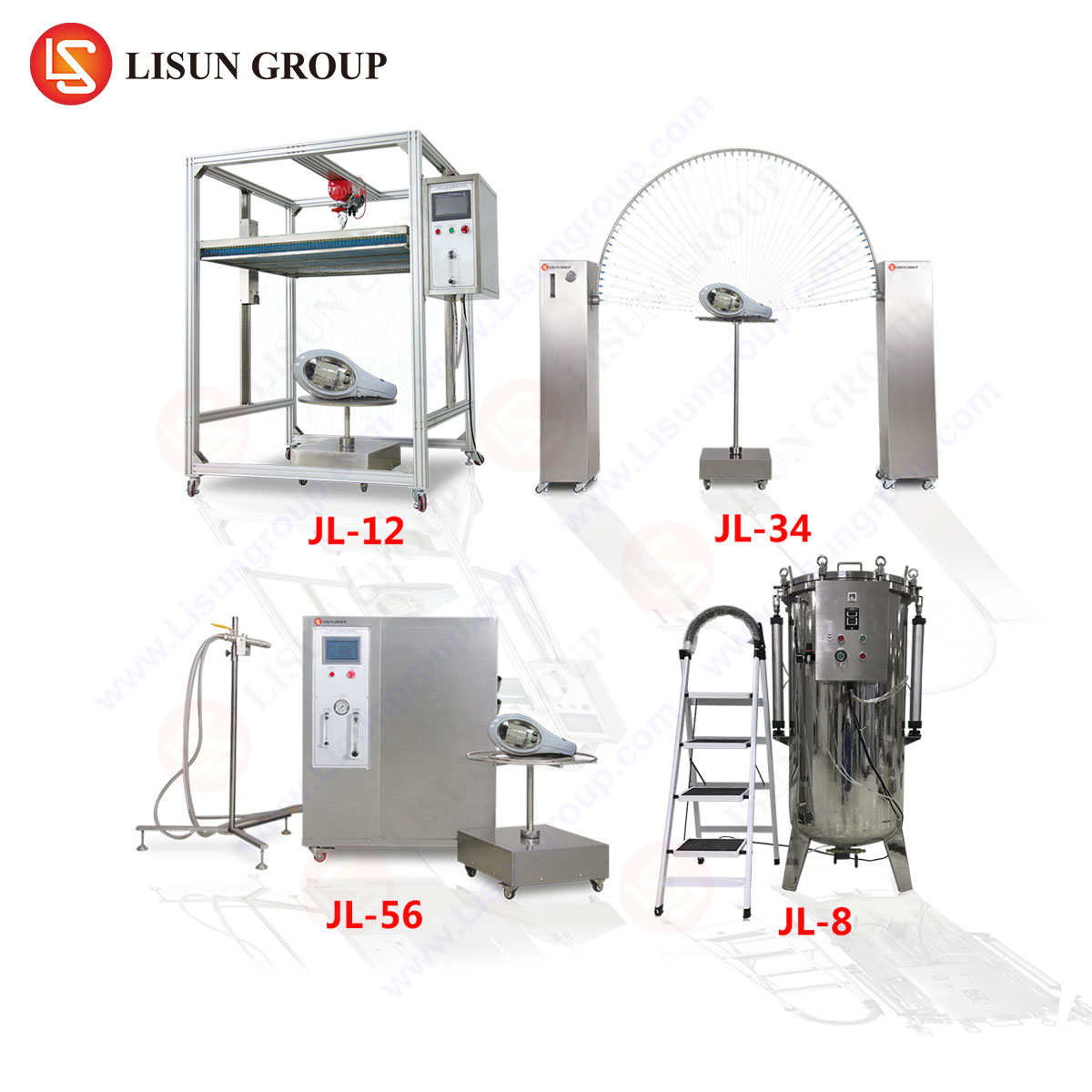
Achieving and maintaining the stringent parameters of the UL Rain Test demands specialized, calibrated instrumentation. The LISUN JL-XC Series Waterproof Test Apparatus is engineered explicitly to meet the requirements of UL 50, UL 50E, and analogous international standards such as IEC 60529 (IP Code). This system transcends a simple spray rig; it is an integrated test solution designed for laboratory accuracy and repeatability.
The JL-XC system typically incorporates a stainless steel or corrosion-resistant reservoir, a multistage filtration system, a precision positive displacement or centrifugal pump with variable frequency drive for pressure control, and a calibrated UL-specified nozzle mounted on an adjustable bracket. Its digital control interface allows for the precise setting and real-time monitoring of test duration, water pressure, and flow rate. For the tilted exposure phase, certain configurations integrate a programmable motorized turntable with precise angular positioning, automating the sequence to eliminate operator error.
Specifications and Testing Principle: The core principle of the JL-XC Series is the closed-loop control of the test’s hydraulic conditions. A pressure transducer provides feedback to the pump controller, maintaining the required (30 pm 1) psi with high stability. An integrated flow meter provides verification of the resultant spray rate. The system’s design ensures laminar flow to the nozzle, preventing pressure pulsations that could create an inconsistent spray pattern. Test chambers are often constructed of transparent acrylic or polycarbonate, allowing for full observation of the specimen during testing, while drainage is managed to prevent flooding and allow for safe evaluation of energized equipment under test (EUT).
Industry Applications and Validation Use Cases
The UL Rain Test procedure, facilitated by equipment like the LISUN JL-XC Series, is applied across a vast spectrum of industries to validate product robustness.
- Automotive Electronics: Components such as engine control units (ECUs), battery management systems for electric vehicles, external sensors (LiDAR, radar), and charging port assemblies must withstand high-pressure car washes and driving in heavy rain.
- Telecommunications Equipment: Outdoor cabinets for 5G radios, fiber optic distribution terminals, and broadband network interface devices (NIDs) are permanently installed in exposed locations and are primary candidates for this validation.
- Lighting Fixtures: Streetlights, architectural floodlights, and industrial high-bay fixtures require proven ingress protection to prevent short circuits and corrosion of internal drivers and LED modules.
- Industrial Control Systems: Enclosures for programmable logic controllers (PLCs), motor drives, and remote I/O stations located on factory floors or outdoors must protect sensitive electronics from washdown and environmental exposure.
- Aerospace and Aviation Components: External navigation lights, antenna housings, and ground support equipment connectors are tested to ensure functionality in all weather conditions.
- Medical Devices: While not typically exposed to rain, devices intended for use in harsh clinical environments (e.g., ambulances, field hospitals) or those requiring regular fluid washdown (surgical tools, dental equipment carts) undergo similar spray testing for hygiene and safety.
Competitive Advantages of Integrated Test Systems
Utilizing a purpose-built system like the LISUN JL-XC Series offers distinct advantages over ad-hoc test setups. First is compliance assurance; the system is designed from the ground up to meet the dimensional and performance specifications of the standard, reducing the validation burden on the quality assurance laboratory. Second is repeatability and reproducibility (R&R); automated control of pressure, timing, and angle minimizes inter-operator variability, producing data that is defensible for certification submissions and internal quality benchmarks. Third is operational efficiency; programmable test sequences allow for unattended operation, and integrated safety features (ground fault interruption, water level sensors) protect both the operator and the valuable EUT. Finally, data integrity is enhanced through digital logging of all test parameters, creating an auditable trail for compliance documentation.
Interpreting Results and Correlation to Field Performance
A successful UL Rain Test is a strong predictor, but not an absolute guarantee, of field performance. It represents a standardized, accelerated stress condition. Correlation to real-world longevity requires understanding the test’s limitations. The test uses clean water, whereas real rain can be slightly acidic and carry particulate matter. The test is of short duration (40 minutes total), while real exposure is cumulative over years. However, it effectively identifies fundamental design flaws: inadequate gasket compression, poorly designed drainage paths, capillary effects in cable glands, and vulnerabilities in seam sealing. For manufacturers, a failure during this controlled test is a far preferable outcome to a field failure, allowing for design iteration before production. When a product passes, it provides a quantified level of confidence for specifiers, installers, and end-users regarding its suitability for protected outdoor or damp indoor applications.
Integration with Broader Environmental Testing Regimes
The UL Rain Test is rarely performed in isolation. It is typically one component within a broader environmental stress screening (ESS) or qualification testing regimen. A product might sequentially undergo temperature cycling (to stress seals and materials), vibration testing (to simulate shipping and operational stresses on mechanical joints), and then the rain test. This sequence can reveal failure modes that would not appear if the tests were conducted in reverse order. Furthermore, for products seeking an Ingress Protection (IP) rating per IEC 60529, the UL Rain Test conditions are analogous to, though not perfectly aligned with, the requirements for IPX3 (spraying water) and IPX4 (splashing water) ratings. A comprehensive testing laboratory will map the specific requirements of all target standards (UL, IEC, MIL, etc.) to develop an efficient, overlapping test plan, often executed on versatile platforms capable of multiple test types.
Frequently Asked Questions (FAQ)
Q1: What is the fundamental difference between the UL Rain Test and the IPX7 (immersion) test?
A1: The tests address fundamentally different failure modes. The UL Rain Test simulates exposure to falling and wind-driven water, evaluating seals against dynamic pressure and surface runoff. The IPX7 test involves static immersion at a depth (e.g., 1 meter for 30 minutes), which subjects seals to constant, higher hydrostatic pressure. An enclosure can pass one test and fail the other, as the mechanisms of potential ingress differ.
Q2: Can the LISUN JL-XC Series be configured for other spray tests, such as IEC 60529 IPX3/IPX4?
A2: Yes, the modular design of the JL-XC Series typically allows for the interchange of nozzles and the programming of different oscillatory or stationary spray patterns. By calibrating with the appropriate nozzle (e.g., the IEC 60529 standard spray nozzle) and adjusting flow rates, the same core system can be used to conduct multiple international standard spray tests, making it a cost-effective solution for laboratories servicing global markets.
Q3: Is it necessary to perform the dielectric test (hipot) immediately after the water exposure?
A3: The standards often specify that the dielectric test, if required, be performed “before drying.” This is crucial because the test aims to discover if water has penetrated to live parts in sufficient quantity to create a conductive path. Allowing the enclosure to dry could evaporate a thin film of water that might have caused a failure, thereby masking a potentially dangerous design flaw.
Q4: How often should a rain test apparatus like the JL-XC be recalibrated?
A4: Calibration frequency should follow a risk-based schedule dictated by quality procedures (e.g., ISO/IEC 17025), usage intensity, and manufacturer recommendations. At a minimum, annual calibration of the pressure gauge, flow meter, and timer is advised. A daily or pre-test verification of flow rate and spray pattern uniformity is considered a best practice to ensure ongoing test validity.
Q5: For a product with multiple cable entry points, how are these addressed during the test?
A5: The standard requires testing the enclosure as it would be installed in the field. Therefore, all conduit entries, cable glands, or other openings must be equipped with the manufacturer-specified seals and closures. If the product is offered with optional sealing methods, the test should be conducted under the most stringent (typically most complex) configuration to qualify all variants. Blanking plugs are used for unused entries.