





Understanding Fire Safety Testing: Principles, Standards, and Apparatus for Hazard Mitigation
Fire safety testing constitutes a critical discipline within product engineering and regulatory compliance, serving as the primary methodological barrier against fire initiation and propagation in consumer and industrial goods. The underlying objective is not merely to satisfy statutory requirements but to fundamentally quantify a material or component’s resistance to ignition and its contribution to fire growth under defined thermal stress. This analytical process provides empirical data that informs design choices, material selection, and risk assessment protocols across a vast spectrum of industries. The consequences of inadequate fire safety validation are severe, encompassing potential loss of life, significant property damage, and substantial liability. Consequently, the apparatus and methodologies employed in such testing must exhibit exceptional precision, repeatability, and alignment with internationally recognized standards.
The Glow-Wire Test: Simulating Fault-Induced Thermal Stress
Among the suite of fire hazard evaluation techniques, the glow-wire test occupies a specialized and indispensable niche. It is designed to simulate a specific, yet common, failure scenario: the thermal effects arising from an overloaded or poorly connected electrical component, such as a resistor, connector, or terminal block, which becomes incandescent (a “glow-wire” condition). This overheated element may then impinge upon adjacent parts or enclosures. The test does not employ an open flame; instead, it assesses a material’s response to a controlled, high-temperature source of thermal energy in the form of a resistively heated element.
The principle is rigorously defined: a standardized wire or rod of a specific material (typically a nickel/chromium alloy) is heated electrically to a pre-determined temperature, calibrated with high accuracy. This heated element—the glow-wire—is then applied with a defined force to the test specimen for a set period. The apparatus subsequently observes and records the specimen’s behavior. Key observational parameters include whether the specimen ignites, the duration of any resulting flames, whether it drips molten particles that could ignite a secondary substrate (like a simulated floor material), and the extent of any afterglow post-removal of the heat source.
This methodology provides a direct assessment of a product’s ability to contain a fault without propagating fire. Its relevance is paramount for enclosures, support structures, and insulating parts that are in proximity to current-carrying components. Industries ranging from household appliance manufacturing to automotive electronics rely on glow-wire test data to certify that a faulty internal component will not compromise the safety of the overall assembly.
International Standards Governing Glow-Wire Evaluations
The execution and interpretation of glow-wire testing are governed by a framework of international standards, ensuring consistency and mutual recognition of results across global markets. The seminal series is the IEC 60695-2 standards, which are widely adopted and often form the basis for regional norms.
- IEC 60695-2-10: This standard details the fundamental “Glow-wire apparatus and common test procedure,” specifying the generic requirements for the test equipment, calibration methods, and the foundational test protocol.
- IEC 60695-2-11: This defines the “Glow-wire flammability test method (GWFT)” for finished products. It establishes the pass/fail criteria based on observation times for flames and glowing, and the ignition of tissue paper by dripping particles.
- IEC 60695-2-12: This outlines the “Glow-wire flammability index (GWFI)” test method for materials. The GWFI is the highest temperature of the glow-wire at which a material specimen does not ignite or, if it does, extinguishes within 30 seconds after removal of the glow-wire and does not ignite a surrounding tissue paper layer with drips.
- IEC 60695-2-13: This specifies the “Glow-wire ignition temperature (GWIT)” test method for materials. The GWIT is the temperature 25°C or 50°C (depending on the result) above the maximum glow-wire temperature that does not cause ignition of the material during a specified test duration.
Compliance with these standards is frequently mandated by broader product safety directives, such as the IEC 60335 series for household appliances, IEC 60950 for IT equipment, and IEC 60601 for medical devices. Automotive manufacturers often reference analogous standards like ISO 20653, which incorporates similar protective principles.
Operational Mechanics of the LISUN ZRS-3H Glow-Wire Test Apparatus
The LISUN ZRS-3H Glow-wire Test Apparatus represents a sophisticated implementation of the standards described above, engineered to deliver precise, reliable, and repeatable test results. Its design integrates critical subsystems to maintain strict control over all test variables.
Core Testing Principle: The apparatus heats a standardized glow-wire (Φ4.0mm Ni80/Cr20) via a low-voltage, high-current power supply. A thermocouple spot-welded to the tip of the glow-wire provides continuous temperature feedback to a closed-loop PID (Proportional-Integral-Derivative) temperature controller. This system dynamically adjusts the heating current to maintain the setpoint temperature with minimal deviation, typically within ±2°C of the target, even during specimen application which acts as a heat sink. The heated glow-wire is then advanced mechanically to apply a precisely controlled force (1.0 N ± 0.1 N) to the test specimen for a programmable duration (e.g., 30 seconds). The entire test chamber is constructed from fire-resistant materials and includes observational windows, an exhaust system for fumes, and a calibrated draught shield to eliminate ambient air currents that could influence test results.
Key Technical Specifications:
- Temperature Range: 500°C to 1000°C (continuously adjustable).
- Temperature Control Accuracy: ± 2°C at setpoint.
- Glow-wire Specification: Nickel-Chromium (Ni80/Cr20), diameter 4.0mm.
- Application Force: 1.0 N ± 0.1 N, applied via a calibrated weight system.
- Timer Range: 0 to 99.99 seconds, with accuracy of ± 0.1 seconds.
- Specimen Support: Adjustable mounting platform to accommodate parts of varying sizes and geometries.
- Drip Tray & Tissue Holder: For assessing the ignition potential of falling molten particles, as per IEC 60695-2-11/12.
- Safety Features: Over-temperature protection, emergency stop, and fume extraction port.
Competitive Advantages: The ZRS-3H distinguishes itself through several engineered features. Its advanced PID temperature control algorithm ensures exceptional thermal stability, a prerequisite for reproducible GWFI and GWIT determinations. The mechanical application mechanism minimizes vibration and ensures consistent, repeatable contact force. Furthermore, its robust construction and intuitive human-machine interface (HMI) streamline calibration and operation, reducing potential for operator error and enhancing laboratory throughput.
Industry-Specific Applications and Use Cases
The application of glow-wire testing via apparatus like the LISUN ZRS-3H is ubiquitous across sectors where electrical energy is present. The following examples illustrate its critical role:
- Household Appliances & Electrical Components: Testing the plastic enclosures of switches, socket-outlets, circuit breakers, and appliance controllers (e.g., for washing machines, dishwashers) to ensure a faulty internal connection cannot ignite the housing.
- Automotive Electronics: Evaluating the materials used for fuse box housings, wire harness connectors, sensor modules, and infotainment system enclosures. The test simulates a short-circuit or overload condition in the harsh, vibration-prone automotive environment.
- Lighting Fixtures: Assessing the plastic body of LED drivers, lamp holders, and luminaire housings, particularly for built-in or recessed lighting where heat dissipation may be constrained.
- Industrial Control Systems & Telecommunications: Validating the fire safety of terminal blocks, PLC enclosures, server rack components, and router/modem casings, which are often installed in critical infrastructure locations.
- Medical Devices: Testing non-metallic enclosures and internal supports for patient monitors, infusion pumps, and diagnostic equipment, where fire safety is paramount in oxygen-rich or critical care environments.
- Aerospace and Aviation Components: While subject to even more stringent standards (e.g., FAA regulations), glow-wire principles inform material selection for cabin electronics, in-flight entertainment systems, and wiring insulation.
- Cable and Wiring Systems: Evaluating the sheathing and insulation materials for their resistance to ignition from a nearby overheated component.
- Office Equipment & Consumer Electronics: Certifying the safety of printer/power supply housings, external battery packs, and charger enclosures.
Interpreting Test Results and Material Classification
The data yielded from a glow-wire test program is not merely pass/fail; it enables the quantitative classification of materials. The determination of Glow-Wire Flammability Index (GWFI) and Glow-Wire Ignition Temperature (GWIT) provides engineers with comparable metrics for material selection.
For instance, a polyamide (PA66) material might achieve a GWFI of 850°C and a GWIT of 775°C. This indicates that at a glow-wire temperature of 850°C, specimens did not burn with flames for more than 30 seconds or ignite the tissue paper below. Furthermore, its GWIT of 775°C means that at 750°C (25°C lower), no ignition occurred during the test. A competing material with a GWFI of 750°C and a GWIT of 675°C would be considered less resistant to this type of thermal fault. This data is crucial for designing cost-effective yet safe products, allowing for the selection of the minimum material grade necessary to meet the anticipated thermal risk in the final application.
Table 1: Example Material Classifications via Glow-Wire Testing
| Material | Typical GWFI | Typical GWIT | Common Application |
| :— | :— | :— | :— |
| Polycarbonate (PC) | 850°C to 950°C | 775°C to 850°C | Electrical enclosures, transparent covers |
| Polyamide 66 (PA66) | 850°C | 775°C | Connectors, circuit breakers, automotive parts |
| Polybutylene Terephthalate (PBT) | 850°C | 775°C | Socket faces, coil bobbins, sensor housings |
| Acrylonitrile Butadiene Styrene (ABS) | 550°C to 750°C | 500°C to 675°C | Appliance housings, consumer electronics cases |
| Polypropylene (PP) | 550°C to 650°C | 500°C to 600°C | Low-cost insulating parts, cable ducts |
Integrating Glow-Wire Testing into a Comprehensive Safety Strategy
It is imperative to recognize that the glow-wire test is one instrument in a broader fire safety orchestra. It specifically addresses fault condition thermal abuse. A complete safety assessment for a product may also involve:
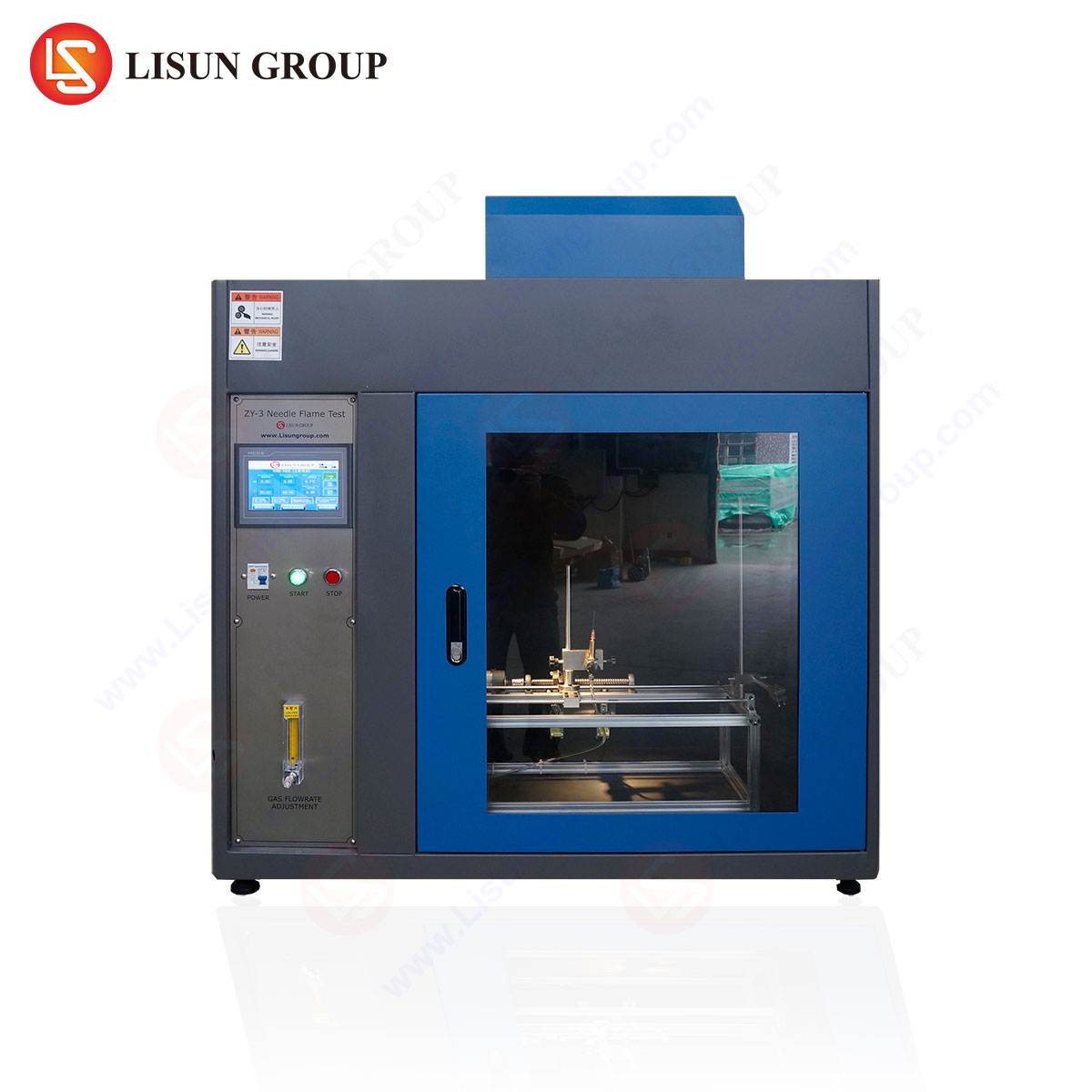
- Needle-Flame Tests (IEC 60695-2-2): To simulate the effect of small flames from faulty components.
- Horizontal/Vertical Flame Tests (UL 94, IEC 60695-11-10): To measure the flammability of plastics under a direct, calibrated flame.
- Heat Release Calorimetry: To quantify the total heat release rate during combustion.
- Tracking Resistance Tests (IEC 60112): To evaluate the material’s susceptibility to forming conductive paths under electrical stress and contamination.
The glow-wire test, therefore, fills a specific and vital gap, addressing a real-world ignition scenario not covered by other methods. Its integration into a product’s design validation phase is a hallmark of rigorous engineering and a proactive approach to risk mitigation.
Frequently Asked Questions (FAQ)
Q1: What is the fundamental difference between GWFI and GWIT?
A1: The Glow-Wire Flammability Index (GWFI) is a pass/fail temperature threshold indicating the highest temperature at which a material does not exhibit excessive burning or drip ignition. The Glow-Wire Ignition Temperature (GWIT) is a more conservative measure, indicating the temperature above which the material will ignite during the test. GWIT is always lower than GWFI for a given material.
Q2: Can the LISUN ZRS-3H test both finished products and raw materials?
A2: Yes, the apparatus is designed to conduct tests in full compliance with both product-based tests (IEC 60695-2-11) and material-based tests (IEC 60695-2-12 & -13). The adjustable specimen support and standardized test fixtures allow for the secure mounting of everything from small material plaques to larger product sub-assemblies like switch enclosures or connector housings.
Q3: How often does the glow-wire tip need to be replaced or calibrated?
A3: The nickel-chromium glow-wire is subject to oxidation and wear. Standards require verification of the wire’s dimensions and the apparatus’s temperature calibration at regular intervals, typically at the start of a test series or according to the laboratory’s quality control schedule (e.g., every 6 months). The thermocouple spot-welded to the tip is a consumable item and must be replaced if damaged or if calibration drift is observed.
Q4: Our product contains multiple plastic types. Must we test each one?
A4: From a compliance perspective, every non-metallic material that is within a specified distance (as defined by the end-product standard) of a potential overheating source must be evaluated. If different plastics are used in the same enclosure—for instance, a main housing and a separate vent grille—each with different thermal exposure risks, they likely require individual assessment. The test data for standardized material grades from suppliers can sometimes be used, but validation on the final part geometry is often necessary.
Q5: Why is the force of application (1.0 N) so critical in the test procedure?
A5: The applied force standardizes the thermal contact resistance between the glow-wire and the test specimen. Variations in force would alter the rate of heat transfer into the specimen, leading to inconsistent results. A force that is too high could cause excessive deformation, altering the thermal interaction, while a force too low might result in poor contact and insufficient heating. The 1.0 N force, maintained accurately by the ZRS-3H’s weight system, ensures reproducible thermal loading.