






Understanding IEC 61032: The Critical Role of Standardized Test Probes in Product Safety Evaluation
Introduction to Mechanical Safety Testing and Standardization
The assurance of product safety constitutes a fundamental pillar of modern engineering and design, particularly within the realm of electrical and electronic equipment. A significant aspect of this safety paradigm is the protection of users—including untrained individuals, children, and maintenance personnel—from hazards arising from mechanical access to live parts, moving components, or other dangerous areas. To evaluate this protection in a consistent, repeatable, and globally recognized manner, the International Electrotechnical Commission (IEC) publishes standard IEC 61032, “Protection of persons and equipment by enclosures – Probes for verification.” This document provides the definitive specifications for a family of test probes, often colloquially termed “finger probes” or “access probes,” which are used to simulate attempts at contact with hazardous parts. The application of these standardized tools transforms subjective assessments of accessibility into objective, quantifiable tests, forming a critical component of compliance with broader safety standards such as IEC 60335 (household appliances), IEC 60601 (medical devices), and IEC 60950/62368 (IT and audio/video equipment).
Deciphering the IEC 61032 Probe Family: Geometries and Applications
IEC 61032 defines a series of probes, each designated to model a specific type of access attempt. The selection of the appropriate probe is dictated by the product standard under which the equipment is being evaluated. The most commonly referenced probes include Probes 11, 12, 13, 18, and 19, each with a distinct physiological or tool-based analogy.
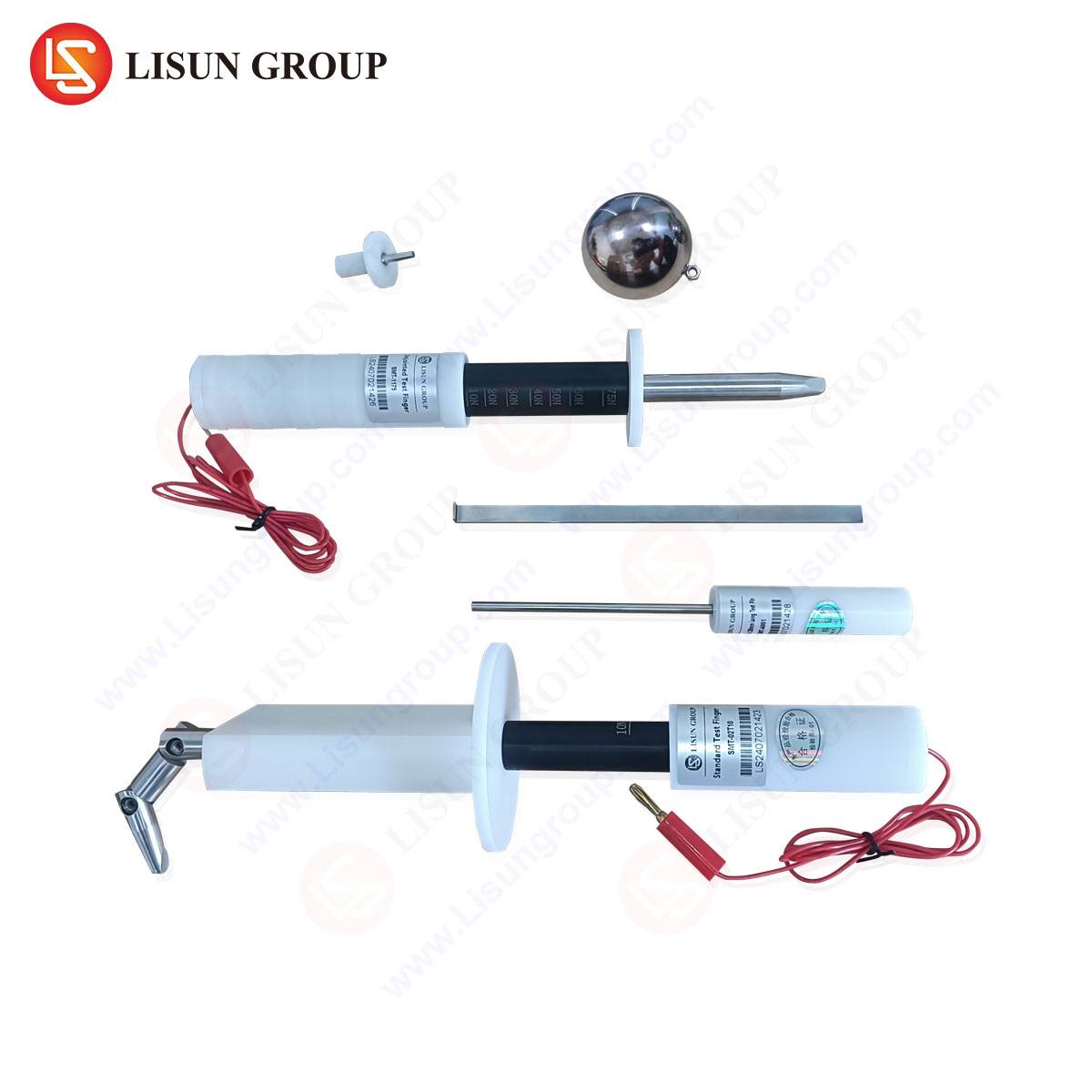
Probe 11, the Jointed Test Finger, is arguably the most iconic. It simulates the finger of a human hand, with articulated joints to replicate natural probing motions. Its dimensions are based on anthropometric data for a representative adult finger. The probe is applied with a specified force (typically 30 N ± 3 N) to any opening in an enclosure. If the probe can contact hazardous live parts (as defined by a touch-current test circuit) or dangerous moving parts, the enclosure is deemed non-compliant. This probe is ubiquitous in testing household appliances, electrical components like switches and sockets, office equipment, and consumer electronics.
Probe 12, the Straight Test Finger, represents a rigid finger or a tool held in the hand. It is a non-articulated, straight probe used to assess protection against access by objects that do not bend. Its application is crucial for evaluating smaller openings where a jointed finger might not ingress but a rigid object like a small screwdriver or a child’s finger could.
Probe 13, the Test Pin, simulates a slender, rigid object such as a wire or a long nail. With a diameter of 2.5 mm, it is applied with a force of 3 N ± 0.3 N. Its primary function is to verify that openings do not permit access to hazardous live parts by such objects. This probe is essential for testing socket outlets, connector ports in telecommunications equipment, and ventilation slots in power supplies across all industries.
Probes 18 and 19 are spherical probes representing small body parts. Probe 18 (50 mm diameter) and Probe 19 (12.5 mm diameter) simulate the back of a hand and a child’s finger, respectively. They are particularly relevant for the toy and children’s products industry, as well as for lighting fixtures and household appliances where curious exploration is a foreseeable use case.
The rigorous application of these probes ensures that products are evaluated against realistic access scenarios, preventing injuries from electric shock, burns, or mechanical trauma.
The Metrological Imperative: Accuracy and Traceability in Probe Fabrication
The efficacy of IEC 61032 testing is entirely contingent upon the physical and dimensional accuracy of the test probes themselves. A deviation of even a few tenths of a millimeter in the radius of a jointed test finger’s knuckle, or an incorrect spring force in its articulation, can lead to false passes or unnecessary failures, undermining the entire safety certification process. Consequently, the manufacture of these probes is a precision engineering task requiring metrological traceability to national standards.
Materials must exhibit defined properties of hardness, durability, and insulation resistance. The articulation mechanisms of Probes 11 and 12 must provide the specified force and freedom of movement. Each probe must be verified against the detailed dimensional drawings and force requirements stipulated in IEC 61032. High-quality manufacturers employ coordinate measuring machines (CMM), calibrated force gauges, and environmental conditioning to ensure each probe batch conforms precisely to the standard. This metrological rigor is non-negotiable for test laboratories (e.g., UL, TÜV, Intertek) and internal corporate compliance departments whose certifications and market access depend on reliable, reproducible results.
LISUN Test Probes: Engineering Fidelity for Global Compliance
Within the ecosystem of test equipment suppliers, LISUN has established a reputation for providing precision-engineered Test Probes, Test Fingers, and Test Pins that adhere strictly to the specifications of IEC 61032 and its regional equivalents (e.g., UL, CSA, GB). LISUN’s product line is designed to serve as the definitive tool for safety evaluation across the spectrum of electrical and electronic industries.
Specifications and Construction: LISUN’s Jointed Test Finger (Probe 11) is machined from high-strength insulating materials with precisely calibrated joint tension to replicate the 30 N application force. Its dimensions are meticulously controlled to match the standard’s reference finger, ensuring it accurately models the worst-case probing action. The Test Probe B (Probe 13) features a hardened steel pin of exact 2.5 mm diameter, mounted in an insulated handle with a force mechanism calibrated to 3 N. Each probe is supplied with a certificate of conformity, detailing its critical dimensions and forces, providing the traceability required by accredited laboratories.
Testing Principles in Practice: The use of LISUN probes follows a systematic procedure. For example, when testing a household blender (IEC 60335-2-14), the jointed test finger is applied to any gap between the jar and the base unit. In automotive electronics (ISO 20653), the test pin may be used to verify that IP-rated connectors are protected against access by small wires. For a medical device like an infusion pump (IEC 60601-1), both the jointed finger and the test pin are used to ensure that service panels accessible without a tool do not expose the operator to mains-voltage components.
Industry Use Cases and Competitive Advantages: LISUN’s probes are deployed in diverse settings:
- Electrical Components & Industrial Control: Verifying gasket integrity on enclosures for switches, contactors, and PLCs.
- Lighting Fixtures & Telecommunications: Testing IP rating claims (Ingress Protection) for outdoor luminaires and base station equipment.
- Aerospace & Aviation: Ensuring cockpit and in-flight entertainment system panels prevent accidental contact with wiring.
- Cable & Wiring Systems: Checking that connector housings provide adequate finger-safe protection.
The competitive advantage of LISUN’s offering lies in its combination of metrological precision, robust construction for laboratory durability, and comprehensive documentation. This triad ensures that product developers and test engineers can have absolute confidence in their safety assessments, reducing the risk of costly re-testing due to questionable tooling and facilitating smoother certification processes with global bodies.
Cross-Industry Application Scenarios and Hazard Mitigation
The universality of IEC 61032 probes stems from the fundamental nature of the hazards they address. Below is a summary of application scenarios:
| Industry | Primary Probe(s) | Typical Test Objective | Hazard Mitigated |
|---|---|---|---|
| Household Appliances | Probe 11, Probe 13 | Check openings around buttons, seams, and ventilation ports on kettles, heaters, etc. | Electric shock from live parts; burns from hot surfaces. |
| Toy & Children’s Products | Probe 19 (12.5mm sphere), Probe 13 | Ensure battery compartments and any openings cannot be penetrated by a small child’s finger or a wire. | Ingestion of small batteries; shock from accessible circuitry. |
| Medical Devices | Probe 11, Probe 12, Probe 13 | Verify that patient-accessible parts are safety extra-low voltage (SELV) and that service panels are secure. | Patient and operator shock; disruption of critical function. |
| Automotive Electronics | Probe 13, Probe 11 | Test IP-rated connectors, infotainment system ports, and under-hood components. | Short circuits from moisture/object ingress; shock during maintenance. |
| Lighting Fixtures | Probe 11, Probe 13 | Validate that diffusers and casings prevent contact with live lamp holders or LED drivers. | Electric shock during relamping or cleaning. |
Integration with Broader Safety Standards and Testing Regimes
It is critical to understand that IEC 61032 probes are rarely used in isolation. They are the specified tools within dozens of vertical product safety standards. For instance, IEC 62368-1, the hazard-based safety standard for AV/IT equipment, explicitly calls for Probes 11, 12, 13, 18, and 19 at various stages of its prescribed tests. Similarly, the mechanical safety tests in IEC 61010-1 for laboratory equipment are built around these probes.
The testing regime typically involves applying the probe with the specified force and in every possible orientation. A “contact” is often determined electrically using a standardized touch-current network (as per IEC 60990), which simulates human body impedance, rather than solely by visual observation. This electrical verification is paramount, as it detects hazardous energy levels even if a visible gap remains.
FAQ: Common Inquiries on IEC 61032 Test Probes and Procedures
Q1: How often should a set of IEC 61032 test probes be calibrated or verified?
A: While IEC 61032 does not specify a recalibration interval, best practice in accredited testing laboratories dictates an annual verification of critical dimensions and spring forces. For high-use environments, semi-annual checks may be warranted. Probes showing any sign of wear, deformation, or damage should be removed from service immediately.
Q2: Can a 3D-printed test finger be used for formal compliance testing?
A: No. For any formal certification testing submitted to a Nationally Recognized Testing Laboratory (NRTL) or regulatory body, probes must be manufactured to the exact material, dimensional, and force specifications of the standard. 3D-printed parts typically lack the required material strength, dimensional stability, and metrological traceability, rendering test results invalid.
Q3: What is the difference between a “Test Finger” and a “Test Pin” in practical application?
A: The Jointed Test Finger (Probe 11) simulates deliberate probing by a human finger, testing for basic protection. The Test Pin (Probe 13) is a more stringent test for “directed” access, simulating a child poking a wire or an adult using a small tool. An opening that safely stops the test finger may still be vulnerable to the test pin, hence both tests are often required.
Q4: Are LISUN probes acceptable for testing against both IEC and UL standards?
A: Yes. The dimensional requirements for test probes in UL standards (e.g., UL 746C) are harmonized with IEC 61032. LISUN engineers its probes to the IEC specification, which ensures compliance with the core mechanical requirements of major global standards, including UL, CSA, and EN. Always confirm with your specific test standard for any unique regional appendices.
Q5: In the context of IP (Ingress Protection) testing, how are these probes used?
A: IEC 61032 probes are referenced in the IEC 60529 standard for IP ratings. Specifically, the jointed test finger (IP2X) ensures protection against finger access, and the test pin (IP1X) ensures protection against tool access. Achieving these IP codes is a prerequisite for many products used in industrial, outdoor, or public environments.