






Understanding IP4X Testing: The Role of the IEC 61032 Probe in Enforcing Ingress Protection
The relentless drive for product safety, reliability, and longevity across global industries necessitates rigorous validation of protective enclosures. Among the most fundamental of these validations is the assessment of protection against the ingress of solid foreign objects, codified in the International Electrotechnical Commission (IEC) 60529 standard as the first numeral of the Ingress Protection (IP) code. The IP4X rating, specifically, denotes a critical threshold: protection against solid objects larger than 1.0 millimeter. The objective, repeatable enforcement of this standard hinges upon a precisely defined tool—the test probe stipulated in IEC 61032. This article provides a comprehensive technical examination of IP4X testing, detailing the principles, applications, and instrumental implementation of the IEC 61032 probe, with specific reference to the implementation by instrumentation such as the LISUN Test Finger, Test Probe, and Test Pin.
The IP Code Framework and the Significance of the First Numeral
The IP classification system, established by IEC 60529, “Degrees of protection provided by enclosures (IP Code),” provides a concise, internationally recognized language for specifying the environmental protection afforded by an enclosure. The code is expressed as IPXY, where ‘X’ represents protection against solid foreign objects and access to hazardous parts, and ‘Y’ represents protection against harmful ingress of water. The ‘4’ in IP4X is a definitive specification. It requires that the enclosure prevent the entry of a probe of defined dimensions (the IEC 61032 probe 12) and that no hazardous parts are contacted by such a probe. Furthermore, it implicitly ensures protection against most solid foreign objects of a diameter equal to or greater than 1.0 mm, such as small tools and wires. This level of protection is not merely about preventing dust (which is addressed by IP5X and IP6X) but is fundamentally a safety requirement to prevent user contact with live parts, moving components, or other hazards, and to ensure operational integrity by excluding potentially damaging debris.
IEC 61032: Defining the Standardized Probes for Verification
IEC 61032, “Protection of persons and equipment by enclosures – Probes for verification,” is the complementary standard that provides the physical definitions for the test tools used to verify the degrees of protection specified in IEC 60529. It ensures that testing is consistent and reproducible across different laboratories and manufacturers globally. For the verification of the first numeral, IEC 61032 defines several probes, each corresponding to a specific level of protection. The probe relevant for IP4X (and IP3X) testing is the Probe 12, often colloquially termed the “test finger.” This probe is designed to simulate the dimensions of a human finger or a small tool that could be inserted into an opening, thereby testing both the safety aspect (access to hazardous parts) and the mechanical exclusion of objects.
The standard mandates precise dimensional and material specifications for Probe 12. It typically consists of a jointed, articulated “finger” section with a specified diameter and length, attached to a handle and a stop face. The articulation is crucial, as it allows the probe to simulate the natural pivoting action of a finger attempting to access an opening. The probe must be pushed against every possible access point in the enclosure with a defined force, usually 10 N ± 1 N for IP4X verification. If the probe cannot enter an opening to contact hazardous live parts or moving components, and if it cannot approach such parts within a specified clearance (typically through openings in grilles or meshes), the enclosure is deemed to comply.
Instrumentation for Compliant Testing: The LISUN Test Finger, Test Probe, and Test Pin
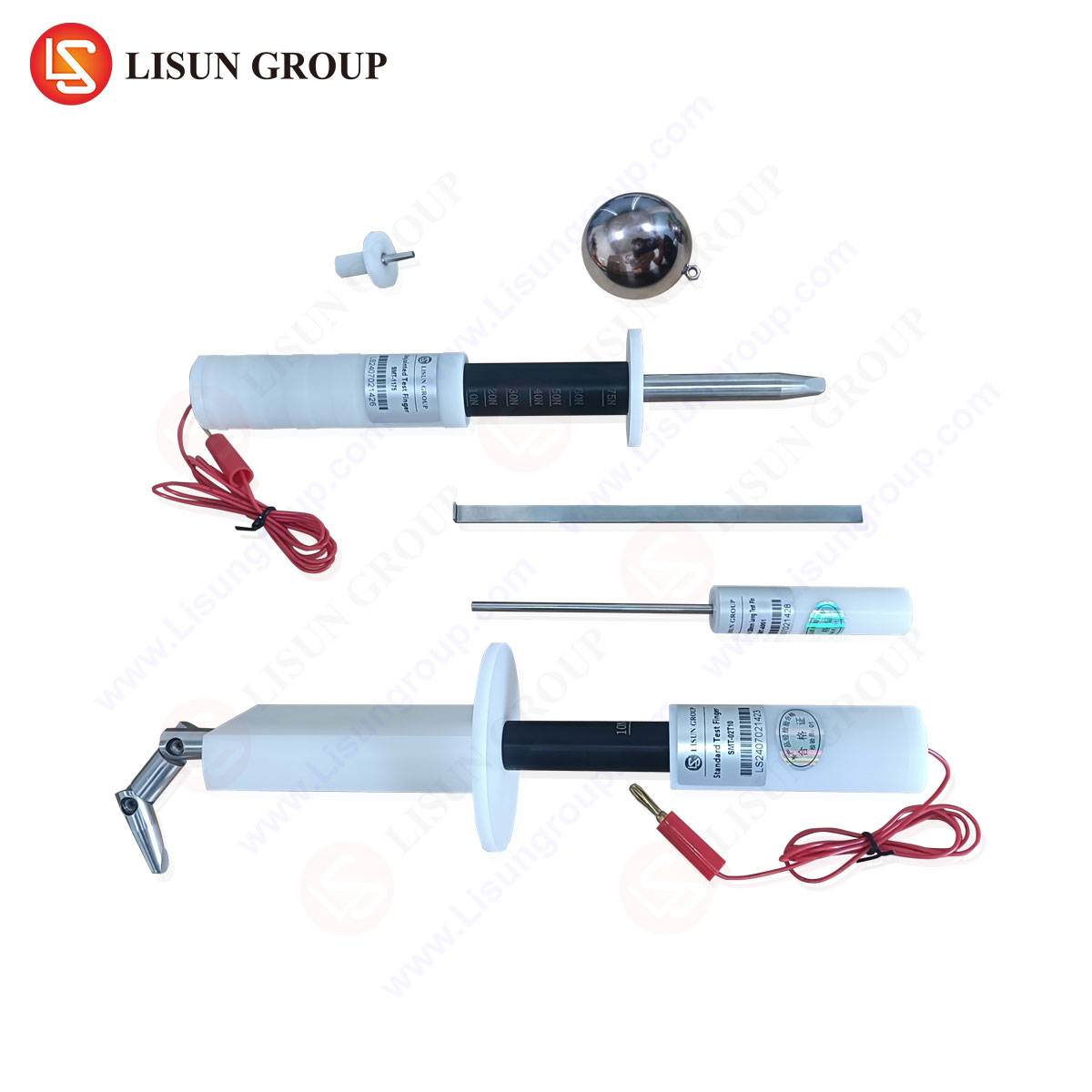
To perform compliant and auditable IP4X testing, manufacturers and testing laboratories require instrumentation that faithfully adheres to the dimensional, material, and force-application criteria of IEC 61032. The LISUN Test Finger (IEC 61032 Probe 12) is engineered for this explicit purpose. Its design incorporates the critical articulated joint, with the finger section manufactured to the exact tolerances specified in the standard—a diameter of 12.0 mm, a length of 80 mm, and a radius of 3.0 mm at the tip. The handle incorporates a mechanism, often a spring system, to ensure the application of the standardized 10 N force during testing. The stop face prevents over-insertion beyond the simulated length of a finger.
Beyond the test finger, comprehensive ingress protection testing often requires a suite of tools. The LISUN Test Probe series may encompass other probes defined in IEC 61032, such as the Probe 13 (for IP1X, simulating a hand) or Probe 19 (for IP2X, simulating a finger). The LISUN Test Pin (IEC 61032 Probe 13) is a distinct tool, a rigid steel wire of 2.5 mm diameter, used for verifying IP1X protection against large parts of the body. The availability of a calibrated, traceable set ensures a complete testing regimen for all first-digit IP ratings.
Specifications and Competitive Advantages:
The efficacy of such instrumentation lies in its precision and reliability. Key specifications for a compliant test finger like the LISUN model include:
- Material: Robust, insulating material (e.g., polyamide) for the finger to prevent electrical conductivity during live testing.
- Dimensional Tolerance: Strict adherence to IEC 61032 Figure 12, typically within ±0.05 mm for critical dimensions.
- Applied Force: Consistent application of 10 N ± 0.5 N, verified by calibration.
- Articulation: Smooth, free movement at the joint to accurately simulate probing action.
Competitive advantages for laboratories and quality assurance departments include the instrument’s traceable calibration certification, which is essential for audit compliance with standards bodies like UL, TÜV, or CSA. Durability and ergonomic design reduce operator fatigue and ensure long-term dimensional stability, while modular systems that integrate the test finger with force gauges and positioning fixtures enhance repeatability and testing throughput.
Testing Principles and Methodological Protocol
The testing principle for IP4X verification is deceptively simple in concept but requires meticulous execution. The enclosure, with its internal components installed as intended for use, is subjected to a probing audit. The tester applies the LISUN Test Finger to every potential access point—joints, openings, vents, gaps around controls, and socket apertures—with the specified force. The probe is articulated to explore the full range of possible angles of entry.
A critical aspect of the test is the determination of what constitutes a “hazardous part.” This includes not only live electrical parts at hazardous voltage but also hot surfaces, moving gears, sharp edges, and other components that could cause injury. The test is often conducted with the aid of an electrical indicator circuit. A low-voltage (e.g., 40-50V) supply is connected between the test probe and the hazardous live parts inside the enclosure. If the probe makes contact, the circuit is completed, and a visual or audible signal indicates failure. For non-electrical hazards, visual inspection or feeler gauges may be used to verify safe distances are maintained.
Table 1: Key Parameters for IP4X Testing with IEC 61032 Probe 12
| Parameter | Specification | Standard Reference | Purpose |
| :— | :— | :— | :— |
| Probe Designation | Probe 12 (Test Finger) | IEC 61032, Fig. 12 | Simulates finger/small tool access. |
| Probe Diameter | 12.0 mm ± tolerance | IEC 61032 | Defines the minimum object size against which protection is claimed. |
| Applied Force | 10 N ± 1 N | IEC 60529 | Standardizes the probing pressure. |
| Joint Articulation | 90° ± 5° in one plane, 180° ± 10° in other | IEC 61032 | Simulates natural pivoting and probing action. |
| Acceptance Criterion | No contact with hazardous parts; no full penetration. | IEC 60529 | Ensures safety and mechanical exclusion. |
Industry-Specific Applications and Use Cases
The IP4X test is a ubiquitous requirement across industries where user safety and product integrity are paramount. Its application is tailored to the specific risks of each sector.
- Household Appliances & Consumer Electronics: For food processors, blenders, power tools, and gaming consoles, the test finger ensures that users cannot contact moving blades, live terminals, or hot internal components through ventilation slots or service openings.
- Electrical Components & Lighting Fixtures: Switches, sockets, circuit breakers, and light fixture housings are tested to prevent finger access to live contacts. A socket outlet, for instance, must prevent the test finger from touching the energized pins when a plug is partially inserted.
- Automotive Electronics & Industrial Control Systems: Control panels, dashboard electronics, and industrial PLC enclosures are tested to prevent accidental contact with hazardous voltages by operators during use or maintenance, even in cramped installation spaces.
- Medical Devices & Telecommunications Equipment: Patient monitors, diagnostic equipment, and network switchgear require IP4X protection to ensure operational safety in clinical or telecom center environments, preventing ingress of small debris and accidental contact.
- Aerospace and Aviation Components: Cockpit controls, in-flight entertainment system housings, and avionics bay enclosures are validated to prevent foreign object damage (FOD) from items like loose screws and to ensure no safety-compromising access points exist.
- Toy and Children’s Products Industry: This is a critical application. Toy safety standards (e.g., IEC 62115) heavily reference IP4X testing to ensure that battery compartments, joints, and openings in toys do not allow a child’s finger to access batteries, wiring, or small parts that could be ingested.
Integration into Broader Quality Assurance and Compliance Regimes
IP4X testing is rarely an isolated activity. It is a core component of a broader product safety and environmental durability testing regimen. It is frequently performed in conjunction with:
- IPX4-IPX9K water ingress tests to complete the full IP rating.
- Mechanical stress tests (impact, vibration) to verify the enclosure’s integrity remains after physical abuse.
- Hazard-based safety testing per standards like IEC 62368-1 for audio/video and IT equipment.
The data generated from standardized probe testing feeds directly into technical construction files (TCF) for the CE marking, certification reports from Nationally Recognized Testing Laboratories (NRTLs), and declarations of conformity. The use of a calibrated, traceable instrument like the LISUN Test Finger provides the objective evidence required to satisfy these rigorous regulatory frameworks.
Conclusion
The IP4X rating represents a fundamental and non-negotiable safeguard in product design. Its verification through the application of the IEC 61032 Probe 12 transforms a subjective safety goal into an objective, repeatable, and internationally recognized metric. The precision-engineered test finger, as exemplified by instrumentation from manufacturers like LISUN, serves as the critical interface between abstract standard text and physical product validation. For engineers, quality managers, and certification professionals across the electrical, electronic, and consumer goods spectra, a deep understanding of this testing process—and the tools that enable it—is indispensable for achieving compliance, ensuring user safety, and delivering robust, reliable products to the global market.
FAQ Section
Q1: Can the LISUN Test Finger be used for both IP3X and IP4X testing?
Yes, the IEC 61032 Probe 12 (Test Finger) is the specified tool for verifying compliance with both IP3X and IP4X ratings, as defined in IEC 60529. The same probe and applied force are used for both levels. The distinction between IP3X and IP4X lies in the interpretation of the probe’s interaction with the enclosure and hazardous parts, but the physical tool is identical.
Q2: How often should a test finger like the LISUN model be calibrated?
Calibration intervals should be determined based on the frequency of use, the conditions of use, and the requirements of the laboratory’s quality management system (e.g., ISO/IEC 17025). A typical recommendation is annual calibration. However, if the probe is used heavily or subjected to impacts, more frequent verification of its dimensions and applied force is advisable. The calibration certificate should provide traceability to national standards.
Q3: Is an electrical circuit indicator mandatory for IP4X testing?
While not explicitly mandated by IEC 60529 for all tests, using a low-voltage (40-50V) electrical indicator circuit connected between the probe and internal hazardous live parts is a widely adopted and highly recommended best practice. It provides an unambiguous, objective pass/fail signal for electrical safety. For testing protection against non-electrical hazards (e.g., moving parts), visual and physical inspection methods are used.
Q4: Our product has a mesh vent for cooling. How is IP4X compliance assessed for such openings?
For meshes, grilles, or slots, the test is applied to ensure the probe cannot pass through the opening to contact a hazardous part. The standard often includes rules for “adequate distance.” If the probe can enter the opening but the hazardous part is kept at a sufficient distance (e.g., by a baffle or deep recess) that the probe cannot make contact, the design may still comply. The probe is used to verify this safe distance.
Q5: Does passing the IP4X test automatically guarantee protection against dust (IP5X/IP6X)?
No. IP4X and IP5X/IP6X test for different phenomena. IP4X tests for protection against object ingress and access. IP5X (dust-protected) and IP6X (dust-tight) involve a different, more severe test using talcum powder in a vacuum or pressurized dust chamber. An enclosure can be IP4X rated but fail IP5X if fine dust can penetrate through microscopic gaps that the solid test finger cannot.