




Understanding the IPX5 Waterproof Rating: A Technical Analysis of Protection Against Water Jets
Introduction to Ingress Protection (IP) Ratings
The Ingress Protection (IP) rating system, codified under international standard IEC 60529, provides a systematic and universally recognized classification for the degree of protection offered by enclosures for electrical equipment against the intrusion of solid foreign objects and liquids. This alphanumeric code, typically expressed as “IP” followed by two digits, serves as a critical specification for engineers, designers, and procurement specialists across a multitude of industries. The first digit, ranging from 0 to 6, denotes protection against solids, while the second digit, from 0 to 9K, quantifies protection against liquids. It is within this framework that the IPX5 rating occupies a significant position, representing a specific and demanding level of water resistance that is neither casual splash-proofing nor full submersibility. This article will provide a detailed technical examination of the IPX5 rating, its testing methodology, its industrial applications, and the instrumentation required for its validation, with specific reference to the LISUN JL-XC Series waterproof test equipment.
Defining the IPX5 Specification: Protection Against Water Jets
An enclosure rated IPX5 is defined as providing protection against water jets from a nozzle. The “X” in the designation indicates that the rating for protection against solids is either unspecified or not relevant to the testing, allowing focus solely on the liquid ingress characteristic. The numeral “5” carries a precise technical definition: the equipment must withstand water projected by a nozzle with a 6.3mm diameter from any direction without harmful ingress. The test parameters are rigorously specified. The water jet is delivered at a flow rate of 12.5 liters per minute (±5%) and a pressure calibrated to achieve this flow. The test duration is a minimum of 1 minute per square meter of the enclosure’s surface area, with a minimum absolute duration of 3 minutes. The distance from the nozzle to the enclosure under test is precisely 2.5 to 3 meters. This creates a forceful, concentrated stream designed to simulate conditions such as water spray from a pressure washer, heavy rain driven by wind, or industrial wash-down processes. It is crucial to distinguish IPX5 from adjacent ratings; IPX4 protects against splashing water from all directions but not a direct jet, while IPX6 uses a more powerful 12.5mm nozzle at 100 liters per minute, representing exposure to powerful seawater jets or very severe water exposure.
The Physics and Engineering of IPX5 Compliance
Achieving IPX5 compliance is an exercise in applied mechanical and materials engineering, focusing on sealing integrity, structural design, and material selection under dynamic fluid pressure. The key engineering challenge is not merely to prevent the passage of water, but to do so under the impact force of a sustained jet, which can exploit microscopic imperfections, flex joints, and gasket interfaces. Design considerations typically involve the use of elastomeric gaskets (e.g., silicone, EPDM) with precise compression ratios, labyrinth seals that create a tortuous path for water ingress, and ultrasonic or laser welding for permanent seam sealing. The enclosure’s structural rigidity is paramount; deflection under the jet’s pressure must not compromise seal geometry. Ventilation and drainage paths, if required for thermal management or pressure equalization, must be engineered with hydrophobic membranes or baffled conduits that resist the direct ingress path of the jet. Material selection extends beyond the enclosure to internal components, where conformal coatings on printed circuit boards (PCBs) provide a secondary defense against any potential ingress, mitigating the risk of corrosion and electrical short circuits.
Validation Through Testing: Principles of IPX5 Certification
Conformance to the IPX5 rating is not a matter of design assumption but must be empirically validated through standardized testing. The test apparatus must replicate the conditions defined in IEC 60529 with high fidelity. This requires a calibrated nozzle system, a pump capable of maintaining the specified flow rate and pressure, a turntable or robotic arm to manipulate the test sample relative to the nozzle (or vice versa), and a controlled test chamber. The test sample, in its operational configuration with all access panels closed, is subjected to the water jet from all practicable angles. Post-test evaluation is critical and involves both visual inspection for water ingress and functional testing. The standard permits the ingress of water provided it does not accumulate in quantities that could interfere with safe operation, impair insulation, or reach live parts. For many safety-critical applications, however, manufacturers impose stricter internal criteria, often demanding “no ingress” whatsoever. The test environment, including water temperature and purity, is also often controlled to prevent thermal shock or conductive residue deposition.
The LISUN JL-XC Series: Engineered for Precise IPX5 Validation
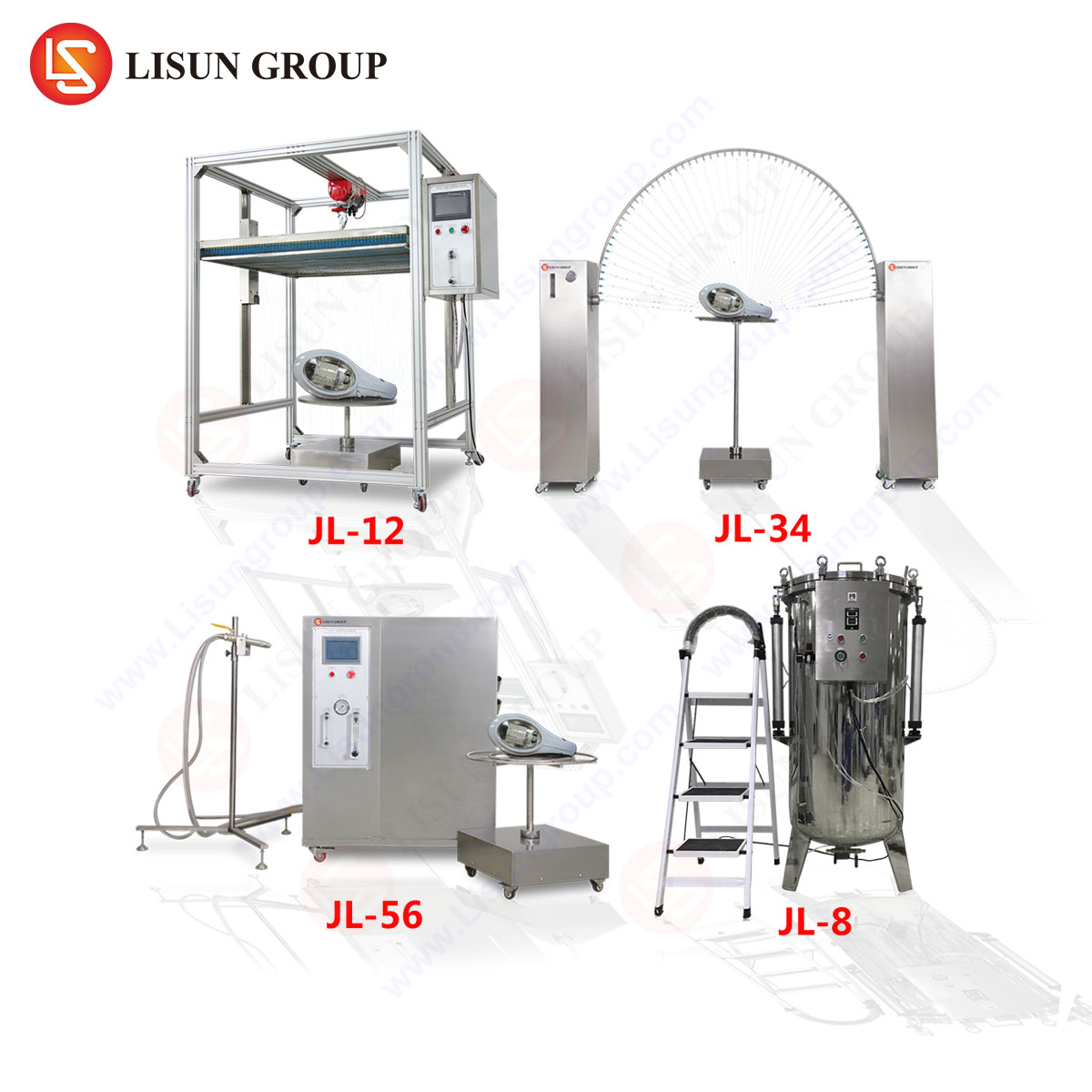
For manufacturers and testing laboratories requiring reliable, repeatable, and standards-compliant IPX5 validation, specialized equipment is non-negotiable. The LISUN JL-XC Series of waterproof test equipment is engineered to meet this exacting demand. This series represents a comprehensive solution for performing IPX5 and other IPX5-9K tests with laboratory-grade accuracy and industrial robustness.
The core principle of the JL-XC Series involves a closed-loop water system driven by a precision pump. The system maintains the exacting flow rate of 12.5 L/min required for IPX5 testing through a calibrated 6.3mm diameter nozzle. Integrated pressure sensors and flow meters provide real-time feedback and data logging, ensuring the test parameters remain within the tolerances stipulated by IEC 60529. The test chamber is constructed from corrosion-resistant materials such as stainless steel and high-grade acrylic, designed for long-term durability despite constant exposure to water.
A defining feature of the JL-XC Series is its programmable motion control system. The sample under test can be mounted on a motorized turntable that rotates at a user-defined speed, ensuring all enclosure surfaces are exposed to the jet. Alternatively, for larger or fixed installations, a robotic arm can maneuver the nozzle around the stationary sample, following pre-programmed trajectories to simulate jets from all relevant directions. This automation eliminates operator variability and ensures complete, reproducible test coverage.
The system’s control software allows for precise configuration of test duration, rotation speed, and nozzle distance. It records all critical parameters throughout the test cycle, generating a detailed report that can be used for certification documentation and quality audit trails. For facilities testing a wide range of products, the JL-XC Series is often modular, allowing for easy interchangeability of nozzles (e.g., switching from the IPX5 6.3mm nozzle to an IPX6 12.5mm nozzle) and adaptation of sample fixtures.
Industrial Applications of the IPX5 Standard
The IPX5 rating is specified in product requirements across a diverse spectrum of industries where equipment must reliably function in the presence of directed water streams.
Electrical and Electronic Equipment & Industrial Control Systems: Outdoor control panels, motor drives, and sensor housings located in environments subject to high-pressure cleaning or storm-driven rain require IPX5 protection to prevent internal corrosion and electrical failure.
Automotive Electronics: Components mounted in the engine bay or underbody, such as electronic control units (ECUs), lighting modules, and connectors, are exposed to high-pressure water spray from road spray and automated vehicle washes. IPX5 is a common requirement in relevant automotive standards like ISO 20653.
Lighting Fixtures: Outdoor area lighting, architectural floodlights, and industrial high-bay lights must withstand rain and jet washing for maintenance. IPX5 ensures the luminaire’s electrical gear tray remains dry, preserving driver longevity and preventing safety hazards.
Telecommunications Equipment: External antennas, base station modules, and junction boxes for fiber optic networks are exposed to the elements. IPX5 protection safeguards sensitive RF and digital circuitry from water ingress that could degrade signal integrity or cause outages.
Medical Devices: Equipment used in surgical suites or sterilization areas, such as certain handheld diagnostic tools or the housings for equipment carts, may require IPX5 rating to survive rigorous decontamination wash-down procedures with chemical agents and water jets.
Consumer Electronics and Household Appliances: While less common for handheld devices, IPX5 is relevant for outdoor speakers, certain ruggedized cameras, and the control panels of appliances like dishwashers or commercial-grade refrigerators that undergo aggressive cleaning cycles.
Advantages of Automated Testing with the JL-XC Series
Implementing a solution like the LISUN JL-XC Series confers several competitive and operational advantages. Firstly, it ensures standards compliance and reduces liability risk by providing auditable proof that products meet their specified IP rating before market release. Secondly, it accelerates the design validation cycle, allowing R&D teams to quickly iterate and test sealing designs, identifying failure points early in development. Thirdly, it enhances production quality control through routine batch testing, catching manufacturing defects in gasket placement or assembly. Finally, the automation and data integrity features reduce labor costs and human error, transforming waterproof testing from a manual, qualitative check into a precise, quantitative engineering process.
Beyond IPX5: The Broader Context of Environmental Testing
It is important to contextualize IPX5 within a broader product qualification regimen. An IP rating addresses only water and solid ingress under specific conditions. A product destined for harsh environments will typically also undergo testing for other environmental stresses, such as thermal cycling (IEC 60068-2-14), shock and vibration (IEC 60068-2-27/64), and corrosion (e.g., salt fog per IEC 60068-2-52). The data from IPX5 testing, especially when conducted with precise equipment like the JL-XC Series, feeds into a larger reliability model, informing decisions about material choices, maintenance schedules, and product lifetime expectations.
Frequently Asked Questions (FAQ)
Q1: Can a product rated IPX5 also be considered suitable for temporary immersion, such as being dropped in a puddle?
No. The IPX5 test is specifically for water jets, not immersion. The forces and mechanisms of water ingress are different. Immersion creates sustained hydrostatic pressure on all seals simultaneously, which an IPX5-rated seal may not resist. For immersion, ratings such as IPX7 or IPX8 are required.
Q2: How often should production-line IPX5 testing be performed on our manufactured goods?
The frequency depends on the product’s criticality, production volume, and quality management system. For high-reliability or safety-critical products (e.g., automotive or medical), 100% testing may be justified. For lower-risk consumer goods, statistical sampling based on AQL (Acceptable Quality Level) plans is common. Any change in seal supplier, assembly process, or tooling should trigger increased testing frequency.
Q3: When using the JL-XC Series, is the temperature of the test water a critical factor?
While IEC 60529 does not strictly specify water temperature, it is a significant practical consideration. Testing with cold water on an enclosure that has been at room temperature or higher can cause thermal contraction of seals and materials, potentially leading to a false failure. Best practice, often followed by certified labs, is to stabilize both the test sample and the water to a standard temperature (typically 10-25°C) prior to testing, unless testing for thermal shock is a specific requirement.
Q4: Our product has multiple cable glands and connectors. How are these addressed during an IPX5 test?
According to the standard, the product must be tested in its “as-used” configuration. If cable glands and connectors are specified as part of the enclosure’s protective system, they must be installed as per the manufacturer’s instructions during the test. The water jet is directed at these potential ingress points. The test validates the complete assembled system, not just the bare enclosure.
Q5: What is the typical lead time for generating a certified test report after completing tests with the JL-XC Series?
The lead time is primarily a function of the testing laboratory’s procedures, not the equipment itself. The JL-XC Series accelerates the process by automating test execution and data capture. However, the subsequent analysis—detailed visual inspection, functional verification, and report compilation—requires expert personnel. A typical timeline for a formal report from an accredited lab can range from several days to a few weeks, depending on complexity and lab workload.