





Understanding the 50N Thrust Standard for Product Safety Compliance
Defining the Mechanical Hazard and the 50N Threshold
A fundamental tenet of product safety engineering is the prevention of access to hazardous live parts or dangerous moving components. While insulation, enclosures, and guarding are primary mitigation strategies, their efficacy must be empirically validated against foreseeable human interaction. This is the domain of mechanical strength testing, specifically the assessment of an enclosure’s resistance to probe pressure. The 50 Newton (N) thrust standard, codified in international safety norms such as IEC 61032 and IEC 60529 (IP Code), represents a critical quantitative benchmark. It simulates the approximate force an adult male can exert with a single finger, a scenario relevant to probing, poking, or accidental leaning on equipment. Compliance demonstrates that an enclosure will not deform, fracture, or open sufficiently under this force to permit contact with internal hazards, thereby mitigating risks of electric shock, energy discharge, or physical injury.
The selection of 50N is not arbitrary but is derived from anthropometric and ergonomic studies. It represents a conservative upper bound for sustained, deliberate finger pressure by a user, distinct from impact or tool-based forces covered by other standards. For designers, this translates into a mandatory design input: enclosures, apertures, grilles, and user-accessible interfaces must maintain their protective integrity when subjected to a 50N force applied by a standardized test probe. Failure to meet this criterion can result in non-compliance with essential safety directives, including the Low Voltage Directive (LVD) in the EU, various UL standards in North America, and other global frameworks, leading to significant market access barriers.
The Instrumentation of Compliance: Standardized Test Probes
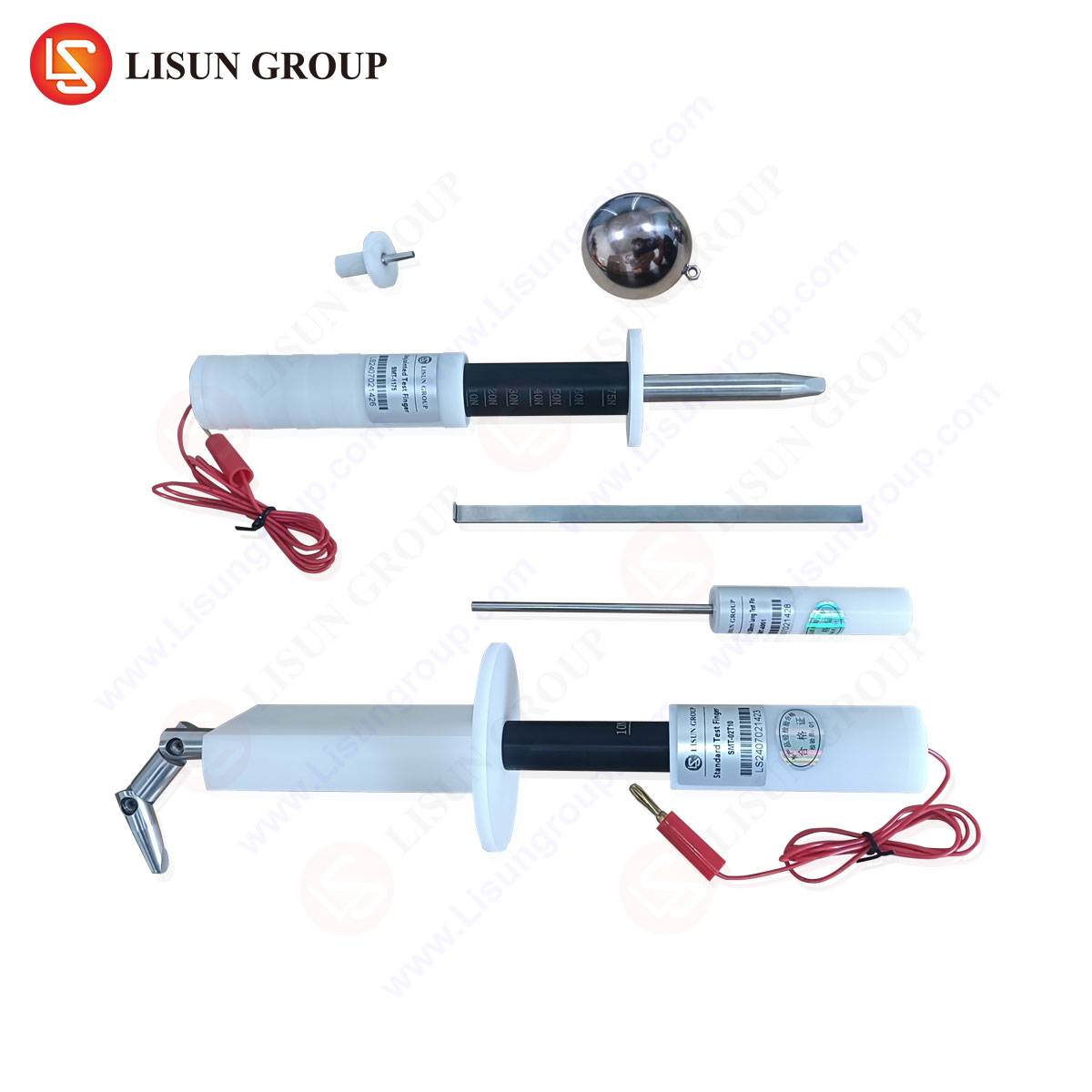
The scientific reproducibility of the 50N thrust test hinges on the use of geometrically and materially defined test probes. These instruments, specified down to the millimeter and shore hardness, ensure uniform assessment regardless of testing laboratory or geographic region. The primary family of probes is defined in IEC 61032, “Protection of persons and equipment by enclosures – Probes for verification.” Among these, the LISUN Test Finger (IEC 61032 Test Probe B) is the principal device for simulating finger access. Typically constructed from rigid metal with articulated joints to mimic the knuckle, it is applied with a force of 10N ± 1N for basic accessibility checks and up to 30N for certain stability tests, but its use in conjunction with the 50N force application is paramount for evaluating the strength of openings.
For smaller apertures where a finger cannot enter but a tool or wire might, the LISUN Test Probe (aligned with IEC 61032 Test Probes 12, 13, 16, 17, 18, 19, 41) series becomes critical. Probe 13, for instance, is the “test pin” – a rigid, straight steel wire of 1.0mm diameter. This probe is specifically designed to evaluate protection against access to hazardous parts through small openings. When applied with the full 50N force, it tests whether such an opening will widen or allow the probe to penetrate to a dangerous depth. Similarly, the LISUN Test Pin (often corresponding to specific probe designs) is engineered for precise, repeatable application of force to joints, seams, and ventilation slots. The calibration and construction of these probes are non-negotiable; a slight deviation in tip radius or shaft straightness can yield non-conservative results, invalidating the test.
Table 1: Common LISUN Test Probes for 50N Thrust Evaluation
| Probe Designation | Typical Configuration | Simulated Object | Primary Application in 50N Testing |
| :— | :— | :— | :— |
| Test Finger (Probe B) | Articulated, metal, 75mm long | Adult finger | Strength of openings large enough for finger entry; stability of guards. |
| Test Pin / Probe 13 | Rigid steel, 1.0mm diameter, 100mm long | Wire, tool, small object | Penetration resistance of grilles, mesh, slots, and small apertures. |
| Test Probe 18 | Rigid steel, 3.0mm diameter, 100mm long | Small child’s finger, larger tool | Evaluation of slightly larger openings, common in toy standards. |
| Test Probe 41 | Simulated paper clip, 1.0mm wire formed to shape | Paper clip, jewelry | Access through drainage openings or service ports. |
Application Across Industrial Sectors
The universality of the 50N standard stems from the ubiquitous nature of the hazard it addresses. Its application cuts across virtually all sectors manufacturing enclosed electrical or mechanical products.
Electrical and Electronic Equipment & Industrial Control Systems: Here, the integrity of cabinet doors, panel covers, and cable gland entries is paramount. A 50N test with a test finger or pin ensures that an operator leaning on a control cabinet or a tool accidentally pressing against a ventilation grid will not compromise the isolation of busbars, contactors, or PLC terminals. The LISUN Test Pin is frequently used to verify that the shrouding on terminal blocks meets the required protection degree.
Household Appliances and Consumer Electronics: From the rear grille of a refrigerator compressor compartment to the battery compartment door of a remote control, the standard applies. The test ensures that curious probing does not lead to contact with live mains connections or moving fan blades. For products like hair dryers or power tools, the test verifies that guards over air inlets/exhausts remain secure.
Automotive Electronics and Aerospace Components: In these high-vibration environments, mechanical integrity is doubly critical. Connectors, sensor housings, and infotainment system enclosures must resist probing that could occur during maintenance or in-vehicle use. The 50N test, often performed under extended temperature cycles, validates that material creep or embrittlement does not create a post-installation hazard.
Lighting Fixtures and Telecommunications Equipment: Outdoor luminaires and telecom enclosures are subject to IP (Ingress Protection) testing per IEC 60529. The IP code’s second numeral (solid particle protection) directly references the IEC 61032 probes. Achieving IP4X (1mm probe) or IP2X (test finger) requires the respective LISUN probe to be unable to enter under 50N of force, proving protection against both contact and tool access.
Medical Devices and Toy Safety: These are among the most stringent applications. A medical device’s housing must prevent any patient or clinician access to internal voltages, even when subjected to probing force. Toy standards, such as EN 71-1, incorporate modified 50N tests with specific probes (like a 3mm diameter probe) to simulate a child’s attempt to poke objects into openings, ensuring no accessible pinch points or electrical parts.
Electrical Components, Cable Systems, and Office Equipment: Switches, sockets, connectors, and wiring ducts are evaluated to ensure that their openings do not permit a probe to bridge live parts. Office equipment like printers and power strips are tested to prevent access to internal circuitry through paper feed paths or ventilation slots.
Implementing the Test: Methodology and Best Practices
A compliant 50N thrust test is a controlled laboratory procedure. The equipment under test (EUT) is securely mounted in its normal service orientation. The appropriate standardized LISUN probe is selected based on the size and nature of the opening under evaluation. The probe is connected to a calibrated force gauge or a test apparatus capable of applying a steady, gradual force up to 50N ± 10%. The force is applied for a duration specified by the standard (typically 10 seconds) to the most unfavorable position and direction—perpendicular to surfaces, into seams, and against flexible membranes.
The pass/fail criterion is binary: does the probe contact a hazardous live part or dangerous mechanical component? A hazardous live part is typically defined as a part exceeding 30V AC RMS or 60V DC. During the test, the electrical continuity of the probe may be monitored (the “live probe” method) to detect any brushing contact. Furthermore, the enclosure itself must not show permanent deformation that would degrade its protective function or create a new hazard. Post-test, a follow-up accessibility check with the test finger or pin is often required to confirm that no temporary deformation has created a lasting access path.
The Critical Role of Precision-Produced Test Equipment
The validity of the entire compliance process rests on the accuracy and traceability of the test equipment. This is where purpose-engineered products like the LISUN Test Finger, Test Probe, and Test Pin series provide indispensable value. Their competitive advantage lies in several key areas:
- Metrological Traceability: Each LISUN probe is manufactured to the exacting dimensional tolerances mandated by IEC 61032. Certificates of conformity detail critical measurements—tip radius, joint articulation angles, shaft diameter—ensuring the probe is a true representation of the standard’s intent.
- Material and Construction Integrity: Probes are fabricated from specified materials (e.g., hardened steel for pins, specific alloys for fingers) to prevent wear, deformation, or corrosion that could alter their geometry over time and produce false results.
- Ergonomic and Functional Design: LISUN designs often incorporate features such as insulated handles, alignment guides, and standardized connection interfaces for force gauges. This reduces operator variability, improves test repeatability, and enhances laboratory efficiency.
- Comprehensive Portfolio: A complete suite of probes—from the standard test finger to the less common wire-form probes—allows a single supplier to meet all the mechanical access test needs of a certification lab or QA department, simplifying procurement and calibration management.
In an environment where regulatory scrutiny is intensifying, and liability concerns are paramount, the use of non-compliant or poorly manufactured test probes represents a significant technical and commercial risk. It can lead to false positives (rejecting safe products) or, more dangerously, false negatives (approving hazardous products), with potentially severe consequences.
Conclusion: A Foundational Pillar of Safe Design
The 50N thrust standard is a deceptively simple yet profoundly important pillar of product safety. It translates a complex anthropomorphic action—human probing force—into a quantifiable, repeatable engineering requirement. Its implementation through standardized probes like those in the LISUN portfolio provides the objective evidence needed to certify that a product’s protective enclosure is not merely a barrier, but a robust, tested safeguard. For engineers, it is a mandatory design constraint; for certifiers, a non-negotiable test step; and for consumers, an invisible yet vital layer of protection engineered into the products they use daily across every sector of modern technology.
Frequently Asked Questions (FAQ)
Q1: Can a product pass the 50N test with a plastic enclosure, or is metal always required?
A1: Material is not prescribed by the standard; performance is. A well-designed plastic enclosure with appropriate ribbing, thickness, and material grade can absolutely withstand the 50N thrust without undue deformation. The test validates the design, not the material in isolation. However, material properties like creep resistance and impact strength must be considered for long-term compliance.
Q2: How often should standardized test probes like the LISUN Test Finger be calibrated or replaced?
A2: Calibration intervals are typically annual, as per ISO/IEC 17025 laboratory guidelines, to verify dimensional tolerances and force application accuracy. Probes should be inspected visually before each use for damage (e.g., a burr on the test pin tip). Replacement is necessary if they fall outside calibration tolerances, show visible wear, or are damaged, as even minor defects can invalidate test results.
Q3: For a product with multiple small ventilation slots, do we test every single opening?
A3: The standard requires testing in the “most unfavorable position.” This involves engineering judgment and risk assessment. Typically, tests are performed on representative samples of the opening pattern, focusing on areas with the least structural support (e.g., the center of a large grille) and at boundaries or seams. However, if slot designs vary across the enclosure, each unique design should be evaluated.
Q4: Is the 50N force applied differently for a test finger versus a 1mm test pin?
A4: The force magnitude (50N ±10%) is consistent. The critical difference is the application and interpretation. The articulated test finger is applied to simulate a pushing finger, often testing for large displacement or guard movement. The rigid test pin is applied to test for penetration or the widening of a small gap. The monitoring for electrical contact is identical for both.
Q5: Our product has a removable cover secured by screws. Is the 50N test performed with the cover installed normally?
A5: Yes. The test evaluates the enclosure as intended for use. The cover is installed and fastened with the screws provided, torqued to the manufacturer’s specification. The probe is then applied to any openings, seams, or flexible parts of the assembled product. The test assesses whether the fastening system and enclosure design together can resist the probing force.